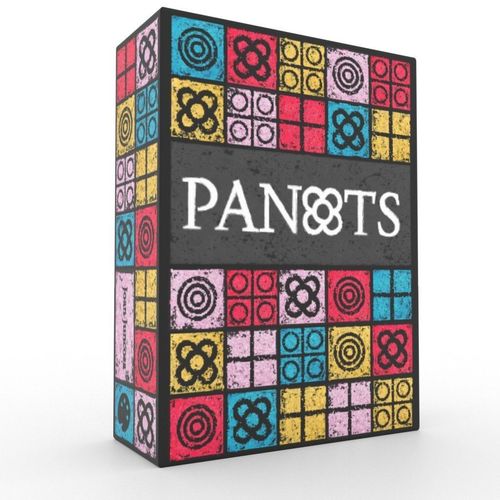
Panots
Panots Rulebook
Table of Contents
Table of Contents
Objective
Place the panots strategically to create the sidewalk that will give you the most victory points (VP).
Components
- 72 panot cards
- 4 objective cards
- 8 feature tokens
- 1 scoring board
- 7 scoring markers
Each panot card is unique and contains two panots, each with a different shape and color.
The five original 1906 panots: Ensaimada, Flower, Four eyes, Pills, Skull.
Set Up
- Place the 4 objective cards on a side of the playing area (choose which side's face up).
- Randomly place 8 feature tokens on the corresponding spaces of the objective cards.
- Shuffle the panot cards and place one face-up in the center of the playing area.
- Deal 10 panot cards face-down to each player, forming a deck, and remove the remaining cards. The deck cards cannot be looked at.
How to Play
All participants play simultaneously. Each round consists of three phases, starting when everyone is ready and repeating until the end of the game:
1. Reveal
On the count of three, place the top card of your deck face up next to the center card, thus forming the warehouse, which contains the panots available to select in this round.
2. Select
When you find the card that interests you the most, take it from the warehouse before your opponents do and move it to your sidewalk (player's area).
3. Place
Place the chosen card following the placement rules. Once a panot card is placed, it cannot be moved.
There must always be one panot card available in the warehouse for the next round.
If you are unable to place the selected card, wait for others to choose their cards, then exchange it for the remaining one.
Placement Rules
- A panot cannot be placed on top of another.
- Panot cards can be placed either horizontally or vertically and must share at least one side with another already placed panot.
- Each panot on the placed card must match at least one feature (shape or color) with each adjacent panot.
Example of Placement
- A. Correct: matches the color and the shape of the adjacent panot.
- B. Incorrect: matches the color and shape of one panot, but there is no match with the other adjacent panot.
- C. Incorrect: matches the color of one panot, but there is no match with the other.
End of the Game
Once you have placed the 10 panot cards, the game ends. Each player chooses a scoring marker to indicate their victory points (VP) on the board.
The player with the most VP wins. In case of a tie, the victory is shared.
Scoring
To determine the final score, add up the points obtained on the four objective cards. Check and indicate everyone's victory points (VP) for an objective before moving on to the next.
Each card shows an objective according to the feature tokens placed on it and it awards the indicated VP each time it is fulfilled on your sidewalk in any orientation.
Each token refers to all panots of that color OR that shape.
Example:
- The blue feature token on the objective cards is valid for any blue panot, regardless of its shape.
- The flower feature token on the objective cards is valid for any flower panot, regardless of its color.
Each panot can be used to complete more than one objective.
The following combinations are examples of objectives.
- 1 VP for each time two panots with these features are adjacent to each other.
- 1 VP for each time two panots with these features are diagonal to each other.
- 2 VP for each time three panots with these features are in line and in this order.
- 2 VP for each time three panots with these features are in an L shape and in this order, including the mirror effect.
- 2 VP for each time a panot with this feature is surrounded on all four sides.
- 1 VP for each time a panot with this feature has three free sides.
- 1 VP for each time two panots with these features have a space between them. The space can be occupied by a panot or nothing.
- 3 VP for whoever has the largest group of connected panots with these features. This side shows two independent objectives; score each majority separately. In case of a tie for the majority, each tied player gains 3 VP.
Scoring Examples: 12 VP
Objectives A = 4 VP, B = 1 VP, C = 3 VP, D = 4 VP.
Solo Mode
For solo play, you just need to make a couple of adjustments in the Setup:
- In step 1, make sure that the side marked with the solo symbol is facing up.
- In step 3, place two face-up cards in the center of the playing area instead of one (there must always be two panot cards remaining in the warehouse at the end of each round).
Title
Score ranges:
- 1-5: Beginner
- 6-10: Apprentice
- 11-15: Professional
- 16-20: Master
- +20: Legend