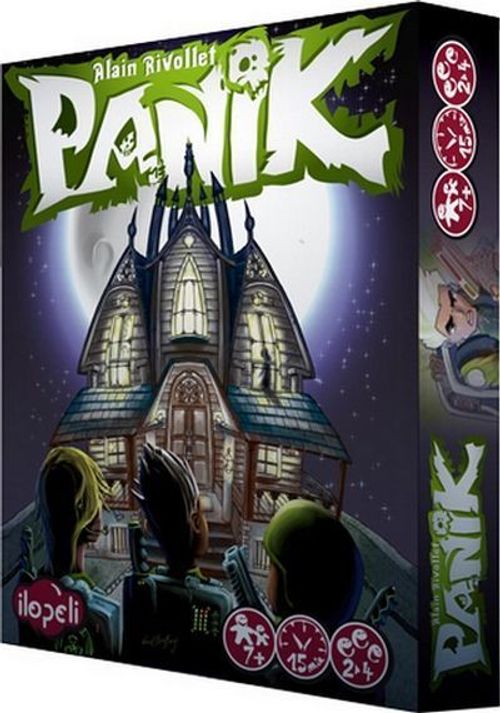
Panik
Panik Rulebook
Table of Contents
Table of Contents
Components
- 19 Manor cards, made up as follows:
- 13 Manor cards (a) with values from 1 to 5,
- 3 Shared Manor cards (b),
- 3 Trapped Manor cards (c), marked 0/3.
- 36 Hunter cards, in 4 teams of 9 cards. Each team contains:
- 3 Standard Hunter cards (d),
- 2 Overequipped Hunter cards (e),
- 2 Duo Hunter cards (f), marked +2,
- 1 Detector Hunter card (g),
- 1 Call-for-Help Hunter card (h).
Setup
The Manor cards are shuffled.
Each player receives the 9 Hunter cards of one team, plus 4 Manor cards, which they look at secretly and place in front of them face down before turning one of their choice face up. Each player then places one of their Duo Hunter cards on one of their three Manor cards that remain face down (their owner may look at these at any time during the game).
The player who most recently encountered a ghost is designated to be the first active player.
Playing the Game
Players take turns in clockwise order. On their turn, the active player places one of their Hunter cards in front of a Manor card, face down or face up, whether that Manor card belongs to them or not.
No more than 4 Hunter cards may be placed in front of each Manor. A Manor that already has 4 Hunter cards cannot receive any more Hunters.
Translator's note: the French sheet prints a red "(I)" marker after "4 Hunter cards" in this rule. Its meaning is not explained on the sheet, so it is reproduced here as printed and not interpreted.
The active player may send back one of the Hunter cards, whether it belongs to their team or not, that is already in the Manor in front of which they have just placed their Hunter. The owner of the Hunter card designated by the active player must immediately place it in front of another Manor card, without being able to send back one of that Manor's occupants and without using any special ability.
Some Hunter cards have special abilities:
- Before placing their Detector Hunter card, the active player turns face up one of the Manor cards belonging to one of their opponents.
- When a player places their Call-for-Help Hunter card in a Manor, they may move a Hunter card from another Manor into it. The Hunter card that is moved must not come from a Manor that is already occupied by 4 Hunter cards.
- A Duo Hunter card can never be called for help.
- An Overequipped Hunter card can never be sent back or called for help.
The active player's turn ends, and the player to their left becomes the new active player.
End of the Game
The game ends when all Hunter cards have been placed. All Manor cards are then turned face up, and points are scored:
- Each Hunter card placed in front of a Manor card scores points equal to the value shown on that Manor card. A Duo Hunter card scores double.
- Each Hunter card placed in front of a Shared Manor card scores 1, 2, 3, or 4 points, depending on whether the total number of Hunter cards placed in front of that Manor is 4, 3, 2, or 1 respectively.
- Hunter cards placed in front of a Trapped Manor card score nothing for their owner.
- The owner of a Trapped Manor card gains 3 points for each opposing Hunter card placed in front of it. A Duo Hunter card gains them 6 points.
The player with the most points wins the game.