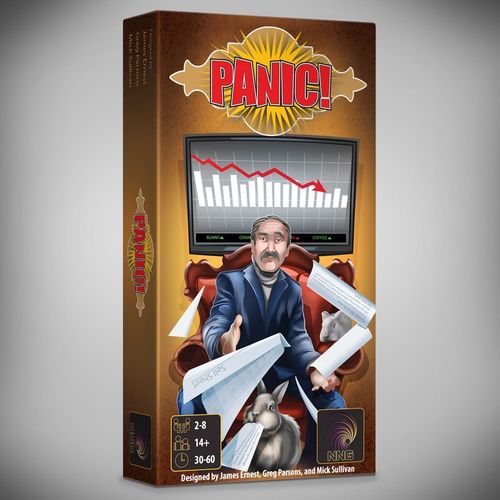
Panic!
Panic! Rulebook
Table of Contents
Table of Contents
Panic! (Base Rules)
Components
- 90 card Panic! Deck
- 9 Demand Tracking Cards
- 1 First Player Token
- 9 Commodity Tokens
- 1 Score Pad
Constructing the Deck
This process is the same for all three games. The complete game deck consists of nine commodities (Gold, Oil, Pork Bellies, etc.), each of which is a suit of 10 cards numbered 1 through 10. To play with fewer than eight players, you must strip out some of these suits.
Your deck for the game you are about to play should contain N+1 suits, where N is equal to the number of players in the game. So for example if you have 4 players, you need a deck of 5 suits. The actual suits used are up to you.
Setting Up the Market
Each game uses the same procedure to set up the Commodity Market for scoring. Locate the tokens matching the commodities being used and set them near the center. Go through the 9 Demand Tracking Cards and keep only the ones required for the number of players in the game. The cards required are listed below:
| # Players | # Suits | Demand Tracking Cards Required |
|---|---|---|
| 2 | 3 | -1, 0, +1 |
| 3 | 4 | -2, -1, +1, +2 |
| 4 | 5 | -2, -1, 0, +1, +2 |
| 5 | 6 | -3, -2, -1, +1, +2, +3 |
| 6 | 7 | -3, -2, -1, 0, +1, +2, +3 |
| 7 | 8 | -4, -3, -2, -1, +1, +2, +3, +4 |
| 8 | 9 | All Demand Tracking Cards are required |
Arrange the cards from the lowest value on the left to the highest value on the right, the same order as shown above. Place all of the tokens on the Highest value card possible (all the way to the right) as at the start each commodity is equally in demand.
Example of how to set up the Commodity Market for a 4-player game.
How Scoring Works
Cards represent different commodities, which players will buy and sell over the course of the hand. At the end of the hand, cards will be located in one of two places: in the center of the table (the "Marketplace"), or in some player's hand (including in the player's playing area on the table but in front of them). Each card's base value is the number printed on it (8 points for an 8, etc.) but the value will be modified by the Market's demand for that commodity.
Cards in the Marketplace represent surplus. They are undesirable. The most common commodities are the ones that no one wants. Thus the more points of a suit in the Marketplace, the less it is worth in the players' hands. The exact scoring depends on the number of players, and it is determined by the scoring markers position on the Demand Tracking Cards.
Each commodity token will rest on a Demand Tracking Card. This card will multiply the face value of the cards matching that token by the number shown on the Demand Tracking Card. If the Wheat Token is resting on the -2 Demand Tracking Card, then a 4 Wheat card is worth -8 Points.
Bull Market
2-8 Players
Summary
Players are trying to predict and manipulate the market. Players will bid for the right to learn information about the market, in advance of the other players.
The Flow of a Game of Bull Market
I. Setup A. Playing the Hand (Repeat 3x) 1. The Bidding Round (repeat 3x) a. The Bid - Pay for the Bid b. The Pass c. The Reveal d. Sort the Marketplace 2. The Panic! 3. Score the Hand B. Total Score of all 3 Hands
I. Setup
Randomly choose a player to be the dealer / scorekeeper. This player takes the First Player Card and shuffles the deck and deals out a hand of 9 cards to each player. Then the dealer creates 3 stacks of 3 cards each in the middle of the table. Set any remaining cards aside for now, they will not be in this hand.
For 2-3 players: create 3 stacks of 2 cards instead of stacks of 3.
A. Playing the Hand (Repeat 3x)
The game is played in three hands, each of which has three bidding rounds, followed by scoring. In each round, players will bid on secret information. The winner of the bid will look at that information, then pay for the bid. Next players will pass cards around the table. This happens three times, one for each pile in the center. After that there is a Panic! step followed by scoring.
1. The Bidding Round (Repeat 3x)
a. The Bid
Players are bidding for the right to peek at the first stack of cards in the Marketplace. If this is the first round of the game, the dealer bids first. If it is the first round of a new hand, the player with the lowest score bids first. If it is the second or third round of any hand, the most recent winning bidder bids first.
Players bid in point values, 1, 2, 3, etc. If you pass, you are out, and eventually the highest bidder remaining after all others have passed wins the bid. The winner sneaks a peek at the facedown stack and then replaces it on the table still face-down. The winning bidder then pays for his bid by locking cards into his final hand.
Paying for the Bid
To pay your bid, you must play one or more cards from your hand with a total face value equal to or higher than your bid.
For example, if you won with a bid of 5 points, you must pay 5 or more points worth of cards (based on the number on the card, not modified by the market value).
These cards are played face up on the table in front of the bidder, and become locked. These cards will be a part of your final hand. Note that other players may be able to learn something interesting about the face-down cards, by carefully considering the cards the bidder plays.
Note: Because your final hand contains five cards, you are not allowed to make a bid that would lock more than five cards total for the hand.
For example, if you had three cards already locked, any further bids by you would allow you to only bid two or fewer cards.
Also be aware that the winning bidder looks at the face-down stack but replaces it face-down (secret from the other players) when done. It is not revealed to all players until after the next step, the Pass.
b. The Pass
After the bidder pays his bid, everyone must pass cards to the player to their left in the first and third hands, and to the right in the second hand.
The number of cards you pass is 3 on the first round, 2 on the second and 1 on the third. (It's easy to remember because it is equal to the number of facedown stacks in the center of the table).
The pass is simultaneous, you may not look at the cards you receive until after you have handed your cards away. Strategically, you want to pass cards in a way that makes your hand better and your opponent's hand worse. Unfortunately this can be hard to judge. But that's the idea.
c. The Reveal
After everyone has passed their cards, turn over the stack of cards that the bidder looked at. Those cards are now public knowledge, and become part of the Marketplace.
d. Sorting the Marketplace
Commodities that are abundant in the Marketplace are undesirable, so the suits with the most card points are sorted to the lowest value markers. (This is determined by the point value of the cards not the number of cards).
EXAMPLE
Crude Oil has the most points at 16, so it is worth -2 per card. Pork Bellies and Orange Juice each have 8 points and share the next higher value (+1). Gold Bullion is the most in demand with only 7 points and is worth +2 each. Coffee has yet to enter the Marketplace, so it's value is in the highest demand spot, sharing with Gold Bullion at +2 each.
d. Sorting the Marketplace (continued)
If two suits are tied, they both take the higher value. This leaves a blank space immediately below that rank (the other suits do not move up to fill the void).
Eventually each suit will probably be represented in the Marketplace, but early on there might be a few suits missing. Assume that all empty suits are tied at zero card points, making them all tied at the highest value, and arrange the non-zero suits at the below the Demand Tracking Cards.
2. The Panic!
After the third round, players will still have hands of nine cards (counting those cards locked face-up in front of them). Now there is a discard step known as the Panic!, in which players each add four cards from their hand (not locked in front of them) face-down at once to the Marketplace. Usually you will want to discard cards that you think will be worth the least, but that is not always easy to judge.
All discards become part of the Marketplace. After this step all players will have five cards remaining.
After the Panic!, turn all of the face-down cards over and sort them into the Marketplace to see which goods are the most in demand (those with the fewest points in the Marketplace).
3. Scoring the Hand
Cards in your hand are now worth positive or negative points. Multiply the rank of the card by the commodity's value, as in the Marketplace.
For example, if you have the 9-value Crude Oil and Crude Oil is valued at +2, that card is worth 18 points.
Each player scores the total point value of his hand. Scores will be close, but the player with the most points after three hands wins the game.
B. Total Score
Add up the scores for the three hands to determine the winner of the game.
Examples of Scoring
Two Players: There are three commodities in a two-player game. The most common one in the Marketplace is worth negative points (-1x). The rarest is worth positive points, and the middle one is worth nothing.
Three Players: With three players, there are four commodities. The most common (worst) is worth -2x, double negative points. The second most common is worth negative points (-1x). The second rarest is worth positive points (+1x), and the rarest is worth double points (+2x).
Tied Goods: If two or more goods are tied for a certain rank, they are both worth the higher value. For example, if Corn and Wheat both have 8 points in the Marketplace and Crude Oil has 24 (in a 2-player game), then Corn and Wheat are both worth +1x and Crude Oil is worth -1x.
Variations
Slow Burn: Rather than discarding at once there are four discard rounds. After each round, sort the Marketplace to see what commodities are now in which slots. This version has more bookkeeping but can have some interesting last-minute reversals, especially when combined with the short selling variant.
Short Selling: Reverse the significance of the Marketplace. Common items are now valuable, and rare items are worthless. Now the Marketplace represents Demand. In this game, it's much harder to control the values in the Marketplace to your advantage. This makes it slightly more like real life. Don't try this variant unless you like wondering what to do at every turn, especially if combined with the Slow Burn.
Bear Market
2-8 Players
Summary
Bear Market is loosely based on Bull Market, but it uses a faster format and a different method for sorting the Marketplace. Again, players are trying to predict and manipulate the market. Each round, players lock one card face down, discard one card, and pass the rest of their hand away.
The Flow of a Game of Bear Market
I. Setup A. Playing the Hand (repeat 3x) 1. Drafting Round (repeat 5x) a. The Lock b. The Discard c. The Reveal d. Sort the Marketplace e. The Pass 2. Score the Hand B. Total Score of all 3 Hands
I. Setup
Randomly choose a player to be the dealer / scorekeeper. This player shuffles the deck and deals out a hand of 10 cards to each player. The remainder of the cards are not used.
A. Playing the Hand (Repeat 3x)
The game is played in three hands, each of which consists of five drafting rounds, followed by scoring.
1. Drafting Round (Repeat 5x)
a. The Lock
Place one card face-down on the table in front of you.
b. The Discard
Place one card face-down in the Marketplace.
c. The Reveal
After everyone has discarded a face-down card to the Marketplace, flip those cards over to reveal the discards.
d. Sorting the Marketplace
Instead of total point value, the worst commodity is defined as the one containing the lowest single card. Ties are broken by the next card, and so on, with zero cards being better than an extra card. As in Bull Market, if two commodities are tied, they are both worth the higher value.
After each drafting round, the discards are from that round are revealed and sorted into the Marketplace. As mentioned above, the commodities are ranked by their single lowest card, with ties broken by next lowest card and so on. "No Card" is better than any card, so 1-3-10 is ranked lower than 3 alone.
EXAMPLE
Suppose Crude Oil is 1-2-4-10, Orange Juice is 1-3-5-9, and Corn is 2-3-4. Corn is the best because it doesn't have a 1. Orange Juice is better than Crude Oil because each has a 1 and Crude Oil has a 2 and Orange Juice doesn't have a 2. Between 1-2-10 and 1-2 (and nothing else), 1-2-10 is worse. Empty commodities are still ranked at the top of the scale.
e. The Pass
After all players have locked a card in front of them and discarded a card to the Marketplace, everyone must pass their remaining cards to the player to the left on the first and third hands, and to the right on the second.
The number of cards you pass is 8 on the first round, 6 on the second, 4 on the third, 2 on the fourth, and none on the fifth.
The pass is simultaneous, you may not look at the cards you receive until after you have handed your cards away. Strategically, you want to pass cards in a way that makes your hand better and your opponent's hand worse. Unfortunately this can be hard to judge. But that's the idea.
2. Scoring the Hand
Scoring is exactly the same as in Bull Market. Multiply the face value of all the cards in your hand by their value as determined by the Marketplace and add (or subtract) that value from one million.
The winner is the first player to score Three Million Points. If multiple players reach that total on the same hand, the total number of points is the tie breaker.
B. Total Score
Add up the scores for the three hands to determine the winner of the game.
Insider Trading
2-4 Players
Summary
Inside Traders has a foundation in the Panic! and Marketplace system introduced in Bull Market. The method of play and adding items to the Marketplace are somewhat different.
The Flow of a Game of Insider Traders
I. Setup A. Playing the Hand (repeat 3x) 1. The Trick (repeat 5x) a. The Lead b. The Follow c. The Decision: Insider Trading / Lock-In / Flood the Marketplace d. Sort the Marketplace 2. The Panic! 3. Score the Hand B. Total Score of all 3 Hands
I. Setup
Randomly choose a player to be the dealer / scorekeeper. This player shuffles the deck and deals out a hand of 10 cards to each player. Set the unused cards face down in a stack within reach of the players.
How Scoring Works
Scoring is setup and tracked exactly as in Bull Market, above.
A. Playing the Hand (Repeat 3x)
The game is played in three hands, each of which has five tricks, followed by scoring. In each trick, players will each play one card from their hand. The current Leader will start the trick and each other player will play one card to that trick face-up. The winner of the trick will take all cards played. One of those will be selected to be locked into his hand, and the remainder will be added to the Marketplace. In addition, any one of those cards may be removed from play and an Insider card may be secretly drawn from the excess cards before the card is locked.
1. The Trick (Repeat 5x)
If this is the first trick of the game, the dealer plays first. If it is the first trick of a new hand, the player with the lowest score plays first. If it is the second through fifth trick of any hand, the most recent winning player plays first.
a. The Lead
This first player is called the Leader and the first card played is referred to as "The Lead". The Lead is played face-up to the center of the table.
b. The Follow
Once The Lead has been played, each other player, in clockwise order, must also play one card for the trick face-up to the center of the table. The highest value card is considered to win the trick and receives all of the cards to make decisions about.
Trump: The suit (Crude Oil, Wheat, Fluffy Bunnies) that the Lead is a part of becomes the highest valued suit of cards. When determining the winner of the trick, The Lead's suit represents the first 10 highest value cards, followed by each other commodity equally in value. Every trick will be won by the highest value card played in The Lead's suit.
For example: In a three-player game, if a 3 Crude Oil is the Lead card and the other players play a 7 Gold Bullion and a 10 Wheat, the Trump suit (Crude Oil) is considered a higher value than any value in Gold Bullion or Wheat. The 3-Crude Oil would win the trick.
c. The Decision
Once the trick winner has been decided, that player takes all of the cards played and makes the following decisions.
Insider Trading: Does that player wish to remove any one card they just won from the game and replace it with a random card from the unused stack of cards created at the deal?
Lock in Card: Then, the winning player must lock one card face-up in front of him on the table. This becomes a part of the player's final hand.
Flood the Marketplace: The remaining cards from the trick are added to the Marketplace face-up and the Marketplace is sorted.
d. Sorting the Marketplace
The Marketplace is sorted exactly as it is done in Bull Market.
2. The Panic!
After the fifth Trick, players will still have hands of varying sizes (counting those cards locked face-up in front of them). Now there is a discard step known as the Panic! in which players each throw into the Marketplace enough cards to bring the combined total of their hands plus locked cards to five. If a player won no tricks that will be zero cards. You cannot throw away cards that are locked. Usually you will want to throw away cards that you think will be worth the least, but that is not always easy to judge.
It is easiest to place the cards you wish to keep face-down in front of you, possibly alongside those you have locked, bringing the total to five. Then discard the rest.
All discards become part of the Marketplace. After this step all players will have five cards remaining which should then be turned face-up in front of them.
After the Panic! sort the Marketplace to see which goods are the most in demand (those with the fewest points in the Market).
3. Scoring the Hand
Scoring is done exactly as it was directed in Bull Market.
B. Total Score
Add up the scores for the three hands to determine the winner of the game.