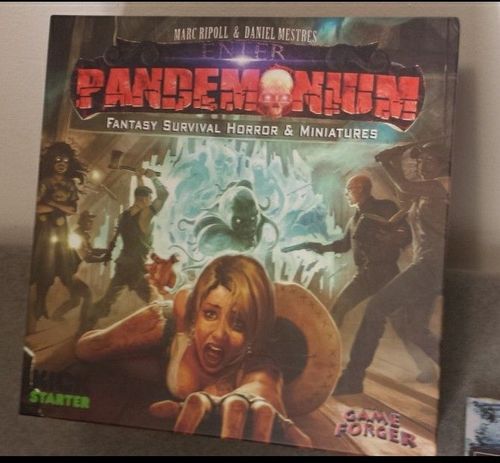
Pandemonium
Pandemonium Rulebook
Table of Contents
Table of Contents
- Setting Up the Game
- Structure of a Game Round
- Objectives
- Game Modes
- Map Tiles
- Doors and Windows
- Barricades
- Activity
- Characters
- Inventory
- Weapons and Objects
- To Explore
- Skill Tree
- Actions
- Movement of Characters
- Run
- Dash
- Attack
- Combos
- Defense
- Reinforce
- Player Death
- Pact Cards
- Reanimation
- Allies
- Creatures
- Appearance of Creatures
- Bosses
- Creatures' Turn
- Creatures' Movement
- Creatures' Attack
- Death of the Creatures
- Stunning Creatures
- Night Rounds
- Generator
- Events
- Souls
- Traps
- Portals
- Dimensional Cards
- Evil Die
- Special Tokens
- Easy Mode
- Solo Game
- Game Over
Setting Up the Game
- Choose a chapter from the Survival Diary and place the map tiles and tokens as indicated.
- Each player chooses the character he wants to play and picks up his character sheet and corresponding miniature.
- Place a Life token at the top of the Life bar and a Fear token at the bottom of the Fear bar.
- Shuffle the various card decks for the game and place them within the reach of all players.
- Set the Timer token on the Round Counter to its starting position.
- Place the Vehicle/Generator sheet next to the Round Counter.
- Prepare the 6 combat dice, 1D6 and 1D12.
- Place creatures on their starting portals.
- Place the characters in their starting point, according to the details given in the selected chapter.
- Start the game.
Structure of a Game Round
In Pandemonium there are day rounds and night rounds. The structure is the same, but the night rounds have a number of peculiarities which the player must take into account (see Night rounds).
Each round consists of a players' turn and a creatures' turn. There are 8 game rounds, which are identified in the Round Counter.
Generally players will start the game in the first space on the counter, but some chapters in the Survival Diary contain variations which must be respected.
Starting a Game Round
- Creatures appear on the portals of the board, according to the rules described in Appearance of Creatures.
- If it is night, the Evil One throws his Evil Die once.
- If the Generator is on, its Energy token drops by 1 space.
- The character with the most Agility starts the players' turn. In case of a tie between characters, the one with most Will starts the turn.
- If the character is in a dark space, his Fear bar increases by 1. If a character is in Panic, he needs to exit Panic.
- During the player's turn, he can perform a series of actions as determined by his character card. When he has no more Actions to perform, his turn will end.
- If he ends his turn in a space without creatures, allies or other characters, he will pick up an Event card.
- The rest of characters will take their turns in order of Agility (in case of a tie, in order of Will).
- When all the players have completed their turns, the creatures' turn begins.
- During the creatures' turn, each enemy in the game moves around the board, trying to kill the characters. See Creatures' Turn for more details.
- When all creatures have moved, the creatures' turn ends.
- When the creatures' turn ends, the game round ends and we move the Time token, on the Round Counter, to the next space.
- The next round starts. If there are no more game rounds left, the game ends.
Objectives
The main objective of the game is to escape the house or defeat the evil that dwells in it. In the Survival Diary, which accompanies this manual, different challenges and objectives are posed, there are also some variations of the mechanics of game play.
This manual explains the basic rules of the game, and the Survival Diary explains how to play each of the chapters and describes their goals.
Game Modes
The Survival Diary suggests the game modes of semi-cooperative play (chapter 8) and elimination mode (chapter 5).
In semi-cooperative mode, a player controls the Evil One and must prevent the other characters from fulfilling their objectives. In elimination mode, players compete with each other and only one of them can win the match.
The alternate rules for playing in both modes are available in their respective chapters of the Survival Diary.
Map Tiles
Each Pandemonium game board consists of four map tiles joined together.
Each tile contains a number of spaces where characters and creatures can move, as well as solid walls and the location of doors and windows.
Characters and creatures cannot cross lines which represent solid walls.
The separation between spaces is marked with a different type of line.
When there is a join between two spaces in different tiles and both spaces contain a door or window, this is treated as a single door or window, it is not necessary to open it twice.
Doors and Windows
At the beginning of the game, all the doors and windows on the board are closed. When a player wants to open a door or window, he places an Open Door or Open Window token on top of the corresponding icon on the board. If you break a door or window, you should place a Broken Door or Broken Window token in its place.
Open doors and windows can be closed again (remove its token from the board). Broken doors and windows cannot be closed again.
When you want to close or open a door or window, simply remove the Open Door or Open Window token from the board.
Doors can be opened from either direction. Windows can only be opened from the direction indicated by the arrow on its icon in its space.
Players can break doors and windows from both directions.
Creatures can only cross open or broken windows, but they can cross doors, even if they are closed (see Movement of Creatures).
Doors and windows are broken when a character dashes through them (see Dash).
Opening or closing doors and windows costs 1 Action.
Barricades
The barricades serve to stop the creatures and prevent them from entering the spaces which you want to protect.
Players can add a barricade to any door or window in the space in which they are located. To do this, they place a Barricade token on top of an existing door or window icon on the map tile or above any other Open or Broken Door or Window token which is already there. Barricades can only be placed on doors or windows.
When a barricade is removed from the board, the door or window where it was placed is broken (a Broken Door or Broken Window token is placed there).
A door or window can only contain one barricade at a time. That is to say, if there is already a Barricade token in one door or window on the map tile, this has to be removed or destroyed before another one can be set in the same door or window.
Any creature attempting to cross a barricade will be automatically stunned (see Movement of Creatures), but the barricade will disappear from the board, leaving a broken door or window.
Placing or removing a barricade costs 1 Action.
Evil Barricades
The maps can contain tokens for an Evil Barricade. This type of token can be shown on a door or window and it cannot be crossed until it has been destroyed.
To destroy an Evil Barricade, a character must perform an attack when he has it within reach. Each Evil Barricade has 9 Life points. If it is destroyed, its token is removed from the board and replaced with a Broken Door or Window token. A new creature appears in its space (on the side closest to the attacking character).
Any creature or boss can cross Evil Barricades without losing Mobility points.
In the semi-cooperative game mode, the player controlling the Evil One can place Evil Barricades on the board, using one of his actions (see Survival Diary).
Activity
The Game Activity serves to aid the creatures' movement during their turn. When a creature does not perceive any character, it will move to the map tile where there is most Activity (see Movement of Creatures).
Activity is the sum of characters and creatures in a map tile. Characters count as 2 Activity points, and creatures and allies as 1 point. Bosses do not count as Activity (see Bosses).
Characters
Each character in the game has a character sheet which is used to control it.
The values of a character are:
- Attack — When attacking, the number of Combat dice rolled is equal to this value.
- Defense — When defending, the number of Combat dice rolled is equal to this value.
- Agility — Determines the order in which players play their turns.
- Action — Determines the number of actions the character can perform.
- Will — Determines the character's resistance to Fear when attacked by creatures.
None of these values may be less than 1, under any circumstances.
Each character has their own special skill and this can have a decisive influence on the group's strategy. Some skills can only be used once per turn, others are permanent.
Example 1, Doctor: "+1 Life point per turn (any player)". He can give 1 Life point to any character on the board, but only once per turn and only to 1 character.
Example 2, Preacher: "-1 Fury to all creatures on his space". Any creature in his space has -1 Fury point, always. This skill can be indirectly used by other characters on his space, because creatures will have -1 Fury point even when it is not the Preacher's turn.
Example 3, Fury: "Dash without losing Life (once per turn)". During her turn, she can choose to dash through doors, windows or barricades without losing Life points, but only once per turn.
Example 4, Geek: "Discard 1 new card for one of the same deck". Every time he picks a new card, he can discard it and pick the next one of the same deck, which he can't discard anymore.
Example 5, Huntress: "Reroll 1 die once per roll". Every time she rolls dice, she can reroll one of the dice. Only the Huntress can do this, and only once per roll.
Example 6, Mechanic: "Place Traps and Barricades for free". She can place Trap and Barricade tokens without using Action points. She must have Trap tokens in order to place them.
Example 7, Stripper: "Move 2 spaces when walking". All characters move 1 space when walking, but the Stripper can move two spaces. It doesn't affect running.
Life Bar
A character starts the game with 6 Life points. If the character runs out of Life points, he dies (see Player Death).
First Aid Kit
The board may contain tokens for First Aid Kits. If the character takes 1 First Aid kit token, his Life bar is filled to the maximum. This effect is immediate and therefore, first aid kits cannot be stored in the inventory.
Fear Bar
The Fear Bar increases by 1 point when the character begins his turn in a dark area or when a creature triggers our Fear by attacking us.
When a character reaches the third space in the Fear bar, he gets -1 Will point. In the fourth space he loses 1 Defense point, adding it to the previous penalization. When the Fear bar reaches the fifth space, the character is in Panic.
Panic
If the Fear bar is completely filled, the character enters Panic. While a character is in Panic, he cannot perform any action, and must stop the Panic.
To stop the Panic, the player must roll 1 Combat die and score a Hit. Every time the player gets a Miss, his character loses 1 Life point. He must roll the die as many times as necessary until he gets a Hit.
When the character stops the Panic, he lowers his Fear counter by one space and can continue playing normally.
In addition, if a character who is in a Panic has Fear triggered at any time in the round, he must subtract 1 point of Life for each point of Fear received. If a character is in Panic at the beginning of his turn, he must first check if he receives any additional Fear point, before trying to stop Panic.
Example: player 1 begins his turn in Panic. He is in a dark space, so he gets 1 point of Fear, which costs him 1 point of Life. He rolls a Combat die and gets a Miss, which costs another point of Life. He throws a Combat die again and gets a Hit, which lowers his Fear bar one space. So, now he leaves Panic and can start to use his actions in a normal way.
Inventory
Each character has an inventory consisting of equipped weapons and weapons or objects stored in their backpack. The inventory contains the cards taken from the Items deck.
It is possible to have an equipped weapon in each hand, with the exception of two-handed weapons, in which case it is only possible to carry 1 equipped weapon. A maximum of two Item cards can be stored in each backpack. The backpack is not represented on the character sheet: the cards are placed next to the sheet or below it. Players can rearrange items in their inventory whenever they want, during the players' turn. Once players' turn has finished, they will not be able to change anything until the start of the next round.
If several characters are in the same space they can exchange Item cards from their respective inventories. Each exchange can include as many Item cards as the players want. Event, Ally and Pact cards can never be exchanged.
Reorganizing inventory does not cost an Action, it is free. Exchanging Object cards between characters in the same space, costs one Action.
Weapons and Objects
Weapons and objects are obtained through the action of Exploring, looting allies or resolving certain cards.
The player takes a card from the Items deck and places it in his inventory.
If the inventory is full, the player must either discard a card to make room for the new one or discard the new one (see Inventory).
Weapons must be equipped in the corresponding spaces in the character sheet for them to have an effect on the game. No weapon in the backpack can be used until it is equipped in a free space in the character sheet. Objects, on the other hand, do not need to be equipped. They are stored in the backpack and have an effect throughout the character's turn.
All objects have a special effect on the game. A player may use any object card during his turn.
All weapons have special effects on the game if equipped. In addition, the weapons cards have these values:
- Damage — the damage points inflicted by the weapon.
- Difficulty — the minimum number of Hits in the attack roll to use the weapon successfully.
- Hands — the number of hands the weapon needs to use it.
- Range — the maximum range in spaces from which it is possible to attack from a distance.
None of these values may be less than 1 under any circumstances.
The weapon and object cards can be exchanged between characters in the same space, using the action Exchange objects between characters.
Single-use weapons are discarded when the player makes a successful attack, that is, if he kills a minimum of one creature. A failed attack does not use up any weapon.
To Explore
When exploring, the player picks up a card from the Items deck. If he has free space in his inventory, he may keep the card. Otherwise, he should discard it or discard an existing card to make room for the new one.
When exploring, the player places an Explored token in his space. If there is already an Explored token in a character's space, he will not be able to explore there. Characters can only explore in spaces without explored tokens.
All Explored tokens are removed from the board in the first night round (see Night Rounds).
Exploring costs 1 Action.
Skill Tree
Most character values can be improved and new special skills can be acquired throughout the game. When leveling up, the player needs to choose a Skill Tree card and improve it.
There are four types of Skill Tree cards, with different combinations of skills and improvements. Once a player has chosen one, he cannot change it, nor select another one, until he has either completed the current skill tree or died.
The available trees are: Corruption, Illumination, Retribution and Survival.
The Corruption, Illumination and Retribution trees offer permanent skills, while the Survival tree offers immediate rewards which the character gets just when he improves his tree by one space.
Example # 1: Player 1 gets an upgrade from the skill tree. He chooses the Illumination card and gains +1 Will for the rest of the game or until his death.
Example # 2: Player 1 only has 1 Life point and has no Fear point. He fulfills a Pact and improves his skill tree by two spaces. He decides to take the Survival card, the first space in which is -2 Fear (which is of no use to him) and for his second space, he selects +2 Life, which allows him to recover 2 points on his Life bar.
The first skill cannot be chosen, it is indicated in the chosen card. After this, the player can choose between skills 2 and 3. Skill 4 can only be achieved if skill 2 has been improved. Skill 5 can only be achieved if skill 3 has been improved. Skill 6 can only be achieved if the five previous ones have been improved.
Example: Player 1 has improved spaces 1, 2 and 4 of the Corruption skill tree. He achieves one new improvement: only space 3 can be improved since spaces 5 and 6 are still inaccessible.
When skill 6 is reached, the skill tree is considered complete. When a tree is completed, the player can choose another one and continue improving the character. The skill trees are cumulative.
When the character dies, the skill tree is lost and must be discarded.
The skill tree is improved in the following situations:
- Killing one or more creatures in an attack, during our turn (+1 space).
- Fulfilling a Pact (as many spaces as specified in Pact card).
- Meeting the challenge of a Dimensional card (as many spaces as the card specifies).
- Reanimating a character (+1 space).
Please note: even if the player kills several creatures in an attack, his skill tree only improves by one space. It's the success of the attack which counts, not the number of creatures eliminated.
Corruption
- -1 Difficulty: all character's equipped weapons have -1 Difficulty point.
- +1 Attack: the character gets +1 Attack point.
- +1 Weapon: the character can equip 1 additional weapon (one or two-handed), even if he doesn't have inventory spaces available.
- +1 Defense: the character gets +1 Defense point.
- Free Traps: the character can place traps without spending Action points.
- Eliminates Fear: the character is immune to Fear from darkness and from creatures (but not to Events, the Evil Die or the Final Battle).
Illumination
- +1 Will: the character gains +1 Will point.
- +1 Action: the character gains +1 Action.
- Don't Fall: when rolling a D6 for running, if a 1 appears, the character can advance 1 space instead of falling.
- Take 2 Items: when exploring, this character can take 2 cards instead of 1.
- +2 Inventory: the character has 2 additional spaces in his backpack, which lets him store 2 extra cards.
- Eliminates Events: the character doesn't need to take an Event card when he ends his turn.
Retribution
- Explorer: the character can explore in spaces already containing an Explored token.
- 1 Reroll: the character can reroll 1 die, once per roll.
- 1 Reroll: the character can reroll 1 die, once per roll.
- -1 Life: all creatures attacked by the character have -1 Life point.
- -1 Fury: any creature attacking the character has -1 Fury point.
- Unbreakable: the character can dash without losing Life points.
Survival
- -2 Fear: the character recovers 2 Fear points. Immediate use.
- +2 Life: the character recovers 2 Life points. Immediate use.
- +4 Souls: the character gets 4 Souls. Immediate use.
- +3 Items: the character picks 3 new Item cards. Immediate use.
- -1 Creature: the player can eliminate 1 creature from the board (no bosses). Immediate use.
- Eliminates 1 Pact: the player can discard 1 Pact card from 1 selected character. Immediate use.
Actions
The characters perform actions during the game. The number of actions each character takes during his turn, is determined by the Action value of his character sheet.
There is a special action which has no Action cost for the character: dash through doors or windows (see Dash).
Using cards, Souls and rearranging inventory is not considered to be an action. All other actions in the game have a cost of 1 Action for the character.
List of actions:
- Move
- Run
- Open/close door or window
- Raise/remove barricade
- Set a trap
- Attack
- Reinforce
- Explore
- Enter a portal
- Exchange Item cards between characters
- Reanimate a character
- Loot an ally
- Dash
- Pick up a board token: First Aid Kit, dagger, book, battery, oars
- Use a board token: radio, telephone, generator
Movement of Characters
The action Move allows a character to move one board space in any direction.
Characters cannot cross solid walls, these are identified on the tile by a solid line.
The separation between spaces is marked with a different type of line.
Characters can cross a solid wall when there is a door or window there. See the rules of doors and windows.
If there is a creature in the character's space and the character moves to another space, he loses 1 Life point. The only way to leave a space with creatures without losing life, is to run.
Run
The action of running can only be used once per turn. The player will roll 1 D6 and use the result as the total number of spaces which he can move. For example, if a player scores a 5, the character can move up to 5 spaces from his current space. It is not necessary to move all the spaces scored in the die's roll.
The action of running cannot be interrupted by any other action. If so, the character must stop running immediately and cannot run again until his next turn.
For example, if the character has to open a door in mid-stroke, he is obliged to stop and open the door (he must finish his action of running immediately).
An exception is the action Dash. Whenever a character runs, he can dash through doors and windows without stopping. However, the player must apply the Life penalties associated with the action Dash.
If a player rolls a die to run, but scores a 1, the character stumbles and loses the action of running, with no possibility of repeating it this turn. Therefore, characters always run from 2 to 6 spaces; 1 is a Miss.
Dash
This is the only action in the game which does not cost the character an Action point. Characters can dash through doors and windows, in any direction. It is not possible to dash between spaces which do not have doors or windows to cross.
- Dash through a closed door: -2 Life points to the character and a Broken Door token is added.
- Dash through a closed window: -1 Life point to the character and a Broken Window token is added.
- Dash an open or broken door/window: -1 Life point to the character.
- Dash through a barricade: -2 Life points to the character, the barricade is eliminated and a Broken Door token is added.
Example # 1: The character has 1 remaining Action and dashes three times in his turn. He will still have 1 Action, since dashing does not cost an Action point.
Example # 2: The soldier has 3 Actions and 5 Life points. He dashes through a closed door. He is left with 3 Actions and 3 Life points.
Attack
The action of attacking can only be performed if the character has a minimum of 1 equipped weapon. The weapon values determine whether the character must be in the same space as the attacked creatures or if he can attack from a distance (see Weapons and Objects).
When an attack is made, the player rolls as many Combat dice as his Attack value indicates. Each Hit inflicts 1 point of damage on the enemy. This damage is added to the Damage value of the equipped weapons, provided they have been successfully used in the attack (see Weapons and Objects).
If the total damage equals or exceeds the enemy's Life value, he dies.
The damage is not cumulative, the player must kill the creatures in a single attack. If the damage done to the creatures does not exceed their Life, you must try again in another attack.
The creatures do not have a Life bar: they die or they regenerate their health completely.
It is only possible to kill one enemy with each attack, except when a card indicates otherwise or when players use Combo cards.
When a creature dies, its miniature is removed from the map and its special effect is applied, if the creature has one (for example, the arcane, aberrations, possessed and spectres perform actions upon dying).
Dead creatures leave a Soul in its space (see Souls).
Killing one or more creatures in an attack improves a character's skill tree by one space.
Any roll of more than one die, that results in 100% Hits, is considered a critical Hit and adds +1 Damage point to the total damage obtained in the attack.
The player can make an attack with one or more characters which are in the same space. The only way to perform a combined attack is by using a combo.
Combos
To make a combo, the player takes a card from the Combos deck.
In the Combo card there are three rows in which you specify a more powerful combo (in the upper), a less powerful combo (in the central) and a penalty for the failure of the combo (in the lower).
The numbers on the left side of each row determine the minimum number of hits the player must score on his attack roll.
We must always choose which of the two combos we want to perform before rolling the die.
A character can launch a combo attack alone, he doesn't need that other characters join the attack. However, if several characters participate in the combo, more creatures can be killed. Performing a combo lets characters attack one additional creature for each character that collaborates in the combo.
Example: one character can kill up to 2 creatures, two characters can kill up to 3, three characters up to 4 and four characters up to 5.
No character without equipped weapons can participate in a combo.
If the combo is formed using more than one character, +1 is added to the number of Hits indicated on the card, for each additional character involved in the attack.
Example: player 1 decides to make a combo with player 2, who is in his space. He takes a card from the combo deck and "The 4 fists of the jade dragon" appears. They decide to use the option "Total damage +4". Combining their attacks, they must score a total of three Hits to complete the combo.
If players do not score the minimum number of hits specified in the card, all characters who have participated in the attack immediately suffer the penalty described therein.
If the combo is fulfilled, the advantages described in the card are applied. Even so, the attack may or may not have been successful. The resolution of the combo does not ensure that the total damage reaches the minimum required to kill all attacked creatures.
If the players fail the combo, the attack is immediately cancelled, and the character who is playing his turn, ends the attack action without success.
If a player on his turn uses a combo to launch an attack with other characters in his space and manages to kill one or more creatures, all rewards (Souls and a +1 space in the skill tree) are given to the character who launched the combo. The rest of the characters do not receive any improvement.
When the combo deck is finished, players will not be able to launch any more combos during the game.
Defense
The player can defend himself when a creature attacks him. To do so, he rolls a number of Combat dice equal to his Defence value.
Each Hit on the defence roll cancels 1 Damage point from the creature's attack. The damage caused by the creature is determined by its Fury value (see Creatures).
Example: player 1 is attacked by an Aberration, which has Fury 6. His character has a Defense value of 3, so he rolls 3 Combat dice. He scores 2 Hits and 1 Miss, so he suffers 4 Damage points and loses 4 Life points or Souls.
When defending himself, the player can use any card with which he is equipped. Some cards and weapons add defence capabilities to the character.
Players usually defend themselves during the creatures' turn. Since it is not the players' turn, the only action they can perform is to defend themselves.
Any roll of more than one die, which results in 100% Hits, is considered critical and adds 1 extra Hit to the total of the defence roll.
If several characters in the same space are attacked at the same time, they will always defend themselves in order, according to their Agility value, from the slower to the more agile.
Reinforce
Characters can use 1 Action to gain +1 Defence during the creatures' turn. They can only be reinforced once per turn.
They will place the +1 Defence token on their character's sheet to remember that they have been reinforced. It is important to remove the token at the beginning of the next round.
Player Death
When a character runs out of Life points, he dies. Upon dying, the player must discard all his cards and leave all the equipped tokens (traps, dagger, battery, etc.) in his space. The character will lose all the progress in his skill tree and must discard it.
In addition, the dead character:
- Puts his Life bar to the maximum and his Fear bar to the minimum.
- Takes a new Item card and a Pact card.
- Moves his miniature to a portal of his choice on the board and remains entombed in that space.
Any dead character is invisible to the creatures until the beginning of the next round, so the creatures will not attack or take him into account in their move. Neither does he count as an Activity.
At the beginning of each round, all the characters entombed in their respective portals get back on their feet and the game continues in a normal way.
Generally characters die during the creatures' turn, but sometimes they can die during the players' turn. If a character dies during the players' turn and has not yet played his turn, he can do so when it's his turn to play.
Likewise, if a character dies during his turn and he still has actions left, he can continue playing from the portal where he decides to appear.
Example # 1: at the beginning of round 6 the Evil Die is launched and -1 Life point appears. Player 2 dies, losing his cards and skill tree, he takes 1 Item card and 1 Pact card and places his miniature flat on a portal on the board. When it's his turn to play, the player will stand up and play his turn normally.
Example # 2: player 1 has 2 actions remaining, but dies due to the effect of another player's Pact card. Player 1 loses his cards and skill tree, takes 1 Item card and 1 Pact card and places his miniature in a portal on the board, from which he continues to play.
Players may die repeatedly and accumulate several Pact cards during the game. Dying is part of the game.
Pact Cards
The Pact cards are secret. It is forbidden to give other players clues about its effects. The Pacts must be fulfilled as soon as the game allows to resolve their effects. They do not need to be resolved during the player's turn.
Example: Player 1 is on his turn and decides to run. Player 2 fulfils his Pact and gets his rewards. Player 1 is still playing his turn, but has lost the action of Running.
When fulfilling a Pact, the player receives all the rewards indicated in the card, which consist of different quantities of Souls, Item cards and improvement in the skill tree. Once a Pact is fulfilled, the Pact card is discarded.
Any player who ends the game with an unfulfilled Pact, will be cursed and lose the game.
Reanimation
In most chapters, if a player dies, he must continue playing by taking a Pact card and complying with all the rules of the game, as described in Player Death. However, in some chapters of the Survival Diary, the action Reanimate is introduced.
In these games, the dead character will keep his cards and tokens, but will lose his skill tree. In addition, his miniature must remain lying on the board, unable to play, until another character reaches his space and reanimates him. When a character is reanimated, he moves his miniature to the standing position, receives Life points equal to his Will value, and places his Fear bar at 0.
If the reanimated character has not yet played his turn in the current round, he may do so after all the other characters have played. If he has already played his turn, he should wait for the next round.
The player who reanimates a companion receives +1 Soul and improves his skill tree by 1 space.
Reanimation costs 1 Action.
Allies
Allies are obtained by taking a card from the Allies deck. Ally cards can be picked up when using Radio and Telephone tokens or when a special card allows it.
The Rescue Helicopter card is only used in chapters designed for it.
Once we have an Ally card, we take the miniature which corresponds to that character and place it in the space where it has appeared.
When an ally whose character is already present in the game as the main character appears, we discard that card and take another one.
Half of the allies are good, and the other half are evil.
If there is a good ally in play and their evil version appears when taking a card, we change the existing ally for the new one, who will become evil. If there is an evil ally in play and their good version appears when taking a card, we change the existing ally for the new one, who will become good.
Good allies can only move, open and close doors and windows and perform their special ability. Good allies cannot attack, but add +1 Hit in any attack by players if they are in the same space, this includes combos.
Good allies have 1 Life point and cannot defend themselves, so they will die if attacked by a creature.
Any dead good ally remains on the map lying down until a player loots him. When looting a corpse, the player obtains 3 Item cards and 1 Soul. The ally miniature is removed from the map immediately and no one else can plunder him.
A good ally is controlled by the player who calls him. That player can move the ally before or after his main character, but always within his turn.
Bad allies act the same as the rest of creatures in Pandemonium and have similar values. They are the last to move and don't have Perception value: they move towards the closest character, and in case of a tie, to the slowest.
Creatures
The creatures in Pandemonium are organized by breed. They appear in the game at the beginning of the round or when a card or die invokes them.
The values of the creatures are:
- Life — determines the Life points of the creature.
- Agility — determines the order in which the breed act during the creatures' turn.
- Fury — determines the damage it inflicts when attacking.
- Mobility — determines the number of spaces it can move.
- Perception — determines the number of spaces from which it can detect a character.
- Terror — determines the minimum Will that a character must have to avoid feeling Fear when attacked by the creature.
Each breed has fixed values and specific abilities, listed in order of Agility and invocation.
Appearance of Creatures
To summon creatures, the Invocation die is rolled (D12). The result determines which of the creatures appears.
If a creature appears for which there are no further miniatures available, the die is rolled again until it summons a race for which there are miniatures available. When the Invocation die is cast (D12) and the result is a 12, it causes the appearance of the last creature which would have been summoned in the game.
Creatures can appear in different situations:
At the beginning of the round:
- In the first day round a creature appears on each portal of each map tile which is not occupied by characters.
- In the first night round a creature appears in each portal on the board.
- In any other round, a creature appears on each portal of each map tile where there is at least one character. Nothing appears in any of the other portals.
Whenever creatures appear at the beginning of the round, a portal is selected where the first creature will appear. The rest of the creatures will appear in the other portals in a clockwise direction.
When players roll the Evil Die: the creature will appear in a portal located on the map tile where there is the least Activity. If multiple portals are available, the player decides where to place the new creature. If there are several tiles with the same level of Activity, the player decides where to place the new creature.
When a card says so: the text of the card specifies the place of appearance.
The maximum number of creatures in a game is 4 per character. For example, in a game where there are 4 characters, there will be a maximum of 16 creatures. When the maximum number of creatures allowed is reached, any new creatures which should appear will add 1 Fear point to all characters instead of appearing on the board.
Example: the board has 3 players and 12 creatures. A player picks up an Event card which summons 2 new creatures. All players must raise their Fear bar by 2 spaces.
Bosses
Bosses are not considered creatures, so they do not follow the effects of any card or rule in which there is a reference to creatures.
Bosses cannot be destroyed, except when a chapter in the Survival Diary specifies it. They also have their own unique abilities.
When attacking in a space with creatures and bosses, the player has to decide which specific one to attack, since he cannot attack both at once. He can either attack the creatures or the bosses.
Bosses have no Perception value. They always move towards the closest character, and in case of a tie, the slowest.
Creatures' Turn
At the beginning of the creatures' turn, any fallen creature which was stunned in the previous round, will get to its feet. These creatures can move and attack. During the creatures' turn, all enemies in play will move around the board trying to reach out to the characters and attack them.
The creatures move in order of their Agility value. Then the evil allies move. The bosses move last.
When creatures belong to the same breed, the creature closest to a character always moves first. In case of a tie, the players decide.
Creatures' Movement
The creatures will move around the board trying to reach the characters. Their movement follows strict rules which the player must respect.
Creatures, like characters, cannot pass through solid walls. They cannot cross windows unless they are open or broken.
Creatures can pass through doors, but they will lose a movement point to open them (except when their ability specifies otherwise, such as aberrations or spectres).
Example: the Psycho has player 1 two spaces away. It tries to reach him, but it must open the door first, so it stays 1 space away and cannot attack him.
The creatures will advance space by space, as many spaces as their Mobility value indicates. If they find a character in their space, they will stop to attack and end their turn immediately (see Creatures' Attack).
When a creature begins its movement, the first point to determine is whether or not the creature perceives a character. To determine if that happens, you have to look at the Perception value of the breed to which it belongs. The creature will perceive any character located in a space which is at a distance of an equal or lesser value than its Perception value. Only the number of spaces are taken into account, not obstacles in their path (doors, barricades, etc.).
If there is no character within its perception radius, the creature does not perceive any character.
Example: the Killer Toy has a Perception of 3: it detects player 1, but not player 2.
To determine whether or not a character is detected, players need to count the number of spaces between his location and the creature's, following the path of the creature's normal movement, which means it cannot pass through solid walls, or closed windows.
Example: the Arcane has a Perception of 2: it detects player 1, but not player 2.
Thus, if the creature perceives a character:
- It will move towards him by the shortest possible path. If there are several paths, which are all equally short, it will use the one which contains the least obstacles (Traps, Barricades and Doors). In case of a tie, the players decide.
- If a creature perceives several characters at the same distance in different spaces, it will move towards the space which contains the greatest number of characters.
- If there is the same number of characters at the same distance in different spaces, it will move to the slowest character. In case of a tie, towards the one who has least Will.
Note: Allies are considered slower than characters, so if a creature has a character and an ally at the same distance, it will always attack the ally. Use them as a human shield.
- Creatures will always take the shortest route, even if it contains traps or barricades.
- All creatures lose a point of movement to open doors, except those which can break them (aberrations) or pass through them (spectres).
- When a creature attacks a character, the creature's turn ends.
If the creature does not perceive any character:
- It moves to the map tile where there are characters and where there is the most Activity, always using the shortest path. It ignores tiles in which there are no characters.
- If there are several tiles with the same level of Activity, it will move to the tile with the most characters. In case of a tie, it will go to the map tile containing the character with least Agility.
- If the creature is already in the tile with the most Activity, it will move to the nearest character, even if it does not perceive it. If there are several characters at the same distance, it will move towards the slowest.
Note: allies are slower than characters, so if a creature has both an ally and a character at the same distance, it will always move towards the ally.
- If it is possible to reach the tile where there is most Activity by two routes which are equally short, it will always take the route which offers the most possibilities to find a character.
- If, as it moves towards its goal, it perceives a character, immediately apply the rules described in the previous section.
Creatures' Attack
If a creature is in a space with one or more characters, it will attack them. It does not matter if it begins its turn in the space or if it reaches it as a result of its movement. When a creature attacks one or more characters, the creature ends its turn.
If there is more than one character in the space, it will attack them all at once. Each character must defend itself from the creature's attack, starting with the character with the lowest Agility value.
When a creature attacks one or more characters, if its Terror value is greater than the character's Will value, the character's Fear bar will increase by 1 point.
Example: The Nightmare has a Terror value of 6 and attacks the Soldier, who has a Will value of 1. The soldier receives 1 point of Fear.
All creatures have a Fury value which represents the total damage they do when attacking. If the player rolls his Combat die and scores enough Hits to counter the creature's Fury, the character will not suffer any damage. If the character suffers Damage, the number of Life points he will lose is equal to the amount of damage inflicted.
Example: The player is attacked by a creature with Fury 5. The player has a Defence value equal to 3, so he throws 3 Combat dice. He gets 2 Hits, which cancels out 2 Damage points and ends up receiving 3 Damage points, which costs him 3 Life points. Since he started with 5 Life points, after the attack he has 2 Life points.
Death of the Creatures
Creatures cannot defend themselves. If a player attacks a creature and inflicts damage equal to or greater than its Life value, it will die. If a creature dies, remove its miniature from the board and fulfill the special effect of the creature, if it has one (e.g., aberrations, possessed, spectres, etc.).
Stunning Creatures
When a creature activates a trap or is struck by a barricade, it is stunned. A stunned creature ends its turn immediately and will be stunned until the start of the next creatures' turn.
To identify that a creature is stunned, players will set its miniature so that it lies flat in the space.
Any stunned creature is vulnerable. If a player attacks one or more stunned creatures, he may roll 1D6 to add extra Damage to his attack. Combine the Hits, the Damage caused by the Weapon, and the value resulting from the D6 roll.
Example: The Soldier attacks an Aberration stunned by a trap. He uses the "two-handed axe", with Damage 12 and scores 3 Hits on his roll. The Aberration has 18 Life points but the Soldier rolls 1D6, because the creature is stunned, and scores a 4. The total result is 12 + 3 + 4 = 19, allowing him to kill the Aberration.
Night Rounds
The night rounds, which are indicated in blue on the Round Counter, differ from the day ones in two basic aspects:
- The whole board is considered to be in darkness.
- The Evil One rolls 1 Evil Die at the start of each night round.
When a character is in a dark space, his Fear bar increases by 1 space at the beginning of his turn. All spaces are dark in night rounds except those where a character is equipped with a light-giving object or weapon (in which case the Item card will specify this).
In the first night round, all the Explored tokens are removed from the board. In the first night round, 1 creature appears in each portal of the board.
Even at night, it is considered that the entire board is illuminated when the Generator is on.
Generator
The Generator token can be used once per game. Any player in its space can use 1 Action to turn on the generator.
To turn on the generator the player rolls 1D6 and uses the result to place the Energy token in the corresponding space from 2 to 5. If the generator is switched on, remove its token from the board and use its sheet to control its load.
If a player rolls a 6, a creature appears in the same space as the generator and it does not turn on. The player can spend another Action point to try to activate it. If a player rolls a 1, it is considered a Miss and the generator remains off. The player can spend another Action point to try to activate it.
At the start of each round, the Energy token drops one space on the generator counter. If it reaches 1, it goes out and players will be without light in the night rounds.
Events
When a player finishes his turn, if there is no creature, ally or other player in his space, he must take an Event card. Event cards can have positive or negative effects on the game.
Negative events must be resolved immediately and then discarded. Negative events are marked with an icon on the card.
Positive events can be saved and used when the player wants, during or outside of his turn. Once used the player must discard them.
Event cards do not take up space in the inventory, but if the player dies, he must discard them.
Players cannot exchange Event cards.
Souls
Each character can collect a maximum of 5 Souls. Souls are obtained by killing creatures, looting allies, fulfilling Pacts, or overcoming Dimensional cards.
The Souls are used to improve the character's abilities or to recover Life and Fear points. Using Souls does not count as an Action, but they must be used during a character's turn.
Recovering 1 Life point costs 1 Soul. Recovering 1 Fear point costs 1 Soul. Once per turn we can also get +1 in a value on the character's sheet (until the end of the round) and may choose between Attack, Defence or Action. This costs 2 Souls.
If a character has Souls and has no Life left, he will spend Souls instead of Life points. If he runs out of Souls and Life, the character dies (see Player Death).
Example: the Stripper is attacked by a Demon, with Fury 5. She rolls her Combat dice and only scores 1 Hit, getting 4 Damage points. The Stripper only has 2 Life points, but she has 4 Souls, so she survives. She can choose between spending 4 Souls and keeping her 2 Life points or spending 1 Life point and losing 3 Souls.
Note: a character cannot die while he has Souls, as he must spend them before running out of Life.
Any character automatically collects any Soul in his space during his turn. If the character already has the maximum permitted number of Souls, they are left in the space so that another character can collect them during his turn.
If a character kills one or more creatures in his space, he automatically collects 1 Soul and does not need to place it in the game board, except if the character reaches the maximum permitted number of Souls (5).
Note: Characters don't get 1 Soul per dead creature, but 1 Soul for each successful attack. So, the maximum number of Souls a character can get in an attack is 1.
Traps
Traps are obtained by discarding weapons or items with which the character is equipped in his inventory. This is not considered to be an action.
The Trap token can be stored on top of the character sheet until the point when the player wants to use it. Each character is allowed to have a maximum of 3 traps.
Traps are placed in the space where the character is located. Placing a Trap token on the board is considered 1 Action.
Any creature that enters a space with a Trap token will automatically be stunned. Place its miniature flat on the space and end its turn. Each time a creature activates a trap, remove that Trap token from the map tile.
If a creature starts its turn in a space with a trap, the trap will automatically activate, the creature will be stunned and players must then remove that Trap token from the map tile.
Players cannot exchange traps.
Note: Traps and barricades are the best way to stop creatures from advancing.
Evil Traps
In semi-cooperative game mode, the player who controls the Evil One can place Evil Traps on the board, using one of his actions (see Survival Diary). Any character who enters a space containing an Evil Trap token must roll 1D6 and receives a number of Damage points equal to the result of the roll. The character can defend himself against the damage inflicted.
No creature or boss is affected by the Evil Barricades, only the characters.
Portals
The portals in the game are represented with Portal tokens. Creatures appear on the board through the portals. The appearance of the creatures is described in Appearance of Creatures.
Any player can travel between portals, entering a portal in his space and moving to another portal on the board. To do this, they must take a Dimensional card.
Dimensional Cards
The Dimensional deck contains small challenges which the player must solve successfully if he wants to be able to travel between portals. If a player successfully solves the challenge, he will be able to travel between portals and win the rewards indicated in the Dimensional card.
Example: the Soldier has 3 Actions and picks up the "Doomed Planet" card, which sets the following challenge: "A creature appears. If it gives you fear, you do not pass the test." The Soldier rolls 1D12 (the Invocation die) and a Demon appears: it has Terror 4. The Will of the Soldier is 1, so he does not pass the test.
If a player fails the challenge, his character will stay in the same space and lose 1 Life point. In addition a new creature will appear in his space.
The challenges posed in the Dimensional cards have an effect on other dimensions, hence they do not affect the game. If, for example, a card indicates that the character must run to another position of the board, the character will not move in the normal game. If a creature appears and attacks him, it will not appear on the board. Only the positive or negative resolution of the card affects the game, as described above.
Taking a Dimensional card costs 1 Action.
Evil Die
The Evil Die has 6 faces. Each result has an effect on the game:
- Miss (1) — Nothing happens.
- Fear (3, 5) — +1 Fear point to all characters.
- Invocation (2, 4) — 1 new creature appears in the Portal with least Activity on the board.
- Life (6) — -1 Life point to all characters.
The Evil Die is rolled once at the beginning of each night round.
The Evil Die is also used by the player who controls the Evil One in the semi-cooperative games (Survival Diary, Chapter 8).
Special Tokens
The Dagger and Book tokens are used to invoke the Evil One in chapter 6 of the Survival Diary and in the semi-cooperative mode.
In the rest of the chapters, we can collect them to improve the Attack or Defence ability of the character: The Dagger adds +1 Attack to the player carrying it. The Book adds +1 Defence to the player carrying it.
If the character dies, the Dagger or Book tokens are placed in the space in which he fell.
The Telephone and Radio tokens are used to ask for help (Ally card). Once used (1 Action), its token must be turned "face down". Characters must spend 1 Action to turn the token "face up" again to its original orientation and reactivate the telephone or radio. If the tokens remain "face down" (X), characters can't use the telephone and/or radio.
Easy Mode
Changing some starting options makes it easy to adjust the game's level of difficulty.
Easy mode:
- All players start the game with 2 random cards from the Items deck.
- All players start the game with 4 Souls.
- All players have +1 Action.
Solo Game
When playing as a single player, you must select and control two characters. All the rules are kept in place, but the mechanics of Pacts disappear. If one of the two characters dies, he will not be able to continue playing and will remain lying on the board in case the other character wants to loot him (take his cards and tokens + 1 Soul). If both characters die, the game ends in defeat.
If a chapter is too difficult, the player can play using the Reanimate mechanic: when a character dies, he can be reanimated again by a surviving character. Again, if both characters die, the game ends in defeat.
Game Over
The game ends when one or more players meet the objectives indicated in the selected chapter of the Survival Diary. Each chapter has different goals, such as escaping the house, rescuing a survivor, surviving several rounds, or defeating the Evil One. Although the chapters follow a narrative order, they can be played independently of one another.
If the Round Counter ends before we are able to achieve the goals, the game ends in defeat.
In most chapters we must avoid ending the game with unfulfilled Pacts or we will be cursed.