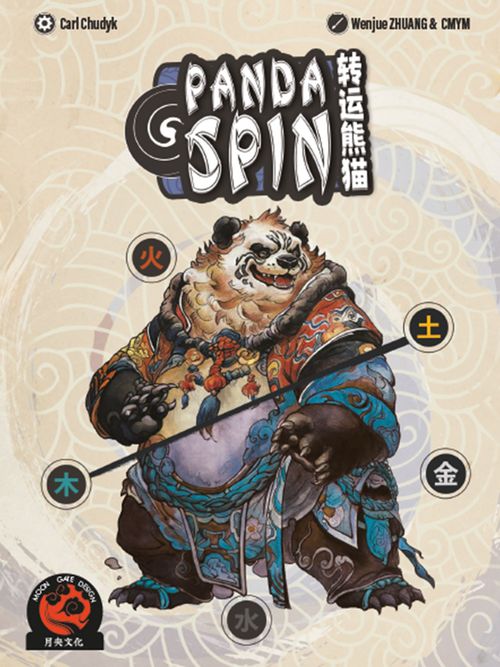
Panda Spin
Panda Spin Rulebook
Table of Contents
Table of Contents
Components
- 75 cards
- 65 Animal cards (13 cards each in 5 suits)
- 5 Element cards
- 5 Player aids
- 45 Bamboo tiles (points)
- 30 ones
- 15 fives
- 1 Panda mood tile
Game Overview
In Panda Spin you have 5 suits of cards representing the 5 elements of the Chinese zodiac.
These elements are associated with colors: Fire (red), Earth (yellow), Wood (turquoise), Water (black) and Metal (grey). You can identify the suits by the colored element symbols at the top and bottom of the cards.
In each suit there is 1 Element card, which does not show a value but a special function, and 13 Animal cards which show a value and sometimes an additional symbol.
One half of an Animal card shows an animal from the Chinese zodiac with white background behind the values, and the other half shows an improved blue version, hereafter referred to as the White side and the Blue side.
The White sides shows the physical representation of the animal, the Blue side the spiritual one.
The value of an Animal card varies depending on the White/Blue side: the White side has a single value, while the Blue side either has a higher value, 2 or 3 identical values or one of the symbols: Panda, Bamboo, Water or Fire.
When you play an Animal card, only its upper half is relevant.
Example for an Animal card: the value of the White side (here: 3); a preview of the value of the Blue side (here 10, Water); the element and color of the card; the Blue side with the increased value 10, Water.
Example for an Element card (Wood): the element and color of the card, and the function of the card.
Bonus symbols
Some of the cards have an additional symbol beneath the value, which allow you a bonus function when you play them:
- Panda: Choose the effect according to the Panda mood tile.
- Hungry Panda: Take 1 point from the player who played into the trick right before you.
- Spin Panda: You may spin 1 of your hand cards from White to Blue side. (Page 7, Element Earth)
- Bamboo: Each Bamboo symbol you play lets you take 1 point from the supply.
- Fire: Each Fire symbol you play allows you to discard a card from your hand.
- Water: Each Water symbol you play you can use as a value of your choice (wild) and use it in a legal Set, Run, or Formation.
If desired, you can ignore all the symbols.
Setup
Place the Bamboo tiles next to the playing area as a supply. Use the Bamboo tiles to count the points you collect in the game. Take 1 point each.
Place the Panda Mood tile on the table, pick a side Hungry Panda or Spin Panda either intentionally or randomly (page 7, Element Earth).
Pick out the 5 Element cards and shuffle them. To determine the Starting player, let every player draw 1 Element card. Starting player is whoever drew the highest number. If you are 2 players, reveal 1 more Element card.
The number on each Element card (find your number on the card):
| Element card | Number |
|---|---|
| Metal | 1 |
| Wood | 2 |
| Water | 3 |
| Fire | 4 |
| Earth | 5 |
Now select the Animal cards from the deck that match the colors of the revealed Element cards. Put the Element and Animal cards you don't need back in the box.
As shown above, the color of each card is indicated on the top and bottom: Fire (red), Metal (grey), Water (black), Earth (yellow), Wood (turquoise).
Tip: Instead of drawing the Element cards you can choose which Element cards you want to play in this game.
Course of Play
Overview
The game is played over several rounds and ends, when after a round at least 1 player has collected 15 or more points.
A round consists of several tricks and ends when all players but 1 have discarded all their cards.
In a trick, you play cards in turn until all but 1 player have passed. Those cards are called your bid.
You may receive points, when you
- show out, i.e. end a round without any cards in your hand (page 5: Showing out)
- play 1 or more cards with a Bamboo symbol (page 7: Element Wood)
- play 1 or more cards with a Panda symbol (page 7: Element Earth)
Play cards - General rules
- If you want to play cards, you have to play a higher bid than the player before you. For this you either play 1 or more Animal cards or a single Element card.
- If you play Animal cards, you have to use all their values, but you can decide not to use the symbols. Example: You can use a double 6 to beat a double 5, but not a triple 6.
- Before playing cards or passing, you can discard 1 or more Element cards unused (that can be necessary at the end of a round).
Tip: When you play cards, say the values out loud to make it easier to understand.
Play a round
Shuffle the selected Animal and Element cards and deal 12 of them to each player. Take the cards into your hand so that all the White sides are on top.
Set the rest aside as a face-down draw pile. Leave some space next to it for a discard pile, where you can place cards that you discard later face up.
Tip: In your first game or to make it easier you can leave away the Element cards.
Start a trick
Whoever starts the trick plays 1 or more cards of a certain Combination (page 6: Combinations).
Then, in clockwise order, the other players decide in turn whether they want to beat the bid or pass.
Beat
To beat the current bid, you have 3 options:
- You play the same type of Combination with the same number of values as in the current bid, but with a higher value (for Runs and Formations, the highest single value is decisive).
- You play a Bomb (page 6: Bomb), which can only be beaten by a higher Bomb.
- You play a single Element card (page 8: Element card) and win the trick.
Pass
If you cannot or do not want to beat the current bid, you pass and may not play any more cards for the rest of the trick.
If you have already played cards to the current trick, there are 2 cases:
- If you have only played cards with White sides up, you spin all of them 180 degrees and take them back into your hand. Example: Cards with White sides are played, without winning the trick — spin them 180 degrees. You now have 3 Animal cards with Blue sides up in your hand.
- If you have played at least 1 card with the Blue side up, you discard all the cards you have played to this trick. Example: At least 1 Blue side is played, without winning the trick — discard all played cards, together with previously played cards.
Winning a trick
You win a trick when everyone else has passed.
Discard all the cards you played to this trick.
Showing out
If you have no more cards in your hand after a trick, you successfully show out of the current round. It doesn't matter whether you won the trick or discarded your last Animal cards when passing.
You receive points: Everyone counts the cards in their hand. You receive the highest number of them as points, but no more than 7.
Note: It can happen that several players discard their last card in the same trick. All of them get the same number of points.
If no one has any cards left in their hands, nobody receives points.
Next trick
- If at least 2 players still have cards in hand: Whoever won the previous trick starts the next trick. If this player has showed out, the player with the most cards begins. Ties are broken by the player who is next in the order of play.
- If at most 1 player still has cards in hand: see Next round or End of Game.
Next round or End of Game
Has anyone of you 15 or more points?
No: you play the next round. The player with the fewest points starts the next round. In the case of a tie, the round is started by the player, who played his last cards earlier in the last round. Continue at Play a round.
Yes: the game ends! The player with the most points wins the game. In the case of a tie, winner is, who played his last cards earlier in the last round.
Combinations
There are 5 possible Combinations to start a trick: Single, Set, Run, Formation, Bomb:
Single
The highest Single value is the "二" (Chinese 2), followed in descending order by A, K, Q, J, 10, 9, 8, 7, 6, 5, 4, 3.
This order also applies to the other Combinations: The higher the highest Single value, the higher the value of the Combination.
Set
A Set consists of 2 or more identical values. Examples: 5, 5 or 7, 7, 7
Examples shown: a Set of 5, 5; a Set of 7, 7, 7, with one Water used as a 7.
Run
A Run consists of 2 to 5 consecutive values, whereby the "二" may not be part of a Run. Examples: 5, 4, 3 or A, K, Q.
Examples shown: a Run of 5, 4, 3; a Run of A, K, Q.
Formation
A Formation is a Set of Runs. Examples: Q, Q, J, J, 10, 10 or 7, 7, 7, 6, 6, 6.
Bomb
A Bomb consists of at least 4 identical values, whereby no Water symbol may be used. Example: 8,8,8,8 or 3,3,3,3,3
Example shown: a Bomb with 3,3,3,3.
More rules for Bombs:
- You can beat a Bomb by another Bomb if it either has the same number but higher values or has more values.
- You ignore all symbols when playing a Bomb. If you want to use the Water symbol, you still can play these cards as a Combination, but not as a Bomb.
- If you pass after your Bomb was beaten by another Bomb, you still discard the cards you have played to the trick.
Elements / Colors
Each of the 5 Element suits has 13 Animal cards and 1 Element card showing this color, and also a special feature that distinguishes it from the other suits when the Blue animal is on top:
Fire (red)
After spinning, a Fire card has either a double value or a high single value with a Fire symbol. For each Fire symbol you play, you may discard an Animal card from your hand.
Example: This Q becomes A plus Fire.
Metal (grey)
After spinning, a Metal card has several identical values. This makes it easier to create Sets, Formations and Bombs (page 6, Combinations).
Example: This 8 becomes 3, 3, 3.
Water (black)
After spinning, a Water card shows a Water symbol. You can use this symbol as a wild in a Set, in a Run, in a Formation, or ignore it.
This wild doesn't have to be adjacent to the single value of the card.
Example: This K becomes 7 plus Water.
Earth (yellow)
After spinning, an Earth card has either a double value or a high single value with a Panda symbol.
Depending on the Panda mood tile there are 2 different rules: For each Panda symbol you play,
- you receive 1 point from the player who played before you in the trick, provided they have points (Hungry Panda)
- you may spin 1 of your hand cards from White to Blue side (Spin Panda)
Example: This J plus Panda symbol becomes J, J.
Wood (turquoise)
After spinning, a Wood card shows a Bamboo symbol. For each Bamboo symbol you play, you receive 1 point from the supply.
Example: This 9 becomes "二" plus bamboo (1 point).
Element Cards
You can play an Element card instead of a Combination.
An Element card beats all Combinations except Bombs, and win the trick immediately.
Before playing cards or passing, you can discard 1 or more Element cards unused.
The following rules apply:
- You may only play an Element card if the condition on it is fulfilled.
- Immediately after playing a card, you must draw 2 cards from the draw pile and place them in your hand with the White sides facing up.
- You win the trick and discard the cards you have played as usual. All other players have to pass and treat their cards accordingly.
| Element card | Number | Card text | Condition |
|---|---|---|---|
| Metal | 1 | "Win a trick with no Bomb in it, if someone has played both White and Blue sides to the trick. Then draw 2 cards." | You may only play the Metal card if someone has played both White and Blue sides to the trick. |
| Wood | 2 | "Win a trick with no Bomb in it, if it contains a 二 or an A. Then draw 2 cards." | You may only play the Wood card if the trick contains a "二" or an A. |
| Water | 3 | "Win a trick with no Bomb in it, if the highest bid has at least 3 values. Then draw 2 cards." | You may only play the Water card if the highest bid has at least 3 values (same or different). |
| Fire | 4 | "Win a trick with no Bomb in it, if you have 7 or less cards in your hand, including this. Then draw 2 cards." | You may only play the Fire card if you have 7 or fewer cards in your hand, including the Fire. |
| Earth | 5 | "Win a trick with no Bomb in it, if it contains a Panda symbol. Then draw 2 cards." | You may only play the Earth card if the trick contains at least 1 Panda symbol. |
Player Aid
FIRST PLAYER: Play one: Single, Set, Run, Formation or Bomb.
Other players: Beat the trick by playing:
- a Combination of the same type and same number of values, but of higher value.
- a Bomb
- an Element card
VALUES: The values in descending order are highest 二, then A, K, Q, J, 10, 9, 8, 7, 6, 5, 4, 3.
SINGLES: Play 1 card with a single value as a Single.
SETS: Play 2 or more identical values as a Set. (Q, Q; or 7, 7, 7).
RUNS: Play 2 to 5 sequential values as a Run (Q, J; or 7, 6, 5, 4, 3). The value of 二 is not allowed in a Run.
FORMATIONS: Play a Set of Runs. (Q, Q, J, J, K, K; or 4, 4, 4, 5, 5, 5).
BOMBS: Play 4 or more identical values. In a Bomb all symbols are ignored.
ELEMENT CARDS: You must match the condition on the card. Draw 2 cards from the deck, after this you win the trick immediately.
SHOWING OUT: If after a trick you have no cards in your hand, you show out. You receive points equal to the most cards still held by another player, up to a maximum of 7.
PANDA: Choose the effect with the Panda mood tile.
- Hungry Panda: Take 1 point from the player who played into the trick before you.
- Spin Panda: You may spin 1 of your hand cards from white to blue side.
WATER: Each Water symbol you play you can use as a value of your choice (wild) and use it in a legal set, run, or formation.
BAMBOO: Each Bamboo symbol you play lets you take 1 point from the supply.
FIRE: Each fire symbol you play allows you to discard a card from your hand.
If desired, you can ignore all the symbols.