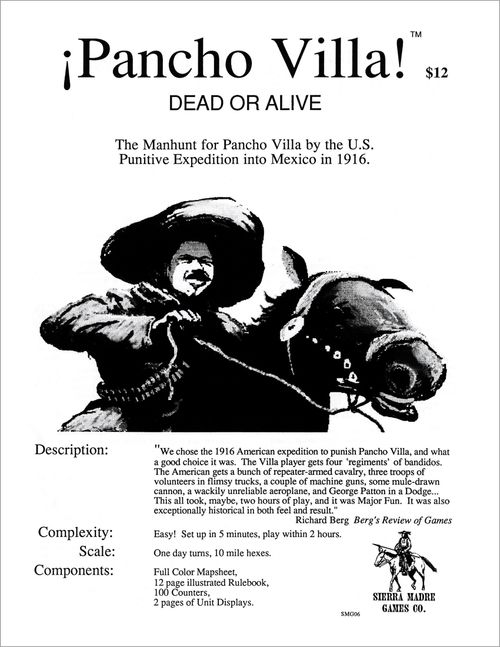
Pancho Villa, Dead or Alive!
Pancho Villa, Dead or Alive! Rulebook
Table of Contents
Table of Contents
- 1.0 Overview
- 2.0 Components
- 3.0 Game Set Up
- 4.0 Turn Sequence
- 5.0 The Segments
- 6.0 Victory Conditions
- 7.0 Historical Commentary
- Event Table
- Roll 2 (Normal) / 8 (Double): Accident
- Roll 3 (Normal) / 3 (Double): Bad Weather, Disaster, International Incident
- Roll 4 (Normal) / 4 (Double): Raiders, Insect Pests
- Roll 5 (Normal) / 5 (Double): Natural Disasters
- Roll 6 (Normal) / 2 (Double): Fatigue and Attrition
- Roll 7 (Normal) / 6-7 (Double): Lost
- Roll 8 (Normal) / 9 (Double): Ambush Guerrillas
- Roll 9 (Normal) / 10 (Double): Game Animals
- Roll 10 (Normal) / 11 (Double): Food
- Roll 11+ (Normal) / 12+ (Double): Seasonal Forage
- Completeness Note (Translator)
1.0 Overview
1.1 Introduction
1.1.1 Commentary: Pancho Villa is a game for two players. One player commands the Villistas under Pancho Villa, a capable bandit leader who has just finished raiding Columbus, New Mexico, in 1916. The other player commands the U.S. punitive force under General Pershing, "Black Jack," which has marched into Chihuahua to capture the famous revolutionary. The game also includes the Carrancistas, the Mexican government forces of the cunning constitutionalist president Carranza. They appear in the game under the American player's control, but depending on circumstances they may switch to the Villista player's control.
1.2 Table of Contents
- 1.0 Overview — ゲームの概要 OVERVIEW
- 2.0 Components — 内容物 COMPONENTS
- 3.0 Game Set Up — ゲームの準備 GAME SET UP
- 4.0 Turn Sequence — ターンの手順 TURN SEQUENCE
- 5.0 The Segments — セグメント THE SEGMENTS
- Movement — 移動 Movement
- Artillery & Aeroplane Attacks — 砲兵と飛行機の攻撃 Artillery & Aeroplane Attacks
- Assaults & Night Raids — 突撃と夜襲 Assaults & Night Raids
- Water Supply Segment — 給水 Water Supply Segment
- 6.0 Victory Conditions — 勝利条件 VICTORY CONDITIONS
- 7.0 Historical Commentary — 歴史解説 HISTORICAL COMMENTARY
1.3 Description of Play
1.3.1 Overview: The Villista player attempts to withdraw south through Chihuahua. The U.S. player advances his forces from the forts near the border, and also controls the Carrancista forces. The game proceeds with a sequence in which both armies fight after movement. Each turn represents one day. The Villista player wins by escaping with Pancho Villa's band off the southern edge of the mapsheet (see 6.0).
1.3.2 Length of Game: The game has no time limit, but it should normally be decided within about 10 turns. Initial set-up takes about 10 minutes, and play takes no more than 2 hours.
1.3.3 Three-Player Play: In a three-player game each player commands one side: the Villistas (red), the Carrancistas (orange), and the U.S. Army (blue). The Carrancista player moves immediately after the Villista player. In this three-player game, all sides (including between blue and orange) may freely attack the other sides. See 6.3 for victory conditions.
2.0 Components
2.1 Components List
- 1 rulebook
- 1 mapsheet
- 2 unit displays
- 100 counters
- (2 six-sided dice also required, not included)
2.2 Mapsheet
2.2.1 The mapsheet depicts the Mexican state of Chihuahua in 1916. Each hex is 10 miles across. Four kinds of terrain hex appear on the map: llanos (flat), Mal Pais (badlands), Montane (mountains), and Pantano (marsh).
2.2.2 Llanos Hexes: Uncoloured hexes represent grassland or desert. The movement cost for entering a llanos hex is 1 MP, or 10 MP for mechanized transport.
2.2.3 Mal Pais Hexes: Orange hexes represent steep forested terrain. The movement cost for entering a Mal Pais hex is 3 MP, or 30 MP for vehicles.
2.2.4 Montane Hexes: Green hexes represent forested mountainous terrain above 2,000 m in the Sierra Madre region. The movement cost for entering a Montane hex is 3 MP, or 30 MP for vehicles. In winter, the cost becomes 4 MP (on foot or horseback) or 40 MP (vehicles).
2.2.5 Pantano Hexes: A Pantano is a marshland that is salty and unfit for drinking. Accordingly these hexes are treated as having no drinking water. The movement cost for entering a Pantano hex is 4 MP, or 40 MP for vehicles.
2.2.6 Cliff Hexsides and Passes: Grey hexsides represent cliffs. These hexsides block movement between the two hexes unless a Trail, marked by a small white square, crosses them.
2.2.7 Settlements: The largest settlement is the City (Ciudad), shown by a blue ring ◎ (about 20,000 people). A small circle ○ represents a Town, of roughly 5,000 people. Settlements of fewer than 1,000 people include the Pueblo (Village), Indian Camp, Hacienda (farm), Mission, Mine, Mormon Colony, and Fort Bliss at El Paso, Texas.
Note: Indian Camps on the map also bear a letter showing the tribal name. These have no effect in the game. The tribal names are: A = Apache, B = Pima Bajo, Y = Yaqui.
2.2.8 Colour Coding of Settlements: Every settlement is coloured to reflect the side to which it belongs. Blue settlements are sympathetic to the Americans, orange to the Mexicans, and green to the rebels (the Villistas).
Even when the American player controls both the blue and orange forces, these are not allied with each other.
Historical background: The mines were owned by Americans and, together with the Mormon colonies, supported the American operations. Hacienda farms in Chihuahua owned by Mr. Hearst supported the American forces. By contrast, the farms owned by Englishmen, Germans, and the Terrazas family largely supported the Carrancistas. However, other farms, oppressed by the monopoly of the Terrazas family, supported the Villistas. Indians and missions also helped the Villistas.
2.2.9 Mapsheet Coordinate System: Each hex column on the mapsheet is assigned a letter from A to U. Each hex is also numbered by its distance from the northern edge of the mapsheet. For example, Guzan's hex is shown as K5.
2.2.10 Rivers: Even today, rivers (Rios) are an obstacle to travel in Mexico. A unit may not cross a river during a turn. It may only move from the bank it occupied at the start of the turn to the opposite bank. A unit that enters a river hex must stop. On the following turn the unit may be placed on any bank of the river hex. For fords and ferries, see 2.2.15.
When moving along a river, river hexes do not impede movement. See the example of Artillery movement on page 7.
2.2.11 Rails: Railroads are shown by red lines. See 5.1.11 Rail Movement.
2.2.12 Wagon Roads: When entering through a road, the movement cost of every terrain is 1 MP for any unit.
2.2.13 Trails: A trail through a llanos hex costs 1 MP (2 MP for vehicles), and a Rough hex costs 2 MP (5 MP) to enter. Trails also show where a unit can cross a river (by a Ford or a Pass) or a Cliff.
Note: Trails and roads are buried under snow in winter in Montane hexes, and the normal 4 MP (40 MP for vehicles) movement cost applies.
Note: When using the movement cost of roads or trails, a unit must enter the hex through the road or trail hexside. If a unit leaves a Rough hex that has a railroad, road or trail in a direction where none exists, it must spend an extra 1 MP (10 MP for vehicles). (See the example of Scouts in 5.1.20.)
Note: "Rough Terrain" is the collective name for the Mal Pais, Montane and Pantano terrain hexes.
2.2.14 Water Sources: River, Tinaja, Railroad and Settlement hexes contain drinking water, which vehicles and aeroplanes may also use. A Tinaja is a water hole: in this region, monsoon rains collect in hollows in the bedrock and form natural reservoirs.
2.2.15 Ferries and Fords: Where a Road crosses a river there is a Ferry, and where a Trail crosses a river there is a Ford. In summer (see 2.2.10), these cancel the river's restriction on movement.
2.2.16 Bridges: Where a Railroad crosses a river there is a Bridge, which cancels the river's restriction on movement. A bridge may be destroyed by a Night Raid.
2.3 Counters
2.3.1 Combat Counters: Combat counters include Troops, Rifles, Machine Guns, Artillery, Scouts, Policia and others. Troops include Cavalry, Rangers, Rurals, Carrancistas and Villistas. Combat counters exist in blue (American), orange (Mexican) and red (rebel). White counters represent supplies carried by the coloured combat counters. Leaders and Aeroplanes are not considered combat counters.
2.3.2 Depleted Counters: Every counter has a full-strength side and a depleted side (shaded). A depleted counter may carry out the same activities as a full-strength counter (movement, assaults, night raids and so on), except that its movement allowance is reduced by [-1] when mounted or on foot.
A counter that is already depleted and is depleted again is removed.
2.3.3 Transport Counters: These represent Horse, Pack Mule, Wagon, Track and so on. Every transport counter may carry one Troop counter and its stack. This set of Troop / Rifle / transport counters is called a unit. The speed of this unit is the same as the slower of the transport counter or the Leader.
Transport counters have no combat strength by themselves. Unescorted, these counters may be captured by a Night Raid (5.3.9).
2.3.4 Blue Counters: Blue counters represent the American punitive expedition. They may not stack with orange or red counters, except Policia.
2.3.5 Orange Counters: Orange counters represent the constitutionalist Mexican government forces of the Carrancistas. At the start of the game they are under the control of the American player. These forces are not, however, allied with the American forces.
Orange counters other than Policia may not stack with blue or red units.
They may carry out a joint attack with the American forces only when attacking the Villistas from a different hex from the Americans.
2.3.6 Red Counters: Red counters represent Villista units that were turned into guerrillas after their defeats in the north.
2.3.7 Leader Counters: See (5.1.2).
2.3.8 Rifles: Rifles are white combat counters. They must be used as armament: a Rifle may not assault or move alone (except for Rail Movement), and may be captured if unescorted.
As with other combat counters, Rifles have both a full-strength and a depleted side. Two depleted Rifle counters may be replaced by one full-strength counter.
Each Troop counter (Villista, Cavalry, Ranger, Carrancista, Rural) and each Wagon may carry one Rifle counter. A carried counter is considered to be the same colour as the Troop counter carrying it.
Leader, Scout, Policia, Artillery, Machine Gun and Aeroplane counters may not carry Rifles.
2.3.9 Policia: These orange counters are set up initially, one in each Mexican Town and two in each City. Policia may not move, and they exert a Zone of Control (ZOC) only in the hex in which they are placed.
They may only make Counterattacks, and their defence strength varies according to the place where they are set up (5.3.5). Only Artillery may attack Policia in an adjacent hex.
All combat counters must enter the settlement in which Policia are placed in order to assault them.
Example: An American unit entered the orange City of Parral and was stopped by two Policia counters placed there. Unless orange has turned (5.1.17), blue and orange are on the same side, so no assault occurs here.
2.3.10 Machine Guns & Artillery: These are combat counters and, like Troops, may carry out movement and combat. No Leader is required to move them. When they are carried by a Pack Mule, follow the rules for the movement of the Pack Mule and for Water Supply. Artillery may not carry out a Double Move, and has an Interdiction Value of [3]. When Artillery carries out a Counterattack, follow the rules for Policia (it exerts a ZOC only in its own hex, and its defence follows the terrain).
Machine Guns have a fixed Leadership value of [4]. Machine Guns and Artillery each have their own Pack Mule, and can move alone without using another transport counter.
2.3.11 Aeroplanes: Their movement follows the rules for motor vehicles, but they use 10 MP to enter a Montane hex, 1 MP for any other hex, and +1 MP for crossing a Cliff hexside (2.2.2). They may land only on Llanos hexes. An Aeroplane counter that lands on Rough terrain is removed.
No Leader is needed to move an Aeroplane. However, an Aeroplane may begin its flight only from a City, Town, Mine, Rail Station, Hacienda, Mormon Colony, or Wagon hex. Also, when flying, the destination and target must be declared before the movement roll (5.1.2). It must fly toward its target by the shortest possible route, and likewise fly to its destination.
Note on printed reference: The printed cross-reference in 2.3.11 to the cliff hexside is "(2.2.2)"; the cliff rule is printed at 2.2.6. The reference is transcribed as printed.
An Aeroplane that cannot reach the destination it declared (2.3.6) may glide to the nearest Llanos hex.
Aeroplanes may be transported by Wagon, Mule or Rail.
An Aeroplane counts as a Water Source, but it must also be Refuelled. When it carries out a Counterattack, follow the rules for Policia (it exerts a ZOC only in its own hex, and its defence follows the terrain).
Enemy stacks placed on a hex other than Montane are subject to attack by an Aeroplane (5.2.1). This attack is carried out during the Aeroplane's movement. The Aeroplane uses its Interdiction Value for this attack.
An Aeroplane is a target of Night Raids (5.3.9); if the raid succeeds, the counter is removed.
2.3.12 Patton: This is a special vehicle unit representing Major George S. Patton, who served as aide and intelligence officer to General Pershing.
It has an Interdiction Value of [3] and exerts a ZOC only in its own hex, and is treated as an ordinary vehicle except that it can move alone without a Leader. Accordingly, its attacks are carried out in the Artillery and Aeroplane Segment. For the treatment when it is attacked, see (5.3.7).
Historical background: Major Patton, driving a Dodge automobile, surprised Villa's band at Rubio Farm (hex 021) in 1916. Patton himself killed one of Villista's senior officers, Julio Cardenas, in a fierce gunfight from the speeding car. This is considered the first combat ever carried out by a mechanized unit of the American army.
2.3.13 Wagons: A Wagon is a transport counter with a movement allowance of [2]. The American player is supplied with two Wagon counters representing the movement headquarters. These may move without a Leader. These also serve the Americans as sources of Gasoline and as Water Sources.
2.3.14 Scouts: A Scout is a combat counter that may move alone without a Leader. It also gives a [+1] modifier to the movement event roll for the stack. A Scout may not carry a Rifle. A Scout has an Offensive Leadership of [1].
2.3.15 Pancho Villa (Optional Rule): At the start of the game, the Villista player secretly notes which of his Leaders is the real Pancho Villa. The identity of the counter is not revealed until it is attacked by the American player. Villa's Leadership is [3], but to conceal his identity the Villista player may use [2] for him.
Rodolfo Fierro was the notorious bodyguard who served throughout Pancho Villa's campaigns. The bloodthirsty dandy Fierro died in his Hollywood-style outfit: he sank into quicksand (hex G6), and the weight of the stolen gold coins he wore pulled him down into the sand.
3.0 Game Set Up
3.1 Map Coordinates: The northern edge of the mapsheet has hex columns lettered from A to U. Every hex on the map is identified by a letter and a number, as in R1. Hex R1 is the first hex in column R, and A4 is the fourth hex in column A.
3.2 Mapsheet Setup: Place all the counters listed below on the designated hexes of the mapsheet. For example, the four American Leaders are placed on hex A4 (Culberson's Ranch).
3.3 Unit Composition Display Setup: The American player and the Villista player each receive a unit composition display. The American player uses the blue one, and the Villista player uses the orange and red ones. Prepare on the displays all the units listed on these two sheets. Some spare counters are also included, but these are not used. The Carrancistas are under the American player's control at the start of the game, but note that their set-up locations are listed on the Villista player's orange / red display.
Note: Each Leader counter on the map represents the counters placed in that Leader's column on the unit composition display. For example, the Colonel Dodd counter represents one Ranger counter, one Rifle counter and one Horse counter.
Note: Owing to a printing error, one Cavalry counter that appears among the American reinforcements is missing. One Policia counter is also missing. Players should use blank counters in their place.
Blue Units (U.S. Punitive Expedition):
- A4: Culberson (New Mexico)
- 10th Cavalry Regiment "Buffalo": Brown detachment
- 2nd Cavalry Regiment: Allen detachment
- 7th Cavalry Regiment "Rangers": Dodd detachment
- 11th Cavalry Regiment: Howze detachment
- I1: Columbus (New Mexico)
- 13th Cavalry Regiment: Tompkins detachment
- Apache scouts
- 1st Air Wing: Aeroplanes, Wagon
- 2nd Engineer Battalion: Machine Gun
- R1: El Paso, Fort Bliss (Texas)
- 16th Infantry Regiment: Pershing detachment
- Patton detachment
- 1st Wagon Train: Wagon, Rifle
- 6th Field Artillery Regiment: Artillery
Orange Units (Carrancistas): At the start of the game these are controlled by the American player. After the occurrence of the 2nd International Incident (5.1.17), they are controlled by the Villista player.
- C9: Ramos
- Villa detachment, Cervantes detachment
- Q1: Juarez
- Machine Gun, Policia ×2
- Q8: Carrizal
- Cano detachment
- U22: Ciudad Chihuahua
- Murguia detachment, Policia ×2
- U32: Hidalgo de Parral
- Loranzo detachment, Policia ×2
- E7: Janos
- G10: Casas Grandes
- H20: Temosachic
- J23: Guerrero
- O25: Cusihuiriachic
- S24: Santa Ysabel
- I27: Bocoyna
Place one Policia ×1 in each of the above hexes.
Red Units (Villistas): Moves first.
- F6: La Acencion
- Cardenas detachment, Lopez detachment
- C9: Ramos
- Villa detachment, Cervantes detachment
Blue Reinforcements (U.S. Punitive Expedition): Enter the mapsheet according to (5.1.17).
- I1: Columbus (New Mexico)
- 5th Cavalry Regiment: Winters detachment
- 4th Field Artillery Regiment: Artillery
- 1st Engineer Battalion: Machine Gun
- R1: El Paso, Fort Bliss (Texas)
- 9th Cavalry Regiment: Langhorn detachment
Note on the printed set-up: The printed set-up lists C9 (Ramos) under both the orange and red Villista units. It is transcribed as printed.
4.0 Turn Sequence
4.1 Sequence of Play:
Commentary: Each game turn of Pancho Villa represents one day. The Villistas move first, moving any number of their units up to the movement allowance printed on each unit or transport counter. Event rolls are made after each movement. Next the Artillery attacks and Assault resolution are carried out, and where possible the defender makes a Counterattack. Then the American player moves his units and resolves events. Next come the Aeroplane and Artillery attacks and assaults, and the defender makes counterattacks where possible.
- 4.1.1 Villistas: Movement Segment
- 4.1.2 Villistas: Remove all Pinned markers from the previous turn
- 4.1.3 Villistas: Artillery Segment
- 4.1.4 Villistas: Assault & Night Raid Segment
- 4.1.5 Villistas: Water Supply Segment
- 4.1.6 Americans: Movement Segment
- 4.1.7 Americans: Remove all Pinned markers from the previous turn
- 4.1.8 Americans: Artillery & Aeroplane Segment
- 4.1.9 Americans: Assault & Night Raid Segment
- 4.1.10 Americans: Water Supply Segment
5.0 The Segments
5.1 Movement
5.1.1 General Movement Rule: Every counter and Leader may move, in its own side's Movement Segment, up to the number of Movement Points (MP) printed on itself or on its transport counter. A Troop counter not stacked with a Leader may not move, except by Rail Movement. Policia may not move. A unit carrying a Pinned marker may not move.
5.1.2 Leaders: No counter may move unless it is stacked with at least one Leader counter. The exceptions are Wagons, Scouts, Artillery, Machine Guns, Aeroplanes and the Patton Vehicle, each of which may move alone without a Leader. A Leader may leave counters behind, or pick them up, during movement. A counter left behind is moved from the unit display to its place on the mapsheet. A stack may not move faster than the movement allowance of its Leader. For combat, see (5.3.12).
5.1.3 Unit Composition Displays: The Villista and American players use unit composition displays to manage the organisation of their units. To keep the counters on the map from piling up, all counters under each Leader's command are placed on this display.
5.1.4 Hex Entry Costs: To enter each hex, a fixed number of Movement Points (MP) must be spent. Llanos cost 1 MP each, Mal Pais and Montane 3 MP each, and Pantano 4 MP each. For vehicles, Llanos cost 10 MP, Mal Pais and Montane 30 MP, and Pantano 40 MP.
5.1.5 Hex Entry Costs (Along a Road or Railroad): When moving along a road or railroad, the entry cost of every hex is 1 MP.
5.1.6 Hex Entry Costs (Along a Trail): When entering a hex along a trail, the MP required is reduced. A unit entering a hex from a trail on horseback (Hoof) or on foot costs 1 MP for a Llanos hex and 2 MP for other terrain. For vehicles, the cost is 2 MP for Llanos and 5 MP for other terrain.
When a unit leaves a hex it entered by using a Road or Trail, the additional cost of (2.2.13) must be paid.
5.1.7 Zones of Control: A unit in motion that enters a hex adjacent to a combat counter (2.3.1) of a different colour from itself (even if the same player controls both) must stop there. This adjacent hex is called the unit's Zone of Control (ZOC).
Because Policia exert ZOC only in their own hex, moving into an adjacent hex does not force a unit to stop. The same applies to a stack containing the Patton Vehicle, an Aeroplane, Artillery, or a Pinned counter.
The ZOC effect on a hex is cancelled by friendly units present in that hex, including Policia.
ZOC does not extend across a Cliff hexside. Leaders and white counters have no ZOC.
Example: An American mechanized unit left El Paso and entered Juarez, where it was stopped by orange Policia placed there. The two sides are not at war for the moment, so no combat occurs, but the American unit must stop there. On a following turn, if the unit secures gasoline by means of a friendly Wagon or a successful Night Raid, it may leave Juarez. It may also leave by Rail Movement.
5.1.8 Transport Capacity: A Troop counter may carry one Rifle counter. Horse, Mule, Wagon and Truck counters may each carry one Troop counter and one Rifle counter. Machine Guns and Artillery have their own Pack Mule, and can move alone, but may also be carried by Truck, Wagon, Mule or Rail. Aeroplanes, Patton and Leaders cannot carry anything, but may be carried by Wagon, Mule or Rail.
A vehicle that can no longer move may be towed by other transport counters, at half their movement allowance (rounded down), including by ordinary Rail Movement or on foot.
5.1.9 Double-Move: A non-mechanized unit may carry out a Double-Move at twice its movement allowance. When it does so, the transport unit (or foot unit) concerned becomes Depleted in the Water Supply Segment (5.3.11). See (4.1.5) and (5.4.2).
Half of the movement may be made on foot and the other half by non-mechanized transport. A Double-Move is also possible in this case, but the unit is then Depleted.
Note: Machine Guns may also carry out a Double-Move, but may not fire during the same turn. Artillery may not carry out a Double-Move.
5.1.10 Horsemanship: Villista, Rural and Ranger units that are mounted may add [+1] to the movement allowance shown on the Horse counter. Thus a normal [4] becomes [5] movement, and a Depleted [3] becomes [4] movement. This ability is shown by a [+] symbol at the upper right of the counter.
Example: All mounted Villista units may move 5 hexes of Llanos in one turn, or 10 hexes with a Double-Move.
5.1.11 Rail Movement: At the start of movement, any number of counters (except Policia) located at a Rail Station may move along the rails regardless of distance, and may get off at any point on the rails to end their movement. A Rail Station is considered to exist in every Settlement located on a railroad hex.
Rail Movement does not require a Leader.
A Double-Move may not be made by Rail Movement.
A unit must stop on a rail hex within an enemy ZOC.
Accordingly, blue and red units must stop in a hex containing Policia. This also applies to white counters.
If a Rail Bridge (considered to exist in a hex where the railroad crosses a River) has been destroyed, the railroad may not pass over it. There is no train counter, and a train may not be destroyed.
Note: Units may also use railroad track simply as a road. In this case, the movement is not considered Rail Movement.
5.1.12 Mechanized Movement: Vehicles that run on gasoline (the Patton Vehicle, Truck, and Aeroplane) may not begin movement from any hex other than a City, Town, Wagon, Mine or Mormon Colony hex. In addition, every Settlement on a railroad hex may be used as a source of fuel. If that Settlement is not friendly, a Night Raid must be successful to obtain fuel; if it fails, place a Pinned counter on the vehicle.
A vehicle requires 10 times the MP of a foot or Hoof unit to enter an unexplored hex. The MP available to the units in a vehicle stack in a given turn is the result of one die multiplied by 5. This is printed on the counter as [x5]. For Aeroplanes, see (2.3.11).
A vehicle may be considered a Water Source.
5.1.13 Stacking: Apart from the rule that different colours may not stack (except when attacking Policia or Leaders), there is no limit on the number of counters in a stack.
5.1.14 Event Roll: Whenever the movement of a stack is completed, two dice are immediately rolled and the Event Table (printed on the last page) is consulted to see what incident occurred on that journey. If several stacks moved together, the roll is made only once. Normal movement and Double-Move use different columns. Counters that did not move do not make this roll.
After rolling the dice, check the leftmost column of the Event Table (the "Aeroplane" column). If the result does not apply (for example, the movement was not Aeroplane movement), go to the next column to the right. Apply the first column that applies in this way. For these Event Table columns, use the terrain of the destination hex, not of the starting hex of the stack.
If the result is [P], place a Pinned marker, which may not be removed until the Pinned-removal segment of the following turn (see 5.3.6).
The Event results carry symbols showing which counters are affected: [D] Troop, Scout, Policia and Leader counters; [V] Truck, Patton, and Aeroplane; [H] Horse, Mule, Wagon, Machine Gun and Artillery; [X] any counter chosen by the controlling player (except Rifles). A [+] symbol means the counter is Undepleted, and a [-] means it becomes Depleted. For example, the result [-D,-V] means that one Troop counter and one vehicle counter immediately become Depleted as a consequence of the incident.
Note: Every unit that has moved, including a Leader moving alone and Rail Movement, must make this roll. An American unit moving with the Apache scout counter, and all Villista units, receive a [+1] modifier to the Event Table roll.
Note: If event checks become too cumbersome, both players may agree not to use events. In that case, however, the American player's Troop counters must still roll to check for the "International Incident" event of (5.1.17).
5.1.15 Lost: This event is handled differently depending on the circumstances.
Unit moving on a road or railroad: The stack's movement is redone, and its direction is determined by the following procedure. Each time it reaches a fork, roll the dice to determine the direction of movement: the direction taken at a fork is random, so an even number means turn right and an odd number means turn left, and so on. If the route reaches its end point, the stack's movement ends there. Otherwise the stack must move in the first direction determined, using either its normal movement allowance or Double-Move, until all its movement points are used up.
Note: If a unit first moves along a road and then, partway, moves off the road, apply the following Lost procedure from the hex after it leaves the road.
Unit moving off road or railroad: The stack is returned to the hex from which it began its movement. Roll the dice to determine a random compass direction, following the compass printed at the right edge of the mapsheet. The result of [1] is North. The lost unit must move as far as possible in the determined direction, spending all its movement points.
Note: This also applies when the stack is following a Trail.
Note: If a lost unit reaches the edge of the mapsheet, it stops there. Incomplete hexes are also used in play.
5.1.16 Unallied Settlement: Each settlement is printed in the colour of the faction it belongs to, as shown in (2.2.8). Entering a settlement of an unfriendly faction colour may cause serious danger, such as a rising of the inhabitants or lynching by a mob.
5.1.17 International Incident, Reinforcements and War: When a blue unit produces a [3] on an event in Mexico (other than in a friendly settlement), an International Incident occurs. When a second International Incident occurs, Mexico enters a state of war with the United States, and all orange units come under the control of the Villista player. In addition, the American player receives reinforcements (the Machine Gun and Artillery units of Major Langhorn, stationed at Fort Bliss in New Mexico, and of Lieutenant Winters, stationed at Columbus).
5.1.18 Mutiny: When an orange stack produces a [3] on an event, the unit mutinies and comes under the control of the Villista player.
5.1.19 Season: Some events depend on the season. The game begins in spring 1916, but each time an International Incident occurs the season advances by one step. For example, in autumn 1916 the American forces receive reinforcements, but as stated in (5.1.17) they are no longer able to command the Carrancistas.
5.1.19 Speeds and Capacities of Transport Counters
Non-Mechanized Movement: The speed of each turn = [MP]. For Double-Move, see (5.1.9).
Non-Mechanized Movement table (transcribed in the printed order; the printed table has no rule boundary between the water-rule entries, so each water rule is listed under the transport it sits beside on the page):
- Foot: Movement Points 2 MP (1 MP when Depleted). Able to carry: one Rifle. Water rule: Depleted if not placed at a Water Source.
- Horse: Movement Points 4 MP (3 MP when Depleted); Rangers and Villistas +1 MP (5.1.10). Able to carry: one Troop + one Rifle.
- Mule: Movement Points 3 MP. Able to carry: one Troop + one Rifle. Water rule: Depleted if it cannot pass through a Water Source during movement.
- Artillery: Able to carry: no Troop.
- Machine Gun: (no separate entry printed).
- Wagon: Movement Points 2 MP (headquarters, Fuel Source). Able to carry: one Troop + one Rifle. Water rule: Water Source.
Mechanized Movement: Speed each turn = [one die result × 5]. Vehicles have the function of a Water Source.
- Truck: Engine Gas*. Movement cost per hex: road / railroad 1 MP, trail 5 MP, unexplored 10 MP. Able to carry: one Troop + one Rifle, Machine Gun or Artillery.
- Aeroplane: Engine Gas*. Movement cost per hex: forest 10 MP, other 1 MP, cliff +1 MP. Able to carry: no Troop.
- Locomotive: Engine Steam. Unlimited movement along track hexes that contain no Red counter. Able to carry: approximately 100 counters.
*Gas: a vehicle must begin its movement from a fuel hex (City, Town, Rail Station, Hacienda, Mormon Colony or Wagon hex).
5.1.20 Movement Example: Orange and blue units move to assault Tuape, a City held by the rebels. (Translator's note: the English rules are referred to here.)
- Cavalry: Moves to hex F with 2 MP (led by a Leader). It becomes Depleted because it has not received water (5.4.1). It cannot use a train, since there is no railroad station (5.1.11).
- Scouts: Have 5 MP. To enter a Mal Pais hex the unit must spend 3 MP, on a Mal Pais trail 2 MP, and on Prairie 1 MP. As (2.2.13) states, leaving a Mal Pais trail requires an additional 1 MP. The unit therefore actually spends 3 MP + 3 MP + 1 MP = 7 MP (Double-Move). Its Horse has not received water (5.4.1), so it becomes Depleted, and the Double-Move then removes it (5.1.9). Note: if this Scout is American and the Machine Gun placed in hex F is Carrancista (orange), the Scout cannot enter that same hex.
- Machine Gun: From hex F it moves 3 MP, receives water at the village of Hidalgo, and moves on to hex E to carry out its attack. It could move directly from F to E, but then the enemy ZOC (5.1.7) would stop it in hex E, and it would receive no water and become Depleted.
- Wagon: Uses 3 MP to reach hex B, and becomes Depleted because of the Double-Move (5.1.9).
- Carrancistas (Depleted): May move from their present waterhole to hex B, but (unless a lucky event occurs) will be removed by the depletion of the Double-Move. Because the Wagon acts as a Water Source, no depletion from water occurs. This Carrancista unit needs 3 MP to reach hex B, but can use only 1 MP, or 2 MP with a Double-Move, so it cannot reach hex B.
- Artillery: Placed at Dolores, this unit cannot cross the river in one turn even with a Double-Move, so it cannot take part in the attack. If it moves to hex G, it can bombard Tuape from hex C or D on the following turn.
- Leader: Can use 5 MP, but hex D requires 7 MP, so a Double-Move and depletion are needed. If the event result [+D] is obtained, the unit may move without becoming depleted by good fortune. If Murgia goes through hex H, he stops at hex G to cross the river and can no longer reach Tuape. Murgia may instead pass through hex C, pick up the Rural unit that has no Leader, and move to hex D for 8 MP.
Note: Cavalry, Ranger, Villista and Carrancista units each have a Leader, but these are omitted from the diagram to simplify the display.
5.2 Aeroplane & Artillery Attacks
5.2.1 General Combat Rule: After all counters of a player have moved, the player may, in any order, carry out interdiction attacks against adjacent (or distant) enemy stacks. The attacker rolls a number of dice equal to the total of the Artillery and Aeroplane counters taking part. If a die result is less than or equal to the Interdiction Value of a unit (printed at the lower left of the counter), the result is a Pin. A stack that has been pinned is marked by placing a "Pinned" counter on it.
Note: The Interdiction Value of all Aeroplanes and Artillery is [3].
5.2.2 Rail Gun: The player commanding the orange forces may, in his own Artillery Segment, carry out a bombardment with Interdiction Value [1] against an enemy counter on any one railroad hex. This attack represents the 88mm railway gun known as "El Nino." This attack requires no counter.
5.3 Assaults & Night Raids
5.3.1 General Combat Rule: After all Interdiction Attacks of its player have been completed, a player may, in any order, carry out assaults against adjacent stacks. He may also carry out assaults against Policia in the same hex, or Night Raids against white counters or a lone Leader.
Each enemy stack may be assaulted only once per segment. Where possible, several units may assault together.
Before the dice are rolled, the defender chooses the tactic of Mounted or Dismounted, or whether he is Pinned (5.3.3).
The combat dice used are equal in number to the total of the Troop, Scout, Machine Gun and Rifle counters that take part in the fight, adjacent to the enemy stack (see 5.3.2). Leaders, Artillery, Transport and Aeroplanes are not counted for this. Each die whose result is less than or equal to the Leadership of the assaulting stack is a Hit. Where possible a Counterattack is also carried out, and the defender may carry out a counterattack by the same procedure at the same time (see 5.3.5).
The player who takes a Hit chooses which counter takes the loss. Each Hit must be applied either to a full-strength counter (making it Depleted), or to a Depleted counter (removing it).
If there is no combat counter (2.3.1) in the enemy stack, no assault is carried out. Such stacks must be attacked by a Night Raid from the same hex.
5.3.2 Combat Procedure:
-
Assault Dice: The attacker and the defender each use a number of dice equal to the combat counters (2.3.1) taking part in the assault. A Troop counter that is not equipped with a Rifle may not be counted in this.
Note: Policia may only assault counters in the same hex as Policia, and may only be the target of an assault from such a counter.
-
Assault Roll: The attacker and the defender roll at the same time. Each die whose result is less than or equal to the Leadership is a Hit, and inflicts 1 point of depletion. The defender also makes a similar roll, but for the Leadership that applies see (5.3.5).
-
Leadership: The Leadership of the attacker is [4] if it is an American Leader, [3] if a Carrancista Leader, and [2] if a Villista Leader (Villa himself [3]). The Leadership of every Machine Gun is [3], and of a Scout [1]. If the defender chooses the Mounted tactic, this Leadership is reduced by [-2] each.
-
Losses: Losses are applied simultaneously, and each player chooses the counter to which his losses are applied. Each loss is met either by turning a full-strength counter to its Depleted side, or by removing a Depleted counter.
Losses may be applied to any combat counter (including Rifles) or Leader counter. Unless the defending stack is Mounted, losses may not be applied to transport counters (Horse, Mule, Wagon, Track).
A die result of [1] must be applied to a Rifle wherever possible.
-
Retreat / Advance: When the defender suffers losses, it must either retreat or take additional losses (5.3.7). If the defender retreats or is wiped out, the victorious side may advance into the emptied hex.
5.3.3 Defender Tactic: The defending stack chooses either the Mounted or the Dismounted tactic, or whether it is Pinned (5.3.3).
If every unit in the whole stack has a transport counter (except by rail or on foot) and no Pinned counter is placed on it, the defender chooses between Mounted (flight) and Dismounted (stand and fight). If any Troop in the defending stack has no transport counter, or the stack is Pinned, the defender must choose Dismounted or Pinned.
For the tactic when the Patton Vehicle or an Aeroplane takes part, see (5.3.7).
Note on printed reference: The printed text in 5.3.3 cross-references "(5.3.3)" for the Pinned state; the Pinned tactic is described at 5.3.6. Transcribed as printed.
5.3.4 Mounted Tactic: If the defender chooses the Mounted tactic, it may no longer counterattack, but the attacker's Leadership (including Machine Guns) is reduced by [-2]. A mounted defender may apply losses to any counter, including transport counters (but not Leaders).
5.3.5 Dismounted Tactic: The defender counterattacks at the following Leadership:
- [6] attacker assaulting across a Cliff.
- [4] defending in a City or Town.
- [3] defending in a Pueblo (village), Mal Pais, Montane or Pantano hex.
- [2] all other cases.
The defender may apply losses only to combat counters and Leaders.
Note: This includes the Apache Scout. A Machine Gun is considered to have Leadership [4] in every terrain when using the Dismounted tactic.
5.3.6 Pinned Tactic: A defender that is Pinned cannot counterattack, and may apply losses only to combat counters and Leaders. The ZOC of a Pinned counter is limited to its own hex, and it may not carry out assaults or night raids.
For the removal of Pinned markers, see (4.1.2) and (4.1.7).
5.3.7 Retreat: When the defender suffers any loss, it must either retreat, or without retreating each counter (Troop, Leader, Rifle, transport and so on) must suffer an additional depletion. A retreat must be made to any adjacent hex that is not in enemy ZOC. Policia may not retreat.
A unit that is Pinned may also retreat.
The Patton Vehicle, Aeroplane, Artillery and others may use the Mounted Tactic provided they are stacked with a Troop or transport counter. If this is not possible, they must use the Pinned tactic.
5.3.8 Troop Combat Example: A Rural and a Carrancista counter, both carrying Rifles, assault a Villista counter placed at a Pueblo (village). The rebels choose the Dismounted tactic (stand and fight). The Carrancistas use 4 dice, with Leadership [3]. The result is one [4] and three [3]s, giving 3 Hits. The Villistas remove a Rifle, using 2 Hits, and apply the last Hit to the Villista counter, making it Depleted. The rebels' counterattack roll is two [3]s. These are within the Leadership of [3] for defending at the Ebro, so they score 2 Hits. The Carrancistas turn two Rifle counters to their Depleted side. On the following turn the Villistas may move away in flight, stand and fight, or do nothing. (Translator's note in the Japanese source, transcribed as printed: "should they not be retreating?")
5.3.9 Night Raids: A Troop counter equipped with a Rifle may, instead of fighting, carry out a Night Raid aimed at any of the following: capturing white counters in a Settlement, blowing up a bridge, capturing gasoline, destroying an Aeroplane, or arresting a Leader. Regardless of the number of counters carrying out Night Raids, a Night Raid against one target may be carried out only once per round.
A Night Raid against a Settlement that is friendly to the raiding Troop succeeds automatically. In other cases, the stack carrying out the Night Raid rolls dice, and a result of [1] or [2] succeeds.
A Night Raid against an unfriendly City or Town is met with a counterattack by the Policia placed there, whether or not the raid succeeds (for the Leadership values, see (5.3.5)).
A bridge exists in a hex where a railroad crosses a river. If a Night Raid blows up a bridge, a "Bridge Out" marker is placed in that hex.
If a Night Raid succeeds, the stack may obtain one of the supplies listed in (5.3.10).
A Troop unit that is not equipped with a Rifle may carry out only a Night Raid to capture a Rifle. The Patton Vehicle and the Apache Scout may carry out a Night Raid to arrest (5.3.13).
5.3.10 Supplies in Settlements: Each Settlement may yield, once per turn, one of the following supplies available for each successful Night Raid:
- City: Gasoline, Horse, Mule, Wagon, Rifle.
- Town: Gasoline, Horse, Mule, Wagon.
- Mine: Gasoline, Wagon.
- Hacienda, Mormon Colony: Gasoline, Horse, Mule.
- Pueblo (village), Mission, Indian Camp: Mule. Gasoline if a railroad is present.
Note: Water is available in every Settlement.
5.3.11 Depletions: Any counter that suffers a depletion effect (from combat, an event, water supply, Double-Move and so on) is turned over. If it is already on its depleted side, the counter is removed.
Depletion does not affect movement, carrying capacity or firepower. Only a depleted Troop, Leader or Horse has its speed reduced by 1 as shown on the counter. See (2.3.2).
Each counter's depleted side carries a shading, as shown in the diagram.
5.3.12 Leaders in Combat: To avoid depleting his troops, a player may assign losses to Leaders. However, if losses are added to a Leader who is already Depleted, he dies, and the stack concerned (having lost the Leadership needed for movement or combat) becomes inoperative. An inoperative stack may not move or carry out an attack. Such a stack still exerts ZOC and may counterattack at the value for its terrain. If a Leader moves into the stack, these stacks may act again.
5.3.13 Leaders in a Night Raid: A Leader not stacked with a combat counter may be killed or arrested by a Night Raid. Each time the raiding player rolls a [1] or [2] on the roll of (5.3.9), one Leader (chosen at random from those present) is removed from the game.
5.4 Water Supply Segment
5.4.1 Water: Each unit must end its movement in a water hex (Settlement, Railroad, Wagon, Truck, Aeroplane, River, or Tinaja). A transport, Machine Gun or Artillery counter that cannot do so becomes Depleted (5.3.11). A Troop counter moving on foot, and a Leader counter moving alone, become Depleted if they end movement in a hex with no water.
Exception: A Mule becomes Depleted for lack of water only if it cannot pass through any water source during movement. Likewise, Machine Guns and Artillery are carried by Mules. See the movement example for the Machine Gun.
Note: If a stack is left without water, all transport counters in it become Depleted. If a Troop is moving on foot, the Troop itself becomes Depleted.
Note (supply): A unit not placed on a water hex becomes Depleted only if it is more than 3 MP away from a friendly Settlement that has no enemy units in it and is not hindered by an enemy ZOC.
5.4.2 Double-Move: Each transport and Troop counter that carries out a Double-Move (5.1.9) becomes Depleted.
6.0 Victory Conditions
6.1 Commentary: The Villista player wins if Pancho Villa escapes off the southern edge of the mapsheet with one Troop counter. If Villa and two Troop counters escape, it is a great victory. If Villa escapes alone, the game is a draw.
6.2 Military Victory: The Villista player also wins if he captures any City defended by two Policia, by attacking with Red units. The rising in the state of Chihuahua changes all orange settlements to green, all Policia are disbanded, and the Carrancistas come under the control of the Villista player.
6.3 Three-Player Game: See (1.3.3). The American player wins by killing or capturing Villa, and the Carrancista player likewise.
7.0 Historical Commentary
Section 7.0 is listed in the printed table of contents, but its body does not appear in the text layer of the source PDF. It is not transcribed here. See the completeness note below.
Event Table
5.1.4 Event Table. The table below shows the hazards that units face crossing wilderness in the various seasons and terrains. The game begins in spring 1916.
How to use: After each stack finishes a move, roll two dice. A stack that did not move does not roll. Make one roll for each group that moved together.
Units moving with the Apache Scouts, and the Villista units, receive a [+1] modifier to the roll.
Double-Moved stacks use the Double Moving column. Check the columns from left to right, starting with Aeroplane Flight, until the column matching the terrain is reached. For these columns use the terrain of the destination hex, not of the starting hex. The result applies to one or more units in the stack.
Columns: Normal Moving (dice total for Normal Moving) · Event · Double Moving (dice total for Double Moving) · Aeroplane Flight · Cliff Crossing · Settlement · River (no bridge) · Llanos · Mal Pais · Montane · Swamp
Roll 2 (Normal) / 8 (Double): Accident
- Aeroplane Flight: Forced landing [-D,-V]
- Cliff Crossing: Crash [-X,-H,-V]
- Settlement: Vehicle breakdown [-V]. Mob lynching [-D] (unfriendly settlement).
- River (no bridge): Dangerous rapids [-D,-X]
- Llanos: Prairie dog burrow [-H]
- Mal Pais: Landslide [-D,-V]. Wagon or Artillery [-H,P].
- Montane: Breakdown [-V]. Wagon or Artillery [-H].
- Swamp: Quicksand [-D,-X,-V,-V,-V]. Wagon or Artillery [-H,P].
Roll 3 (Normal) / 3 (Double): Bad Weather, Disaster, International Incident
- Aeroplane Flight and Cliff Crossing: see the merged entries below (Roll 3 and Roll 4 share these cells).
- Settlement: Quack doctor [-D]
- River (no bridge): Encephalitis [-H] (spring, summer, autumn)
- Llanos: Malaria [-D] (spring, summer, autumn)
- Mal Pais: Influenza [-D]
- Montane: Smallpox or cholera [-D]
- Swamp: Yellow fever [-D,-D] (spring, summer, autumn)
Aeroplane Flight (Roll 3 and Roll 4): Enemy not in sight: a landing succeeds, but the stack cannot make an attack this turn.
Cliff Crossing (Roll 3 and Roll 4): Fall or puncture [-H,-X,-V] ⇒
International Incident (merged across Settlement to Swamp): When a Blue stack, other than one in a friendly settlement, is in Mexico, an International Incident occurs. Each International Incident advances the season one step. After a second International Incident, all orange units come under the control of the Red player. If an International Incident occurs from an orange stack's event, that stack mutinies (5.1.18) and comes under the control of the Red player.
Roll 4 (Normal) / 4 (Double): Raiders, Insect Pests
- Settlement: Thieves [-H]. Ignored in Indian and Mormon settlements.
- River (no bridge): Mire [P] Wagon, Artillery, Truck ⇒
- Llanos (Roll 4 row): 1-2 Rattlesnake [-H] (spring, summer, autumn). 3-4 Blowfly [-H] (summer). 5-6 No event.
- Mal Pais (Roll 4 row): 1-2 Rattlesnake [-H] (spring, summer, autumn). 3 Jaguar [-H]. 4-6 No event.
- Montane: 1 Puma [-H]. 2 Blackfly [-D]. 3 Grizzly bear [-X]. 4 Wolf [-H]. 5-6 No event.
- Swamp: 1 Puma [-H]. 2 Mosquito [-D]. 3 Alligator [-D]. 4-6 No event.
Note: in the printed grid the Llanos and Mal Pais cells for Roll 4 are split into the two rows shown above, as printed.
Roll 5 (Normal) / 5 (Double): Natural Disasters
- Aeroplane Flight: Bad weather [P]: cannot take off; movement cancelled.
- Cliff Crossing: Rockslide [-V,-X]
- Settlement: Volunteers and famous doctor [+D], friendly settlement
- River (no bridge): Monsoon [-D,-V] (summer) ⇒. Spring, autumn, winter ⇒.
- Llanos: Wildfire [-H] (spring). Flash flood [-V,P] (summer, autumn). Locoweed [-H] (winter).
- Mal Pais: Flat tire [-V] (spring). Flash flood [-V,P] (summer, autumn). Snow [P] (winter).
- Montane: Forest fire [-X,P] (spring). [-H] Artillery (summer, autumn). Blizzard [-D,-X,P] (winter).
- Swamp: Mire [-V,P] (spring, winter). Sunstroke [-D] (summer). Quicksand [-X,-V] (autumn).
Roll 6 (Normal) / 2 (Double): Fatigue and Attrition
- Aeroplane Flight: Successful takeoff. Check the event for the landing terrain ⇒
- Cliff Crossing: No passable road; give up the cliff crossing ⇒
- Settlement: Jailed [P] after a tavern brawl or breakdown of discipline. Unfriendly settlement.
- River (no bridge): Shallows vanish: if the stack crosses a river without a bridge, redo the movement. ※ Summer ⇒
- Llanos: Sand [P]: Wagon, Aeroplane, Truck. Overheating [-V] (summer).
- Mal Pais: Thorn bush [-H]. Overheating [-V] (summer).
- Montane: [-H,-H] Artillery (summer). Blizzard [-V,P] (winter).
- Swamp: [P] Artillery, Machine Gun. Overheating [-V] (summer).
Roll 7 (Normal) / 6-7 (Double): Lost
- Aeroplane Flight: Mechanical problem: movement for this turn is halted (movement cancelled).
- Merged across Settlement to Swamp:
- Rail, road, or trail movement: use all movement points to follow the chosen rail, road, or trail. At forks, randomly determine the route used.
- Off-road movement: this turn's planned movement is cancelled, and the stack moves in the direction given by the roll result (for example, [1] is north). This stack must move in the randomly determined direction, moving as far from its starting point as its movement allowance allows.
Roll 8 (Normal) / 9 (Double): Ambush Guerrillas
- Aeroplane Flight: Successful takeoff. Check the event for the landing terrain ⇒
- Cliff Crossing: ⇒
- Settlement: Riot [-D], unfriendly settlement.
- Merged across River to Mal Pais:
- US scouting party [-X], Red stack
- Militia [-D], Red and Blue stacks
- Carrancista unit [-D], Red and Blue stacks
- Red Flag force [-D,-V], Blue and orange stacks
- Bandits [-D,-V], Blue and orange stacks
- Indians [-D,-V], Blue and orange stacks
- Montane: Bandit raid [-D,-H], non-Red stacks. [-H,-H] non-Red Artillery.
- Swamp: Mire [-V]
Roll 9 (Normal) / 10 (Double): Game Animals
- Aeroplane Flight: Successful takeoff. Check the event for the landing terrain ⇒
- Cliff Crossing: ⇒
- Settlement: Pigs, goats, chickens [+D]. Mechanic [+V], city.
- River (no bridge): 1-2 White-tailed deer [+D]. 3-4 Mule deer [+D]. 5-6 Beaver [+D].
- Llanos: 1 Horse [+D]. 2 Pronghorn [+D]. 3-4 Mule deer [+D]. 5-6 Cattle [+D].
- Mal Pais: 1-2 Peccary [+D]. 3-4 Mule deer [+D]. 5 Quail [+D]. 6 Chachalaca [+D].
- Montane: 1-2 White-tailed deer [+D]. 3 Turkey [+D]. 4 Mule deer [+D]. 5-6 No event.
- Swamp: 1-2 White-tailed deer [+D]. 3-4 Eggs [+D]. 5 Shellfish [+D]. 6 Raccoon [+D].
Roll 10 (Normal) / 11 (Double): Food
- Aeroplane Flight: No anomaly on takeoff or landing.
- Cliff Crossing: Bighorn sheep [+D]
- Settlement (merged across Roll 10 and Roll 11+ rows): Beans, squash, corn, winter wheat [+D,+H]
- River (no bridge): Crayfish, suckers [+D]
- Llanos: Mesquite [+D,+H] (spring). Amaranth [+D,+H] (summer). No event (autumn, winter).
- Mal Pais: Rock squirrel, jackrabbit [+D]
- Montane: No event.
- Swamp: No event.
Roll 11+ (Normal) / 12+ (Double): Seasonal Forage
- Aeroplane Flight: No anomaly on takeoff or landing.
- Cliff Crossing: Agave [+D] ⇒
- River (no bridge): Watercress, purslane, lamb's quarters [+H]
- Llanos: Pitaya, cucu [+D] (spring). Tepary beans [+D] (summer). Bundled grass [+H] (autumn). No event (winter).
- Mal Pais: Pitaya, cucu [+D] (spring). Acorns, pinole, apples [+D,+H] (summer, autumn). No event (winter).
- Montane: No event.
- Swamp: Grain grass [+D,+H] (summer, autumn). No event (winter).
Symbol Key
- [P] All units in the stack become Pinned, and a Pinned marker is placed on them. The marker stays until the following turn (4.1.2, 5.3.6).
- [⇒] After applying this column's result, go on to the next matching column to the right and apply that result too.
- [-D] Turn one Troop, Policia, Scout or Leader counter of the controlling player's choice to its Depleted side.
- [+D] Return one Troop, Policia, Scout or Leader counter of the controlling player's choice to full strength.
- [-H] Turn one Horse, Mule, Wagon, Machine Gun or Artillery counter to its Depleted side.
- [+H] Return one Horse, Mule, Wagon, Machine Gun or Artillery counter to full strength.
- [-V] Turn one Truck, Aeroplane or Patton counter to its Depleted side.
- [-X] Turn one counter of the controlling player's choice, other than a Rifle, to its Depleted side.
Completeness Note (Translator)
This translation is incomplete in one respect:
- Section 7.0 (Historical Commentary) is listed in the table of contents but its body is absent from the text layer of the source PDF.
- The Event Table is transcribed above from the page image (source pages 17 and 18). Its grid was scrambled in the PDF text layer, so cell-to-column assignments follow the rendered page. Merged cells are noted in the entries where they occur.
The printed Japanese credit block at the end of the rules (version and translator attribution) is not transcribed.
About the Mapsheet: The mapsheet of this game was drawn from many sources, including personal travel accounts. It owes much in particular to the Sonora News Co. map by Don Bufkin in the Special Map Collection of the University of Arizona; to the Forest Service / U.S. Dept. of Agriculture vegetation maps (terrain classification); to the Estados Unidos Mexicanos topographic maps (placement of fords, farms and roads); and to the Defense Mapping Agency's World Aeronautical Charts (placement of rivers and cliffs). Unusual features include the Cascade Basascachic (the hexside of hexes C26/D26), said to be the highest waterfall in North America, and the Rio Urique Barranca Cobre (Copper Canyon, hex H31), a gorge comparable to the Grand Canyon.