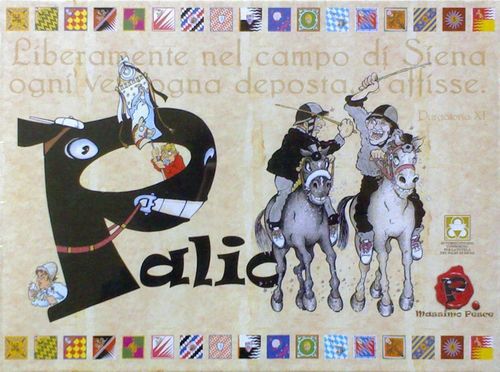
Palio
Palio Rulebook
Table of Contents
Table of Contents
Siena y el Palio
Every summer, on 2 July in honour of the Virgin of Provenzano and on 16 August in honour of the Assumption, the traditional "Palio" is run in Siena in the famous Piazza del Campo. Ten horses ridden "bareback" by jockeys wearing jerseys in the characteristic colours of each Contrada gallop three complete laps of the Piazza. In each Palio only 10 of the 17 Contradas present in the city take part; the 7 excluded (plus 3 drawn at random from the first 10) will take part by right in the race of the following year.
Palio© recreates the atmosphere not only of the "race", but also of the rivalry, expectation and magic typical of this extraordinary and unique event. In reality, to see all the Contradas race in a normal Palio (the Palio of Provenzano or the Palio of the Assumption), you must wait two races in successive years: in fact, ten run in the first year and the other seven (plus three selected at random) run in the following one. For that reason, in the game a normal Palio is considered to consist of two races, while the extraordinary one forms a single race.
Before beginning the selection of the Contradas, the players must decide whether they will contest the normal Palio of Provenzano or the normal Palio of the Assumption (two races), or an extraordinary Palio (one race).
After that, the game is played in the following phases:
- Selection of the Contradas
- The Tratta (assignment of the horses)
- Choice of the jockeys
- Dealing of the "Pact" cards
- The Race, divided into two parts: (The Lanzada (the Mossa) and the race itself)
Components
(Component list as printed in the contents box of the rulebook. Quantities are as printed.)
- 1 Game board (Tablero de Juego)
- 1 Starting board (Tablero de Salida, "Mossa")
- 17 Contrada cards (Tarjetas de Contrada)
- 17 Jockey cards (Cartas de Jinete)
- 10 Horse cards (Cartas de Caballo)
- 17 Contrada cards (Cartas de Contrada)
- 17 Horses without jockey (Caballos sin Jinete)
- 17 Jockeys on horseback (Jinetes a Caballo)
- 54 Pact cards (Cartas de Pactos)
- 1 Red die (Dado Rojo)
- 1 White die (Dado Blanco)
- 1 Black die (Dado Negro)
- 10 Plastic bases (Bases de plástico)
- 3 Palio standards (Estandartes del Palio)
Selection of the Contradas
The city of Siena is territorially divided into Three Thirds (Tercios). The Tercio of the City (Tercio de la Ciudad), the Tercio of S. Martino (Tercio de S. Martino) and the Tercio of Camollia (Tercio de Camollia). The Tercio of the City contains: Aquila, Chiocciola, Onda, Pantera, Selva and Tartuca. The Tercio of S. Martino contains: Civetta, Leocorno, Nicchio, Valdimontone and Torre. The Tercio of Camollia contains: Bruco, Drago, Giraffa, Istrice, Lupa and Oca.
Each player, starting with the youngest, chooses a Contrada card until they run out, and places it in front of themselves.
After the Contrada choice, the first ten are selected: the seven excluded from the first race (first Palio) will take part by right in the second race (the Palio of the following year), together with three drawn at random from the first ten. It may happen that a player, according to the draw, has all, some or none of their Contradas in the first Palio; having more Contradas in the race is an advantage in the tactics to follow, to benefit one's own Contradas (allied Contradas) or to penalise rivals (adversary Contradas).
The Tratta
The Tratta randomly assigns the horses to the ten participating Contradas in the first race. The youngest player takes the deck of horse cards, shuffles it, and deals one to each Contrada. The horse card is placed on the Contrada card, in the appropriate space. As in reality, the game also has strong horses ("Bono") and weak horses ("Brenna"). The first will use for its movement the white die (3,4,4,5,5,6), and the second the black die (3,3,4,4,5,6). As you can see, the dice differ by only two points in the total sum, but over the three laps of the Piazza they represent a considerable advantage.
Source note: the caption beside the "Brenna" illustration in the Spanish rules says Brenna rolls the white die (3,3,4,4,5,6), while the running text says the second horse uses the black die. The running text (black die for the second horse) is followed in the body of the rules; the caption's die colour is left unresolved in the source and should be checked against the original Italian rules or the official English edition.
Jockey
After assigning the horse, it is time to choose the jockey. Each Contrada, in order, chooses the jockey from the 17 caricatures which, with their nicknames, humorously represent the qualities and defects of these characters, so loved and hated by the Sienese. The choice of jockey has no effect on the race and is a purely aesthetic factor. The jockey card is placed on the Contrada card in the space provided for that purpose.
Once each of the ten Contrada cards has been completed with a horse and a jockey, the "Pact" cards may be dealt, and then the race begins with the "Mossa".
"Pact" Cards
These cards actually represent the agreements or pacts that the Contrada Captains celebrate on the days before the Palio in order to influence the outcome of the race. The official regulations prohibit any agreement between Contradas, but everyone knows that they will be made on the eve. Without the "Pacts", the Palio would not be the Palio!
In the game these agreements are represented by penalties or benefits indicated on the card. Each player in the "Mossa" receives nine "Pact" cards, which they may play during the race, against or in favour of other Contradas (pawns) that are to their left or right before starting the turn, or to give it to the Contrada rincorsa in order to facilitate the departure from the "Mossa". Allied or friendly Contradas are the ones you have; adversary Contradas are all the others. Having more Contradas in the same Palio or more "Pact" cards is a great advantage. In fact, it is believed that the more "Pact" cards one has, the greater the chances of winning. The "Pact" card in the "Mossa" can only be played at the moment the rincorsa Contrada enters, when the player rincorsa decides that the start is valid (see the following paragraph). * The rincorsa Contrada is the last horse (the 10th) which, when it enters at a gallop in the "Mossa", marks the start of the race.
Card captions on the "Pact" page of the Spanish rules, as printed: "The effects of 'Pact' cards are cumulative, but a pawn can never move backwards." "The penalties are applied to the dice roll."
La Mossa (the Lanzada)
With the Mossa the start is prepared from the ropes (the two stretched ropes). The small Mossa board is placed on top of the game board so that it coincides with the starting line (fig. 1). The oldest player is the "Mossiere"*, who takes the deck of Contrada cards, removes the 7 excluded and shuffles the rest. He reveals them one by one on the board. This determines the order of entry or calling to the ropes. The player who has the first Contrada revealed rolls the red die and places his pawn on the Mossa board in the first lane on the right, according to the result of the die. Then all the others are placed.
* The Mossiere is the judge who gives the starting signal.
Figure 1 caption as printed: "The Mossa board is used to determine the order of entry of the Contradas, the Contrada of rincorsa and the start. It must be placed so that it coincides with the starting line of the game board." Also: "It is like a magnifying glass over the start."
The last Contrada to be placed is the Contrada of rincorsa. The player who has it is the one who rolls the die, but at that point, seeing the result and taking into account the position of his adversaries in the Mossa, he must decide whether or not to enter the ropes and therefore start the race.
The other players may try to provoke the departure of the player of the rincorsa Contrada by offering him "Pact" cards in exchange (which the rincorsa player will draw at random). If the entry is annulled, the pawns must be placed again and the red die rolled again, respecting the previously established order of the Contradas (in reality the jockeys take their horses outside the ropes and make a new entry).
The player of the rincorsa Contrada may annul the entry to the ropes a maximum of 2 times; the third time, he must necessarily make the start, whatever the result of the die.
At the moment the player of the rincorsa Contrada decides to enter (obviously, he cannot go back), he may use the "Pact" card of the Mossa to penalise or favour other pawns. The effect of a "Pact" card is indicated on the card itself, and the player who holds it may, if he considers it appropriate, use as many as he wishes. When no player has any more "Pact" cards relating to the Mossa to use, the race is considered to have begun.
The Race
First, you must transfer the pawns from the Mossa to the corresponding space on the game board (fig. 2), taking into account the possible bonuses and penalties of the "Pact" cards that have just been played. Remove the Mossa board, because it will not be used again in the race.
Figure 2 caption as printed: "When the Contrada of rincorsa decides to enter, the race begins!"
Figure 2 side notes as printed: "Each pawn is transferred from its current position in the Mossa to its corresponding position on the game board." "Note: if a player has obtained a 6 with the die in the Mossa phase and has a +1 (from a 'Pact' card in the Mossa), apply the +1 at that moment." "Once all pawns have been transferred, remove the Mossa board." "Remember that 2 pawns can never occupy the same space. Conflicts are resolved as indicated on the left."
Movement: From this moment on, the turn always starts with the pawn at the head of the group (the one on the right is always first), and then the others. Each player moves his pawn using the die of his own horse (white die for "Bono" or black die for "Brenna"), as indicated on his horse card, adding or subtracting the penalties or bonuses of the "Pact" cards from the result. Horses may overtake (if there are free spaces) on the right or on the left.
A jockey who cannot complete all of his movement indicated on the die (spaces occupied by other pawns) runs the risk of falling. In that case, he must roll the red die: if it shows 1 or 2, the jockey manages to brake the horse; if it shows 3 or 4, the jockey falls but the horse stays in the race (the pawn is exchanged for that of the riderless horse); if it shows 5 or 6, both the horse and the jockey fall, and the race is over for them. Pawns that manage to brake are placed behind the one that obstructs their path. The riderless horse continues in the race but can no longer use or access "Pact" cards after having lost its jockey.
Each player evaluates the right moment to play "Pact" cards, trying to favour his own Contradas and harm rivals. "Pact" cards may be played at any moment on adjacent horses (in the space to the right or to the left). The effect of the card is applied at the moment the pawn that receives it rolls the die to move. In the dangerous curve of S. Martino and Casato the risk of tripping is high, and therefore of devastating falls.
Winning
The pawn that manages to complete three laps of the Piazza first and crosses the finish line in the Mossa wins the Palio. Siena counts only those who arrive first, and the winner is acclaimed by the jubilant Contradaioli, receiving the Palio or standard.
You have little time to celebrate it, because the next race soon begins (the following year). In that challenge the seven excluded Contradas will take part, plus three chosen by lot from the first ten. The oldest player will be in charge of drawing from the deck of the ten excluded Contradas the three lucky Contradas. The race is carried out following the same system as the previous one (Tratta, Jockey, Pacts, Mossa and Race), and a new winner will be decided, and a new standard will fly from the Palazzo Pubblico.
Extraordinary Palio (Palio Extraordinario)
On certain special occasions an Extraordinary Palio may be called; the formula establishes that the game is played in a single race. The oldest player draws at random the ten Contradas that will take part in the race. In turns, following on with the youngest players, each player draws one Contrada until they run out. From that moment on, the game is played with the normal rules (Tratta, Jockey, Pacts, Mossa and Race), and there will be a new winner and a new standard flying over Siena.
Verse printed on the page as flavour text:
Luck is the queen of the Palio... In the Palio anything can happen... everything can happen, anyone can win... Winning a Palio makes an old man of a young one and turns an old one into a young one...