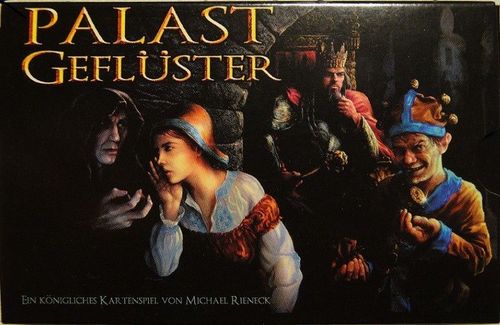
Palastgeflüster
Palastgeflüster Rulebook
Table of Contents
Table of Contents
Components
- 5 player sets of different colors, one per player, each consisting of a king's-favor marker and an arrow card
- 49 character cards: 5 sets of 7 characters in the player colors, plus 2 additional grey sets of 7 characters
- 6 King cards — one for each character except the Spy
Objective
Each player tries to play their cards so that each character appears only once in their own display. If a player fails to do this, all the other players rise in the king's favor and are rewarded. At the end of the game, the player with the most points wins.
Setup
- Give each player a king's-favor marker and an arrow card of one color. Lay the arrow card down first, then place the favor marker on top of it so that it fully covers the arrow card; during the game the arrow card is slid out to point to the player's current number of favor points, starting at 0.
- Assemble the playing deck: take all 14 grey character cards, plus the 7-card set for each color actually in play (with 3 players, 3 color sets; with 5 players, all 5). Character sets in colors not being used are set aside along with their matching player set and are not used this game.
- Shuffle the assembled deck and deal 6 cards to each player, face down. Lay the remaining cards face down in the middle of the table as the draw deck.
- Shuffle the 6 King cards and place them face down as the King deck next to the draw deck.
- The oldest player begins.
Turn Sequence
- On their turn, the active player plays one card from their hand face up in front of themselves, starting or continuing their own display. They then carry out that card's action, unless the action is currently forbidden by an open King card (see King Cards, below).
- The next player to act is whichever player owns the color that matches the border of the card just played. Example: if the played card has a green border, the player with the green set acts next.
- If the played card has a grey border instead, the next player to act is whoever currently has the fewest cards in their own display. If several players are tied for fewest, the player who just played the grey card decides who goes next among them — and may choose themselves, if they are one of the tied players.
Character Cards and Their Actions
Treasurer (Schatzmeister) — The player who plays this card must show all of the cards remaining in their hand to the other players.
Magician (Magier, Zauberer) — The player who plays this card must exchange any number of cards with one other player of their choosing. The player who played the card announces the number of cards to be exchanged before the exchange happens; this number cannot be more than either player's hand size, and at least one card must be exchanged. Each player decides for themselves which of their own cards to hand over. Both players exchange their chosen cards at the same time, face down.
Maid (Zofe) — The player who plays this card discards one card of their choice from their hand, face up, and then draws one card from the draw deck.
Courtesan (Kurtisane) — The player who plays this card exchanges one card each between two other displays of their choosing (not their own), as long as doing so does not create an intrigue (i.e., does not give either display two of the same character). The Courtesan card that was just played cannot itself be one of the exchanged cards. If the Courtesan is the first or second card played in the round, its action does not happen — but the card remains in the display and may trigger its action later if played again in a future round.
Guard (Wächter) — The player who plays this card takes one other card back from their own display into their hand. If their display has no other cards in it yet, the action does not happen, but it can still be carried out later.
Fool (Hofnarr) — Nothing happens when this card is played. It is the only character card that must not be played while a King card forbids it (see King Cards, below).
Spy (Spion) — The player who plays this card reveals the next card from the King deck (see King Cards, below).
King Cards
- As soon as a Spy has been played, that player turns over the top card of the King deck and lays it face up beside the King deck. The character named on that card loses their voice: their action is blocked. That character's card can still be played as normal, but its action will not be carried out.
- Exception: the Fool cannot be played at all while the King has silenced him. If a player is nonetheless forced to play the Fool card (for example, because it is the only card left in their hand), an intrigue begins and the round ends — all other players receive the king's favor.
- An open King card keeps blocking that character's action until a new Spy is played and a new King card is revealed, silencing a different character. Only one character can be silenced at a time.
- If the Spy is played but there is no card left to reveal from the King deck, shuffle the previously revealed King card(s) back into a deck and reveal the new top card.
End of Round
A round ends as soon as one of the following happens. In either case, the action of the very last card played is not carried out.
- Intrigue: A player plays a character card that is already present in their own display, so that display now shows the same character twice. This is an intrigue. All of the other players receive the king's favor and gain 1 point, sliding their arrow card forward one space.
- Full display: A player has 6 different characters in their own display. Only that player receives the king's favor and gains 1 point.
Preparing the Next Round
- Gather up all of the character cards from every display and from the draw deck, and shuffle them together into a new deck.
- Deal 6 cards to each player again, face down.
- The King cards stay exactly as they are; they are not reshuffled or reset between rounds.
- The player who ended the previous round (by causing an intrigue or completing their display) begins the next round.
End of Game
The game ends as soon as one player reaches the number of favor points shown below for the current number of players. That player wins the game and receives the king's reward for loyalty.
| Number of Players | Points Needed to Win |
|---|---|
| 3 | 6 |
| 4 | 5 |
| 5 | 4 |
If two or more players are tied on points when the game ends, whoever has more cards in their own display wins the tie.
Variant: Intrigues in the Dark
Note: This variant increases the chance of a clear-cut winner at the end of the game and rewards more aggressive play.
- You will need a pencil and a sheet of paper.
- Play proceeds exactly as in the base game. Additionally, after every round, write down the number of cards each player has in their display at that moment. For the player who caused the intrigue that round, write down 0 instead of their actual display size.
- As before, the player with the most favor points wins the game. If players are tied on points, the tie is broken by whoever has the highest total of recorded card counts across the whole game.