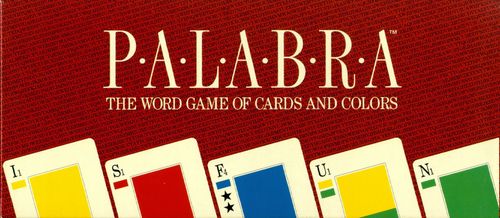
Palabra
Palabra Rulebook
Table of Contents
Table of Contents
Quick Start Rules
-
The object of the game is to outscore your opponents. Cut the cards in the deck to see who goes first. The one closest to "z" begins. (A wild card outranks the "Z." The joker ranks less than the "A.") This person deals seven cards to each player.
-
The dealer forms one of the eight play options as listed on the other side of this sheet, scoring with a word, a straight, a flush, a build, vowels, a Palabra, an exchange or a pass. He places it in front of himself, turning it toward the other players so that they can read it. (It is available to the other players for building, jokering, and shaving until the beginning of his next turn.) He writes down his score, and then draws replacement cards for his next turn, so that he has seven cards again.
For a word or straight add up the number value on the cards used. Cards marked with two stars () or three stars (*) double or triple the number value of the word or straight in which they are used - and also multiply upon each other. (Using a double star card and a triple star card together multiplies the number value by 6. Using a triple star card with another triple star card multiplies the number value by 9.) When making a color-locked word or straight (cards all of the same color), multiply the number value by two, yet again. (For more details, see the rulebook.)
-
The next person to the left takes his/her turn in a similar fashion; also scoring with one of the eight play options. Turns continue, and rotate to the left.
-
At the beginning of his next turn, the dealer places his previous play, the cards still in front of him, into the discard pile. (That play is no longer accessible to the other players and any points still remaining from that play are now completely his.) He then scores by forming another one of the eight play options.
-
Once familiar with the plays, use the pre-plays of jokering or shaving. Laying your joker on an opponent's play cancels it. Then draw one replacement card and create your own play option, as listed above. Shave points by placing a letter, or letters, from your hand near a matching letter in an opponent's word or straight, thus stealing all the points for that letter from the points originally earned in that word or straight - including any increases from the color-lock or star multipliers (as described on the other side of this sheet). Then, draw a replacement card, or cards, and make one of the 8 play options listed above. [It is very common for a 50-point word or straight to be shaved for 40 points by a second player. It is also common for the replacement card(s) to change a worthless hand into an 80-point surprise for the play option that follows.] So jokering and shaving offer two great counterstrategies: canceling or stealing points, and getting new cards.
Overview of Scoring, the Plays and the Pre-Plays
The "star cards" are multipliers. Two stars () double the score. Three stars (*) triple the score. If they're used in the same "word" or "straight" they first double and then triple the score, multiplying the score by six, since 2x3=6. Depending on the combination of star cards, the score can be multiplied by 2, 3, 4, 6, 8, 9, 12, 16, 18, etc. Also, if a "word" or "straight" is all in one color, or "color-locked," that multiplies the score by 2, yet again! (Multicolored cards can be used as either color.) For 2-6 players use a single deck. For 7 or more players, or for double-deck fun, use both a "red deck" and a "blue deck." (Laminated reference sheets, or "cheat sheets," are included in the game.)
The object of the game is to outscore your opponents, using the two parts of your turn:
The Plays (Choose only one of these 8 options.)
- Spelling a "word," such as "TO."
- Making an alphabetical "straight" of three or more letters, such as "ABC" or "PQRS." (Notice how the "Q" doesn't need a "U" or any other vowel for that matter.) Looping around the end of the alphabet is also possible, as in "XYZABC."
- Forming a "flush" of 5 or more cards in one color. A "flush" is a great way to get rid of a "Q," an "X," or a "Z," since a "flush" is usually gibberish and doesn't make a "word" or "straight." (A "flush" scores number value only - without multipliers.)
- "Building" on either end of an opponent's prior "word" or "straight;" such as "building" "TO" into "STOPS" or "ABC" into "YZABCDE." (Add up all the number points, and multiply only by the newly added star cards, and any color-lock if it still applies.)
- "Vowels:" 6 vowels = 20 pts; 7 vowels = 40 pts; any combination, including "Y."
- Spelling a "Palabra," (a seven-letter word using all the cards in your hand) earning an additional 70 bonus points on top of everything else.
- "Exchanging" some or all of your cards with the draw-deck.
- "Passing," when you can't or don't want to do any of the above.
The Pre-Plays (Choose only one, if you can; done before the Plays, listed above.)
- "Jokering," or canceling, an opponent's high scoring play. Draw one replacement card then make one of the 8 play options listed above.
- "Shaving," or stealing, points from an opponent's play, followed by drawing replacement cards, and creating your own play option. (Shaving example: Player #1 ends his turn, creating "CAT." Player #2 shaves Player #1, by putting her "C" and "A" near the original "CAT." The total value of the "C-3" and "A-1" is now subtracted from the score of Player #1, "minus 4," and added to the score of Player #2, "plus 4." If "CAT" involved any color-lock or star multipliers, those would multiply the shave, the "minus 4/plus 4," into "minus 8/plus 8," or "minus 12/plus 12," etc.) Only the prior play can be shaved, and it must be a word or a straight; otherwise it cannot be shaved. Draw replacement cards, and then make one of the 8 play options listed above.