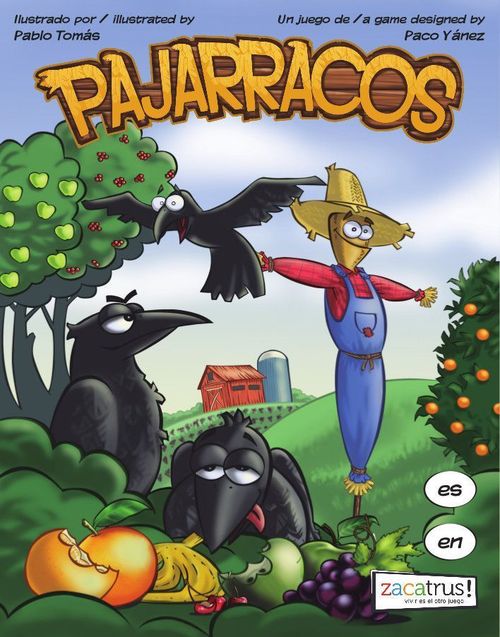
Pajarracos
Pajarracos Rulebook
Table of Contents
Table of Contents
Components
- 45 fruit cards
- 10 scarecrow cards
- 10 crow cards (8 single crows and 2 flocks of crows)
Fruits come in ordinary and juicy kinds. The cards include fruits and berries, but in these rules they are all called fruit cards.
Overview and Goal
Players play fruit cards in their orchards, trying to grow as many fruits as possible on their fruit trees. The goal is to score the most victory points. Points are determined at the end of the game by the number of fruit cards in a player's orchard; the player's largest fruit tree scores points twice.
Setup
Shuffle all the cards and deal 5 cards to each player. Place the remaining cards in the middle of the table as a face-down pile. This is the reserve pile. Leave space next to the reserve pile for the discard pile.
The player who most recently ate a fruit starts the game. After taking their action, a player passes the turn to the next participant clockwise.
Turn
During a turn a player may take one of four possible actions:
- Play a fruit card,
- Play a crow card,
- Play a scarecrow card,
- Discard cards from their hand.
1. Play a Fruit Card
A player may play any number of fruit cards of one kind. To play means to put a card from the hand onto the table. Played fruit cards are placed face up in front of the player, in their orchard.
Fruit cards may be played into your own orchard or into the orchards of other players. Fruit cards of one kind are placed one on top of another so that their number can be seen.
Several cards of one kind laid out in a player's orchard are called a fruit tree in these rules.
When building your orchard, remember:
- each fruit tree must consist of fruits of one kind;
- you may have only one fruit tree of each kind (there are 5 kinds of fruit in the game);
- you may not add fruit cards to a tree that is protected by a scarecrow or attacked by crows.
Juicy Fruits
Juicy fruits are so tasty that they attract the crows that are on the game table. It is very advantageous to place them on your opponents' trees. During a turn a juicy fruit can be played together with cards of ordinary fruits of the same kind.
If there is only one crow card on the game table, it flies to the tree on which the juicy fruit card has just appeared. If there are several crows on the table, the player who played the juicy fruit decides which of them flies to the new tree. If there are no crows on the table, the juicy fruit is played as an ordinary fruit card and does not attract crows that appear in the future.
2. Play a Crow Card
Crows are very greedy and also great lovers of fruit. A player may play one or several crow cards from their hand. They can be placed on other players' fruit trees, but no more than one card on one tree. There are two kinds of crow cards in the game.
Lone Crow
A crow sitting on a fruit tree eats one fruit card at the end of the turn of the player who owns the tree. The eaten fruit card is put into the discard pile. The player has the option to protect their tree with a scarecrow card before the crow eats a fruit. If the player does not protect their tree, the crow will eat one fruit every turn. When the last fruit card is discarded from the tree, the crow card also goes to the discard pile.
Example: at the end of Seryozha's turn the crow eats one fruit card, which goes to the discard pile.
Flock of Crows
The flock of crows acts by the same rules, but eats all the fruits from the tree in one turn. If the player does not protect their tree, then at the end of their turn all the fruit cards of that tree are discarded, together with the flock of crows card.
Example: at the end of Seryozha's turn the flock of crows eats all the fruit cards on the tree.
3. Play a Scarecrow Card
During their turn a player may play one or several scarecrow cards from their hand. With a scarecrow you can protect your fruit trees in one of two ways:
- protect a fruit tree before it is attacked by crows;
- drive away crows sitting on a fruit tree.
1. Protect a Tree
A player may put a scarecrow card on their own tree that has no crows. Crows cannot attack a tree protected by a scarecrow; however, until the end of the game no new fruit cards can be added to that tree either.
2. Drive Away Crows
A player may put a scarecrow card on their own tree attacked by crows in order to drive them away. The player may do this in one of two ways.
Shoo, out of the orchard! The player may put both cards, the scarecrow and the crows, into the discard pile. After this the player gets the right to take one extra turn.
An extra turn allows the player, right after playing one or several scarecrow cards, to take a new turn, during which they may choose a new action.
If a player discarded more than one crow card, they still get only one extra turn.
Shoo, to another tree! The player may move the crow card from their tree to another player's tree. The crows act as usual, but now on the other tree. In this case the scarecrow card is put into the discard pile, and the player's turn ends immediately, even if they had the right to an extra turn.
4. Discard Cards from Your Hand
A player may discard any number of cards from their hand. This ends the player's turn.
End of Turn
After a player has taken one of the actions above, they draw cards from the reserve pile up to 5 in hand and pass the turn to the next player on the left (clockwise).
End of the Game
When no cards remain in the reserve pile, the participants continue playing using only the cards in their hands. The game ends as soon as it is the turn of a player who has no cards left. Crow cards on the trees immediately stop acting.
All players put into the discard pile the cards remaining in their hands, as well as all crow and scarecrow cards from their trees.
Scoring
Players count the number of all fruit cards in their orchard and add to the total the number of cards of their largest fruit tree. If a player has several equally large trees, only one of them is counted.
The winner is the player with the highest total of victory points. In case of a tie, the player with more kinds of fruit trees in their orchard wins. If the tie still remains, play another game.
Scoring Examples
- Seryozha's largest tree is the apple tree; his total is 1+4+3+5x2 = 18 points.
- Olya chose the cherry as her largest tree; her total is 3x2+3+3+2 = 14 points.
- Katya's largest tree is the orange; her total is 4x2+3+2+3+2 = 18 points.
Katya is the winner. Although Katya and Seryozha have the same number of points, Katya has more kinds of fruit in her orchard than Seryozha.