Pai Gow
Pai Gow Rulebook
Table of Contents
Table of Contents
- Type of Game
- Object of the Game
- Description of the Deck and Number of Decks Used
- Tile Values
- How to Arrange the Tiles
- Hand Rankings
- House Way
- Description of Table Used and Total Number of Seated Positions
- Dealing Procedures and Round of Play
- How Winners are Determined and Paid
- Collection Rates Schedule
Type of Game
The game of Pai Gow Tiles utilizes a player-dealer position and is a California game. The position shall be offered systematically and continuously in a clockwise manner around the table after every two (2) hands. The player-dealer shall collect all losing wagers, pay all winning wagers, and may not win or lose more than the original amount wagered. Once the player-dealer's wager has been exhausted, the wagers not covered by the player-dealer shall be returned to the respective players. The gambling establishment does not participate in the actual play of the game and has no interest in the outcome of the play.
Object of the Game
The object of the game is for the player to beat both the high and low hands of the player-dealer.
Description of the Deck and Number of Decks Used
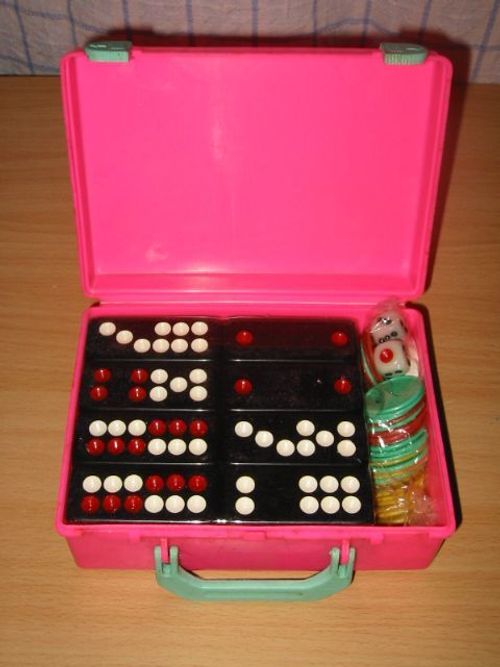
Pai Gow Tiles is played with 32 Chinese dominoes or 'tiles', which form 16 possible pairs.
Tile Values
The value of a hand is based on both the numeric and symbolic ranking of the tiles. To find the numeric value of a tile, count the total of the dots on each tile. Use only the right hand digit value if the total is over 9. Example: A 12-spot tile has a value of 2. The object is to make both your high hand and low hand as close to 9 as possible.
To form a hand, add the total number of spots contained on two tiles, again using only the right hand digit value of any two-digit value. Example: An 8-spot tile and a 9-spot tile have a value of 17 which equals 7. When two hands have the same numeric value, the symbolic ranking of the tile determines the winner. To find which is higher, take the highest ranked tile in each hand and compare them.
When two hands have the same numeric value and identical high tiles, it is called a 'copy' hand. The player/dealer wins all copy hands. When two hands have a numeric value of zero (0), regardless of the high tile, the player/dealer also wins.
How to Arrange the Tiles
- Supreme Pair
- Matched Pairs
- Unmatched Pairs
- Wongs
- Gongs
- Any two tiles that total 9 or less
- Largest tile with the smallest tile
Hand Rankings
The color of the dots has no significance and does not change the value of any tile numerically or symbolically.
Supreme Pair: Jee Goon (shown in the source diagram as a pair of tiles).
Matched Pairs: Any matched pair. (The source shows a diagram for each matched pair.)
Unmatched Pairs: Any of the below mixed pairs. (The source shows a diagram for each: Mixed 9s, Mixed 8s, Mixed 7s, Mixed 5s.)
Wong: Any 2 or 12-spot tile and any 9-spot tile. (The source diagrams show the combinations: a 2 or 12-spot tile with either of two 9-spot tiles, or a 9-spot tile with either of two combinations, joined by "OR".)
Gong: Any 2 or 12-spot with any 8-spot tile. (The source diagrams show the combinations: a 2 or 12-spot tile with either of three 8-spot tiles, or an 8-spot tile with either of three 2 or 12-spot combinations, joined by "OR".)
Single Tile by Ranking: Any combination that totals as close to 9 as possible. The single-tile ranking, in order from lowest to highest, is:
- Teen
- Dey
- Yun
- Gor
- Mooy
- Chong
- Bon
- Foo
- Ping
- Tit
- Look
- Chop Gow
- Chop Bot
- Chop Chit
- Chop Ng
- Jee Goon
House Way
- Most valuable high hand is a pair.
- Split paired Supreme Pair (Gee Joon) if the third tile has 6-spots and the fourth tile has 4, 5 or 6-spots.
- Split 7-spot tiles if hand has a Teen, Dey and the low hand after the split has a value of 7 or higher.
- Split 8-spot tiles if the low hand after the split has a value of 7 or higher.
- Split 9-spot tiles if the low hand after the split has a value of 9 or higher.
- Split the Teen or Dey tiles if the low hand after the split has a value of 6 or higher, or with tiles containing 9 or 11-spots.
- Never split pairs with tiles that have 4, 5, 6, 10 or 11 spots.
Source note: the house-way bullet refers to the Supreme Pair as "Gee Joon", while the hand-ranking diagram calls it "Jee Goon". Both are transcribed as printed.
Description of Table Used and Total Number of Seated Positions
The game shall be played on a standard Pai Gow table that accommodates up to seven players and a player-dealer position for a total of eight seated positions. Within each betting area for each seated player, there shall be one separate betting space specifically designated for one separate base game wager. Each position at the table has a fixed amount for wagering limits defining the minimum and maximum amounts that may be wagered in each position. Players must bet at least the table minimum. Back-line betting is permitted for all wagers, and players may wager on available betting spaces.
Dealing Procedures and Round of Play
Pai Gow Tiles is played with 32 Chinese dominoes or "tiles", which form 16 possible pairs. All players post wagers in the betting circles on the table in front of their position before the dice cup is opened.
The house dealer shuffles the tiles and stacks them in rows, with four tiles face down in each row. Starting with the action button and proceeding counterclockwise, the house dealer then deals four tiles to each player, and to the player-dealer. Players then proceed to set their tiles into two hands; each consisting of two tiles, with the high hand in one stack and the low hand in another. Players may also ask the house dealer to set the tiles in a "house way." Once this is complete, the player-dealer sets his/her hand.
The goal is to make two hands that are both higher than the two hands made by the player-dealer, and as close to 9 as possible.
The game also utilizes an action button to determine which player receives first action on their wager. The player-dealer shakes a dice cup, which contains three dice, and the numerical total of the three dice determines the position of the action button. The player-dealer's position is always one, nine, and seventeen. Other seats, in clockwise rotation around the table, respectively represent the other numbers. If the numerical total of the dice are one, nine, or seventeen, the player-dealer shall receive the first set of cards, regardless of how many players are seated, and the player to the right of the house dealer shall receive the action button.
How Winners are Determined and Paid
All bets are against the player-dealer. A player wins if both hands rank higher than both hands of the player/dealer. If only one hand ranks higher, it is a tie or a "push." If both of the player's hands rank lower than the player-dealer's hands, the player loses to the player-dealer. The player-dealer wins all situations where both hands are identical to the player's hands. The player-dealer can only receive action on the amount wagered and cannot win or lose more than their original wager. Wagers shall be settled in a clockwise manner around the table, starting with the player with the action button. Furthermore, all wagers shall be settled from seat to seat. Wagers are collected or paid, to the extent that the player-dealer's wager covers. Once the player-dealer's wager has been exhausted, the wagers not covered by the player-dealer shall be returned to the respective players.
Collection Rates Schedule
For schedule options 1 and 2, a collection fee shall be taken per round of play from the player-dealer. Only one collection fee shall be taken based on the amount wagered per betting circle, per round of play, from each player. The collection fees shall be collected and dropped by the house dealer at the conclusion of the hand or round of play. The collection fees shall be pre-determined and conspicuously posted on each table prior to any cards being dealt or a round of play commencing. Only one collection schedule option, which utilizes one table limit and the specified collection fees for that table limit, as listed below, shall be used at a table at any one time. Rates may not be calculated as a fraction or percentage of wagers made or winnings earned. Flat fees on wagers may be assessed at different collection rates; however, no more than five collection rates may be established per table. The approved collection fees and schedules for the game of Pai Gow Tiles are as shown below:
| Schedule Option | Table Limit | Amount Wagered Per Betting Circle | Player Collection | Player-Dealer Collection |
|---|---|---|---|---|
| 1 | $10 - $1000 | $10 - $200 | $1 | |
| 1 | $10 - $1000 | $201 - $400 | $2 | |
| 1 | $10 - $1000 | $401 - $600 | $3 | $2 |
| 1 | $10 - $1000 | $601 - $800 | $4 | |
| 1 | $10 - $1000 | $800 - $1000 | $5 |
Source note: in the printed schedule the player-dealer collection amount is shown once per schedule, against the wager bracket in which the source places it ($401 - $600 for option 1, $201 - $300 for option 2). Transcribed as printed.