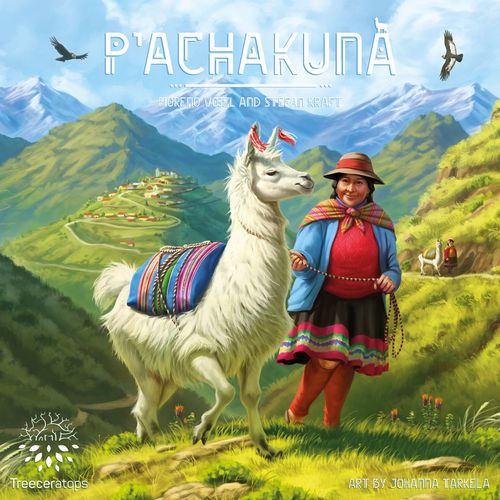
P'achakuna
P'achakuna Rulebook
Table of Contents
Table of Contents
Game Content
- 6 Frame pieces — a village in every corner
- 6 Llamas — 3 per player, 2 colors
- 54 Terrain tiles — 24 neutral tiles, 15 mostly flat tiles and 15 mostly mountainous tiles
- 42 Demands — two-tone, kept in an opaque cloth bag
- 1 White village — for the center of the board
- 3 Wooden rocks — for marking rotated Terrain tiles
- 57 Resources — 8 pieces per color, 7 colors, 1 brown piece
- 1 Assembly plan — for setting up the modular board
Game Setup
Board
The board is set up in the middle of the table. The frame is assembled from the 6 Frame pieces. The Terrain tiles are assembled according to the Assembly plan (Variant A or B). The Assembly plan can be used directly as a base on which the individual Terrain tiles can be placed.
For each village, a Demand is drawn at random from the Cloth bag and put into the corresponding cutout. Demands cannot be the same color as their village, i.e. a red village cannot have a red Demand. If such a Demand is drawn, it is put back into the Cloth bag and a new Demand is drawn. No white Demand may be on the board at the beginning of the game.
Next to the board, the Resources are arranged by color in stockpiles (= General supply).
Player
The players each decide on a color. Each player receives one Llama of their color, which is placed on the central White village with a white Resource on its back. The remaining Llamas are put aside.
The white Llama moves only through the valleys, while the black Llama moves only over the mountains.
White begins. Black gets the one brown Resource, which like all Resources can be used to buy Llamas or additional rotations.
The Game
The players take turns. One turn consists of the following actions, which take place one after the other:
1. Rotate
The player can rotate one Terrain tile at will (0-360°), i.e. change its orientation. Further rotations with other Terrain tiles can be performed by the player spending 2 Resources per additional rotation from their Personal supply. Terrain tiles that are occupied by a Llama cannot be rotated.
After rotating, the player marks all Terrain tiles rotated in this turn with a Rock and removes all other Rocks. Such rotated Terrain tiles marked with a Rock may not be rotated by the opponent in their upcoming turn.
2. Moving
The players must move each of their Llamas at least one Terrain tile – only when on villages may Llamas rest several turns. The Llamas may move to any Terrain tile or village on the board that has an uninterrupted path from the starting point of the Llama (regardless of distance). However, if a village is crossed on the way, the Llama must stay there for the rest of the turn and may not move any further.
With the exception of the villages, Llamas are not allowed to move on the Frame pieces. Villages are accessible to both players and can be entered from 6 directions (central White village) or from 3 directions (villages on the Frame pieces).
Several Llamas may be on one village or Terrain tile at the same time.
3. Trade
For every Llama that rests on a village after moving, the player can trade, i.e. sell Resources, and buy Llamas.
Sell:
If a Llama is on a village that does not have the same color as its Resource, it may now sell the Resource.
There are three different cases:
i. If a Llama has a Resource which is not shown on the Demand flag of the village, it can sell it (i.e. the Resource goes back into the General supply), but it receives nothing in return. The Demand flag of the village is then removed.
ii. If a Llama has a Resource which is shown on the lower/smaller Demand flag, it can sell it. The traded Resource is added to the player's Personal supply. The Demand flag of the village is then removed.
iii. If a Llama has a Resource that is shown on the upper/larger Demand flag, it can sell it and adds 2 pieces of the traded Resource to the player's Personal supply. The Demand flag of the village is then removed.
Since the Demand of a village is removed after each sale, a player can only sell a Resource once per turn in a village.
Removed Demands are placed next to the board and do not return to the Cloth bag.
If, by trading, players receive a Resource that they do not yet have, they put it into one of the 7 cutouts in front of them. Other Resources of the same color are placed in front of the players. Players' Personal supplies consist of both the Resources they have put into the cutouts and the Resources that are placed loosely in front of them.
Buy:
In exchange for 4 Resources from their Personal supply, a player can buy one Llama of their color. The new Llama is placed on the village where it was bought. A player can own a maximum of 3 Llamas. The Llamas are moved independently.
4. Refill
At the end of the turn, missing Demands are renewed by random drawing from the Cloth bag, always following the rule that a Demand must never be the same color as the corresponding village. When the Cloth bag is empty or when there is no valid Demand left, all used Demands are added back into the bag.
In addition, the player equips all the Llamas that have previously sold their Resource or were newly bought with a new Resource matching the color of the village.
End of the Game
The first player with at least one of each of the seven Resources (except for the brown one) wins the game. Resources that are still being transported by Llamas are not counted.
Background
About Natural Dyes
In Quechua, the language of the Andes, the word 'P'achakuna' means 'textiles'. The dyeing of llama and alpaca wool using natural resources has a long tradition in Peru and Bolivia and is still practiced today. With the colored yarns, the local people weave their unique costumes, which differ from region to region. The people are proud of their origins and their colorful clothes decorated with woven patterns and embroidery. The seven villages in P'achakuna each concentrate on one natural dye.
Wool from white llamas, sheep or alpacas serves as the starting point for each colored yarn but is also used undyed. In Quechua white wool is called 'Yuraq Millma'. The colors black and brown, called 'Yana' and 'Ch'unpi', do not have to be created by dyeing either, since they are also available as natural wool colors.
Yellow, called 'Q'ello', is produced from the ball-shaped flowers of the 'Qolle' tree (Buddleja coriacea).
The color orange, 'Killmu', is produced from strips of the deeply orange bark of the 'Yanali' shrub (Bocconia frutescens).
Cochineals (Dactylopius coccus), small insects that live on opuntia (cacti), are crushed to acquire an intense red ('Puka').
The color purple, called 'Kulli', originates from purple corn (Maíz Morado).
From the leaves of the indigo plant (Indigofera tinctoria), a beautiful blue ('Anqas') is obtained.
The color green, called 'Q'omer', is obtained from leaves of the 'Ch'illka' shrub (Baccharis latifolia).
This wide range of natural colors is impressive and showcases the creativity of the local people and their close bonds with their natural environment. And this list is far from comprehensive; each valley has its own dyes, and the colors are also mixed to create new colors or darker and lighter tones. An almost infinite number of color variations can be produced with this precious knowledge.
About Suyana
Suyana is a Swiss NGO fighting against poverty and for a sustainable improvement of the quality of lives all over the world.
In Bolivia and Peru, Suyana has been present for over 15 years with its program for the holistic development of rural communities in extreme poverty, which is developed in direct collaboration with individuals, families, and communities.
This program has become a model for governments in the region, making vital contributions to health, education, economic and environmental development.
Moreover, Suyana empowers people in Bolivia and Peru to produce sustainable and fair products from alpaca wool and other textiles, which Suyana then sells in Switzerland and online.
This is also how the Kickstarter-exclusive bags of P'achakuna were created in collaboration with the organization Luz De Esperanza which helps young people in a poor district of El Alto who previously lived on the streets. Luz de Esperanza gives them fairly paid work, a long-term perspective, and a safe home.
Help Suyana realize its vision of a self-empowered world without poverty. Visit Suyana's website to learn more! www.suyana.ch
About Camelids of South America
The camelids (Camelidae) are a family of mammals that can be divided into two groups. One group, called Old World camelids (Camelini), is found on the African and Asian continents. It consists of the one-humped Dromedary (Camelus dromedarius), and the two-humped Bactrian camel which occurs both in domesticated form (Camelus bactrianus) and in its wild form (Camelus ferus). Domesticated Bactrian camels are widespread, but the wild form is seriously threatened by extinction, with an estimated species count of about 1,000 individuals.
The second group, New World camelids (Lamini), is found in South America. It consists of the four species: Guanaco (Llama guanicoe), Llama (Llama glama), Vicuña (Vicugna vicugna) and the Alpaca (Vicugna pacos).
The seven species differ greatly in size and shape. The difference between the New World and Old World camelids is especially remarkable. With a size of up to 2.3 m (7' 7"), both the Dromedary and the Bactrian camel are almost twice as large as the New World camels. Accordingly, they are also heavier. New World camelids reach a weight of 35 to 200 kg (77 – 441 lb), while Old World camels weigh between 300 and 700 kg (661 – 1543 lb). Another interesting difference is that the New World camelids do not have humps.
However, there are many similarities among camelids, such as their long, graceful necks, their small heads, pronounced split upper lips, and long, slender legs. Unlike most other even-toed ungulates, camelids do not have hooves, but two-toed feet with curved toenails. The toes rest on an elastic pad of connective tissue that forms a broad padded surface.
The evolutionary history of camelids explains why the New World and Old World camelids are located on different continents. It is believed that the first known ancestor of the camelid family, called Protylopus, came from North America 45 million years ago. Fossils indicate that it was smaller than a goat.
Over the next 10 to 25 million years, the camelid family then separated into the New World and Old World camelids. While the group of New World camelids moved towards South America, the group of Old World camels migrated over the Bering Strait, a former land bridge, towards Asia, where they then spread to the north of Africa. From different fossil findings, we know today that over these many millions of years different camelid species evolved and disappeared during this migration process.
When looking at the distribution of each species, we should mention that the Dromedary was not originally distributed in Australia. It is a feral population, imported for expeditionary purposes during the 19th century, that has adapted to life in the Australian desert. Today there are over three hundred thousand individuals and they are considered an environmental concern.
The evolutionary history of the New World camels is also interesting. DNA analysis has revealed that the Guanaco is the wild ancestor of the Llama, while the Vicuña is the wild ancestor of the Alpaca. Humans thus domesticated both the Guanaco and the Vicuña thousands of years ago.
The indigenous people of the Andes have used Llamas as pack animals for centuries. Llamas can carry up to 30 kg (66 lb) over a distance of up to 30 km (18.6 mi). The sole pads on their feet allow them to carry goods over rocky and rough terrain. Their skin is used to make leather, their meat is consumed, and their wool is made into rope, rugs and cloth. Their fat is also utilized to make candles and their excrement is used as fire fuel. For daily life in the Andes, the Llama was and is of great importance.
Alpacas in comparison are mainly used for their dense wool and partly for their meat. However, they are too weak for transporting goods. Their wool is of exceedingly high quality, which is why they are still bred today. Alpaca wool is described as exceedingly fine, and the fibers also insulate better against cold and are more resistant than those of sheep's wool.
About Treecer
Our ambition is to bring to the market products that are creative, unique and sustainable.
Our core values are: Sustainable products, Immersive gaming experience, Reliability.
You can find more products on our store at www.treecer.com.
Thank You!
P'achakuna was funded by 4,588 wonderful people on Kickstarter. We are deeply grateful to everyone for their trust in us, in our vision and in P'achakuna. P'achakuna as it is now in your hands is not only the work of our team, but also to a significant extent the work of these 4,588 people.
If you want to be part of one of our future Kickstarter campaigns, follow us on Social Media or subscribe to our newsletter at www.treecer.com, that way you won't miss a thing.
Terrain Tile Preparation
Before your first game of P'achakuna, you must assemble the Terrain tiles. Here are brief instructions on how to do this:
- On each punchboard (cardboard plate) you will find the parts that belong together. The numbering on the individual parts shows you which mountain element must be stuck to which valley tile.
- Place the sticker on the circle on the back of the mountain element and press it down firmly.
- Remove the protective foil and stick the prepared mountain element onto the valley tile with the same number. It is important that the mountain element is at roughly the same distance from all the edges (1 mm = 0.04") and does not protrude.
- If you have problems sticking parts together, there are several replacement parts (R) and 6 additional stickers in the box.
- If you are still unsure how to prepare the Terrain tiles, check out the short demonstration video available on the publisher's website.
Follow the QR code in the printed rulebook to download the rule book in other languages. You will also find the Assembly plan for printing in case you need a new one.