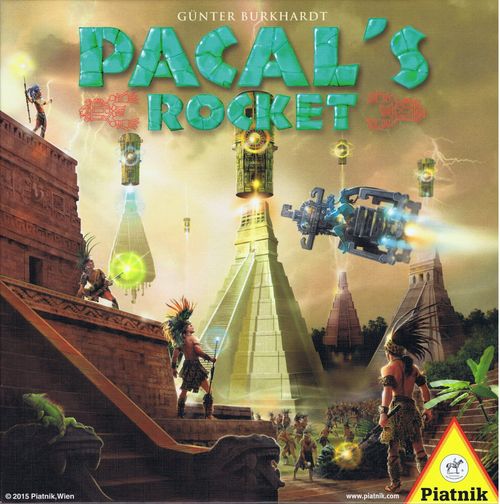
Pacal's Rocket
Pacal's Rocket Rulebook
Table of Contents
Table of Contents
Object of the Game
The goal is to collect the most points by strategically building pyramids in the districts of the city of Palenque.
Components
- 1 game board: shows Palenque, divided into 16 districts of differing values, a river, a lake, and a scoring track
- 55 pyramids, 11 in each of 5 colors: 1x one-story, 3x two-story, 3x three-story, 2x four-story, 2x five-story
- 5 spaceships, hollow inside so that energy stones can be dropped into them
- 5 overview boards
- 15 god stones, 5 each with the value 2, 4 and 6
- 3 cover pieces for making the playing area smaller
- 55 triangular energy stones, 11 in each of 5 colors
- 1 special die
Setup
- The game board is placed in the middle of the table.
- Each player chooses a color and receives in that color:
- all energy stones and pyramids; one stone is placed immediately on the first space of the scoring track
- 1 spaceship
- 3 god stones: one each with the value 2, 4 and 6
- 1 overview board
- A starting player is determined. He receives the die. The game then proceeds clockwise.
- Beginning with the starting player, each player in turn places his spaceship on any space in the holy district with the value 7 in the middle of the game board.
- Important: If fewer than five players are playing, the playing area is made smaller. To do this, one or more districts are covered with the cover pieces:
- With two players, the cover pieces 2 and 2/3 are used to cover the corresponding districts as shown in the illustration.
- With three players, the cover piece 2/3 is used, and with four players the cover piece 4, to cover the corresponding district as shown in the illustration.
These rules apply to 3 to 5 players. A special rule for two players and for experts is at the end of these rules.
Course of Play
- The starting player rolls the die. He then places the die, with the rolled result facing up, on the stone space of his overview board. This way it is always clear who rolled, because the die result applies to ALL players in this round. Only when every player has had a turn does the die pass to the next player. That player rolls and thereby determines the new die result for the next round. Note: The starting player of a round is always the last player of the next round. This can be important later when building pyramids!
- The player whose turn it is carries out his turn, which consists of the following actions, performed in this order:
- Move spaceship (mandatory!)
- Drop in energy stone(s)
- Build pyramid
- Collect points
- After a player has finished his turn, the next player takes his turn.
The Actions in Detail
1. Move spaceship
The player whose turn it is must move his spaceship according to the die result. To do so, he first lifts his spaceship so that any energy stones that may be inside it remain on the space from which he moves his spaceship away. The spaceship may be moved as follows:
If a number of pips is rolled, the player may choose:
- Move his spaceship in a straight line in ONE direction (without turning!). Moving forward and then back again is not allowed. Moving diagonally is not allowed either. If his spaceship meets an obstacle (another spaceship, the edge of the board, the lake, or a pyramid), it stops in front of it, and the excess pips are forfeited. Energy stones are not obstacles; the spaceship may be moved over them. A player who chooses this option may afterwards bring two energy stones into play (see point 2).
- Turn at right angles with his spaceship as often as he likes. In this case the rolled number of pips must be traveled in full. Stopping in front of an obstacle is not allowed; it must be driven around. Exception, dead-end rule: If the player moves his spaceship onto a space that is surrounded by obstacles on three sides, the excess pips are forfeited. A player who chooses this option may afterwards bring only one energy stone into play (see point 2).
If the symbol with the arrows is rolled, the player may move his spaceship in ONE direction any number of spaces along the row or column in which it is currently standing. Moving forward and then back again is not allowed. Obstacles do not matter here; the spaceship may be moved over them. Afterwards the player may bring two energy stones into play (see point 2).
God stone: Instead of moving, the player may use one of his god stones and then gives it up. He may then place his spaceship on any free space on the game board. In this case he may again bring only one energy stone into play (see point 2). Note: Unused god stones are worth 2, 4 or 6 additional points in the final scoring at the end of the game! Attention: It can happen that the player's own spaceship is surrounded only by obstacles and the player can no longer move it. In this case he must use a god stone. If he has none left, and only then, he must place his spaceship on any free space on the game board, but afterwards he may not drop in an energy stone (see point 2).
In general:
- In the first round, each player must leave the holy district with his spaceship in a straight line. The option of turning at right angles with his spaceship is only allowed from the second round on.
- A spaceship may be moved onto a space on which one or more energy stones already lie.
2. Drop in energy stone(s)
Depending on how the player moved his spaceship, he may either
- bring two energy stones into play. To do so he takes two stones and drops one into his own spaceship and one into any opponent's spaceship, OR
- bring only one energy stone into play. He may only drop this one into his own spaceship.
Only one energy stone per color may be on each space. Players must therefore remember where they dropped their stones. When a spaceship is moved, the energy stones remain on the space from which it is moved away. Should it happen that two stones of the same color are on one space, they are removed from the game board and returned to the corresponding player. He may use these stones again in a later turn.
A player may also choose not to drop in any stones.
If a player has no energy stones left in front of him, he may during his turn take back his own freely lying stones from the game board, but must reuse them immediately.
3. Build pyramid
As soon as a player's energy stones lie visibly on the game board in a certain constellation, a new pyramid may be built:
- A one-story pyramid with one energy stone.
- A two-story pyramid with two energy stones lying directly next to each other horizontally or vertically. Building is not allowed if the stones lie diagonally or if one or more empty spaces lie between the two energy stones.
- A three-story pyramid with three energy stones in a line, whether horizontal, vertical or diagonal. One or more empty spaces between the energy stones are allowed, but only if the number of empty spaces between the individual stones is always the same.
- A four-story pyramid with four energy stones in a line, whether horizontal, vertical or diagonal. One or more empty spaces between the energy stones are allowed, but only if the number of empty spaces between the individual energy stones is always the same.
- A five-story pyramid if four energy stones form a square. Here too one or more spaces between the individual energy stones are allowed, as long as the number of empty spaces between the individual stones is always the same.
The overview board shows the possible constellations.
The following rules apply to building pyramids:
- The player may choose on which space he builds the pyramid. He first places the pyramid on a space with an energy stone of the constellation concerned. Then he removes all of his own energy stones of that constellation, places them in front of him, and may use them again in later turns.
- If the player chooses a space on which stones of other colors also lie, these are returned to the corresponding players. Example: The player with the green pieces wants to build a three-story pyramid. If he builds on A or B, he then removes only his 3 own energy stones of this constellation. But if he builds on C, the yellow and the blue stone are removed as well.
- To build a new pyramid, a player may also use one or more of his own, already built pyramids like energy stones. These are then not removed after the pyramid is built like an energy stone, but may remain standing. It is important, however, that the constellation must contain at least one energy stone, since a new pyramid may only be built on a space with an energy stone. Example: The player wants to build a pyramid. The two-story pyramid is included like an energy stone. The player may now build a new four-story pyramid (e.g. on A).
- Upgrading a pyramid: This means that an already built pyramid may be replaced by a higher pyramid. For this the player again needs a valid constellation that allows him to upgrade to the desired height. (Note: several of his own, already built pyramids may also be used for this, but the constellation must contain at least one energy stone, which is removed after upgrading.) Example: The player wants to upgrade his two-story pyramid on space C. The existing constellation allows him to replace it with a three- or four-story pyramid. He decides on a four-story pyramid and then removes all energy stones of this constellation. Had he decided on a three-story pyramid, however, he could have left either the energy stone on space A or the one on space D, since he needs only three stones to build a three-story pyramid.
- There is no obligation to build when a constellation lies on the game board.
- A player may build only one pyramid during a turn.
- If a player no longer has a certain type of pyramid, he may instead build a lower pyramid, provided he still has one.
4. Collect points
If the player builds a pyramid, he receives points for it immediately. To do so he must either
- be the first in a district to build a pyramid there, OR
- take over the majority in a district. For this, the stories of all of his own pyramids are added together.
Whoever fulfills one of these conditions may immediately move his stone forward on the scoring track at the edge of the playing area by the value of this district.
Attention: A player who already has the majority in a district and builds a further pyramid in the same district does not receive points again, since he already holds the majority and is not taking it over. However, if two or more players share the majority in a district and one of these players builds a new pyramid there, he thereby takes over the sole majority and collects points for it.
End of the Game
The game ends when either
- a player builds his second-to-last pyramid. The game ends immediately, and this player receives 5 bonus points, which he may move forward with his stone on the scoring track, OR
- a player reaches the following points with his stone on the scoring track: 40 points with 3 players, 35 points with 4 players, 30 points with 5 players.
In this case the round is played to the end. There are no bonus points, unless a player still manages to build his second-to-last pyramid. Then he receives the 5 bonus points, which he may move forward with his stone on the scoring track, and the game ends immediately.
Final Scoring
First all spaceships and energy stones (except those on the scoring track) are removed from the game board. They are worthless. Then proceed as follows:
- Scoring of river and lake: This concerns the marked spaces as shown in the illustration. For the majority at the river and lake, 12 / 8 / 4 points are awarded for places 1 / 2 / 3, which the players may move forward with their stones on the scoring track. In case of a tie, the points of the corresponding places are added together and divided equally among the players. With an odd number, round down. Example: Yellow has built pyramids with a total of 8 stories at the lake, Violet and Green pyramids with a total of 6 stories each. Yellow receives 12 points; Violet and Green share 8+4 points, i.e. each receives 6 points.
- Scoring of the individual districts: In the districts, points are only ever awarded for 1st and 2nd place. Whoever holds the majority in a district moves his stone forward on the scoring track by the value indicated in that district. The player in second place may move forward 2 points. If there are two or more first places, all players concerned may move their stone forward on the scoring track by the value of the district. There are no points for 2nd place in this case. If there are two or more second places, all players concerned may move their stone forward two spaces. Note: For a better overview, pyramids that have already been scored may be taken off the game board.
- Scoring of the god stones: Finally each player receives points for his unused god stones (2, 4 and 6), which he likewise may move forward with his stone on the scoring track.
The player who has scored the most points with his stone on the scoring track after the final scoring wins.
The Game for 2 Players
The two-player game is played as described above, but with the following difference: The players roll the die alternately, each for himself. The game ends as soon as a player has reached 45 points with his stone on the scoring track.
The Game for Experts
The game is played as described above, but with the following added difficulty: New pyramids may only be built with energy stones, but not including already built pyramids of one's own. Exception = upgrading one of one's own pyramids. That is: if ONE of one's own pyramids is used in a constellation, it MUST be replaceable by a higher pyramid.