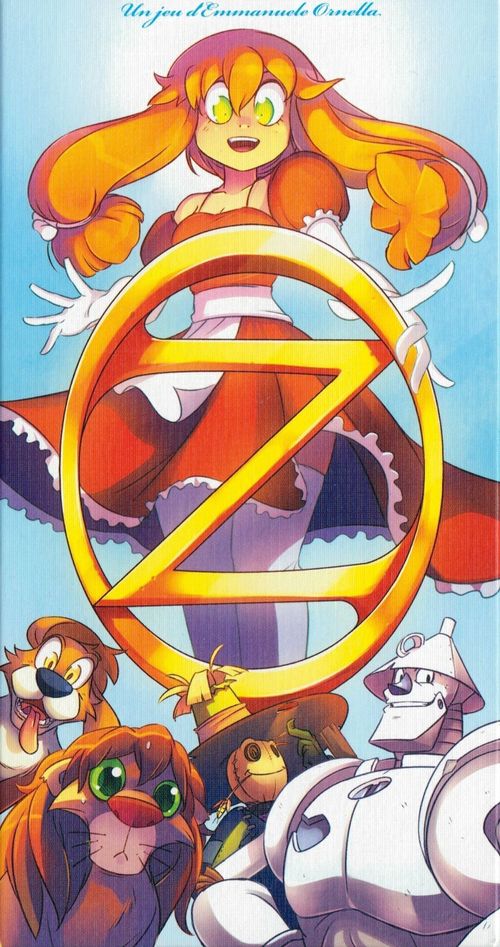
Oz
Oz Rulebook
Table of Contents
Table of Contents
Components
- 1 first player token
- 72 Character cards (8 characters in 9 copies each)
- 48 Story cards
- 1 rulebook
Goal of the Game
Each game round, each player chooses two Character cards and one Story card. The Story cards represent objectives that must be compared to the Character cards at the end of the game. The player who scores the most points wins the game.
Rules of the Game (3 players)
One player is designated first player and receives the first player token. He shuffles the Character cards and draws 8 of them, which he lays out face up in 4 columns of 2 cards. He shuffles the Story cards and draws 4. He places one Story card face up under each column of Character cards (see the diagram: a draw pile in the middle, players 1, 2 and 3 around the table).
Game Round
The first player then selects one of the 4 columns. He takes the two Character cards into his hand and places the Story card face up in front of him. It is then the turn of the player on his left to choose a column: he proceeds like the first player. The round continues in this way until each player has selected a column, placed the Character cards in his hand and the Story card in front of him.
End of the Round
The cards remaining in the middle of the table are discarded. The first player then passes the first player marker to the player on his left. This player becomes the new first player. A new round begins (the new first player sets up 4 columns of cards as before and chooses one, then the round continues).
Story Cards
A player may not have more than 4 face-up Story cards in front of him. From the fifth round onward, and for all following rounds, he must therefore turn face down either one of the Story cards taken in previous rounds or the Story card he has just taken.
End of the Game
The game ends after 9 rounds. Each player therefore has 18 Character cards in hand and 9 Story cards in front of him (4 face up and 5 face down). The face-down Story cards are discarded. Each player then reveals his Character cards and counts the points he obtains through his Story cards (see "Presentation of the Story cards").
Note: the Character cards in a player's hand can be used to score points on several Story cards (see the example below).
The player who scores the most points wins the game. In case of a tie, the tied players are declared winners.
Scoring Example
At the end of the game, Philippe has in hand: 4 Dorothy, 4 Lion, 3 Oz, 3 Toto, 2 Scarecrows, 1 Glinda and 1 Witch. He reveals his cards and counts his points with the 4 Story cards that are face up in front of him:
- the 2 points for each Dorothy+Lion pair card earns him 8 points (4 pairs);
- the Lion majority card earns him 5 points (he has as many Dorothy as Lion, but in this case the points are still valid);
- the 1 Scarecrow maximum card earns him nothing (2 Scarecrows);
- the Oz 3 points / Witch -1 point / Glinda -1 point card earns him 7 points (3 Oz x 3 points, -1 point for his Witch card and -1 for his Glinda card).
In total, Philippe therefore scores 20 points.
2-Player Variant
The game is identical to the 3-player game with the following adjustments:
- at the start of the game, remove 3 Character cards of each type (that is, 24 cards);
- lay out 3 columns (2 Character cards and 1 Story card);
- the game ends after 8 rounds (instead of 9).
4-Player Variant
The game is identical to the 3-player game with the following adjustments:
- lay out 5 columns (2 Character cards and 1 Story card);
- the game ends after 8 rounds (instead of 9);
- in the last round, use the 2 remaining Character cards as well as 8 other Character cards discarded during previous rounds.
Presentation of the Story Cards
The Story cards allow players to score points at the end of the game. Each card shows a text taken from the tale (left page of the grimoire) and the conditions for scoring points (right page). There are 9 different types of Story cards and, for each type, several Story cards (for example 1 point per Lion, but also 1 point per Scarecrow, etc.). The list below presents one card of each type:
- The player scores 1 point for each "Lion" card in his hand.
- The player scores 2 points for each pair of "Dorothy" + "Scarecrow" cards in his hand.
- The player scores 3 points for each pair of "Toto" cards in his hand.
- The player scores 4 points for each set "Dorothy" + "Lion" + "Scarecrow" + "Robot" in his hand.
- The player scores 2 points if he has one triple "Dorothy" + "Toto" + "Oz". He scores 7 points if he has 2 triples and 12 points if he has 3 triples; a 4th triple scores no points.
- The player scores 4 points if he has 0 or 1 Robot card in his hand.
- The player scores 5 points if the "Witch" cards are the most represented (most numerous) in his hand. If he has as many cards of another type as "Witch" cards (for example 4 "Witch" cards and 4 "Dorothy" cards), he still scores the points.
- The player scores 8 points if no other player has more "Glinda" cards than he does (he scores the points if another player has as many "Glinda" cards as he does).
- The player scores 3 points for each "Oz" card in his hand. He loses 1 point for each "Glinda" card and each "Witch" card in his hand.