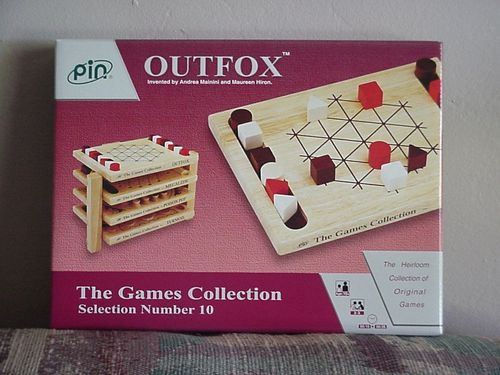
Outfox
Outfox Rulebook
Table of Contents
Table of Contents
Components
- 1 game board
- 18 game pieces (2 identical sets of 9 pieces)
Note: each set contains a square, a triangle and a circle in each of the three colours.
Goal of the Game
Finish your turn by aligning three pieces, EITHER three different shapes of the same colour, OR three identical shapes of three different colours. The pieces of a winning line must be next to each other.
- Example, one shape in three colours: a winning line.
- Example, three shapes in one colour: a winning line.
Warning: a line of three pieces of three different colours AND three different shapes is NOT a winning line.
Not winning: three aligned pieces must be EITHER of the same colour, OR of identical shapes.
Does not win: a winning line of three pieces never contains two identical pieces.
Playing the Game (2 Players)
Each player has 9 pieces: 3 shapes in each of 3 colours. All pieces are placed on the game board, face up.
To begin, a player places a piece on one of the intersection points. Note: pieces can only be placed on intersection points. The players then take turns alternately.
On your turn, first place a piece, then move a neighbouring piece. Your turn is then over.
When you place a piece, place it next to a piece that has enough space around it to be moved. That piece may "fly over" the board in a straight line, of any length, but it must not pass through an occupied intersection point.
Place first: a piece is placed, then a neighbouring piece is moved.
Then move: the neighbouring piece moves in a straight line over empty space; it may not pass through an occupied intersection.
Note: if no pieces surround an intersection point, it is then impossible to place a piece on that point, since no piece can then be moved.
Illegal placements:
- Illegal placement: no neighbouring pieces. A piece cannot be placed on an intersection point that has no neighbouring pieces.
- Illegal placement: the neighbouring pieces cannot be moved anywhere else. A piece cannot be placed where its neighbouring pieces have no legal move.
Likewise, if pieces completely surround an intersection point and cannot be moved in any direction, it is impossible to place a piece on that point.
At the end of each turn, the players check whether the board contains a winning line.
Note: a line of three pieces with three shapes is not winning if a piece still has to be moved. If one of the pieces of a three-shape line must be moved to finish the turn, then the turn is not won and the game continues.
Non-winning moves: a line of three shapes that must be broken before the end of the turn does not count.
The Winner
The winner is the player who, at the end of a turn, has a line of 3 pieces: EITHER three identical shapes in three different colours, OR three different shapes in the same colour. The three pieces must be next to each other.
It does not matter which player placed the pieces originally, or which player moved them afterwards.
Basic winning moves:
- Placing a piece to obtain a winning line.
- Moving a piece to obtain a winning line.
- Combining two moves in one turn to form a winning line.
If the game can no longer be played, the player who played LAST wins.
Variant for 3 Players
The game is the same as for two players, except that each player starts the game with all the pieces of one single colour.
Have fun!