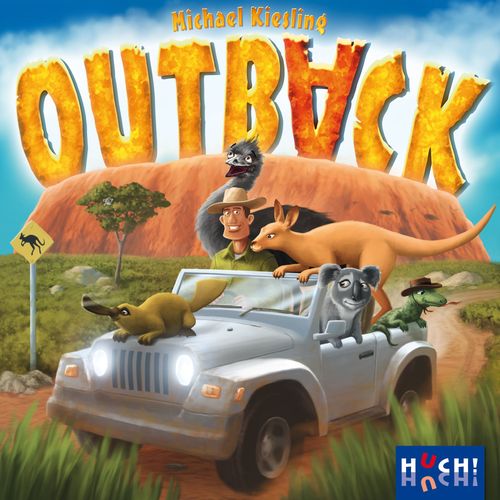
Outback
Outback Rulebook
Table of Contents
Table of Contents
Aim of the Game
Arrange the animals in your Outback landscape in such a way that you gain as many points as possible. Matching animals are worth more points when they are next to one another than when they are by themselves. But be careful! The scoring track along the top of the board starts back at 1 point again, and you only get points for your last 3 animals on the scoring track on the left side of the board.
4 Outback landscapes. Your Outback. Place your animals on the hexagonal spaces. The upper scoring track runs along the top of the board, with bonus spaces for different types of animals. The left scoring track runs down the left side of the board.
Contents
1 jeep. Animals arrive in the Outback with the jeep. Throughout the course of the game take animals from the jeep and put them in your Outback landscape. Beside each row in your landscape is a number. These numbers indicate how many of the same animal symbol you have to roll to be able to lay an animal in that row.
90 animal tiles. There are 18 tiles of each animal (Emu, Kangaroo, Koala, Platypus, Monitor lizard), front and back.
20 bonus tiles. There are 4 bonus tiles for each animal (1 set for each player). Note: There are another 14 bonus tiles and 4 scoring tiles needed only in the Plus version of Outback, which are explained at the end of these game instructions.
7 animal dice (1 of which is only for the "Outback Plus" version). Each animal appears once on each die. One symbol is the joker symbol.
1 cloth bag.
20 scoring markers. There are 4 scoring markers for each animal (1 set for each player).
1 start player marker.
Game Setup
Put the jeep in the middle of the table so that everyone can reach it. Put all the animal tiles in the bag and mix them up. Then take out of the bag 5 tiles without looking at them, laying them on the designated spaces in the jeep.
Have the 6 animal dice ready. The seventh die is not needed for this game.
Each player receives one Outback landscape, 5 scoring markers (one of each animal type) and 5 bonus tiles (one of each animal type).
Put the landscape with the 5 bonus spaces in front of you on the table. Put the scoring markers in the inlet next to -3 on your landscape. Put the bonus tiles next to your landscape for now; you will need them later on in the game.
Have the start player marker ready, which will be given to the start player at the beginning of the game.
Put all the remaining game materials back into the game box. You do not need them for this game.
How to Play
Roll the dice to see who goes first. The player with the highest number of matching animals gets to go first and puts the start player marker in front of him on the table. Jokers do not count when rolling to see who goes first.
Each player takes turns in a clockwise direction.
Is the jeep full? On your turn, first look at the jeep to see if there are 5 animals in it. If not, fill the designated spaces with new tiles, which you pull out of the bag. You are not allowed to look in the bag when pulling them out!
How to get an animal from the jeep. You want to add animals to your Outback landscape. When doing so, there are a few things to keep in mind: Beside each row in your landscape, there is a number. The number indicates how many of the same animal symbol you have to roll to be able to lay an animal in that row. You can use the joker symbol on the die to represent any one of the animals, but you cannot use it on its own without another animal symbol. Depending on what you roll, you can lay 1, 2 or even 3 animals in your Outback on your turn.
Example: On her first attempt, Anna rolls 3x Koalas, 1x kangaroo, 1x platypus and 1x joker. She keeps the 3 koalas and the joker, putting them off to the side. She then rolls the remaining dice again. Now she rolls 1x emu and 1x joker. She is satisfied with the result and passes on her third roll. She arranges her dice into two groups: 3x koalas + 1x joker = 4x koalas and 1x emu + joker = 2 emus. She then takes 1 koala tile and 1 emu tile from the jeep and puts the koala in the row with the number 4 and the emu in the row with the 2. She lays the emu on the space to the far left and the koala on the space to the far right of their respective rows. This gives her enough room on her following turns to lay more emus and koalas next to them.
Rolling the Dice
On your turn, roll all 6 dice. You can roll the dice up to 3 times on your turn. After each roll, you can keep 1 or more dice, which you will later use to take animals from the jeep. You can also add dice that you kept from your previous roll back into the mix for the next roll.
Important! Pay attention to which animals are in the jeep, because these are the only animals you can put into your Outback. If, for example, there are no kangaroos in the jeep, it won't do you any good to collect dice with the kangaroo symbol on them.
Laying Animal Tiles in Your Outback Landscape
Once you have rolled the dice 3 times (or fewer if you were already satisfied after the first or second roll), match the dice with the animal(s) in the jeep that you want to take. Then take the animal(s) and lay them on any one of the spaces in the corresponding row.
After laying the tiles in your Outback landscape, fill the empty spaces in the jeep again by pulling tiles out of the bag without looking at them.
No Matching Animal Symbols?
If after 3 attempts of rolling the dice you do not roll the matching animal symbols that you need to be able to take animal tiles from the jeep, you're out of luck. Pull out a tile from the bag and lay it facing down on any space in your Outback landscape. This space is now blocked and can never be occupied by an animal. At the end of the game, you get 2 minus points for every blocked space in your landscape.
Scoring
You get points for all the animals you were able to put in your Outback landscape during this round. For each new animal, you get to move your scoring marker of the corresponding animal 1 point ahead along the scoring track.
If the new animal is next to another of its kind or a group of animals of the same kind, you receive an additional point for each of these animals.
Example: Julie was able to put 2 animal tiles in her Outback. She laid a monitor lizard next to another monitor lizard that was already in her Outback and a platypus next to a group of platypuses. For the monitor lizard, Julie gets 2 points: 1 point for the new animal tile and 1 point for the animal tile already in her Outback. Julie was able to lay her platypus next to a group of multiple platypuses and gets 1 point for the new platypus tile and 1 point each for every other platypus in the connected group. For the lone platypus not in the group she does not receive any points. By laying the new platypus, she has formed a group of 4 platypuses. She gets a total of 4 points for the group.
The Scoring Track
The scoring track is divided into two parts, one on the left and one at the top. Scoring starts on the left scoring track. Once a scoring marker reaches the end of the left scoring track, it continues along the upper scoring track. The upper scoring track starts at 1 again, but don't let that worry you. At the end of the game, points for the left scoring track are awarded only for the last 3 scoring markers, i.e. the 3 animal scoring markers closest to the bottom. That means, it is worth it to have 2 animals on the upper scoring track at the end of the game.
Note:
- When receiving points for an animal for the first time, move the corresponding scoring marker from the -3 inlet to the 1. Ignore the other -3 inlets.
- Once your scoring marker reaches the end of the upper scoring track, leave it there. Remaining points are forfeited.
Bonus Tiles
If you manage to place 3 animals of the same kind in your Outback, take the bonus tile corresponding to the respective animal type and place it on the first free bonus space on your Outback landscape. For the first bonus tile, you get 1 point, for the second, 2 points, for the third, 3 points, for the fourth, 4 points, and for the fifth, 5 points. Immediately move the respective scoring marker ahead on the scoring track.
End of Game
The game is over when someone has occupied all the spaces in his landscape. The round is played out until each player has had his turn. The round is over once the player to the right of the start player marker has finished his turn; the player with the start player marker does not get another turn.
And the winner is... Each player counts his points. Add up the points of your last 3 scoring markers on the left scoring track and all the points of all your scoring markers on the upper scoring track.
From this subtotal, subtract 2 points for every blocked space in your Outback landscape (spaces occupied by face-down tiles).
The player with the most points wins. In the event of a tie, the involved player with the most bonus tiles wins. And if it is still a tie, these players share the win.
Example: Sabina receives points for the last 3 scoring markers on the left scoring track as follows: -3 points for the koala, 2 points for the monitor lizard, 5 points for the emu. For the kangaroo, she doesn't receive any points, unfortunately, because it is not among the last 3 scoring markers. Sabina also receives points for all of her scoring markers on the upper scoring track. On the upper scoring track, she has only one scoring marker, the platypus, for which she receives 8 points. -3 + 2 + 5 + 8 = 12 points. Since she has one turned-over tile in her landscape, she has to subtract 2 points. Her total is thus 10 points.
Alternative End to Game
Keep playing until everyone has occupied every space in his respective landscape. Each player who has completed his landscape has finished the game and can sit back and wait for the others to finish. Everyone else most points wins! In the event of a tie, the player with the most bonus tiles wins. And if it is still a tie, these players share the win.
Plus (Variant)
For this game variation, some of the rules change.
Game Setup
In this version, you will also need:
- the other bonus tiles
- the seventh die
- possibly the 4 scoring tiles, if you want to play according to the scoring version (see end of the game instructions)
In this version, you no longer need:
- the bonus tiles for the basic game
Set up the game as described above. However, lay the Outback landscapes with the bonus spaces facing down. Place the 14 additional bonus tiles in the playing area so that everyone can see them.
Note: If you want to, you can also play with less bonus tiles. If so, simply turn over all the bonus tiles, so that the back is facing up. Shuffle the tiles and select any 5 of them. Turn the selected tiles back over again so that everyone can see them. The remaining tiles are not needed for this game.
Hint: It is recommended to sort the bonus tiles according to kind so that you have a better overview when playing.
How to Play
Play as described above in the basic game, but this time roll all 7 dice instead of 6. The bonus for three animals of the same kind no longer applies. But, at the end of every turn, look to see if you qualify to receive one or more of the available bonus tiles. To receive one of the tiles you have to meet the given criteria. If you meet the criteria, take the bonus tile and place it face down in front of you on the table.
Note: There is only 1 of each bonus tile, once it has been taken, it cannot be taken by anyone else.
Bonus tiles:
- The first player to complete the indicated row by occupying all its spaces with animals receives the points shown on the tile. If there are turned-over tiles in the row, the player does not qualify for the bonus tile.
- The first player to have 5 animals of one kind in his landscape (they do not have to be connected) receives 2 points.
- The first player to complete his landscape receives 3 points.
- Whoever no longer has a scoring marker on the starting position with the -3 receives 2 points.
- The first player to move 2 scoring markers onto the upper scoring track receives 2 points.
End of Game
The game ends just as it does in the basic game. Add up your points from the scoring tracks and the blocked spaces. Then turn over your bonus tiles and count up their points. Add them to your subtotal. The player with the most points wins! In the event of a tie, the player with the most bonus tiles wins. And if it is still a tie, these players share the win.
Scoring Version for Blocked Spaces
Before starting the game, shuffle the 4 scoring tiles face down and then turn over the top tile. This tile applies for the entire game. The other 3 tiles can be put back into the game box.
Play as described in the rules for Outback Plus until the end of the game.
When scoring the blocked spaces (the spaces with the turned-over tiles on them), you no longer have to merely subtract 2 points, there are now stricter rules! Depending on the scoring tile, you now get the following minus points:
- For each blocked space, you receive 3 minus points.
- For each blocked space, you receive as many minus points as indicated on the right side of the corresponding row. So, if the turned-over tile is in the 4th row, you get 4 minus points.
- For this scoring tile, the neighboring animals play a role. For each neighboring animal, you get as many minus points as shown on the scoring tile. So, if a koala bear is next to the blocked space, you receive 2 minus points. If there are multiple koala bears next to the tile, you receive 2 minus points for each koala bear!
- This tile works just as the previous one, but with different minus point values.