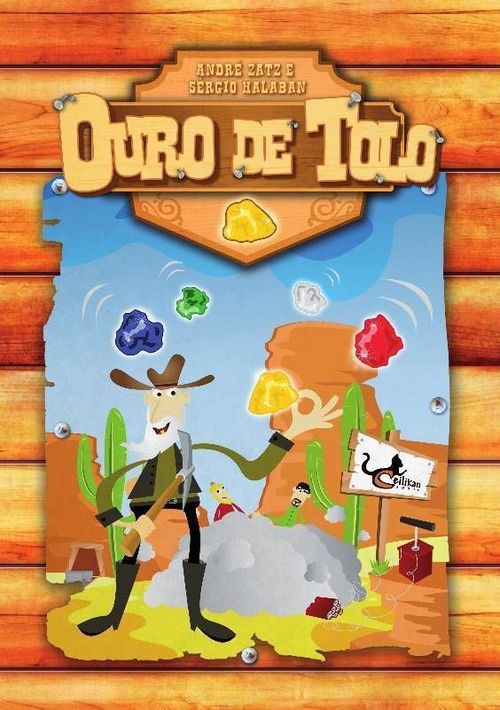
Ouro de Tolo
Ouro de Tolo Rulebook
Table of Contents
Table of Contents
Components
The game contains:
- 70 stones in resin, in 7 different colours:
- 20 Ouro de Tolo (Fool's Gold) stones
- 15 Quartz gems ($1)
- 12 Amber gems ($2)
- 10 Emerald gems ($3)
- 7 Sapphire gems ($4)
- 4 Ruby gems ($6)
- 2 Gold nuggets ($8)
- A deck of cards, consisting of:
- 12 "Dynamite" cards
- 10 "Do Me a Favor" cards (Me faz um favor)
- 9 "Light Hand" cards (Mão leve)
- 8 "Not Mine" cards (Isto não é meu)
- 2 "Not Mine Either" cards (Nem meu)
- 3 "Very Light Hand" cards (Mão levíssima)
- 3 "I'm Tired" cards (Estou cansado)
- 6 auxiliary cards
- Money
- 1 TNT bag
- 1 rulebook
Component note: the back of the game cards shows the Ouro de Tolo logo on a wooden background; the back of the auxiliary cards shows a mine entrance under the words "Fora da Mina" (Out of the Mine).
Objective
The objective of Ouro de Tolo is to become the richest player at the end of the game by mining precious stones, and by using a few cards up your sleeve.
Setup
Each player takes one auxiliary card, which they use to mark the stones they have picked up and also to indicate whether they are inside or outside the mine. Remove the remaining auxiliary cards from the deck. The auxiliary card is placed in front of the player as shown in the manual's diagram.
Shuffle the remaining cards and deal them to each player according to the table below:
| Number of players | Cards per player |
|---|---|
| 6 | 5 |
| 5 | 5 |
| 4 | 4 |
| 3 | 3 |
Put all the stones into the bag. Separate the money notes and sort them by value. The game begins with the last player to have taken part in a Gold Rush; in case of a tie, the youngest player starts, and takes the bag into their hand.
Quick Guide
The manual's quick guide (Guia rápido) repeats the setup and turn structure in summary form.
Setup: Put the stones in the bag. Give each player an auxiliary card. Deal cards according to the table below.
| Number of players | Number of cards | Desired amount |
|---|---|---|
| 6 | 5 | 50 |
| 5 | 5 | 55 |
| 4 | 4 | 60 |
| 3 | 3 | 65 |
Turn a card from the deck face up to be the insurance bonus. The game starts with the last player to have taken part in a Gold Rush, or the youngest.
Playing: On your turn you may:
- Draw a stone: take a stone from the bag for yourself. Check whether it is not your second Ouro de Tolo.
- Play a card: play any card from your hand that can be used on your turn (wooden border).
- Leave the mine: turn your auxiliary card to show that you have left the mine for this workday.
You may perform only one of the three actions described. If at any time you hold two Ouro de Tolo stones in your hand, you suffer an accident and must stop working for the day (turn your auxiliary card).
Note as printed: the quick guide says "You will not be able to trade your stones for money at the end of the day." This line conflicts with the full rules, which describe trading valuable stones for money at the end of each workday (see "End of the Workday" below). It is transcribed as printed.
You will not be able to trade your stones for money at the end of the day. Outside your turn you may only play a card in response to a card that another player has played against you.
Playing the Game
A game is played over several rounds, and each round represents one workday in the mine. At the end of each workday, players receive money according to what they managed to mine that day.
At the start of each round, a card from the deck is turned face up. This card is the "insurance bonus", and it is given to the first player who leaves the mine, if that player chooses to leave.
On your turn, you must choose one of the three possible actions while there are other players in the mine with you. If you are alone in the mine, you have other choices to make, which are explained below. On your turn you may:
- Draw (mine) a stone from the bag.
- End your turn and leave the mine for the day.
- Use one of your cards.
Drawing a Stone from the Bag
When a player chooses this action, they draw a stone from the bag without looking at its contents. The stone drawn may be an Ouro de Tolo stone (black) or a valuable stone (coloured). At the start of each round the ratio is 5 valuable stones for every 2 Ouro de Tolo stones. The player sees which stone they drew.
- Valuable stone: Very good. The player picks up the stone and places it around their auxiliary card, so that the stone is easy to identify. If the player manages to leave the mine safe and sound, at the end of the round they receive the money value of the stone.
- Ouro de Tolo: Not everything that glitters is gold, and this time you were unlucky. An Ouro de Tolo stone does not mean any risk in itself, but if at some point you receive a second Ouro de Tolo stone, you have risked far too much for nothing, and you must abandon the mine in a hurry, leaving behind all the riches you accumulated during the day.
Ending Your Day
Ending your day means you have weighed the riches you have already accumulated for today against the risks of continuing in the mine, and have decided to stop working for today and trade the riches you have accumulated for money. If you are the first player to leave the mine in this round, take the bonus card.
Turn your auxiliary card face up to show all players that you have stopped working for the day. When all players have finished their turns for the round, you may trade your jewels for their value in money.
Note 1: You are entitled to the bonus card only if you chose to leave the mine. If you had to leave because of a second Ouro de Tolo stone, you must leave the card for the next player who leaves the mine.
Note 2: If you have drawn a stone or played a card from your hand, you cannot end your day in the same turn; you must wait until your next turn.
Playing a Card
Instead of drawing a stone or ending your day, you play a card from your hand. There are two kinds of cards: those that may be played on your own turn, which are marked with a dark tab, and those that may only be played as a response to another player's card, which have a light tab. In total there are seven different types of cards. Four of them can be played during your turn, and the remaining three can only be played in response to another player.
Note: When you play a card, you use your turn, and you cannot end the day or draw a stone (other than the action described on the card). You must wait until your next turn to choose another action.
Card Types
- Dynamite: Allows you to draw three stones from the bag at once. If any of the stones drawn is Ouro de Tolo (black), return it to the bag; the valuable (coloured) stones you keep for yourself.
- Do Me a Favor (Me faz um favor): When you use this card, choose any player who is still in the mine. That player must draw two stones. After looking at the drawn stones, you may take one of them for yourself and leave the other for the player who drew them, or leave both for the player who drew them.
- Note: this card allows a player to receive Ouro de Tolo stones outside of their turn. If they receive their second Ouro de Tolo stone this way, they are immediately out of the round, under the rules for a second Ouro de Tolo stone.
- Light Hand (Mão leve): Choose any other player who is still in the mine and steal two of their stones.
- Not Mine (Isto não é meu): Choose another player who is still in the mine and pass them one Ouro de Tolo stone that you hold.
- Note: this card allows a player to receive Ouro de Tolo stones outside of their turn. If they receive their second Ouro de Tolo stone this way, they are immediately out of the round, under the rules for a second Ouro de Tolo stone.
Response Cards
Besides these, there are cards that you play when someone tries to use one of the cards above against you. To use them, you must discard the card at the moment another player chooses you as the target of one of those cards. They are:
- I'm Tired (Estou cansado): Use against "Do Me a Favor". You do not have to draw the two stones, cancelling the other player's action.
- Very Light Hand (Mão levíssima): Use against "Light Hand". In addition to not handing over two of your stones, you take one stone from the other player.
- Not Mine Either (Nem meu): Use against "Not Mine". Choose another player who is still in the mine to receive the Ouro de Tolo stone instead of you. It is possible to use this card to avoid holding two Ouro de Tolo stones at the same time.
All cards, once used, are immediately discarded.
Tip: New cards are very hard to come by, so be very careful not to waste any card.
The Caxias
When a player is the last one inside the mine, whether because the others left or because of accidents, that player is called the Caxias. If the "insurance bonus" card is still available, discard it: the Caxias is not entitled to it for working alone in the mine. The Caxias has two options instead of the usual actions of the game:
- Buy a card from the deck: the Caxias takes a face-down card from the deck and adds it to their hand, and the workday ends.
- Draw stones from the bag: the Caxias draws one stone at a time from the bag until they hold two Ouro de Tolo stones, or until they decide to end their workday.
Note 1: No card can be used at this point, while one player is alone in the mine.
Note 2: If the player chooses to draw stones from the bag, they cannot buy a card, even if they draw only one stone.
Note 3: If the Caxias draws a second Ouro de Tolo stone, they also lose all the stones accumulated in their hand and end their workday.
End of the Workday
When the Caxias ends their workday (or suffers an accident), the mine is empty. Then those who left the mine without suffering an accident, and who did not lose their stones, may trade their stones for money.
Each player who was involved in an accident with two Ouro de Tolo stones must take all of their stones and return them to the bag, receiving nothing for them.
Then each player who left the mine without suffering an accident must trade their valuable (coloured) stones for their value in money, and then return all of their stones to the bag. The money received must be kept hidden from the other players.
After all trades have been made and all stones returned to the bag, the players begin a new workday. The first player of the new workday is the Caxias of the previous day. Do not forget to turn over another card from the deck, which becomes the "insurance bonus".
The values of the valuable stones, as printed in the manual's end-of-day table, are:
| Stone | Value |
|---|---|
| Amber | 1 |
| Emerald | 2 |
| Sapphire | 3 |
| Ruby | 4 |
| Diamond | 6 |
| Gold | 8 |
Note as printed: this table does not match the component list, which gives Quartz $1, Amber $2, Emerald $3, Sapphire $4, Ruby $6 and Gold $8. The table also lists a "Diamante" (Diamond) stone, which does not appear in the component list. The table is transcribed exactly as printed and has not been corrected; the discrepancy should be checked against a physical copy.
Sidebar summary (as printed): every player holding two Ouro de Tolo stones returns their stones to the bag without gaining anything in exchange. The other players trade their valuable stones for their values in money. Money is kept hidden from the other players. Valuable stones are also returned to the bag. Turn over one more card for the insurance bonus, and the Caxias starts the new workday.
End of the Game
The game continues day after day in the mine until, at the end of a workday, a player declares that they have more money than the desired amount for that game. This declaration may only be made after all players have made their trades of stones for money for the day, but before the next workday begins.
The desired amount depends on the number of players:
| Number of players | Desired amount |
|---|---|
| 6 | 50 |
| 5 | 55 |
| 4 | 60 |
| 3 | 65 |
A player who has more money than the desired amount may choose not to declare it, extending the game if no other player declares it.
Tip: If you are not sure whether you are the player with the most money, it may be worth not making the declaration, and seeing whether you can be the richest player after one more workday.
Each player then counts the money they have earned up to that point, and the richest player is the winner of the game.
Note: The winner is not the player who declared reaching the desired amount, but the player who, after the count, has the most money.
Sidebar summary (as printed): A player with more money than the desired amount of the game declares that they have more money. All players count their money, and the richest one wins the game.
Variants
- Shorter or longer games: If you wish, you may play a shorter game (with a lower desired amount) or a longer one (with a higher desired amount).
- Hard week: Instead of a fixed desired amount, you can see which player has the most money after a fixed number of days. This can be a week, more or less time, according to your preference.
- Safe mine: A player does not lose their stones when they draw a second Ouro de Tolo stone; they are only obliged to leave the mine for that day. This variant is recommended only for young children.
- Gold fever: Each player takes only half of the cards (rounded up) at the start of the game. But whenever a player ends their workday, they buy a face-down card from the deck. This card is in addition to the insurance bonus and to the Caxias card, so one player may receive two new cards on the same day. This variant makes the use of cards more intense.