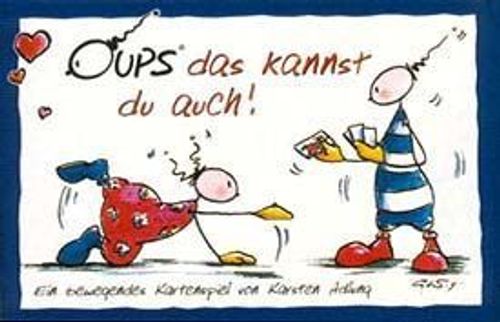
Oups das kannst du auch
Oups das kannst du auch Rulebook
Table of Contents
Table of Contents
Game Equipment
60 cards:
- 30 different postures and movements presented by OUPS
- 30 postures and movements identical to OUPS' – presented by OUPSINCHEN
- 1 Rules of the game
OUPS and OUPSINCHEN
(Finding matching movements / postures)
For 2 – 8 players aged 5 years and up.
Preparation
- Shuffle all 60 cards and place them on the table, face down, forming a rectangle (for example 6 x 10 cards). If necessary, eliminate difficult OUPS and OUPSINCHEN cards first.
How to Play
- The youngest player starts. He turns over a card (for example with OUPS) and looks for the corresponding OUPSINCHEN card. This card must show exactly the identical posture or realize the same movement respectively.
- Note: In the game, there are no identical cards. Only the posture and the movement matter!
- If the player turns over an OUPSINCHEN card first, he has to look for the corresponding OUPS card.
- If the second card does not match the first one, the player turns both cards back over and the next player takes their turn.
- If the player finds two matching OUPS and OUPSINCHEN cards, he can keep them. Afterwards, he continues to look for pairs for as long as he keeps finding matching pairs.
- Then, it's his left neighbour's turn to look for matching cards.
End of the Game
- When all pairs are found, the player who has collected the most cards wins the game.
WHERE IS OUPSINCHEN?
(Quickly looking for matching movements / postures)
For 2 – 8 players aged 6 years and up.
Preparation
- Separate the OUPS cards from the OUPSINCHEN cards and shuffle the two decks separately.
- Place the OUPS cards' deck in the centre of the table, face down, and distribute the OUPSINCHEN cards freely around the deck, face up and without shuffling them.
How to Play
- One player turns over the first card of the deck and places it on top of the deck, face up. Immediately, all players look for the corresponding OUPSINCHEN card together – that is, the OUPSINCHEN card that shows OUPSINCHEN in the identical posture or making the same movement as OUPS.
- If a player thinks that he has found the matching OUPSINCHEN card, he puts his hand on it.
- If the card matches, he may take the OUPS card from the deck and places it in front of him on the table, face down. The OUPSINCHEN card remains on the table.
- If the card does not match, it remains in its position. This player may not continue to look for the matching card. All other players continue until it is found.
- Afterwards, the next card is turned over and all players look again for the matching card together.
End of the Game
- The first to collect 5 OUPS cards wins the game.
OUPS, WHAT IS HE DOING?
(Showing and recognizing movements / postures)
For 2 – 8 players aged 7 years and up.
Preparation
- Separate the OUPS cards from the OUPSINCHEN cards and shuffle the two decks separately.
- Place the OUPS cards' deck in the centre of the table, face down, and distribute the OUPSINCHEN cards freely around the deck, face up and without shuffling them.
How to Play
- The youngest player looks at the first card from the deck without letting anyone else see it and then imitates what OUPS is doing on the card. For example, if OUPS is lifting his left arm, the player also has to lift his left arm. All the other players immediately and simultaneously look for the corresponding OUPSINCHEN card that shows OUPSINCHEN doing exactly what the player does.
- If a player thinks that he has found the card, he immediately places his hand on the corresponding OUPSINCHEN card. There can only be one hand on a card.
- Once a player has chosen an OUPSINCHEN card, his hand must remain on it even if he thinks that another card is better.
- As soon as each player has put his hand on a card or nobody wants to choose a card any more, players verify if the right card has been found.
- If a player has found the matching card (compare the OUPSINCHEN card with the posture / movement shown by the player), he may keep it.
- Finally, compare the posture or movement presented by the player with the OUPS card. If it matches, this player also may keep his card. Otherwise, he has to place it on the bottom of the OUPS deck of cards.
- Then, it's the player's left neighbour's turn to show the posture / movement on the next OUPS card.
End of the Game
- As soon as each player has played OUPS three times, the game is over.
- The player with the most cards wins.
OUPS, YOU CAN DO IT TOO!
(Describing and reproducing postures / movements)
For 2 – 10 players aged 8 years and up.
Preparation
- Separate the OUPS cards from the OUPSINCHEN cards and shuffle the two decks separately.
- Place both decks in the centre of the table, face down, forming two separate stacks.
How to Play
- The youngest player starts.
- He draws the first card from the OUPS deck and looks at it.
- He then describes exactly what OUPS is doing on this card to a player opposite him. For example, if OUPS is lifting up his left arm, the player must also lift up his left arm.
- The player opposite him tries to imitate exactly what the first player describes. If he succeeds (compare with the card), he receives the OUPS card. The first player receives any OUPSINCHEN card from the deck.
- If the player does not manage to imitate it, he does no receive a OUPS card.
- If the first player does not correctly describe the card and the player opposite him has done everything in the first player's description, he receives the OUPS card. In this case, the first player does not get anything.
- Afterwards, the player's left neighbour draws the first OUPS card from the deck and becomes the new first player. He describes the card to the player opposite him (that is the player who sits left of the player to whom the last card has been described).
End of the Game
- Continue playing in this way until each player has described 3 cards.
- The player with the most cards wins.
I AM OUPS AND YOU ARE OUPSINCHEN
(Imitating shown movements / postures)
For players aged about 4 years and up.
This game is perfectly suited to an adult and a child, the age of whom will depend on the child's stage of development. In this game, it is not a question of collecting cards, but of imitating and playing OUPSINCHEN's role.
Preparation
- You only need the OUPS cards.
How to Play
- The adult chooses one card and acts out OUPS' exact posture or movement.
- The child imitates the adult's posture or movement exactly.
- You also can change roles, so that the child acting out the postures or movements and the adult imitates them.
WHAT ARE YOU SEEING?
(Looking for different motifs)
For players aged about 2 years and up.
This game is perfectly suited to an adult and a child.
Preparation
- Place all the cards in any order on the table, face up, one next to another. (You may also only use a part of the cards.)
How to Play
- The child decides what he wants to search for (for example hearts, snails, butterflies and so on) and places the cards that he finds in front of him on the table.
- The game becomes more difficult if the child has to look for hearts, snails, butterflies etc. in their respective positions (in front of, behind, on top of, under). The child could, for example, look for all motifs that are situated in front of OUPS and OUPSINCHEN.
Card Descriptions
(x) = crossed exercises • (II) = parallel exercises
Postures
OUPS / OUPSINCHEN
- 1 / 60 (x) – Bend the right leg, left hand on the right knee; right arm stretched forwards.
- 2 / 59 (x) – Bend the left leg, right hand on the left knee; left arm stretched forwards.
- 3 / 58 (II) – Bend the right leg, right hand on right knee; left arm stretched forwards.
- 4 / 57 (II) – Bend the left leg, left hand on left knee; right arm stretched forwards.
- 5 / 56 (x) – Lift up the left foot backwards and hold it with the right hand behind the back; left arm stretched forwards.
- 6 / 55 (x) – Lift up the right foot backwards and hold it with the left hand behind the back; right arm stretched forwards.
- 7 / 54 (x) – Stretch the left leg forwards, right hand takes hold of the left foot.
- 8 / 53 (x) – Stretch the right leg forwards, left hand takes hold of the right foot.
- 9 / 52 (x) – Left leg forwards, bend the knees slightly; right arm stretched forwards, left arm hangs straight down.
- 10 / 51 (x) – Right leg forwards, bend the knees slightly; left arm stretched forwards, right arm hangs straight down.
- 11 / 50 (x) – Stretch the right leg sidewards, bend the left knee; stretch the left arm upwards to the left, the right hand touches the ground.
Movements
(Paint figures in the air, pay attention to the body's centre axis!)
- 23 / 38 (x) – Paint a lying figure eight with both hands, starting top left.
- 24 / 37 (x) – Paint a figure eight with the left hand, starting top left.
- 25 / 36 (x) – Paint a figure eight with the right hand, starting top left.
- 26 / 35 (x) – Paint a figure eight with both hands, starting top right.
- 27 / 34 (x) – Paint a figure eight with the right hand, starting top right.
- 28 / 33 (x) – Paint a figure eight with the left hand, starting top right.
- 29 / 32 (II) – Paint a house with both hands, begin above and paint simultaneously from top to bottom.
- 30 / 31 (II) – Paint a heart with both hands, begin above and paint simultaneously from top to bottom.