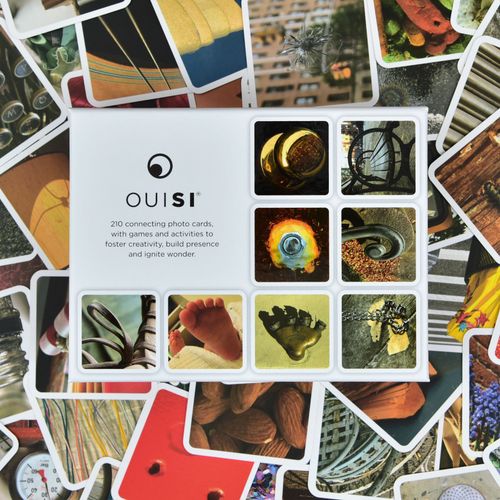
OuiSi
OuiSi Rulebook
Table of Contents
Table of Contents
Quickstart
Grab a stack of photo cards and start making "visual connections" based on shapes, colors or patterns. Have fun with it; at this stage there's no right or wrong answer.
If you are exploring with other players, "play" off each other's card like you might in dominoes. Not sure about a connection they made? Ask them!
Don't feel like reading this guide at all? Head to go.ouisi.co/games where you'll find videos about how to play OuiSi games and activities.
OuiSi Connections
OuiSi connections happen between cards that match in some kind of visual way. Perhaps they have a similar shape, color, pattern or even concept! Each card connects with many others in the set, often in more than one way. It really all depends on your unique imagination.
The guidebook illustrates four kinds of connection: Shape, Color, Composition & Pattern, and Concept (for example, "Lock & Keys").
Index of Activities and Games
Creative Play (ages 4+). The rules in this section are flexible. Make them your own by finding new ways of playing, or use them as building blocks for unconstrained play. Ages 4 to 104.
- OuiSinoes
- OuiSi Imaginate
- OuiSi Trainmaker
- OuiSi Storybuilder
- OuiSi Scavenger
- OuiSi Eye Spy
- OuiSi Draw
Competitive Play (ages 10+). Challenge your visual acuity.
- OuiSinoes
- OuiSi Capture
Unconstrained Play. Explore with imagination.
Mindfulness. Less screens, more noticing.
- OuiSense
- OuiFeel
OuiSi Learning and Exploring Safely.
Creative Play
The rules in this section are flexible. Make them your own by finding new ways of playing, or use them as building blocks for unconstrained play. Ages 4 to 104.
1. OuiSinoes ("we-see-nose")
Make photo-card connections in this engaging take on dominoes. Like a great conversation, everyone wins as each person adds something thoughtful to the growing board.
Basic Play
- Place one card in the middle of the playing surface.
- One at a time, add cards to the board based on how each new card visually connects with already played cards (see OuiSi Connections).
- Cards can be drawn from a communal image-up pile. Or, deal ten cards at a time to each player (and draw a new card after you play one).
- Play alone or with friends.
Types of Board Matches
- Cards must match any and all adjacent cards. Placing a card next to two cards (B and C below) increases the difficulty.
- Simple connect (A): The card placed matches with just one other card.
- Intersecting connect (B): The card is placed at the intersection of two other cards, matching both.
- Corner connect (C): The card placed fits square with two other cards, matching both.
(Diagram in the guidebook shows examples A, B and C on a board of cards.)
2. OuiSi Imaginate
Each card in the deck looks like something else. It's kind of like when the clouds overhead look like a herd of sheep. The guidebook gives three examples: guitar strings or a running track, a mooring or a boar's head, a coin in tar or the moon rising over mountains. Imaginate can be combined with other activities in the Guide like Storybuilder and Draw.
Basic Play
- Take turns selecting a card from the deck and place it image-up so that everyone can see.
- Each player imagines what else that image might be. Discuss with each other what you see.
- Option: write down or draw what you see, and compare answers.
- Enjoy everyone's wonderful imagination!
3. OuiSi Trainmaker
Build a "train" of images one at a time, with each image connecting to the one prior (see OuiSi Connections). Have fun with the train shapes you make, from spirals to one long line. There are so many connection possibilities that you'll never make the same train twice.
Basic Play
- Place any photo card photo-up on your playing surface to start your train, and place the remaining cards photo-up beside the playing surface.
- Build your train by choosing any card from the pile that connects with the latest card played, and add that card to the end of the train. Keep going until you run out of matches, cards, time or space!
4. OuiSi Storybuilder
Choose cards as prompts to craft your next written or verbal adventure. Use the Imaginate activity to come up with ideas from each card. Stories can be created on your own or with friends. The guidebook's example uses the card of a guitar-strings-or-running-track image: "Gary the wild boar is running a marathon but stops to pick up a nickel on the road. Unfortunately the coin is stuck in tar! He has a choice to make..."
Basic Play
- Choose five or more cards from the deck and spread them out photo-up.
- In a journal, start to write down observations and ideas about what you see in each card.
- Connect your observations and ideas to the characters, setting and plot of your story.
- Once you think you have the basics of your story together, begin writing the whole thing!
Optional Play
- Option 1: Create an impromptu story by pulling one card at a time instead of pulling all cards at once:
- Pull just one card and go through steps 2 to 4.
- When you've finished writing based on that card, pull another one and again go through steps 2 to 4.
- Keep alternating between pulling cards and writing until your story is finished!
- Option 2: Based on an old game called Exquisite Corpse, take turns telling an improvised story:
- The first player pulls a card and begins telling a story out loud based on that card.
- The next player pulls a card and then continues to tell the story, adding on from the previous player.
- Continue until all players have had at least one turn (or more).
5. OuiSi Scavenger
Explore your world for OuiSi connections using the photo cards as prompts. Scavenger is great for mindfulness, photographers and for curious kids! (See OuiSi Connections.)
Basic Play
- Choose any photo card from the deck.
- Look for something in your surroundings that connects with your chosen card.
- Find a new card in the deck that matches what you just found in your surroundings.
- Continue back and forth between steps 2 and 3. Feel free to document the hunt using a camera (great for parents looking to introduce technology as a creative tool).
The guidebook's example: starting with a photo card of a piano, the players matched it to piano keys, then to typewriter keys, then to a crossword (letters), then to some fencing with yarn-flowers (grid pattern), and finally to real-life flowers.
6. OuiSi Eye Spy
Eye Spy is a fun take on the game I Spy ("with my little eye") and is a great option on a road trip, a walk or even around the house!
Basic Play
- Choose any photo card from the deck.
- Find something in your environment that connects visually (see OuiSi Connections).
- Have friends guess what you've spotted! Give them a clue, like "this is made of..." or "this starts with the letter..."
- The player who guesses correctly chooses the card in the next round.
7. OuiSi Draw
Turn the spark of a photo card into a full-blown drawing. Draw alone or with friends.
Basic Play
- Choose a card, and imagine it as just a snippet of a much larger picture or scene.
- Place the card on a sheet of paper (in any spot you like) and draw the rest of the picture.
The guidebook's example: a picture of a bridge is expanded and imagined with more trees, rocks and a river.
OuiSi Imaginate Version
- Note that in OuiSi Imaginate (see above), players "imagine" what else an image might be. For example, the mooring that also looks like a boar's head or the coin that looks like the moon.
- Using a similar approach, choose a card and imagine what else the card could be.
- Now, imagine that card as part of a larger image. Place the card anywhere on a page and draw the remainder of the picture.
The guidebook's example: the picture of a bridge is reimagined as part of a bouquet of flowers.
Optional Play
- Each player in a circle takes a photo card from the top of the deck.
- Using a timer, spend two minutes drawing the rest of an imagined scene based on that card.
- Each player passes their card to the left, repeating step 2. Continue until the original card returns to each player. Present the drawings!
Competitive Play
Ready to test your visual skills against others? Give the competitive version of OuiSinoes a try. Or, team up against a common opponent in OuiSi Capture.
8. OuiSinoes
In this winner-takes-all version, make photo-card connections (a "match") that wow opponents in the style of dominoes (see OuiSi Connections). Find an uncompetitive and collaborative version of OuiSinoes in the Guide to Creative Play.
- Players: 3 to 7.
- Time to play: about 20 minutes.
- Ages: 10 & up.
- To win: get to five points, one for each winning match. Optional: increase the game length and matching opportunities by increasing the winning point goal.
- Additional items: a token (e.g. a coin) for each player.
Initial Set-up
- Place a stack of cards (photo-down) and the tokens beside the main playing surface.
- Choose who will play the Judge for the first turn.
- The first Judge takes ten cards from the top of the deck and places them image up.
- The Judge selects two cards from the face-up images that connect with each other (this match is at the Judge's discretion). Place the pair side-by-side in the middle of the playing surface.
- Place the remaining eight cards in the discard pile. Deal or draw ten cards per player, face down.
Play
- The Judge is "blind" (closes eyes, or uses a blindfold) for the turn while remaining players act.
- One at a time and beginning with the player to the left of the Judge, players match one of their cards with a card(s) on the board, placing their card beside that card. (See "Notes for Matching" and "Types of Board Matches" below.)
- Players place a random token on their played card (showing the Judge which cards have been played).
- Once all players finish, the Judge opens their eyes or removes the blindfold.
- The Judge surveys all matches made by the other players and chooses the match they like best (the Judge can move played cards out of the way to assess each match). This is at the Judge's sole discretion. Players must not reveal which answer is theirs until the Judge has chosen a winner. The winning card earns that player one point.
- Remove the tokens from all the cards. Remove the losing cards from the board and add to the discard pile. The remaining cards on the board become the starting point for the next round.
- All players (except the Judge) draw a new card from the deck.
- The player to the left of the current Judge becomes the new Judge for the next round. Continue until one player wins by reaching five points (or more, if chosen ahead of time).
Notes for Matching
- Players can only match with cards on the board before the turn began. In other words, cards can't be played off of other new cards played in the turn.
- If more than one player wants to put their card in a particular spot, stack the cards. The tokens will indicate that there are multiple cards in a spot.
- "Best" connections are subjective. Try to learn how different Judges reward connections.
Types of Board Matches
- Cards must match any and all adjacent cards. Placing a card next to two cards (B and C below) increases the difficulty.
- Simple connect (A): The card placed matches with just one other card.
- Intersecting connect (B): The card is placed at the intersection of two other cards, matching both.
- Corner connect (C): The card placed fits square with two other cards, matching both.
(Diagram in the guidebook shows examples A, B and C on a board of cards.)
9. OuiSi Capture
In Capture, all players work together against a common opponent represented by a penalty pile. Players take turns giving a one-word clue that visually describes five photo cards on a 5x5 board. Remaining players earn the whole team points for successfully guessing the clued photo cards, and are penalized for incorrect choices. Make the game easier or harder using the variations at the end of these instructions.
- Players: 2 or more.
- Time to play: 20-30 minutes.
- Ages: 10 & up.
- To win: Earn 25 cards before the penalty pile gets to 25.
- Additional items: A coordinates board (page 23 of the guidebook) and five small tokens (e.g. coins).
Set-up
- Lay 25 cards photo-up on a flat surface, making a 5x5 game board. Place remaining cards near the game board to use as a draw stack, and keep space for a penalty pile and team pile.
- Choose one player to go first as the clue-giver (e.g. youngest player).
- Create a spot on the table for the coordinates board to be used by the clue-giver. Use the game box as a blind to hide the coordinates board from remaining players.
- Remaining players should be on the other side of the table so that they can see the game board but are blind to the coordinates board.
Play
- The clue-giver examines the 5x5 board, looking for five cards they can describe with a single word. For example, a pattern ("lines"), color ("blue") or purpose ("food").
- Once the clue-giver has chosen a word, they place tokens on the coordinates board representing the positions of the five selected cards. This activity should be hidden from the other players. The clue-giver then announces the clue.
- The rest of the team investigates the five most likely cards the clue-giver chose given the clue. To make an official guess, one member of the team must touch a card and say "we guess this card."
- Cards are chosen one at a time. The clue-giver responds after each choice, responding with only "yes" or "no." The team makes exactly five guesses in each round, regardless of how many are correct.
- Each guessed card is removed from the board. It is placed photo-up in the team pile if guessed correctly. If incorrect, it is placed photo-down in the penalty pile, along with an additional card from the draw pile (a wrong choice costs twice as much).
- Once all five guesses are made, new cards are added from the draw stack to the five empty spaces on the board.
- The player to the left of the clue-giver becomes the new clue-giver (either move the coordinates board and blind to the left, or rotate all players one seat to the right).
- The game ends when either the team pile or the penalty pile reaches 25 cards.
Notes for Clues
- While a clue may apply to more than five cards, choose the five most likely.
- Clues can't hint at location (e.g. "corners" is an invalid clue if it is describing the actual corner cards on the board).
- Clues must only be one word and can not be qualified. For example "kind of rounded" would be invalid but "rounded" would be fine.
- Clue-givers can not discuss their chosen word or give any indication of their thinking prior to announcing the clue.
- While the clue-giver is working, the guessers must not discuss what visual connections they see on the board, as this could provide the clue-giver with hints.
- Clue-givers must remain quiet while the team guesses. No making faces, noises, or any other indication that can help the team.
Change the Difficulty
There are many ways to make Capture easier or harder. We invite you to find combinations that create an enjoyable challenge for you and your team.
- Change the board size to 4x4, 6x6, 7x7 or more (download different sizes at ouisi.co, or make your own).
- Increase or decrease the number of guesses made in each round (from five).
- Increase or decrease the point total required to win (from 25).
- Increase or decrease the penalty for wrong guesses (from two).
(The guidebook's last page, "Coordinates Board," is a printed grid for the clue-giver's tokens and is not reproduced here.)
Unconstrained Play
OuiSi's unique images and visual connections make excellent ingredients for unconstrained play. Due to its very nature, we don't want to add too many specifics that could limit experimentation. Instead, we offer suggestions to spark imagination and play. If this section is too open-ended right now, start with some activities found in the Creative Play section.
Prompts/Suggestions
- Do any of the cards look alike?
- Do the cards tell any stories? If a card had something to say, what would it be?
- What sound might a card make? What might it smell like? Do cards have similar sounds or smells?
- If the images capture only a fraction of a larger scene, what does that larger scene look like?
- Can the cards be integrated with other toys like building blocks or a train set?
- Do the images on the cards remind you of anything else in the room?
- Can you build things with the cards themselves? A bridge using some building blocks and any card that contains metal, for example?
- Can you make OuiSi connections and then play versions of Memory?
- How many cards look like animals or faces? What are their names? Where do they live?
- Do any of the cards remind you of how you are feeling right now? For example, happy, hungry, sad, or courageous?
Mindfulness
Doesn't it feel like we are always glancing at our screens? Thousands of images flying at us each day. It's tough to slow down long enough to enjoy activities that harness curiosity. OuiSi offers an antidote through play and the act of noticing.
Try pulling a card at random in the morning and find matches in your environment throughout the day. Or, try the Eye Spy and Scavenger activities to develop mindfulness through play. Really, all OuiSi games and activities will add intention to "how" you see.
10. OuiSense
OuiSense is a five-minute break that will bring you back to a state of presence, noticing and imagination. While OuiSi is primarily visual, OuiSense is an activity that engages all senses. If you get stuck, no problem! Move on to another sense.
Basic Play
- Pick a card and simply notice the details of it for a few moments.
- "Find" four things that visually connect with your card. You can search the rest of the deck for connections, you can explore your surroundings (like in Eye Spy), or you can close your eyes and imagine four connections.
- Think of three sounds that might relate to your card. Now that you've shifted to a new sense, it may require more imagination. You can again search the deck for inspiration, or you can close your eyes and think of sounds that might relate.
- Think of a smell that might relate to your card. Use the cues in Step 3 to help.
- Think of a touch/feeling sensation that relates to your card. Maybe the picture looks fuzzy, or has a "warmth" to it. Use the card deck or your surroundings for inspiration if stuck.
- Finally, think of a taste that relates to the card.
Example
Starting with the top card with the bluebells:
- "These three cards visually connect. Also, the bluebells remind me of a bunch of closed umbrellas."
- "I imagine the sound of wind rustling the bluebells. Speaking of bells, I can hear them ringing!"
- "The bricks in the background make me think of the smell of pavement after it rains."
- "I can imagine the feeling of the tiny bluebell flowers in my hand."
- "The bluebells look like blueberries, my favorite-tasting fruit."
11. OuiFeel
Try out the activities below and see which one is a fit for you. There's no wrong way to try.
Option 1: How do you feel?
- Spend a quiet minute reflecting on how you're feeling. Focus on your body. Are you hungry, tired, excited, nervous? Can you sense "where" in your body you are holding these feelings?
- Look through the photo cards to find a card that represents this feeling.
- Focus on the feeling and the photo card for several moments. Ask yourself, "what about this card represents my feeling?"
- Spend time journaling your response, or share your thoughts with others.
Option 2: Gratitude
- Select a photo card from the deck and examine it closely. Let the image inspire ideas/things for which you are grateful.
- Say to yourself "I am grateful for..." and finish the sentence based on the previous step. For example, "I am grateful for fresh air and clean water." Repeat this sentence a few times.
- Repeat the previous steps for two minutes. Over time, build your "practice" to five or even ten minutes.
Exploring Safely
OuiSi games and activities are observational by nature. OuiSi activities may invite observation and exploration of a player's environment and available objects. OuiSi activities should only take place in safe and permitted environments to discover and observe safe objects from a safe distance. If OuiSi cards depict or display foreign or dangerous objects, such depiction or display is not intended for purposes of making physical contact with such objects or any similar or related objects. If in order to observe or explore any object for the purposes of playing with OuiSi, you would require engaging in any activity that might put you at risk, please do not undertake that risk, and OuiSi takes no responsibility for any consequences of such risk. Purchasers, users, and participants in OuiSi assume all risk of injury or other harm, and OuiSi takes no responsibility for any injury or other harm that may result from engaging in OuiSi activities. Certain OuiSi activities should be played with adult supervision. Adult caregivers of young children should read through the entire rulebook and decide which games should be played under their supervision.
(The guidebook closes this page with a light-hearted aside, which is omitted here.)