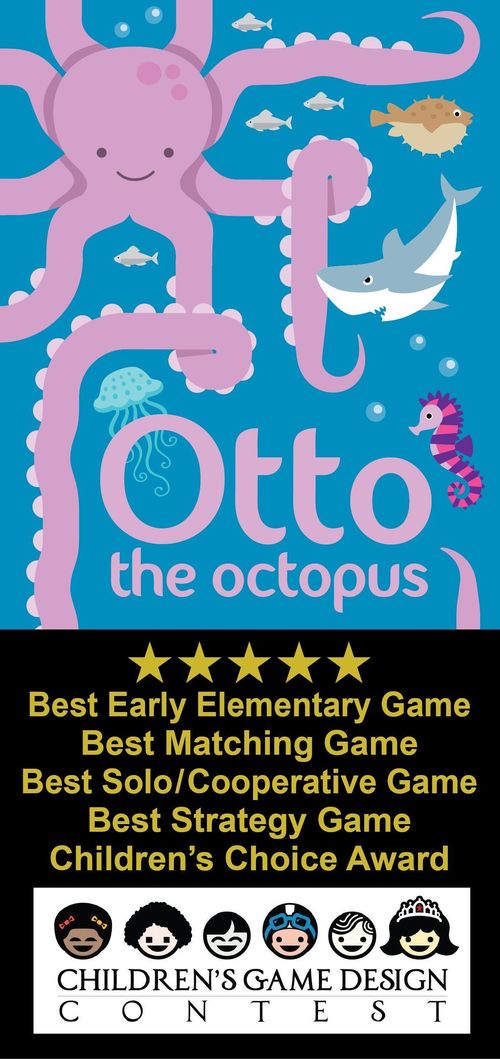
Otto the Octopus
Otto the Octopus Rulebook
Table of Contents
Table of Contents
Components
60 tiles, 1 larger Otto tile, 1 playing board (the 'Ocean'), 1 score tracker and token per player, 2 Fish Identifier cards.
Set up
Each player takes a score tracker and token.
Place the Fish Identifier cards within reach of all players.
Place the Otto tile, face up, in the centre of the Ocean.
Place all the tiles face down on the playing surface, near the Ocean, and shuffle them around to form the draw pile. (alternatively they can be put into a bag).
Each player then takes 3 tiles and holds them so that the other player(s) cannot see them.
The youngest player goes first.
Each turn
Place one tile face up on the Ocean, according to the rules below. Score the turn and draw another tile from the draw pile.
If a player is unable to place a tile, or prefers not to, then they simply miss their turn.
Note that if a player's initial hand has no playable tiles, they replace ALL 3 of them back into the pile and draw another 3.
Play then passes to the player on the left.
Playing a tile
A tile must be placed against another tile already on the Ocean (use the Ocean's grid as a guide).
A tile must never be placed in such a way as to make it impossible for an arm to be extended or completed or so that 2 arms are joined together. See page 2 for examples.
There are 4 tile types: Arm tiles, End tiles, Fish tiles & Bubbles tiles.
Arm tiles and End tiles
An arm is started by placing an Arm tile next to the Otto tile, so that the open ends of the arm join.
An arm is extended by placing an Arm tile next to another Arm tile already in play, so that the open ends of the arms join.
Note that, when 2 Arm tiles are joined, the suckers must continue along the same side of the arm.
An Arm is completed by joining an End tile to the last Arm tile.
Note that an arm must consist of at least 1 Arm tile before it can be completed with an End tile.
Fish tiles
Some Fish tiles have particular effects. These are explained on the Fish Identifier card. Also, an icon is shown on the tile so that, once you're familiar with the effects, you won't need to consult the reference card.
Bubbles tiles
These tiles have no effect.
Scoring
- An Arm tile scores 1 point.
- A Fish tile scores the points shown on the tile.
- A Bubbles tile does not score.
- An End tile scores 1 point plus 1 point for each Arm tile of the completed arm.
- An End tile holding a shell scores 2 points plus 2 points for each Arm tile of the completed arm.
Additional points can be gained in the following ways:
- Placing any tile (including a Bubbles tile) on a Seaweed square of the Ocean scores 1 extra point.
- Placing a tile on a corner Coral square will double its points.
- So, completing an Arm with its End tile placed on a Coral square will score 2 points for each tile of that arm (including the End tile)
- and completing an Arm with an End tile holding a shell placed on a Coral square will score 4 points for each tile of that arm (including the End tile).
Players move their token forward on their tracker the number of spaces equal to the points they scored that turn.
End of game
Once all the tiles possible have been played, the game ends.
Players deduct 1 point for each tile remaining in their hand.
The player with the most points is declared the winner!
Solo play
Play the game in exactly the same way, but ignore the effects of the first four Fish shown on the Fish Identifier card.
When you reach 50 points on the tracker, continue onto a second tracker using another token.
The game ends when you are unable to play any more tiles.
Deduct 1 point for each tile that remains both in your hand and in the draw pile.
Open play
For a more strategic game, players must have 2 of their tiles visible to other plaiyers, keeping just 1 tile secret in their hand.
Simplified play
Depending on age and playing ability, all effects on the Fish tiles can be ignored and the game played by just scoring the points shown.
Very young players can simply enjoy making Otto's arms grow and the fish swim around him.
Examples of incorrect tile placement
The Ocean below has been set up to illustrate some of the ways you should NOT place tiles. Playing like this would make Otto very unhappy.
- Placing this tile here would mean that a tile placed above it would either stop the arm to the right extending or join both arms together!.
- This arm is not long enough. It needs a minimum of 1 Arm tile before it can be completed by an End tile.
- This tile has suckers on the opposite side to the Arm tile it joins.
- The Angler Fish needs to be placed on one of the outer perimeter of squares.
- This arm has not been completed by an End tile.
- This tile is not joined to a tile already in play.
- Placing this tile here would mean that the arm above (not yet started) would be unable to be extended long enough (the minimum Arm tiles in length).
Diagram annotations: "+1" (Seaweed square), "x2" (Coral square), "also for the Coral square this End tile sits on".
* Otto, however, loves this arm. Completing the arm with an End tile scores 6 for its number of tiles. This is then doubled because the arm end holds a shell, and doubled again because the End tile was placed on a Coral square. Making a grand total of 24 points!