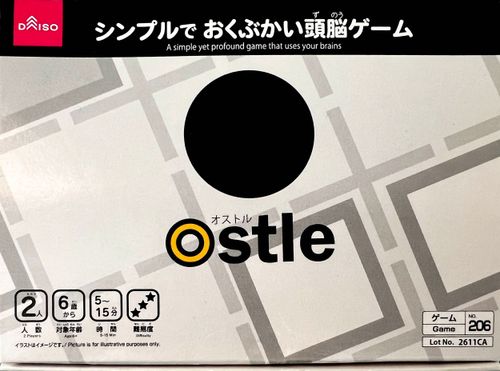
Ostle
Ostle Rulebook
Table of Contents
Table of Contents
Overview
Ostle is a two-player game. Each player has five pieces. One black circle, the hole, is also in play. Players take turns pushing pieces, dropping them, and taking them. Pieces that are pushed off the edge of the board are taken.
Cover tagline: "If you don't attack, you get dropped."
Setup
Set up the practice mat as a 5×5 grid. Place the five opponent pieces (white squares) along one edge and your five pieces (dark squares) along the opposite edge. Place the hole (black circle) in the center square.
- Opponent's pieces: white squares, one row along the top edge.
- Your pieces: dark squares, one row along the bottom edge.
- The hole: black circle, in the center square.
Pictogram label: ready (ジュンビ)
Taking Turns
Pictogram label: take turns (シンコウ)
On your turn, choose one piece or the hole and push it. Then it is your opponent's turn.
- Your turn: choose either one of your pieces (dark square) or the hole (black circle), and push one of those. When you are done, it is your opponent's turn.
English caption printed on the pamphlet: "First-move: Choose a piece or the hole. Push one of those. Next, opponent's turn."
Pushing Pieces
Pictogram label: push (オス)
- Push your piece one square. A piece moves one square in any of the four directions: up, down, left, or right.
- Your piece can push other pieces, but only one square. You may push a line of pieces in a row. Every piece in the line moves one square. Pieces may be pushed in a line of any length, but the whole line moves only one square.
English captions printed on the pamphlet: "Push your piece one square." and "Your piece can push other pieces. But ONE square."
Taking Pieces
Pictogram label: take it! (トル)
- Drop off a piece and take it! When you push an opponent's piece off the edge of the board, you take that piece. Taking a piece is good.
English caption printed on the pamphlet: "Drop off a piece and take it! Well done!"
The Hole
Pictogram label: hole (アナ)
- This is a "hole". The black circle is the hole.
- The hole moves one square. The hole can be moved in the next square, one square in any direction.
- Drop a piece to the hole. When you push an opponent's piece into the hole, it falls in and you take it.
- Push the hole only to an empty square. The hole may be pushed, but only onto an empty square. It cannot be pushed onto a square occupied by a piece.
English captions printed on the pamphlet: "This is a "hole"." "The hole moves in the next square." "Drop a piece to the hole. You got it!" and "Push the hole only to an empty square."
Caution: Repetition Rule
Pictogram label: caution (チュウイ)
- Do not push pieces back to the position they had one turn earlier. Returning pieces to the position they occupied at the previous turn of the same player is not allowed. The pamphlet illustrates this with the same board position appearing at the first and fourth points of the sequence: "#1 and #4 are the same... they're back! It's not OK."
English caption printed on the pamphlet: "Do not push back pieces to the last position of your turn. No no."
Winning
Pictogram label: win (カツ)
- Take two of your opponent's pieces and you win. When you have taken two pieces, you win. The pamphlet's Japanese parenthetical reads "(includes self-destruction)" after this rule; it is printed without further explanation and is reproduced here as printed.
English caption printed on the pamphlet: "When you took two pieces, you win!"
Closing line of the pamphlet: "Now, give it a try!"
Practice Mat and Pieces
The pamphlet includes a practice mat (体験用マット), a 5×5 grid with the "Ostle" marking at two corners, and a strip of trial pieces to cut out for play: five dark pieces, five white pieces, and one black circle (the hole). The pamphlet also carries website QR codes; these are not rules.