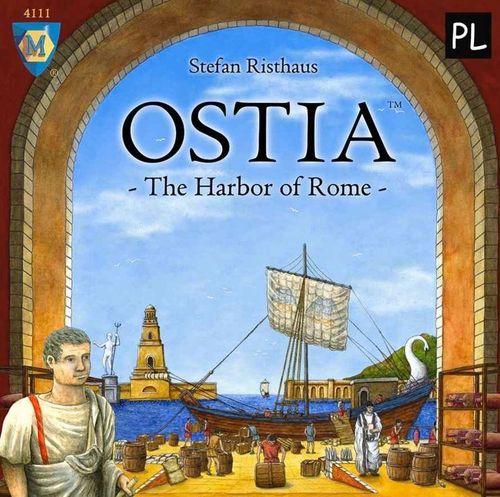
Ostia: The Harbor of Rome
Ostia: The Harbor of Rome Rulebook
Table of Contents
Table of Contents
Materials
- 1 rulebook
- 6 Senate cards
- Paper money (in denominations of: 1 denarius and 2, 5, 10 and 20 denarii)
- 51 cards showing resources, minimum price and frequency (each resource card shows a ship icon and an "owned resources" icon)
- 5 ship cards (two-sided with ship and storage symbols)
- 10 bluff cards
- 5 player boards (each with an area where cards will be sold at the Forum, an area where cards will be donated to the Senate, storehouse construction sites, an area where cards will be put into storage (kept for future rounds), and a turn summary)
- 1 starting player token
- 60 victory point chips
- 20 storehouses
A. Goal of the Game
The player with the most victory points after 5 rounds wins. You receive victory points during each round for the most valuable resource donation to the Senate. At the end of the game, you receive victory points for the variety of resources in your storehouses and for having the most money.
B. Game Preparation
The player who has visited Rome most recently receives the starting player token. Otherwise, the oldest player receives the starting player token.
If this is the first game of OSTIA for all players, pull the 6 resource cards showing ivory out of the deck and set them aside.
Each player receives: 1 player board, 1 storehouse (which is set on a construction site), 1 ship card, 2 bluff cards, 1 facedown resource card from the shuffled pile of resource cards, 55 denarii (players may make change at any time).
Keep your money supply secret throughout the game. Victory points, hand size and storehouses remain visible.
Shuffle the Senate cards. Place the top card facedown back in the box. Reveal the next card for all players to see. Mark it with a victory point chip to denote that it is the active Senate card. Now reveal an additional Senate card and place it next to the first. This will be the active Senate card for the following round.
C. Game Play
The game is played in 5 rounds. Each round contains 5 phases that involve all the players:
- Harbor Phase: First, obtain and distribute NEW RESOURCES from arriving trade ships. Assign the resources you receive between those you want to keep and those you want to auction to other players. You will then auction pairs of resources during two auction cycles.
- Office Phase: Second, ASSIGN RESOURCES to the Forum, to the Senate and to the storehouses that you own.
- Forum Phase: Third, you go to the FORUM and earn money by selling resources to the population of Rome.
- Senate Phase: Fourth, you acquire victory points through your donations at the SENATE.
- Storehouses Phase: Fifth, your STOREHOUSES make it possible for you to store your resources and wait for better opportunities in future rounds.
D. Game Phases
1. HARBOR
Each player takes his ship card into his hand. There are two pairs of icons in the upper corners: the auction icon (the ship) and the "owned resources" icon (the storehouse). As each player receives cards during the phase, the ship card will separate his hand based upon chosen card use. One pair of icons will be hidden. The visible pair will show the ship icon towards the resources in a player's hand to be auctioned, and the storehouse towards the cards that are to be kept. The bluff cards are not used in this phase.
a) Distribute resources from arriving ships
The starting player distributes 5 resource cards from the deck to each player (dealing individual cards is recommended). If the draw pile is exhausted, shuffle the discards and create a new draw deck. These cards do not yet belong to players. Four of these cards will be sold, generating income for both the players and the owners of the long-distance trade ships (the bank). The icons on the corner of the ship card show for which purpose each set of cards is to be used, and each player may arrange his cards as he chooses (left or right) as long as the applicable icon pair is visible. Any opponent can easily look at another player's hand to see which cards that player owns, and which ones will be auctioned, as the ship card has corresponding symbols on the back.
b) Assign resource cards
Each player selects four of the resource cards he just received to be auctioned (placing them on the auction/ship side of the ship card). The resource that is kept is placed on the storehouse side of the ship card, along with any resources kept from previous rounds. During the trade rounds (see below), players will offer two sets of two cards for auction. Any cards a player obtains during the auctions will join his kept cards. Note that during the first round, players will start with TWO kept cards: one card dealt at game setup, and one set aside from the set of five obtained during the Harbor phase. In future rounds, a player may also wish to add resources from his storehouses (from previous rounds) to his kept cards, for easier reference. However, resources from storehouses may NOT be auctioned.
c) Auction resources
The starting player now begins the first of two auction rounds. He chooses two of his four auction resources and places them faceup on the table. They may be two of the same resource, or two different ones. In the second auction round he must put up his remaining two auction cards.
Beginning with the player to the left of the starting player, each player makes one bid (or passes) on the two faceup resource cards. A bid must be at least equal to the minimum price of the two cards. For example, if wood and wine were offered, a bid must be at least 15 denarii (8 for wood, 7 for wine). The resources can only be acquired together as a pair. IMPORTANT: players do NOT have to surpass previous bids. As long as the minimum price is met, players may bid amounts equal to or less than other bids.
If the seller does not want to buy the cards for himself, he selects any of the bids offered to him for the cards. He is not required to take the highest bid! The seller receives the bid amount from the selected player, but then pays a commission to the long distance shipper (the bank) equal to half of the bid (rounded up).
If at least one player makes a bid, the seller must pay one more denarius than the highest bid in order to keep the cards for himself. If the seller purchases the resource cards, he pays the full bid amount to the bank.
If all of the other players pass, the seller MUST buy the resource cards for half of the minimum price shown (rounded up). The seller CANNOT pass if all of the other players pass.
If a player cannot pay for his resources, he must mortgage (remove) any available storehouses for 7 denarii (per storehouse), until he has sufficient money to cover the cost. If the player still cannot cover the cost, he must take a loan from the bank (denoted by setting a storehouse on its side on the player board). For each loan (a maximum of four active loans at a time), the player receives 7 denarii. Any amount beyond the required cost is paid to the player. (Loans cost ten denarii to pay off; see Storehouse Building for more details.)
When a player purchases auction cards, they belong to that player. They are placed to the storehouse side of the ship card (NOT with your selected resources for auction) and may not be sold again.
After the starting player has sold his first set of resources, each of the other players (proceeding clockwise) sells his first set of two resources from the four set aside in his hand.
d) Auction resources again
Once each player has sold his first pair of resource cards, a second trade round begins with the starting player. This round proceeds identically to the first round.
At the end of the second round each player will have no cards remaining on the auction side of his ship hand. The ship cards are now set aside, and are not used for the remainder of the turn. Each player now adds his bluff cards to his hand. The bluff cards have the same backs as the resource cards, but show a smiling senator on the front.
2. OFFICE
If there are fewer than 5 players, now reveal additional resource cards. For 3 players, 4 resource cards are turned faceup from the draw deck. Reveal 2 cards in a 4-player game. These cards will affect prices in the Forum phase.
Keeping his cards hidden, each player now decides which cards he wants to: (a) assign to the Forum for income, (b) assign to the Senate for victory points and (c) wants to keep for future uses (i.e., assign to his storage). Use the bluff cards during this process to disguise the exact number of resources being assigned to each purpose.
Place each selected group of cards facedown in the appropriate areas of the player board:
- Place Forum resources on the area with the Forum symbol (scale and coins),
- Place Senate resources on the area with the Senate symbol (Senate building),
- Place saved resources on the area with the storehouse symbol.
Each player's card hand is now empty.
The Senate looks suspiciously on those merchants that overextend themselves. Consequently, you cannot use more than 3 different resource types between those you assign--combined--to the Senate and Forum (i.e., to the two combined categories). The number of cards does not matter, as long as you use no more than three different resource types each round. (You can also use less than 3 resource types.) You can save as many resource types as you desire.
When all players have distributed all cards on the areas of their player boards, reveal the Forum and Senate piles. The cards on the storehouse areas remain hidden! Remove the bluff cards immediately, and set them aside for the next round.
Players now verify that each player used only three types of resource cards in the round. If someone has more than three types of resource cards between his Senate and Forum piles, that player must remove all cards that are considered to be the most valuable by the Senate from both his Forum and Senate piles. If the player still has too many resources, the above process is repeated for the next most valuable resource, until only three resource types remain.
3. FORUM
The resources that are sold at the Forum generate income. The starting player determines the value of each resource. This is based on the total number of cards revealed by ALL players, and by consulting the value table on the player board.
For each resource type, the players add together the number of cards of that type they have in their Forum piles (see example below). If there are less than five players, also include the cards of that type that were revealed during the Office phase. Do not include the resources offered to the Senate. Total the number of cards in each resource type. Consult the resource value table (which appears on each player's board) to determine the price that will be paid that turn for each individual resource card of that type. Put sold cards on the discard pile.
Resource value table:
| Number of cards | 1 | 2 | 3 | 4 | 5 | 6 | 7 | 8 | 9+ |
|---|---|---|---|---|---|---|---|---|---|
| Price per card (denarii) | 15 | 12 | 10 | 8 | 6 | 4 | 3 | 2 | 1 |
Note: The resource type plays no part in the pricing of the resource! It is a matter of the total number per type. Even though there are different counts of resource cards, the value is based ONLY on the total number of that type of resource card sold at the Forum that round!
Beginning with the starting player, each player receives income for the current resource type being evaluated. Then, the starting player sells the next resource type - this continues until all players have sold all Forum-assigned resources.
4. SENATE
After each player receives his income, evaluate the various offerings to the Senate. Find the value of each offering by consulting the active Senate card shown on the table. Only players who produce a donation worth at least 1 are considered for victory points.
Example: A player submits 3 wine cards as a donation. On the Senate card, wine is shown with a value of 3. This brings the value of the donation to 9. Adding a wood resource card (with a value of 4) would bring the donation up to 13.
The player with the most attractive donation (i.e., the donation with the highest value) receives 3 victory points in the form of chips. The second-place donation receives 2 points, and the third 1 victory point. If players are tied, their victory points are added together and evenly distributed (rounding down). Put all donated resources on the discard pile.
Examples: A has a donation of 12; B and C are tied at 9. A receives 3 points; B and C receive 1 point each. Had A, B and C all tied for most valuable donation, each would receive 2 points.
5. STOREHOUSES (RESOURCE SPOILAGE)
At the end of the round, you may only keep as many resource cards as you have storehouses within which to put them. You may keep a single card in each of your storehouses. (The bluff cards were set aside earlier and do not require storage.) Discard all resource cards you cannot store.
In order to prevent spoilage, you may build storehouses at this time for the price of 10 denarii per storehouse. Set these storehouses on the construction sites on your player board. You may not own more than 4 storehouses.
To clarify: Spoilage occurs at the END of the round. During the round, you may hold as many cards in your hand as play permits. You only worry about spoilage just before the new round begins.
At this point, you must repay--if possible--any loans at 10 denarii per loan. (Remove the tipped storehouse from the player board when the loan is paid.) You must pay 2 denarii interest (per loan) on each loan that you cannot repay. Loans take precedence over any other purchases during the storehouse phase.
E. End of the Round/Preparing for the Next Round
At the end of the round, the starting player passes the starting player token to the player to his left. Discard the current Senate card (i.e., put it back into the box, separately from the card removed before play began). The faceup Senate card remaining on the table becomes the new active card (move the victory point chip on top of it). Reveal a new Senate card for the following round (until the Senate cards run out).
F. Game End and Final Scoring
The game ends after 5 rounds. Play the last round completely, including storehouse building and spoilage.
You receive victory points based on your cash and your remaining resources, so you need to decide if you want to adjust your holdings accordingly.
Take your bluff cards into your hand and put all your cards on your player board. Place resources that you want to keep on the storehouse field. Place the remaining cards on the Forum field.
All players reveal their cards simultaneously. Beginning with the starting player, each player takes a victory point for each DIFFERENT resource type that he has in his storehouses. Discard the remaining (Forum) resources. Players that put fewer resources on the board than they have storehouses may immediately sell the surplus storehouses for 7 denarii. Any player that still owes any outstanding loans loses. The player with the most money now gets 3 victory points, with second place worth 2 victory points, and third place receiving a victory point. Ties are handled as ties are at the Senate.
G. Victory
The player with the most victory points wins!
If there is a tie, the player with the most storehouses wins. If there is still a tie, the player with the most resources in his storehouses at game's end wins. If there is still a tie, the player with the highest value of resources in his storehouses (as determined by the Senate card that was removed before the game started) wins.
OSTIA Example Round
(In the printed rulebook the resources are shown as icons. They are written out by name here; the icon key is in the Resource Cards List below: ivory, wood, wine, olive-oil, textiles, grain.)
1. HARBOR
Player A receives cards from the draw deck. His kept side holds 1 wine (from setup / earlier); the five new cards are 2 olive-oil, 1 ivory, 1 grain and 1 wine.
Since in this round grain is desirable to the Senate, A decides to keep this resource card and places it on the storehouse side of his ship card: kept: wine, grain; auction side: 2 olive-oil, 1 ivory, 1 wine.
Therefore, A must auction 2 olive-oil, 1 ivory and 1 wine this turn.
AUCTION:
Player A offers ivory and wine this turn. A plans to acquire his own two olive-oil cards in the second auction round inexpensively, and hopes that the other players will have less money by then.
The minimum price for both resources is 16 denarii.
Unfortunately, none of the other players make a bid! Since no one placed a bid for the lot, Player A must pay half the minimum price (8 denarii) to the bank. He then places the self-purchased resources with his owned resources on the storehouse side: ivory, wine, wine, grain on the storehouse side; olive-oil, olive-oil on the auction side.
Player B auctions grain and ivory (minimum 13 denarii). Player C offers 18 denarii, Player D says 19 denarii, and Player A offers 16 denarii. Player B wants to acquire the resources personally by paying the highest bid plus 1 denarius. Player B pays 20 denarii to the bank. Player A cannot increase his offer, even if he would be willing to pay 22 denarii for the resources.
Player C reveals 2 grain (8 denarii). Because this is a valuable resource in the Senate, Player D offers 18 denarii, Player A 21 and Player B places a bid of 22 denarii. Player C decides that Player B already has enough resources. She selects Player A's bid for the resource cards. Player A gives her the offered 21 denarii and receives the resource cards to add to the storehouse side of his hand: ivory, wine, wine, grain, grain, grain on the storehouse side; olive-oil, olive-oil on the auction side.
Player C pays the bank half of the purchasing price (11 denarii) and keeps the remainder of the sale price (10 denarii).
Player D completes the first round of auction this turn. A second auction round follows, and Player A's strategy pays off, as he manages to acquire his own cards during the auction. His card hand after the harbor phase: ivory, wine, wine, grain, grain, grain, olive-oil, olive-oil.
2. OFFICE
Because there are less than 5 players, 2 resources are drawn from the deck, revealing two wine cards.
Player A has 4 different resources. Since he may only use 3 different resources between the Forum and the Senate, he must decide which resources he will want to put into the storehouse for next round, and how to distribute the remaining resources between the Forum and/or the Senate. TIP: Players may find it helpful to first remove the resources from their hand that they intend to store for future rounds. This makes it easier to simply examine the cards you intend to use, and ensures no mistakes when choosing up to 3 resource types to use between the Forum and/or the Senate.
Olive-oil will be popular in the Senate during the next round. Therefore, Player A stores both olive-oil cards. Because wine was sold frequently during the harbor phase, and 2 wine cards were uncovered from the deck, Player A decides to sell only 1 wine, to try and keep the value of wine high. Grain is desired by the Senate, and Player A guesses that very little grain will show up in the Forum. He distributes the cards as follows:
- Forum: 1 grain, 1 wine
- Senate: 2 grain, 1 ivory, 2 bluff cards
- Storehouse area: 1 wine, 2 olive-oil
All cards (besides the olive-oil and the wine in the warehouse area) are now revealed, and the bluff cards are removed from his Senate offering and set aside for later use.
The remaining players reveal the following cards (once bluff cards are removed):
| Player A | Player B | Player C | Player D | Talon | |
|---|---|---|---|---|---|
| Forum | grain, wine | ivory, ivory, olive-oil, grain (crossed out) | olive-oil, textiles, textiles | textiles, wine, wine, wine | wine, wine |
| Senate | grain, grain, ivory | wood, grain (crossed out) | ivory, ivory, ivory | wine, grain, grain |
(As printed, the Talon column shows the two revealed wine cards. In the Senate row, Player D's three cards are one wine and two grain.)
Player B has uncovered 4 different resources (oops!) and must discard both grain cards because, of all of his revealed resources, this is the resource the Senate finds most valuable. The Forum and Senate values are now calculated.
3. FORUM
In the following order, earnings are distributed:
Player A receives for his grain (remember, the Senate offerings do not count!) 15 denarii and for one wine card (out of 6 wine cards offered for sale) 4 denarii. Player D takes 12 (= 4x3) denarii for wine. Player B receives 12 denarii for olive-oil, and Player C likewise. Then Player B takes 24 denarii for 2 ivory. Player C gets 20 denarii for 2 textiles, while Player D receives 10 denarii.
4. SENATE
The victory points are distributed in the Senate as follows:
| Player | Victory points | Donation worth |
|---|---|---|
| Player A | 3 victory points | 14 |
| Player C | 1 victory point | 12 |
| Player D | 1 victory point | 12 |
| Player B | 0 victory points | 0 |
(Note: grain was previously discarded for no points.)
With a donation of 0, Player B receives no victory points. Players C and D divide the second and third place awards (rounded down), so each receives 1 victory point.
5. STOREHOUSES (RESOURCE SPOILAGE)
Player A has 3 resources in his storehouse area, even though he only has one storehouse built. During the round, a player may put as many resource cards as they choose in his storehouse area. However, to be able to keep the resources for the next round, a player must have a storehouse for each card kept. As Player A has only one storehouse, he buys 2 storehouses for 20 denarii (total) and keeps all 3 resources (hidden). He could also buy only one storehouse for 10 denarii and discard one resource (probably the wine). The remaining players (clockwise) also store and/or discard resources. Bluff cards are set aside, and do not require storehouses.
6. PLAY PASSES
Player A puts the current Senate card in the box and moves the chip to the other faceup Senate card. He then turns over another Senate card and passes the starting player chip to Player B.
End of Game Example
After round 5 is completed (including the storage and discarding of resource cards), the players end up with the following resources, storehouses, victory points and money:
| Player A | Player B | Player C | Player D | |
|---|---|---|---|---|
| goods | ivory, ivory | wood, wood | ivory, textiles, grain, wine | olive-oil, wine |
| storehouses | 2 | 4 | 4 | 2 |
| victory points | 6 | 10 | 7 | 7 |
| money | 18 | 4 | 24 | 31 |
The players add their bluff cards to their resources in their hand. They simultaneously decide which resources they want to put into storehouses for final scoring, and which will not be used (place these on the Forum spot to avoid confusion). The players do this to decide if, and how many, storehouses will be kept and/or sold. (Cards in the storehouse area represent storehouses being kept, in addition to resources being used for final scoring.)
| Player A | Player B | Player C | Player D | |
|---|---|---|---|---|
| Storehouse area | ivory, bluff | wood, wood, bluff | bluff, bluff | olive-oil, wine |
| Forum area | ivory, bluff | bluff | ivory, textiles, grain, wine | bluff, bluff |
(Transcribed as printed. Player C's four different resources are shown in the Forum row in the printed illustration, although the text says she converts them into 4 victory points.)
Player A has two identical resources. Since victory points are only given for different types of resources, he decides to sell a storehouse, to increase his cash and earn victory points for most denarii. He sells a storehouse for 7 denarii and takes one victory point for his ivory.
Player B keeps both resources, even though it is only worth one victory point. His hope is that, since it is unlikely he will receive any victory points for most denarii, he wants to keep the storehouses and resources for the tiebreakers. Player B receives a victory point for wood.
Player C has 4 different resources, which she transforms into victory points. She receives 4 victory points for 4 different resources.
Player D keeps 2 different resources in his storehouse, even though he might have considered selling a storehouse to ensure victory points for most denarii. He gets 2 victory points for wine and olive-oil.
The situation is now as follows:
| Player A | Player B | Player C | Player D | |
|---|---|---|---|---|
| storehouses | 1 | 4 | 4 | 2 |
| victory points | 7 | 11 | 11 | 9 |
| money | 25 | 4 | 24 | 31 |
Player D receives 3 victory points for having the most denarii; Player A receives 2 victory points; Player C one:
| Player A | Player B | Player C | Player D | |
|---|---|---|---|---|
| storehouses | 1 | 4 | 4 | 2 |
| victory points | 9 | 11 | 12 | 12 |
| rank | 4 | 3 | 1 | 2 |
Player C wins because of the storehouse tiebreaker.
Advanced OSTIA
Experienced merchants who would like to add some variety to their games, may change any of the following rules:
During phase 1 (Harbor), each player decides whether he wants to offer all or part of the resources he has received for auction. Before beginning the auctions, each player may discard facedown up to two cards from the auction side of his hand (place these discards under the current discard pile, or facedown for the first card). In each auction turn, a player must offer exactly 1 or 2 resources. You cannot offer 1 card, then offer three cards during the second auction.
At the start of the game, players receive 70 denarii. Players now pay the full price to the bank for each resource card, not just the (half-bid) commission. Example: Wine and ivory (minimum price is 16 denarii) is sold for 21 denarii. The seller pays the bank 16 denarii, and keeps 5. If the seller receives no bids, he is forced to buy the resources by paying 16 denarii to the bank.
The person with the fewest victory points CHOOSES the new starting player of each round. If there is a tie for fewest victory points, the tied player who is closest to the former starting player (moving clockwise) chooses.
The other rules should remain unchanged.
Resource Cards List
| Symbol | Name | Minimum price | Frequency (number of cards) |
|---|---|---|---|
| tusk | ivory | 9 | 6 |
| logs | wood | 8 | 7 |
| barrel | wine | 7 | 8 |
| amphora | olive-oil | 6 | 9 |
| bundle | textiles | 5 | 10 |
| sack | grain | 4 | 11 |