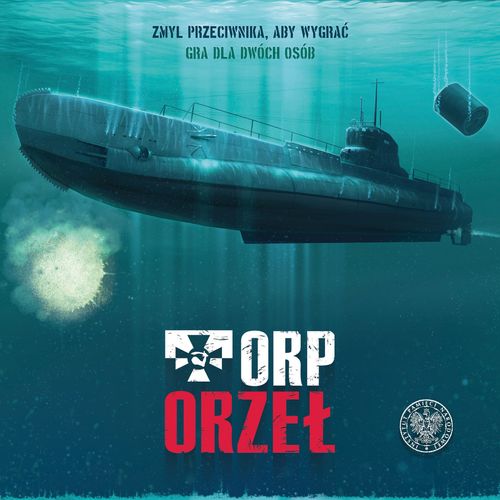
ORP Orzeł
ORP Orzeł Rulebook
Table of Contents
Table of Contents
Components
Players: 2. Playing time: 20 minutes. Age: 10+.
- Game board with a map of the Baltic Sea, divided into hexagonal spaces
- Orzeł miniature figure
- 12 Orzeł movement tokens: 6 revealed with a submarine image, 6 revealed with empty sea, hidden side showing a compass
- 4 Kriegsmarine ship tokens
- 8 Kriegsmarine minefield tokens: 4 revealed with a minefield, 4 revealed empty, hidden side identical
- 4 white Kriegsmarine dice
- 4 red Polish Navy dice
- 2 cardboard player screens
Game Preparation
-
Place the board in the middle of the table.
-
Assign sides to players by choice or randomly.
-
Place the Orzeł miniature in Tallinn (with an orange outline).
-
The Polish Navy player receives:
- 4 red dice,
- 8 movement tokens: 4 with a submarine and 4 with empty sea.*
Return the remaining movement tokens to the box, as they will not be used. They are extras.
-
The Kriegsmarine player receives:
- 4 white dice,
- 8 minefield tokens: 4 with a minefield and 4 empty,
- 4 Kriegsmarine ship tokens.
Players hide their own tokens behind their own player screens, so the opponent cannot see them.
* For your first game, the Polish Navy uses 10 movement tokens: 5 with a submarine and 5 with empty sea. Return the rest to the box.
Game Goal
Each player has a different goal.
The Polish Navy player wants to guide Orzeł toward the Danish straits to ultimately reach Great Britain, in accordance with the order of Fleet Command of September 14, 1939.
The Kriegsmarine player wants to find and sink Orzeł before she leaves the Baltic Sea.
Sequence of Play
The game continues through rounds, until the moment when one player achieves their goal.
Each round has three phases:
- Roll dice.
- First the Polish Navy player rolls dice,
- then the Kriegsmarine player rolls dice.
- Do actions shown on dice.
- First the Polish Navy player does actions,
- then the Kriegsmarine player does actions.
- Set Orzeł's new position.
The players always follow this order.
Roll Dice
Players roll their dice to determine what actions they will be able to do in the second phase of the round.
The dice have various symbols, each of which represents an action. Players do actions only after both players have rolled their dice. A later rule section describes the actions in detail.
Actions of the Polish Navy
- Surface
- Set a course (black or white compass symbol)
- Break contact
Actions of the Kriegsmarine
- Lay mines
- Send a ship on patrol
- Prepare a ship
- Search
- Attack
- Fog (no action)
Dice Rolls of the Polish Navy
The Polish Navy player rolls their dice first.
- The player rolls all their dice.
- After each roll, the player MUST set aside at least one die.
- If any dice show a black symbol, the player must set aside one of these dice.
- The player may set aside more than one die. The player may not set aside two or more dice showing the same result.
- After setting aside dice, re-roll the remaining dice.
- Dice which were set aside cannot be re-rolled this round.
- It is legal to set aside a die with the same result as dice set aside from earlier rolls this round.
- A player stops rolling after all their dice have been set aside. (Thus a player may roll at most 4 times.)
Note: Two faces with different numbers of the same symbol are considered different results.
Example: First the Polish Navy player rolls all 4 dice, getting a result in which two different results are available to set aside. It is not legal to set aside multiple dice with the same result, so in this case the player has three options: set aside one of the first result, or set aside one of the second result, or set aside one of each. The player decides to set aside one of each.
Example continued: The Polish Navy player re-rolls the two dice which were not set aside. The result is two identical black symbols (Set a course). The player must set aside one of them (it is illegal to set aside two identical results) and re-roll the other one. After re-rolling this final die, its result must be set aside, regardless whether the player likes its result.
Example continued: The Polish Navy player sets aside their last die after their third roll, thus ending their dice rolling.
Dice Rolls of the Kriegsmarine
The Kriegsmarine player rolls after the Polish Navy rolls are finished. The Kriegsmarine player sees the final Polish Navy dice results.
The Kriegsmarine player rolls and re-rolls following the same rules as the Polish Navy player.
After both players have finished rolling dice, players proceed to the Do Actions Phase.
Do Actions
Each player has available actions shown as symbols on their dice results. Each symbol gives one action. Some die results show 2 identical symbols, so the player does such a die's action twice (but is free to do other dice's actions in between those two actions).
Note: Knowledge of the detailed rules of each action is not necessary to understand the general principles of their execution. Details of each player's actions appear in later rule sections.
Each action is done as many times as its symbol appears on a player's dice results. Unlike when rolling dice, a symbol's color has no meaning when doing actions.
A player MUST do all the actions shown on their dice. Exception: Dice with selectable actions give a choice.
Results with a Choice
Some dice results show different symbols, separated by a diagonal line. When doing such a die's action, the player chooses to do the symbol (or symbols) on only one side of the line and skips (ignores) the other side of the line.
The player can make this choice after doing other dice actions, but when they do actions for this die, exactly one of the two options MUST be done.
Example of die result with a choice: 1 x Break contact or 2 x Set a course. The player must choose to Break contact once, or to Set a course twice.
Order of Action Execution
Unless otherwise stated, a player may do their actions independently in any order.
After doing each die's action, set the die aside, to remember that it has been used.
Example: With these 4 dice results, the Kriegsmarine player does actions:
- First, they do Fog and set this die aside.
- Then they do a die with two possible actions: they choose to Send a ship on patrol twice (ignoring Prepare a ship) and set this die aside.
- Then they Search and set this die aside.
- Finally, they choose to Search (ignoring Attack) and set their last die aside.
The Kriegsmarine player has now finished doing all the actions of their 4 dice.
Polish Navy Actions
The Polish Navy player does actions first.
The Polish Navy player can do actions in any order, except that Surface must be done after all other actions.
Surface
The sub rises to the surface after dark and ventilates to refresh its air. Also, batteries are recharged. The night break also allows the tired crew to rest.
After doing all other actions: For each Surface symbol, the Polish Navy player takes back one empty sea movement token from the Kriegsmarine player (see Search) and hides that movement token back behind the Polish Navy player's screen.
A movement token with a submarine that was removed from the game (see Attack) cannot be taken back with this action.
If the Kriegsmarine player has no empty sea movement tokens, then it is illegal to do this action. Therefore, Surface always appears as one of two possible choices.
Set a Course
The captain gives an order to set a new course for the vessel.
For each Set a course symbol (black or white compass), the Polish Navy player takes a movement token from behind their screen and places it face down (with compass visible) in a sea space (empty or with a minefield token).
Each movement tile placed must be adjacent to Orzeł or reach Orzeł through a continuous chain of other movement tokens.
The movement token must be placed in a space adjacent to:
- Orzeł
- or any other movement token.
Exception! Spaces separated by a thick jagged line are not considered adjacent to each other!
The Polish Navy player chooses whether to place a token with a submarine or with empty sea, but does not show it to their opponent!
Example: With these 4 dice results, the Polish Navy player may Set a course 6 times (ignoring Surface), or Set a course 5 times and then (afterward) Surface once. The Polish Navy player decides to place 6 movement tokens (and not surface). The Polish Navy player places 6 movement tokens as shown in the rulebook; as required, all are continuously connected back to Orzeł.
Example of illegal placement: The highlighted movement token is illegally placed. It does not touch Orzeł directly or through a chain of other movement tokens.
Example of illegal placement: The highlighted movement token is illegal: it is not considered adjacent to the movement token northwest of it, because a thick jagged line separates the two spaces.
A movement token cannot be placed in a space occupied by another movement token, a Kriegsmarine ship, or Orzeł. A movement token may be placed in a space with a minefield.
If a movement token is placed in a space with a minefield, first turn the minefield face up to reveal it, and then:
- If the revealed minefield token shows a minefield, the Polish Navy player does not place the movement token, but instead reveals it to the Kriegsmarine player.
- If the movement token shows a submarine, remove the token from the game permanently (return it to the box).
- If the movement token shows empty sea, place it on the table in front of the Kriegsmarine player.
- If the revealed minefield token is empty, the Polish Navy player places the movement token face down in that space, without showing the other side of the movement token.
- Remove the minefield token from the map and from the game (regardless whether it had a minefield or not).
If the Polish Navy player has fewer movement tokens than the number of desired Set a course actions, then they do as many as they can.
Break Contact
The submarine crew manages to spot German units before they spot the submarine. Orzeł dives to avoid detection. German cutters are moving away ...
For each Break contact symbol, the Polish Navy player removes a Kriegsmarine ship that is adjacent to a movement token or Orzeł. Place the removed ship in front of the Polish Navy player.
Example: In the situation shown in the rulebook, the Polish Navy breaks contact, and so may remove a Kriegsmarine ship that is adjacent to a movement token or Orzeł. In this case, there is one eligible ship. The other ship (highlighted) cannot be removed, since it is not adjacent to a movement token or Orzeł.
If no Kriegsmarine ship is adjacent to a movement token or Orzeł, then it is illegal to do this action. Therefore, Break contact always appears as one of two possible choices.
Kriegsmarine Actions
The Kriegsmarine player does actions second, after the Polish Navy player has done all their actions.
The Kriegsmarine player does actions in any order, except that Lay mines and Send a ship on patrol must be done before all other actions.
Lay Mines
(Do before other actions, except Send a ship on patrol.)
For each Lay mines symbol, the Kriegsmarine player takes a minefield token from behind their player screen and places it face down in any empty map space.
A minefield token must be placed in an empty space (without another minefield token, movement token, Kriegsmarine ship, or Orzeł). Game components may be placed freely on the spaces beyond the orange line marked with orange shading.
The Kriegsmarine player chooses whether to place a token showing a mine (a real minefield) or empty sea (a bluff), but does not show it to their opponent!
Minefield tokens already placed on the map cannot be repositioned!
The Kriegsmarine player has 8 minefield tokens to place during the game, and receives no more during play. If the Kriegsmarine player has no more minefield tokens to place, this action has no effect.
Example: The rulebook shows several possible empty map spaces where the Kriegsmarine player may place a minefield token.
Send a Ship on Patrol
Kriegsmarine Command sends torpedo boats (Schnellboots) on patrol.
(Do before other actions, except Lay mines.)
Each time the Kriegsmarine player sends a ship on patrol, they put a Kriegsmarine ship in an empty map space.
A ship token may only be placed on a space adjacent to:
- Orzeł
- or a Polish Navy movement token,
- or another Kriegsmarine ship that was just added in the immediately previous action.
A ship must be placed on an empty space (without another Kriegsmarine ship, minefield token, movement token, or Orzeł). Game components may be placed freely on the spaces beyond the orange line marked with orange shading.
Example: The Kriegsmarine player can place a ship token only in any of the green (highlighted) spaces, which are each empty spaces adjacent to Orzeł or Polish Navy movement tokens.
Example: The die result shows two Send a ship on patrol symbols, so after placing one ship, the Kriegsmarine player places a second ship. In addition to the highlighted spaces, it can also go next to the already-placed ship. The player decides to place the second ship next to the ship they just placed.
The number of ships is limited. After placing all ships, the Kriegsmarine player does not receive more.
If the Kriegsmarine player has no more ships to place behind their own player screen, they may move a ship from one map space to another map space, which must meet the same placement requirements. Kriegsmarine player may do so even when one or more ships has been removed by the Polish Navy player.
If the Kriegsmarine player has no ships to place or move when sending a ship on patrol, the action has no effect.
Search
German sailors have spotted the enemy submarine! The enemy's position is transmitted by radio to other units.
For each Search symbol, the Kriegsmarine player reveals one face-down Polish Navy movement token on the map, turning it face up:
- If the movement token shows a submarine, it stays in its space, face up.
- If the movement token shows empty sea, remove it from the map and place it in front of the Kriegsmarine player.
Example: The Kriegsmarine player Searches twice. They choose and reveal one movement token, which shows a submarine, so it stays face up in its space. They choose and reveal a second movement token, which shows empty sea, so it is removed and placed in front of the Kriegsmarine player.
If there are no face-down movement tokens on the map, then this action has no effect.
Prepare a Ship
After returning from patrol, the crew prepares their torpedo boat to go to sea again.
For each Prepare a ship symbol, the Kriegsmarine player takes back a ship token from the Polish Navy player (see Break contact).
If the Polish Navy player has no Kriegsmarine ship tokens, then it is illegal to do this action. Therefore, Prepare a ship always appears as one of two possible choices.
Attack
Torpedo boats and planes bombard the area where the submarine was recently observed. Kriegsmarine seamen search for oil on the water, which could indicate a crack in the hull and the sinking of the enemy ship.
For each Attack symbol, the Kriegsmarine player selects one face-up Polish Navy movement token showing a submarine and removes it permanently from the game, returning it to the box.
Example: Earlier, the Kriegsmarine player did Search and revealed a Polish Navy movement token showing a submarine. Now the Kriegsmarine player Attacks and removes this movement token permanently from the game!
The Orzeł miniature and face-down (navigation divider visible) movement tokens cannot be removed by Attack!
If there is no face-up submarine token, then Attack has no effect.
Fog
Due to unfavorable weather conditions, sea reconnaissance is ineffective.
Fog has no effect. It simply hinders the operations of the Kriegsmarine.
Set Orzeł's New Position (only Polish Navy player)
After the action phase is done, the Polish Navy player sets Orzeł's new position.
Remove unlinked movement tokens
First, check whether any movement tokens are no longer linked (directly or by a chain of tokens) to Orzeł. (Some tokens may have been removed by Kriegsmarine Search and Attack actions, disconnecting other tokens from Orzeł.) Remove all unlinked movement tokens and place them behind the Polish Navy player's screen.
Example: The highlighted token has become unlinked from Orzeł. (It is not adjacent to Orzeł, nor to a chain of tokens that reaches Orzeł.) So this token is removed and returned to the Polish Navy player's screen. The remaining 3 movement tokens are all linked to Orzeł, as shown by the dotted lines linking them.
It does not matter now whether movement tokens are face down or face up.
Move Orzeł to a new space
Then the Polish Navy player may move Orzeł to any selected empty space adjacent to a movement token on the map (face up or face down).
If Orzeł moves, it must go to an empty space (without a movement token, Kriegsmarine ship, or minefield).
If there are no movement tokens on the map, Orzeł may move to any empty space adjacent to its current location.
Example: In the situation shown in the rulebook, the Polish Navy player may move Orzeł to one of the green (highlighted) spaces.
Example: In another situation, there are no Polish Navy movement tokens on the map, so Orzeł can move to one of the adjacent (green) spaces.
Remove movement tokens from the map
Next, remove all remaining movement tokens from the map and put them behind the Polish Navy player's screen. (Minefield and ship tokens remain on the map.)
This round is now over, and the next round begins, with the Polish Navy player rolling dice!
End of the Game
The game ends immediately when either side fulfills their victory condition:
- The Kriegsmarine player wins by permanently removing from the game all of the Polish Navy movement tokens showing a submarine.
- The Polish Navy player wins by moving Orzeł to any space close to the Danish straits (marked with orange shading).