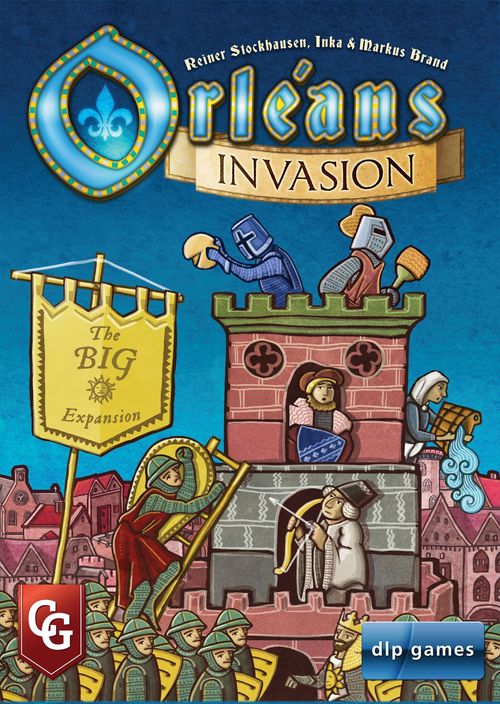
Orléans: Invasion
Orléans: Invasion Rulebook
Table of Contents
Table of Contents
Additional Components
You will need the following components aside from the base game components (including the components for the fifth player, if need be):
- 1 two-part "City Defense" Scenario Board, featuring 5 Accomplishments and 5 Common Objectives
- 9 Character Cards with Personal Objectives
- 31 "Cooperative Events" Hour Glass Tiles (16x A, 14x B, and 1x C)
- The "Fountain", "Market Stand", "Stage Coach", "Black Market", "Tavern" and "Vineyard" Place Tiles
- 13 "Special Building" tiles
- 1 "Assembly Hall" board
- Per player: 1 "Support" Action Board
Setup
Set up the game according to the base game rules with the following changes:
- Place the two-part "City Defense" board (simply called "City" hereafter) next to the game board.
- Only use the following Place Tiles, placing them in separate stacks for categories I and II: Black Market, Cellar, Cheese Factory, Gunpowder Tower, Hayrick, Herb Garden, Horse Wagon, Laboratory, Library, Market Stand, Pharmacy, School, Shipping Line, Stage Coach, Tailor Shop, Tavern, Vineyard, Well, Windmill, Winery, Wool Manufacturer.
- Put the remaining Place Tiles back into the game box.
- Separate the new Hour Glass Tiles into stacks A and B and shuffle them separately. Then draw the following numbers of tiles from each stack, without looking at them:
- 2- and 3-player game: 9x A, and 8x B
- 4- and 5-player game: 8x A, and 7x B
- Place the drawn "B" tiles on top of the "C" tile, and the "A" tiles on top of "B".
Note: Event Tiles with a lightning-bolt symbol are extra mean. If you do not like that, sort those out before preparing the Event Stack. If you want a greater challenge, leave all Events in the game and instead sort out "Support" and "Training".
- Place a Citizen Tile on each designated space on the game board, except for the space for most Trading Stations. Place a Citizen Tile on each Accomplishment on the "City" board. Also place a Citizen Tile each next to the Supply Spaces for Grain, Cheese, and Wine on the main game board. Place another above the last space of the Farmers Track, and a last one on "Le Blanc" on the map.
- Place a "Special Building" tile on each outer town of the map. These are the towns from which transparent paths are leading outwards.
- In a 3-player game, place a Trading Station in the unused color as a Fortified Tower in the following towns (with a "Special Building" tile): La Chatre, Briaire, Tours.
- In a 2-player game, do the same as in a 3-player game, also placing a Fortified Tower in: Etampes, Montagis, S.-Amond-Montrand, Chinon.
- Shuffle the Character Cards and each draw one of them, placing it face up in front of you. If a player got the "Councilman", they must take the "Assembly Hall" board and place it next to their Player Board.
- Put the remaining Character Cards back into the game box—you will not need them.
Note: Some Characters are more difficult to play than others. If you would rather have more control on which one you get, simply choose one instead of drawing one at random. For an easier game use: Councilman, Fisherman, General, Innkeeper, and Librarian. For a more difficult game use: Estate Manager, Mayor, Merchant, and Scholar.
- Each take a "Support" Action Board and place it next to your Player Board.
- Remove the base game Hour Glass Tiles and Beneficial Deeds from the game—you will not need them.
Course of Play
The players team up to complete only one goal—to save the city. To do so, you must complete all Common and Personal Objectives. You can play the Planning Phase together and discuss your choices.
The game is played over 16 or 18 rounds—depending on the number of players—with the new Hour Glass Tiles. If all Objectives are complete before the end of the last round, you win as a team.
The game is played like the base game, except there is no Census (phase 2).
Additional Actions
-
Vehicle: You can send up to 3 Goods to the City or another player. You must send the Goods to a single destination though—you cannot split.
-
Guild House: You can send up to 4 Coins to the City or another player. You must send the Coins to a single destination though—you cannot split.
-
Hostel: You can send a Follower in your Market to another player who can immediately place that Follower on one of their boards. For more efficiency, discuss this move during the Planning Phase already. After the Action Phase, the Follower remains with the player it was sent to.
Example: Alice has almost activated her Guildhall with all the required Followers—she is just missing the Farmer. It is Bob's turn who placed a Monk on his Hostel. He uses the "Hostel" action to send a Farmer from his Market to Alice so she can place it on her Guildhall. Now it is Alice's turn and she can use her Guildhall immediately.
Important: If you receive a Follower from another player via the Hostel, you can place it in your Town Hall, even if you use the Town Hall yourself already. Keep in mind, you can use it multiple times per round.
-
Palatinate: You can use an action that another player has activated. That other player must return the Followers used for activation to their bag as if they used the action (which they do not).
As usual: You can use Technology Tiles to replace a Character Tile on any of the additional actions as long as you follow the normal placement rules. Monks can replace any Character Tile.
Achievements
Like the Beneficial Deeds, the 5 Achievements can be completed over several turns. As usual, use the Town Hall (or Gunpowder Tower) to send Character Tiles to the City. For Goods, use the Vehicle; for Coins, use the Guild House.
To complete the Catapult, you must send Technology Tiles to it. When taking the "Craftsman" action, you must decide whether you place the Technology Tile on an Action Space or the Catapult. The rule about the first Technology Tile still applies: it must be used to replace a Farmer and cannot be sent to the Catapult. This restriction does not apply to Technology Tiles you get from the Laboratory.
As soon as an Achievement is complete, you—as a team—receive the Citizen Tile.
Common Objectives
In any order and as a team, you must complete the following 5 Common Objectives before the end of the game:
- City Walls: You must place a certain number of Knights on the City Walls. 2 players: 5 Knights. 3 players: 8 Knights. 4 players: 10 Knights. 5 players: 13 Knights. Use the Town Hall (or Gunpowder Tower) to send the Knights to the City Walls.
- Citizen Tiles: You must collect a certain number of Citizen Tiles. 2 players: 7 Citizens. 3 players: 8 Citizens. 4 players: 9 Citizens. 5 players: 10 Citizens.
- You receive the Citizen Tile in "Le Blanc" as soon as any player builds a Trading Station there.
- You receive the Citizen Tile next to the Grain, Cheese, and Wine Supply Space once you manage to empty the respective pile at any point in the game. A pile does not need to remain empty forever—you can keep the Citizen Tile once you earn it.
- You receive the Citizen Tile above the Farmers Track as soon as there is at least one Marker on the last space of each of the 6 Followers Tracks, regardless of whose Marker that is.
- City Treasury: You must fill the City Treasury with a certain amount of money. 2 players: 30 Coins. 3 players: 40 Coins. 4 and 5 players: 50 Coins. Use the Guild House to send Coins to the City Treasury.
- Warehouse: You must fill the Warehouse with certain Goods. 2 players: 6 Grain, 3 Cheese, and 3 Wine. 3 players: 10 Grain, 5 Cheese, and 5 Wine. 4 players: 12 Grain, 6 Cheese, and 6 Wine. 5 players: 14 Grain, 7 Cheese, and 7 Wine. Use the Vehicle to send Goods to the Warehouse.
- Fortified Towers: You must build a Fortified Tower in each town at the edge of the map. To build a Fortified Tower in a town, use the "Guildhall" action on your Player Board and place a Trading Station on the "Special Building" tile in that town. You can still build regular Trading Stations, but only in towns without a "Special Building" tile.
Personal Objectives
To win the game, all players must complete their Personal Objectives as specified by the Character Cards.
- Librarian: As the Librarian, you must advance your Marker on the Development Track to the space with the 5 in a star or further. Additionally, you must build a Trading Station in Loches and have at least 4 Place Tiles in front of you by the end of the game. Whether these Places are from stack I or II does not matter.
- Scholar: As the Scholar, you must advance your Marker to the last space of the Development Track, i.e. the space with the 6 in a star. Additionally, you must have 4 Trading Stations (not Fortified Towers) on the map.
- Mayor: As the Mayor, you must have at least 10 Coins and 2 Citizen Tiles in your supply at the end of the game. When another player receives a Citizen Tile, they cannot simply give it to you. You must collect 2 Citizen Tiles on your own, which do not count towards the team effort.
- General: As the General, you must advance your Marker to the last space of the Knights Track. Additionally, you must have at least 4 Technology Tiles total on your boards and Place Tiles.
- Fisherman: As the Fisherman (or -woman), you must advance your Marker to the last space of the Boatmen Track. Additionally, you must have at least 4 Monks and 2 Wool in your supply by the end of the game. It does not matter whether the Monks are in your bag or on your boards.
- Merchant: As the Merchant, you must collect at least 50 Victory Points from Brocade, Wool, and/or Coins only (see the table on the game board) and have them in your supply at the end of the game.
- Councilman: As the Councilman, you must fill the Assembly Hall with Followers. Only you can send Followers there via the "Town Hall" action. The other players cannot send any Followers to the Assembly Hall. Your Personal Objective is complete as soon as all spaces in the Assembly Hall are occupied.
- Innkeeper: As the Innkeeper, you must have at least 16 Victory Points from Grain, Cheese, and/or Wine only (see the table on the game board) and have them in your supply at the end of the game. Additionally, you must build a Trading Station ("Tavern") each in Châteaudun and Châteauroux.
Events
Some Hour Glass Tiles have a timing icon (a grey disc in the printed rules) at the top, meaning these Events take place at a certain point in time or for a certain period of time, as described on the tiles. Events without the icon (a brown disc in the printed rules) take place in Phase 6 (Events), as usual.
If an Event requires you do something "as a team", you must decide together how much each individual player shall contribute to the task. It is not required that every player contribute, as long as the demands are met by the others.
Stack A (in alphabetic order)
- Assembly: No player can use the "Town Hall" this round.
- Demolition: As a team, you must return a total of 2 (in a 2- and 3-player game) or 3 (in a 4- and 5-player game) Technology Tiles to the general supply. For each Technology Tile you cannot or do not want to return, you must pay Coins. If you do not have enough Technology Tiles and Coins, you lose the game immediately.
- Donation: As a team, you receive 3 Development Points, 1 Wine, and 3 Coins. Decide together how to distribute these among the players. For instance, 3 players could receive 1 Development Point and/or Coin each.
- Drought: You must remove 4 Grain Tiles from the map and return them to the supply. Decide together which tiles to remove.
- Earthquake: Turn over 5 Place Tiles in the supply, which cannot be built for the rest of the game. Decide together which tiles to turn.
- Escape: Remove the Citizen Tile from "Le Blanc", unless a player has already taken it after building a Trading Station there. In that case, nothing happens.
- Good Trade: As a team, you can pay 8 Coins total. It does not matter how much each individual player contributes. Then place 3 Grain from the general supply in the Warehouse. If there is not enough Grain in the general supply, you pay and gain nothing. This action is optional—you are not required to take it.
- Good Winds: At the end of the round, one player can use a Waterway at no cost, collecting a Goods Tile, if possible. Decide together who may move their Merchant to an adjacent town via a Waterway. If nobody is adjacent to a Waterway, nothing happens.
- Highwayman: You cannot use Roads this round, but you can use Waterways.
- Example: Alice advances her Marker on the Craftsman Track. She can immediately take a Place Tile, but she does not receive a new Craftsman into her bag.
- Trip: Each of you whose Merchant is in Orléans by the end of the round must pay 4 Coins. You must pay on your own—the other players cannot pay for you. If a player cannot pay, the entire team loses immediately.
- Wool Market: As a team, you can buy or sell Wool for 2 Coins and Brocade for 3 Coins. You can make at most 3 transactions. Pay and decide together who receives what.
Stack B (in alphabetic order)
- Arson: As a team, you must remove a total of 2 (in a 2- and 3-player game) or 3 (in a 4- and 5-player game) already built Place Tiles from the game, which you cannot build again later. For each Place Tile you cannot or do not want to remove, you must pay 6 Coins. If you do not have enough Place Tiles and Coins, you lose the game immediately.
- Bon Voyage: Each pay 2 Coins and move your Merchant to an adjacent town, collecting a Good on the way, if possible. You must pay on your own—the other players cannot pay for you. This action is optional—you are not required to take it.
- Famine: Each return 3 Followers of your choice to the general supply, taking them from your boards and/or bag. Do not move your Markers on the corresponding tracks back. You cannot choose your own Followers. If you do not have enough Followers to return, return as many as you can.
- Fishing Grounds: Each player receives Coins according to their position on the Boatmen Track. If your Marker is on the last space of the track, you do not receive any Coins.
- Harvest: See the base game rules.
- Income: See the base game rules.
- Pirates: Remove all Brocade and Wool Tiles from all Waterways on the map and return them to the general supply.
- Plague: See the base game rules.
- Raging Plague: Like Plague, except each player must draw 2 Character Tiles from the bag.
- Rats: Remove 2 Cheese Tiles and 1 Grain Tile from the Warehouse and return them to the general supply. If there are not enough of those tiles in the Warehouse, remove as many as you can.
Stack C
- Invasion: This is the moment of truth! At the end of the round, all Common and Personal Objectives must be complete. Which one will it be: defeat or victory?
Game End
The game ends at the end of the round in which you turn the "Invasion" Hour Glass Tile face up.
If at this point all Common and Personal Objectives are complete, you successfully fend off the invasion and win the game! However, if even one Objective is not complete by the end of the last round, the invasion takes place and you all lose. Don't worry: next time you'll manage!
New Place Tiles Used in Invasion
The following new Place Tiles are used in this scenario's setup. Their texts are reproduced from the expansion's "New Place Tiles" appendix, which applies to the Invasion setup and can also be used in the base game.
- Market Stand: You can buy and/or sell up to 2 Goods of the same or different type. The price of each Good is equal to its value (see the game board). Return Goods you sell to the general supply. If the general supply is out of a certain Good, you cannot buy it.
- Tavern: You can build a Trading Station in a town, even if another player has already built one there (at most once per town). Carry out the Tavern action when you use the Guildhall action to place the Trading Station (they are considered a single action).
- Well: Carry out any action on your Player Board or any of your Place Tiles, regardless of whether or not that action is activated. After taking the action, only return the Followers from the Well to your bag. This way you can use an action more than once per round.
- Stage Coach: Pay 3 Coins and move your Merchant to an adjacent town via a Road or Waterway, collecting a Goods Tile on the way, if possible.
- Black Market: Exchange any 2 Goods of the same type for 1 Good of another type. Return the Goods you exchange to the general supply. If the general supply is out of a certain Good, you cannot exchange for it.
- Vineyard: Each time you build a Trading Station in a town at the river, you can buy 1 Wine for 1 Coin.