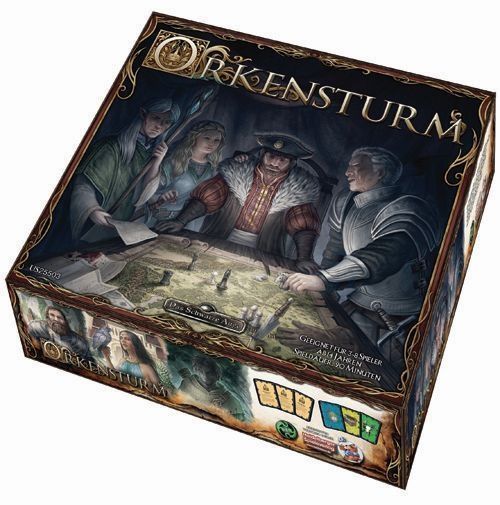
Orkensturm
Orkensturm Rulebook
Table of Contents
Table of Contents
Goal of the Game
The goal of the game is to accumulate the most prestige points (AP) through skilful alliances and by exercising influence over the course of the Orkensturm.
Contents
- 1 game board, showing the influence on the characters, the AP tracks and the strength of Brin's troops (Mittelreich troops) and of Aikar's troops (orc troops), the Imperial Treasury, which is managed, and the remaining time until Brin's return is counted down
- 16 playing pieces, two for each of the 8 colours
- 4 counters: 1 red, 1 green, 1 purple and 1 yellow
- 165 influence cards, divided as follows: 24 influence cards each in blue (Trade), yellow (Wealth), purple (Time) and white (Alliances); 33 red influence cards (Mittelreich troops); 36 green influence cards (orc troops)
- 8 loyalty cards: 4 for the players on Brin's side and 4 for the players on Answin's side
- 14 Brin advisor cards
- 14 Answin advisor cards
- 18 event cards
- 1 starting-player marker
- 1 display board for the remaining available influence cards (= reserve) and event cards
Setup
-
The players choose a starting player from among themselves in any way they like. The starting player receives the starting-player marker for this turn. Each player chooses a colour, places one playing piece of that colour on the "0" of the AP track and places the other playing piece in front of them on the table.
-
Now assemble the supply deck: shuffle 12 influence cards of each colour together and place this deck face-down on its designated space on the game board. Sort the remaining influence cards by colour and place them on the display board; this is the reserve. Each player receives 6 random cards from the supply deck (with 5–8 players, each player receives 7 random cards).
Important note: If the supply deck ever runs out during the game, take 6 influence cards from the reserve (one of each colour), shuffle them, and form a new supply deck.
-
Shuffle Brin's advisor cards and Answin's advisor cards into two separate decks and place them face-down on their designated spaces on the game board.
-
Now take the loyalty cards (with 3–4 players: 2 loyalty cards for Brin and 2 loyalty cards for Answin; with 5–6 players: 3 loyalty cards for Brin and 3 loyalty cards for Answin; with 7–8 players: all loyalty cards). Beginning with the starting player, all players decide clockwise whether they stand on Brin's or Answin's side, by taking the corresponding loyalty card and placing it face-up in front of them.
-
Then each player draws one advisor card from the deck of their faction, reads it, and places it face-down in front of them.
-
Now the Orkensturm deck must be assembled. Take the following cards from the reserve to form this deck: 1 yellow, 1 purple, 1 blue and 1 white influence card. Add the following to it:
- 2 red influence cards for each player who has chosen Answin's side
- 2 green influence cards for each player who has chosen Brin's side
Shuffle the Orkensturm deck and place it face-down on its designated space on the game board.
Important note: If you ever have to divide numbers during the game, always round up any fraction.
Optional Rule for Experienced Players: Event Cards
The event cards should be shuffled into one deck and placed face-down on the designated space of the display board. We recommend playing this variant if you are experienced players or already know how to play this game.
Optional Rule: Historia Aventurica
If you even want to recreate the historical course of the Orkensturm, do not shuffle the event cards. Instead, take all cards numbered with Roman numerals I to VIII and stack them in order, with card I on top and card VII at the bottom. Form a stack from the other ten cards without numbering, and slip them individually or in pairs between the pre-sorted numbered events of the Orkensturm. Make sure that the card numbered I always lies on top, because the Orkensturm in the Middle Kingdom begins with the march of the orcs on Lowangen. The order of the events corresponds to the chronicle of the official Aventurian historiography, loosened up by some random events.
Overview of the Game Flow
A game of Orkensturm is divided into turns. Each turn consists of several steps:
- Optional: If you are playing with the optional event card rules, the event for the current turn is revealed. Otherwise this step is skipped.
- The players compete for influence over the characters.
- The respective actions of the influenced characters are carried out.
- The players contribute to the outcome of the Orkensturm.
- The outcome of the Orkensturm (for the current turn) is determined.
- Optional: If you are playing with the optional event card rules, the effects of the current event are resolved. Otherwise this step is skipped.
- Influence cards played into the Orkensturm are sorted back into the reserve.
When all players have had their turn and the conditions for the end of the game are not yet met, the starting-player marker passes clockwise to the next player. This player is the starting player in the new turn.
The Turn in Detail
Optional: Revealing the event. The starting player reveals the top card of the event card deck and reads it aloud.
1. Influencing the Characters: Positioning
Beginning with the starting player, each player places the playing piece of their colour, clockwise, on an empty character space on the game board. A player cannot influence the same character that they influenced in the previous turn. The player who places their playing piece last also draws 1 additional green or red influence card and 1 further card of a colour of their choice from the reserve. This turn ends as soon as all players have placed their playing piece.
2. Influencing the Characters: Resolving Actions
Beginning with the starting player, each player in clockwise order chooses one of the two possible actions of the character they are influencing in the current turn, and carries it out. Afterwards, each player moves their playing piece from the character space to the exit of the character space.
Here the playing piece stays until the next turn. This helps to record who has influenced which character in the current turn, and so that the player cannot do so again in the coming turn.
A precise list of the actions of the influenceable characters can be found from page 5 onwards (see Action Overview below).
3. Contributing to the Outcome of the Orkensturm
Beginning with the starting player, each player in clockwise order chooses 2 influence cards from their hand and adds them to the Orkensturm deck. The colour of the influence cards remains secret, but participation is mandatory. If a player does not have enough cards to take part, they lose 1 AP for each card they cannot contribute.
Important note: Negative AP totals (below 0) are possible.
4. Determining the Outcome of the Orkensturm
It is time to find out how Brin of Gareth fares in the battle against the black-furs!
The starting player shuffles the Orkensturm deck and reveals a number of cards face-up on the table equal to twice the number of players (6 cards with 3 players, 8 cards with 4 players, 10 cards with 5 players, and so on, up to a maximum of 16 cards with 8 players).
Comparing the troops of the Mittelreich (red) with the troops of the orcs (green):
- If, after counting, there are more green cards than red, the Mittelreich troops are reduced by the difference, and the indicator on the game board is moved down by the corresponding number. In this case Brin has lost the battle.
- If, after counting, there are more red cards than green, the orc troops are reduced by the corresponding difference, and the change is shown on the game board. In this case Brin has won the battle.
- If, after counting, there are equal numbers of red and green cards, the battle ends in a draw and nothing changes for the troops of either army.
The time counter is moved 1 space further towards 0, which stands for Brin's return to Gareth.
Comparing the cards for Time and Trade (purple and blue):
- If, after counting, there are more purple cards than blue, the counter on the timeline is moved up by 1. In this case Brin's return has been delayed.
- If, after counting, there are more blue cards than purple, the counter on the timeline is moved down by 1. In this case Brin's return has been hastened.
- If, after counting, there are equal numbers of purple and blue cards, there is no change and nothing else happens.
Comparing the cards for Wealth and Alliances (yellow and white):
- If, after counting, there are more white cards than yellow, the Imperial Treasury is reduced by the corresponding difference, and the change is shown on the game board.
- If, after counting, there are more yellow cards than white, the Imperial Treasury is increased by the corresponding difference.
- If, after counting, there are equal numbers of yellow and white cards, there is no change to the counters.
Optional: Effects of the event card. The effect of the event card of this turn (the card drawn before step 1) is resolved, taking into account the outcome of the Orkensturm (determined in step 4). The card then goes to the discard pile.
5. Aftermath of the Orkensturm
The cards drawn in step 4 must be returned to the reserve, the starting-player marker passes clockwise to the next player, and the turn ends.
Meaning of the Card Colours
- Green: troops of the orcs (Truppen der Orks)
- Red: troops of the Mittelreich (Truppen des Mittelreichs)
- Purple: time (Zeit)
- Blue: trade (Handel)
- White: alliances (Bündnisse)
- Yellow: wealth (Vermögen)
Action Overview
The actions of the characters are listed below. Each character offers two possible actions; a player who influences a character chooses one of them.
Regent
-
Take 2 white influence cards from the reserve and draw 1 influence card from the supply deck.
or
-
Place 6 cards of different colours into the reserve and gain 5 AP. Draw the top 4 influence cards from the supply deck.
Merchant (Kaufherr)
-
Take 2 blue influence cards from the reserve and draw the top influence card from the supply deck.
or
-
Place 2 blue and 2 white influence cards into the reserve. Gain 3 AP and draw 2 random influence cards from the supply deck.
Tax Collector (Steuereintreiberin)
-
Take 2 yellow influence cards from the reserve and draw the top influence card from the supply deck.
or
-
Announce a Tax Collection (Steuereintreibung). Beginning with the player to the left of the player who performed the action, each player in clockwise order may openly offer none, one, or several yellow influence cards. To do so, the player must lay their offered cards face-up in front of them. A player must offer at least one yellow influence card to be able to receive any AP from a tax collection at all.
Then the evaluation takes place:
- The player who offers the most cards receives 3 AP.
- The player who, after that player, has offered the most cards receives 1 AP.
- The other players receive nothing.
In case of a tie, all players with the same number of offered influence cards receive the same amount of AP. All offered cards, including those of the players who received no AP, are discarded and placed into the reserve.
Knight (Ritter)
-
Take 2 red influence cards from the reserve and draw the top influence card from the supply deck.
or
-
Announce a Joust (Tjost). Each player secretly offers as many red influence cards as they wish. The cards should not be shown openly, but held in a hand under the table. For the evaluation, the offers are revealed simultaneously:
- The player who offers the most cards receives 3 AP.
- The player who, after that player, has offered the most cards receives 1 AP.
- If the player who announced the joust is not the winner, that player receives 1 AP (this is in addition to any AP for second place, should they land there).
- All other players receive nothing.
In case of a tie, the player who announced the joust takes precedence; next, the next player clockwise after them is considered. All offered cards, including those of the players who received no AP, are discarded and placed into the reserve.
Magician (Magierin)
-
Draw the top 2 influence cards from the supply deck and take 1 influence card of a colour of your choice from the reserve.
or
-
Draw 1 advisor card from the advisor deck of your side (either Brin or Answin) and take 1 influence card of a colour of your choice from the reserve.
Inquisitor
-
Take 1 green and 1 purple influence card from the reserve and choose a player. The chosen player must show you their hand cards, and you receive AP equal to the number of their green influence cards.
or
-
Place 2 green influence cards into the reserve. Gain 1 AP and draw the top 3 influence cards from the supply deck.
Spy (Spion)
-
Take 1 purple and 1 green influence card from the reserve and draw the top influence card from the supply deck.
or
-
Place 2 purple influence cards into the reserve, then choose a player and a colour. The chosen player must show you their hand cards, and you receive AP equal to the number of their influence cards of the chosen colour. Draw the top influence card from the supply deck.
Aventurian Messenger (Aventurischer Bote)
-
Place 1 influence card of your choice into the reserve and gain 1 AP. Then take 1 white and 1 green influence card from the reserve.
or
-
Place 1 influence card of your choice into the reserve and gain 1 AP. Then take 1 red and 1 yellow influence card from the reserve.
Important note: The Aventurian Messenger cannot be influenced in a game with fewer than 6 players.
Important note: Advisor cards can only be used once per game. Once an advisor card has been revealed, it is not returned to the advisor deck.
End of the Game
The game can end at the end of any turn. The game ends as soon as one of the following conditions is met. When evaluating, remember to round up any shared AP numbers.
Victory conditions
- A. If the counter for the Mittelreich troops reaches 0, Brin falls in battle. The players who have sided with Answin share 8 AP among themselves. If there is only one player loyal to Answin, that player receives 8 AP; if there are 2 such players, both receive 4 AP; if there are 3, all receive 3 AP.
- B. If the counter for the orc troops reaches 0, Brin is victorious and the Orkensturm comes to a halt. The players who have sided with Brin share AP equal to the value of the Imperial Treasury.
- C. If neither of the two conditions above is met, but the counter on the timeline reaches 0, Brin returns early to Gareth and has enough troops to win back his throne. The players who have sided with Brin share AP equal to half the value of the Imperial Treasury.
- D. If none of these three conditions is met, but the Imperial Treasury drops to 0, Brin has used up all of his wealth. The war against the black-furs was so costly that he no longer has any chance of winning back the throne, and he has plunged the realm into a deep crisis. The players who have sided with Answin share 4 AP among themselves.
Each player also receives AP at the end of the game equal to the value that their own advisor cards grant them. The player with the most AP wins the game.
If two or more players are tied on AP, the player(s) who have sided with Answin win if condition A or D was met at the end of the turn. Alternatively, the player(s) who have sided with Brin win if condition B or C was met at the end of the turn.
Once the game is decided, the starting player may read aloud the corresponding ending from the epilogue, depending on the outcome of the story. (The epilogue texts and the historical background panel are narrative flavour and are not transcribed here.)
Important Notes: Overview
- A player cannot influence the same character that they influenced in the previous turn.
- If the supply deck runs out at any point during the game, take 6 influence cards from the reserve (one of each colour), shuffle them, and form a new supply deck.
- If you have to divide numbers during the game, always round up any fraction.
- Negative AP totals (below 0) are possible.
- Advisor cards can only be used once per game. Once an advisor card has been revealed, it is not returned to the advisor deck.
- The Aventurian Messenger cannot be influenced in a game with fewer than 6 players.