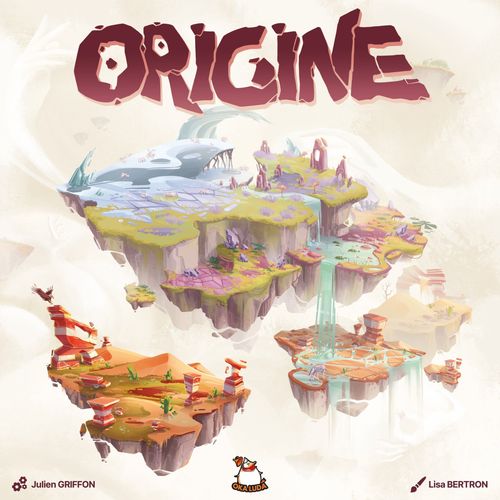
Origine
Origine Rulebook
Table of Contents
Table of Contents
Material
-
26 Element pawns:
- 4 Oxygen pawns (white)
- 4 Water pawns (blue)
- 4 Mineral pawns (brown)
- 4 Plant pawns (green)
- 4 Insect pawns (black)
- 4 Animal pawns (orange)
- 2 Bacteria pawns (purple)
Each Element pawn has an Element face (recto) and a Need face (verso).
-
1 cloth bag
-
4 game aids
-
6 double-sided Continent boards, each with an easy level side and a difficult level side.
Continent boards
Each Continent board shows:
- Oxygen pawn location (white)
- Silt type location
- Sand type location
- Rock type location
- Clay type location
- Link between locations
- Difficulty level, which corresponds to the number of locations on the Continent (here 5)
Set up
- Give each player a game aid. The game aid indicates the requirements for all Elements.
- Place all Element pawns (blue, brown, orange, green and black) into the bag.
- Each player draws 3 Element pawns from the bag and places them in front of them, with the "need" side facing the player, taking care not to show this side to the other players.
- Then place all the (white) Oxygen pawns in the bag.
- Place 4 Continent trays in the middle of the table (faces chosen for easy, difficult or random mode), with a total of 20 Element places. (The printed text reads "with a total 20 number place of Element"; the 20 Element places are shown by the sum 4 + 5 + 5 + 6 = 20 on the page.) Note: for your first games, prefer faces with an easy difficulty level.
- Stick three continents together and leave one continent aside at random (you can only play on this continent if certain conditions are met, detailed on page 9). Place the two Bacteria pawns (purple) on this continent. These counters will be placed in the bag when the continent is activated (see page 9).
- Randomly select the first player.
Game turn
Warning: you cannot, at any time, reveal to other players the need for Element pawns that you know, nor give them clues on the best way to place their pawns. The turn of the game takes place in a clockwise direction.
The turn of a player, who we will refer to as the "active player", takes place as follows:
- Select an Element pawn (active player)
- Designate a continent (previous player)
- Place an Element pawn (active player)
- Draw an Element pawn from the bag (active player)
1. Selecting an Element pawn
The active player indicates which of his or her pawns he or she would like to place.
2. Designating a Continent
The previous player, the player to the right of the active player, designates a continent on which the active player places an Element pawn. The choice of continent must be valid, neither discarded nor complete!
3. Placing an Element pawn
The active player chooses one of his Element pawns, not necessarily the one indicated*, and places it face-down on any free space on the Continent designated by the previous player. He must, but will not always be able to, place it in such a way as to respect the need for the Element pawn and any Element pieces already placed (see next chapter).
Note: Oxygen counters may only be placed on white spaces, which themselves can only hold Oxygen counters.
* The choice of pawn to place is an indication, and not placing the indicated pawn and choosing another one can also be an indication. (This footnote is printed in French in the source rulebook; translated here.)
4. Drawing an Element pawn from the bag
If there are any remaining counters in the bag, the active player picks one and places it with his other two pawns, taking care not to show his possible Need to the other players.
Note: Bacteria counters (purple) are a special case (see below).
Once your new counter has been recovered, it's the next player who becomes the active player and begins his turn.
Needs of the Elements
WATER (blue): Blue Elements represent water. There are 4 Water pawns for the 4 continents. To be validated, a continent must contain a single Water pawn at the end of the game.
MINERAL (brown): Brown Elements represent minerals. There are 4 Mineral pawns, each distinct, and each will be validated at the end of the game only if it is the corresponding soil type.
PLANT (green): Green Elements are plants. There are 4 Plant pawns, each distinct, and each validated only if it is not linked to the crossed-out Element at the end of the game.
INSECT (black): Black Elements are insects. There are 4 Insect pawns, each distinct, and each validated at the end of the game only if it is linked to the Element indicated.
ANIMAL (orange): Orange Elements are animals. There are 4 Animal pawns, each distinct, which must be linked to an Element of a given color, but not to an Element of a different color, to be validated at the end of the game.
OXYGEN (white): White Elements are Oxygen. There are 4 Oxygen pawns for the 4 continents, which can only be placed on white locations. They can trigger a special action (see Oxygen below).
BACTERIA (purple): Purple Elements are bacteria. There are only 2 Bacteria pawns, which have an immediate action and which will not be placed on the continents but will be discarded after use (see Bacteria below).
Link
A link connects two Elements together.
So an Element with this pictogram must be linked by a link to this Element. Conversely, a crossed-out pictogram must not be linked by a link.
Discarded continent
As soon as a first Continent is completed (excluding the Oxygen pawn), the discarded Continent becomes accessible until the end of the game.
Now that the last Continent is activated, place the two Bacteria pawns (purple) in the bag.
Oxygen
If the white space on the designated continent is free, the active player may place an Oxygen on that slot. There are two possibilities:
- If he places the Oxygen pawn with its need side visible, he immediately performs the pawn's special action.
- If he places it with the Element face up, the player gives up the Special Action, but this will score 1 additional point at the end of the game (+1 pt).
Special actions
- Flipping over: flip over any Element pawn already placed on this continent.
- Exchange: exchange the position of any two Element pawns, at least one of which is on this continent.
- Look-move: secretly look at any Element pawn placed on this continent and move it to a free any continent. (Printed as "to a free any continent".)
Exceptionally, the gods (players) can debate at this time the possible choices based on the revealed action: which pawn to look at, move or exchange with which. However, it remains prohibited to reveal the needs of known Elements.
Example: "Based on what I know about the situation on this Continent, I think we should return this one!"
Bacteria
When a player draws a purple Bacteria pawn, he/she must immediately reveal the pawn, apply the corresponding action, and discard it:
- Share: each player passes one of his Element pawns in front of him to his left-hand neighbor.
- Move: if possible, move an Element pawn from one Continent to another, without turning it over (it is forbidden to place it on the Continent moved).
He then draws a new Element counter from the bag.
Vary the difficulty
The more difficult Continents you use, the more complicated your games will be.
If you want to further increase the difficulty, simply start the game by placing a certain number of Oxygen counters on the white face up, and ignore the corresponding Special Actions. You can then set the level of difficulty you want.
End of the game
The game ends as soon as all the Element and Oxygen pawns have been placed (or played in the particular case of Bacteria).
Then turn over all the Element pawns (with the exception of the Oxygen pawns, which remain as they were played) so as to make their need visible and check if this is respected.
Discard each Element pawn whose need is not met.
- If a pawn is missing on a Continent, it does not score a point.
- If all the locations on a Continent are occupied after removing the Elements whose need is not met, it is validated. Each Element token present on it is worth 1 point, with the exception of Oxygen. Oxygen scores 1 point if its Element side is visible (see Oxygen above), whether the Continent is validated or not.
Examples (the callouts on the page, in the printed order):
- The WATER pawn is alone on the Continent. (checked)
- The INSECT pawn is well linked to the WATER Element. (checked)
- The PLANT pawn is not linked to the WATER Element.
- The ANIMAL pawn is not linked to the WATER Element but should have been linked to the PLANT Element. (crossed out)
- The MINERAL pawn is well placed on the corresponding type: sand. (checked)
- The OXYGEN pawn here earns 1 pt. (checked)
- An Element is missing. The Incomplete Continent is not validated. (crossed out)
Final score
You will know if you are gods who will mark the history of this planet by consulting the following table:
| 2 players | 3 players | 4 players | Level |
|---|---|---|---|
| 14 or less | 13 or less | 12 or less | DEMI-GODS |
| 15 to 19 | 14 to 18 | 13 to 17 | WORTHY OF A PROPHET |
| 20 to 23 | 19 to 23 | 18 to 23 | DIVINE COLLEGE |
| 24 (for all player counts) | GODS |