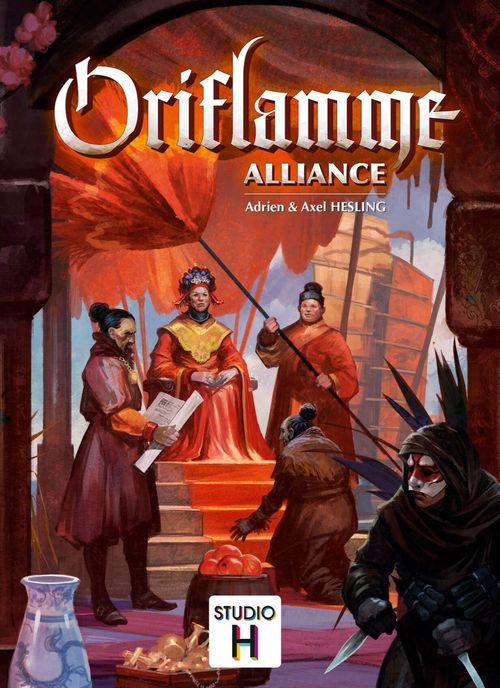
Oriflamme: Alliance
Oriflamme: Alliance Rulebook
Table of Contents
Table of Contents
Goal of the Game
The player whose family has accumulated the greatest number of Influence Points by the end of the 6th round wins the game.
Contents
- 50 Character and Intrigue cards (5 families of 10 cards)
- 5 reminder cards
- 5 Verdict tokens
- 64 Influence Point tokens (values 1 and 5)
- 1 First Player tile
- 1 Resolution Direction tile
Setup
- Each player takes a set of 10 cards belonging to one family (cards of the same family share the same coat of arms on their backs).
- Players shuffle their 10 cards, randomly set aside 3 of them face down next to themselves. These cards take no part in the round to come. Players keep the remaining 7 cards in hand, without showing them to the other players.
- Each player receives 1 Influence Point and places it in front of them. Place the rest on the table where every player can reach them; this is the Influence Point supply.
- Place the 5 Verdict tokens nearby.
- The oldest player starts the game. They take the First Player tile and place it in front of them. Place the Resolution Direction tile in the middle of the table, and make sure there is enough room to lay out a row of cards. This tile serves as a reminder to the players and determines, for the entire game, the direction in which cards in the Influence Queue are activated (see the Resolution Phase section).
Round of the Game
The game lasts 6 rounds. Each round consists of 2 phases:
- Placement Phase
- Resolution Phase
1/ Placement Phase
Important: at any time, each player may look at their own family's face-down cards in the Influence Queue, as well as the cards set aside during setup.
During this phase, players lay cards in the center of the table, forming the Influence Queue. Starting with the first player and proceeding clockwise, each player secretly chooses a card from their hand and places it face down in this row.
At the start of the game the Influence Queue is empty, so the first player places their card in the center of the table. On their turn, the other players may place their card:
- At the start of the row,
- OR at the end of the row,
- OR on top of another card of their own family already in the row (see Stacks of Cards).
Important: you may not place a card between two cards already in the row.
The Placement Phase ends once every player has placed one card from their hand into the Influence Queue.
Placement phase example:
- Red is the first player; they place their card face down in the center of the table.
- Blue must place their card to the left or right of Red's card.
- Green must place their card to the left of Blue's card or to the right of Red's card. They cannot place their card between the blue and red cards.
2/ Resolution Phase
In this phase, players carry out actions with the cards in the Influence Queue. The Resolution Direction tile determines the direction in which the cards in the row are activated: right to left, or left to right. The owner of the card at that end acts first.
1) If a card is face down (unrevealed), its owner must do one of the following:
- Leave the card face down. They place 1 Influence Point on it from the supply. A player may leave a card face down for several rounds, adding a new Influence Point to it each time.
- Reveal the card. They turn it face up and immediately apply its effect. If there were Influence Points on it, the player takes them into their personal supply.
2) If a card was already activated in an earlier round and lies face up (revealed), its owner must apply the card's effect.
Applying the effect of a revealed card is mandatory. For example, the Deserter card must always eliminate an adjacent card, even one from its own family.
Eliminate a Card
The effects of some cards let you eliminate cards in the Influence Queue.
Important: each time a player eliminates a card (regardless of which family it belongs to), they gain 1 Influence Point. The Influence Point symbol next to the card's name is a reminder of this.
If the eliminated card was face down, any Influence Points on it are returned to the supply and the card is turned face up. The eliminated card is then removed from the Influence Queue and placed in its owner's discard pile. If this leaves a gap, slide the cards together so the row closes up.
Important: discarded and eliminated cards are placed face up in their owner's discard pile. Any player may look through discard piles at any time during the game.
Resolution phase example:
- As indicated by the Resolution Direction tile, cards are activated from left to right.
- Red decides not to activate their card, so they place 1 Influence Point from the supply on it.
- Blue decides to activate their card. They immediately take into their supply the 1 Influence Point that was on it. It is a Deserter, which must eliminate an adjacent card.
- Blue chooses Red's card to their right, discards it and returns the 2 Influence Points on it to the supply. Blue gains 1 Influence Point for the elimination, and 1 more from the Deserter's own effect.
- Since there is no other Character card adjacent to the Deserter, the Deserter is discarded, and the remaining cards slide together; the next card to be activated in the row is Green's. Green decides not to activate their card, and places 1 Influence Point from the supply on it.
- Blue's Fanatic is already revealed, and its effect must be applied. Blue gains 1 Influence Point. Since there is no other revealed card of Blue's family left in the row, Blue gains 1 more Influence Point.
A New Round of the Game
Pass the First Player tile to the next player on the left. The cards in the Influence Queue remain in place. The new round begins with the Placement Phase.
Stacks of Cards
Starting with the 2nd round, players may place a new card on top of a card of their own family already in the Influence Queue, whether it is face up or face down. The newly placed card now covers the one beneath it, along with any Influence Points on it. This is called a stack. There is no limit to the number of cards in a stack.
Cards underneath a stack are not taken into account for game events. For example, during the Resolution Phase, cards under a stack cannot be revealed, cannot accumulate additional Influence Points, their effects cannot be applied, and other cards' effects cannot target them.
However, be careful when stacking cards, since covered cards become unavailable to their owner for an indefinite time, cannot accumulate Influence Points, and do not count toward the final score.
With a stack, players can protect their cards from elimination, or, for example, place a Deserter in the middle of the row to eliminate opponents' cards otherwise out of reach, or even set up a chain of useful effects.
Example: Red activates the Infiltration card, which they had placed on top of their revealed Deserter, and applies its effect: placing 1 Influence Point on every face-down card of their family, then reserving Infiltration, thereby uncovering the Deserter. The Deserter, now face up, becomes the next card in the queue, and its effect is immediately applied. If the Deserter had been face down, Red could instead have left it face down and placed 1 Influence Point on it.
End of the Game
The game ends after the 6th round. Players do not play their remaining 7th card.
The player who has accumulated the greatest number of Influence Points wins the game. Players' Influence Points must be kept open and visible to all other players throughout the game. Influence Points still on cards in the Influence Queue do not count at the end of the game. Only Influence Points in a player's personal supply count.
If there is a tie, the player who has the most cards remaining in the Influence Queue wins (only the top card of a stack counts).
Abilities
There are two types of cards in the game: Character cards and Intrigue cards. A card lying face down in the Influence Queue is considered unrevealed, and one lying face up is revealed.
Character Cards
When a Character card is activated, its effect applies immediately, and the card remains face up in the Influence Queue. In following rounds, the Character card's effect is applied again, in the row's activation order.
Empress
Gain 2 Influence Points. Place 1 Influence Point on another player's face-down card.
Tip: the Empress hands victory points to your opponents. Use her to negotiate an alliance.
Informer
Gain as many Influence Points as are on the 2 face-down cards adjacent to it, belonging to other families.
OR: Exchange this card for a card from your hand, placing the new card face down.
A card placed this way can only be activated starting the following round.
Tip: the second effect can be used to move the Informer to a more advantageous spot, letting you gain more Influence Points, or slot another card into the row.
Judge
Gain 1 Influence Point. Place a Verdict token on any card in the Influence Queue.
OR: Eliminate a card that has a Verdict token on it.
Verdict tokens are shared among all players. Two Judges from different families can strike a deal to eliminate an opponent's card.
Fanatic
Gain 1 Influence Point. If there is no other revealed card of your family in the Influence Queue, gain 1 additional Influence Point.
Diplomat
Gain 1 Influence Point. Place 2 Influence Points on 1 other revealed Diplomat card.
OR: Gain all the Influence Points on this card, then discard it.
The Diplomat is the only revealed card that can have Influence Points placed on it. If a Diplomat is covered by another card, the Influence Points remain on it. If it is eliminated, the Influence Points are discarded.
Tip: by leaving a Diplomat in the Influence Queue, you can build up a lot of Influence Points, especially if there are other Diplomats nearby. But it's important to leave the negotiating table at the right moment, to collect all the Influence Points from the card when it's most advantageous.
Deserter
Eliminate an adjacent card. If it is a Character card, gain 1 additional Influence Point. Then discard the Deserter, unless it is adjacent to another revealed Character card.
Intrigue Cards
When an Intrigue card is activated, its effect applies immediately. In Oriflamme: Alliance, Intrigue cards can remain in the game.
Rebellion
Discard 1 Influence Point from this card to activate it. Eliminate both adjacent cards, then turn this card face down again.
The player only needs to spend 1 Influence Point to activate this card. If there are several Influence Points on the card, the player gains the rest into their supply as usual.
Tip: to activate Rebellion faster, use Infiltration's effect, or try to win the favor of other families' Empresses!
Extortion
Discard all Influence Points from this card and gain 1 Influence Point. Discard this card.
OR: if Extortion is eliminated by another family, gain 2 Influence Points for every card of the attacking family in the Influence Queue. The attacking player discards 1 Influence Point from each face-down card of their family.
The player gains 2 Influence Points for every card of the attacking family in the Influence Queue, whether revealed or not.
Tip: the second effect is of course the most rewarding one. But if it cannot be triggered, the player can at least gain 1 Influence Point.
Reserve Effect
Two Intrigue cards have a Reserve effect. When a player reserves a card, they remove it from the Influence Queue and place it in front of themselves. From that point on, the effect shown in the card's box takes effect. The card stays in reserve and remains active for the rest of the game. A reserved card cannot be affected by other cards' effects.
You cannot use the Reserve effect at the moment a card is eliminated.
Infiltration
Place 1 Influence Point on each face-down card of your family. Reserve this card. Whenever you eliminate a face-down card, gain 2 additional Influence Points.
From the moment Infiltration is activated, the player gains 2 additional Influence Points every time they eliminate any face-down card.
Deal
Reserve this card, along with any Influence Points on it. At the start of every round, if there is at least one card of your family in the Influence Queue, gain as many Influence Points as are on the Deal card.
Important: at the end of the game, the player gains all the Influence Points that remain on their family's Deal card.
Compatibility with the Oriflamme Series
This section is translated from the compatibility insert packaged with the Evrikus edition.
Oriflamme: Alliance is a standalone game, but it is also compatible with the first and second games in the Oriflamme series. You can combine the Character and Intrigue cards from all installments by following the rules below.
Setup for a Combined Game
- Before beginning setup under the standard rules, one player takes every card of a single family from all the games in the series. Following the table below, they sort them into 5 piles of cards. Each pile is shuffled separately.
- That player then builds a combination of 10 cards, drawing them at random from these piles (as shown in the table).
- The other players each choose a family for themselves and draw the same combination of cards.
- From there, follow the standard setup rules.
Card Piles
| Pile | Draw | Oriflamme (base game) | Oriflamme: Ablaze | Oriflamme: Alliance |
|---|---|---|---|---|
| 1 | 1 card | Conspiracy | Machination | Deal |
| 2 | 1 card | Ambush | Ambush (Guet-apens) | Extortion |
| 3 | 2 cards | Royal Decree, Assassination | Usurpation, Corruption | Rebellion, Infiltration |
| 4 | 2 cards | Soldier, Archer | Cutthroat, Apothecary | Deserter, Judge |
| 5 | 4 cards | Heir, Lord, Spy, Shapeshifter | Queen, Prince, Schemer, Felon | Empress, Informer, Diplomat, Fanatic |
Use the website https://oriflamme.games/ to automatically build a set of cards.