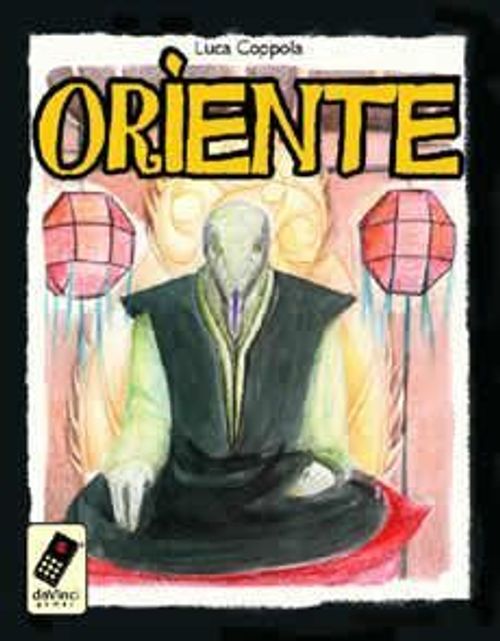
Oriente
Oriente Rulebook
Table of Contents
Table of Contents
Contents
- 55 cards:
- 41 Lords of Oriente (the playing deck); the lower the value, the lower the social rank:
- 1 Shogun (Shōgun) - value 7
- 2 Priests (Sōryo) - value 6
- 4 Wizards (Mahō-Tsukai) - value 5
- 5 Nobles (Daimyō) - value 4
- 6 Samurai (Samurai) - value 3
- 7 Merchants (Akindo) - value 2
- 12 Farmers (Nōfu) - value 1
- 3 Ninja (Ninja) - value 0
- 1 Geisha (Geisha) - no value
- Treasure cards (four worth 2 victory points each, four worth 3, four worth 4)
- the Workshop square with the hut
- 1 summary card
- 41 Lords of Oriente (the playing deck); the lower the value, the lower the social rank:
- 12 action disks
- 6 laborers
- 1 destiny token
- these rules
Game Overview and Aim of the Game
You are a leader in the land of Oriente, and hold the fate of the people in your hand. You try to become rich one season after another. You try to gain victory points by using the special abilities of various lords, or by entering into agreements to attack and defeat the others. At the end of the game, the player with the most points will be the winner.
Important: Each lord of the land has a value between 7 (Shogun) and 0 (Ninja). The lower the number, the lower his social rank. The number represents two things: 1) his combat value during a fight, and 2) the victory points that card is worth.
Preparation
-
The owner of the game chooses a player to receive the destiny token, or you can just choose at random.
-
Each player gets an action disk. Shuffle the treasure cards and deal one face up to each player. Keep this card face up in front of you. Place any unused disks and treasure cards back in the box as they are not needed.
-
Place the workshop in the middle of the table; put the six laborers next to it. Keep the summary card handy.
-
Now prepare the playing deck:
- Set the Geisha, the Shogun and the three Ninja aside for the moment, and shuffle the remaining cards.
- Divide these cards into three groups: two groups of four cards each and a group with the remaining cards.
- Put the first group of four cards face down on the table.
- Shuffle the Geisha into the second group of four cards, and pile these five cards on top of the first group.
- Shuffle the Shogun and the three Ninja with the remaining group and put it on top of the other cards.
Drawing the Geisha determines the end of the game: By preparing the cards this way, you will not know exactly when the game will end!
-
Each player draws one lord card face down from the top of the deck. You may examine your card secretly, then lay it face down in front of you.
-
Take the top card of the deck and put it face down sideways near the deck: this is the prize for the first player to "fulfill his destiny."
The Game
This game is not played in turns: it is played in seasons. During each season, you may perform one single action, then you must discard your action disk. Performing an action is called "fulfilling your destiny." However, you will not always be able to fulfill your destiny: often, your action will be cancelled by a lord who is more entitled to fulfill his destiny, because of his higher rank. The season is over when no player is able to fulfill his destiny, or when the remaining players choose to give up their opportunity to do so.
During each season, the sequence of play is always the same:
- declare an action
- call for privilege
- fulfill your destiny
This sequence repeats until all players pass in a row: the season is then over and a new one begins.
Declare an action
Starting with the player who holds the destiny token and proceeding clockwise, each player that still has his action token may either pass or declare an action and try and fulfill his destiny. If you have already used your action disk, then you must pass. As soon as someone declares an action, the round stops while the action is resolved. The declaring player must turn his lord face up (if it wasn't already), take the destiny token, and declare one of the following two actions:
- attack another lord, or
- use a special ability.
Example 1: Andrew has a Noble (Daimyo), and he declares "I fulfill my destiny!" He turns his card face up, revealing his Daimyo to all, and announces "I attack you, Danielle!"
Example 2: Andrew has a merchant, the Akindo. He declares "I fulfill my destiny!" turns the card face up and announces: "I use my special ability 'Credit' on you, Emma!"
Call for privilege
Even if you declare an action, it doesn't mean it will actually take place. After you announce which action you will take, you must ask the other players, proceeding clockwise, if there is anyone willing to call the privilege to cancel your declaration, and fulfill his destiny instead. You may choose between passing or calling your privilege. If a player calls the privilege, the round stops. You may only call the privilege if:
a) You still have your action disk; and b) Your lord is of higher rank than the declaring player, or he is of the same rank but you have fewer cards in your prize stack.
Important! The target of an attack or special ability may not call the privilege!
If you call the privilege, the player who declared an action is instead honored to hand over the right: the action he announced does not take place, and he keeps his action disk. He will be able to fulfill his destiny later in the season (since he still has an action disk), and can announce the same action he just attempted, or a different one.
When you call the privilege, you must turn your lord card face up, take the destiny token, and announce which of the two actions (attack or special ability) you wish to take. After declaring your action, you must then ask other players, again proceeding clockwise, if any of them wish to call the privilege. Another player of higher rank can cancel your declaration, and so on, until no player chooses to call the privilege.
Fulfill your destiny
If no one calls the privilege, then you may fulfill your destiny. Discard your action token. If you are the first player of the season to fulfill your destiny, then you take the prize card placed sideways by the deck, and place it under the destiny token. Then you take the action you declared, either attacking another lord, or using your special ability.
After the action is complete, you take this card from under the destiny token, and add it to your prize stack. The outcome of the action has no effect on taking this card: For example, if you attack another lord, you will keep this prize card whether you win the battle or not.
You must always keep all your prize cards lined face up in front of you (keep them sideways so they do not get confused with your lord).
Once you have finished your action, repeat the sequence described above. As before, starting with the player who has the destiny token, players may pass or declare an attempt to fulfill their destiny, etc. But: remember that only the first player of the season to fulfill his destiny will gain the prize card! If the prize card has already been taken, the other players can try to increase their score or their rank by fulfilling their own destiny.
End of the season
If all players pass, no one else will be able to fulfill his destiny that season. The season ends and a new one begins. Each player keeps his lord and continues to play with it, whether it is face up or face down. Each player that does not have an action disk takes one. A new prize card is placed next to the deck, face down (this card adds to the one from the previous season, if no one fulfilled his destiny that season), and a new season begins.
Here's a detailed look at the two possible actions:
- attacking another lord;
- using a special ability.
1. Attacking another Lord
In order to fulfill your destiny, you may attack any other lord, of any rank. The attacked player turns his lord face up (if it wasn't already) but he does not discard his action disk. The two players may then seek help from the other lords, by negotiating agreements freely. Each player helping in a fight turns his lord face up and discards his action disk. Then he adds the value of his lord to the value of the lord he is helping.
The total strength of both sides are then compared: the side with the highest sum of values wins. In case of a tie, the defending player wins. If you are the winner in a battle, you capture your opponent's lord (but not the lords who agreed to help him!) and add it to your prize stack. If you are the loser in a battle, then you immediately draw a replacement lord from the top of the deck and place it face down in front of you. Players helping either side keep their lords.
Example: At the start of the season, the Shogun (value 7) takes the destiny token and announces an attack against a Maho-Tsukai (value 5). No one may call the privilege over the Shogun, so he fulfills his destiny: he discards his action disk, puts the prize card under the destiny token and the battle begins. The Maho-Tsukai alone would lose the fight against the Shogun (7 vs. 5), and so he asks for the help of a Nofu (value 1) and of another lord who is still face down, by offering one card from his prize stack. Both players agree to help. The face down lord is turned face up (another Nofu) and both players discard their disks. The Maho-Tsukai only needs a tie to win the fight (7 vs. 5+1+1=7)! The Shogun is defeated!
Since he was the first player of the season to fulfill his destiny, the Shogun takes the prize card and adds it to his prize stack (note that it does not matter that he lost the fight). The prize card is a Daimyo, which is worth 4 victory points. The Maho-Tsukai captures the Shogun and adds it to his prize stack. The defeated player immediately draws a new lord face down from the top of the deck. The Maho-Tsukai is not forced to obey his agreement with the two Nofu; however, he decides to be fair: he gives the two Nofu a Samurai from his prize stack (worth 3 victory points). But this is only one card! So the two Nofu must reach an agreement: one of the two adds the Samurai to his prizes and gives the other a Nofu card taken from his prize stack (1 victory point); he also promises that he will give another Nofu as soon as he gets one.
2. Using a special ability
In order to fulfill your destiny, you may use the special ability of your lord.
The Daimyo, Akindo and the Nofu each have two special abilities: you may choose to declare either one of the two (but not both at the same time).
The special abilities of the Shogun and the Samurai activate automatically during each battle: they may not fulfill their destiny by declaring a special ability. If they want to fulfill their destiny, they must attack another lord.
7 Shōgun
Invincible defense: the Shogun wins all battles when he is the target of an attack. When he attacks, he may be defeated normally. His ability does not work when he is helping another player.
6 Sōryo
Prayer: the Soryo takes the prize card(s) (provided it is still available) and adds it to his prize stack.
5 Mahō-Tsukai
Transmutation: the Maho-Tsukai becomes another lord and changes all the others! Put your Maho-Tsukai at the bottom of the deck. Take all the lords in play, and secretly choose one: you become that lord (place it face down in front of you). Take a card from the top of the deck, add it to the remaining lords, shuffle them and deal one face down to each of the other players. The Maho-Tsukai may not use his special ability if there is another face up Maho-Tsukai in play.
4 Daimyō
Annuity: the Daimyo takes the top card from the deck and adds it to his prize stack.
Succession: if the Shogun is in play, or is in the prize stack of any player, the Daimyo may target him and swap places with him.
3 Samurai
Martiality: during a battle, after helpers have chosen sides, the Samurai turns over the top card of the deck, and adds that value to his strength. If he defeats another lord, that player takes the turned-over card as his replacement; if more than one Samurai is involved in a battle, the defeated player may choose which revealed lord to keep, while the others go to the bottom of the deck. Exception: if any Ninja would go to the bottom of the deck, the player who won the battle adds them to his prize stack instead.
2 Akindo
Credit: the Akindo chooses another player and takes all the Nofu cards from his prize stack.
Trading: the Akindo chooses another player and takes a card from his prize stack chosen at random. At the same time, the Akindo gives him a card of his choice taken from his own prize stack: if he has no cards: too bad! The Akindo may not use either of his abilities on another face up Akindo.
1 Nōfu
Recruitment: a Nofu may recruit one laborer and put him in the hut of the workshop square. However, if there is already a laborer in the hut he does not add another, but instead moves that laborer from the hut to the square. The laborers in the square are only used with the second special ability of the Nofu: Revolution. A laborer in the hut is only useful because he may later be moved to the square.
Special rule for 4 - 7 players: the laborer is added directly to the square, not to the Hut. The Hut is ignored.
Revolution: When a Nofu declares a Revolution action, the points of the oppressors will be redistributed among the Nofu. If a Revolution has been declared, then you can only call the privilege if your rank is at least equal to the value of the Nofu (1) plus the number of laborers in the square (not the hut).
Example: A Nofu calls for Revolution and there are 2 laborers in the square. In order to call privilege, you must have a rank higher than 3, or a rank of 3 but with fewer cards in your prize stack.
If your Revolution succeeds (the Nofu fulfills his destiny), you then ask the other players, proceeding clockwise, if any other Nofu wants to join you: any Nofu who still has his action disk may participate in the Revolution by turning their card face up (if it wasn't already) and discarding their action disk. At this point, all players turn their lords face up. Determine the strength of the Revolution: this is the sum of the number of Nofu participating, plus the number of laborers in the square (not in the hut). Any player whose rank is equal to or less than the strength of the Revolution is defeated; exception: all Nofu and Ninja are immune. Each player defeated by the Revolution takes half (rounded down) of his prize cards at random, and gives them to the Nofus participating in the Revolution. These Nofus shuffle all these cards together with their own point cards and distribute them randomly one by one between them, starting with the Nofu who announced the Revolution and proceeding clockwise. At the end of the Revolution, all the laborers in the square run away: remove them from the square and put them nearby like the beginning of the game.
Example of Revolution: Soryo (A) asks if anyone wants to fulfill their destiny: B says no, Nofu C says yes and declares a revolution. He asks in turn if anyone wants to cancel his declaration by calling the privilege, but all players say no. Akindo (E) would want to, but he can't: the Nofu is supported by the laborer in the square, and thus in order to cancel this declaration the Akindo would have to have fewer prize cards than the Nofu. At this point, the Nofu asks if there are any other Nofu who want to join the revolution: G does, and unveils his Nofu. All the lords are turned face up: B is a Ninja, and is immune to the revolution; D is a rich Nofu, and he won't be hit by the revolution either! Since the strength of the revolution is 3 (2 Nofus plus one laborer in the square), it strikes both the Akindo (E) and the Samurai (F) but not the Soryo (A). The two defeated lords offer their point cards to the Nofu, who draws half of them (rounded down) randomly: two cards from the Akindo, one from the Samurai. The revolutionary Nofus add to these three cards their 6 and 2 (both belonging to B, G does not have any!), they shuffle those cards and deal them to themselves face down. The Nofus reveal their points: Nofu C has got a 0, a 2 and a treasure 3; Nofu G, 1 and 6 (Akindo kept 1 and a treasure 3; Samurai 4 and 7). Nofu G has gained something after the revolution, C has lost some points but has gained a precious Ninja, who is useful for the special victory condition (see below). The laborer is removed from the square.
0 Ninja
Assassination: the Ninja points to another lord and adds that card to his points stack. The player losing his lord immediately draws a new one from the deck (face down). The Ninja may not use his ability to assassinate another face up Ninja.
Agreements and Negotiations
At any time during the game, you may enter into public agreements with other players. These agreements might concern battles, help during a battle, use of ability, calling the privilege, etc. and may involve any trade or payment in prize cards, even promises of future payments. It is forbidden to trade or give away your lord, or to give away your points for free. There are no other limitations to deals and negotiations. However, you are never forced to honor your deals or obey your promises!
Example of play: At the beginning of a season, a Nofu (value 1) attempts to fulfill his destiny by Recruiting a laborer. He takes the destiny token, and asks the other players if someone is calling the privilege or not. An Akindo (value 2) calls the privilege, takes the destiny token and announces an attack against another lord, who still lies face down. This lord cannot call the privilege, even if he is of higher rank than the Akindo, because he is the target of the Akindo's attack. So, he offers a deal to a Daimyo (value 4): one Nofu from his points for the Daimyo to call the privilege, cancel the Akindo declaration and attack the Akindo himself! The Daimyo accepts. He adds the Nofu to his points, but does not obey his agreement! When the Akindo asks if anyone wants to call the privilege, the Daimyo does, but after taking the destiny token, he declares his Annuity instead! However, when the Daimyo asks the others if anyone wants to call the privilege, the face down lord does: he reveals himself to be a Soryo (value 6), he cancels the Daimyo's declaration, takes the destiny token and announces that he is using his Prayer ability. No one cancels the declaration of the Soryo, and he fulfills his destiny. He discards his action disk, puts the prize card under the destiny token, and performs the Prayer: he takes the prize card and adds it face up to his prize stack.
End of the Game and Victory
As soon as the Geisha is drawn, the game ends. Each player adds his current lord to his points. The player with the highest total is the winner. In case of a tie, the winner among tied players is the one with the single card of the highest value.
Special victory
A player wins the game immediately if he has all three Ninja in his points stack at the end of any season.
Summary of the Lords of the Land of Oriente
- 1 x 7 Shōgun - Invincible defense: he wins all battles when he is the target of an attack.
- 2 x 6 Sōryo - Prayer: he takes the prize card, provided it is still available.
- 4 x 5 Mahō-Tsukai - Transmutation: he becomes another lord and changes all the others.
- 5 x 4 Daimyō - Annuity: he takes the top card from the deck. / Succession: he swaps places with the Shogun.
- 6 x 3 Samurai - Martiality: during each battle, he adds the value of the top card of the deck to his strength.
- 7 x 2 Akindo - Credit: he takes all the Nofu from another player. / Trading: he takes a card at random from another player, and gives him one of his cards.
- 12 x 1 Nōfu - Recruitment: he recruits one laborer / Revolution: Nofu joining the Revolution shuffle prize cards from others together with theirs, and redistribute them.
- 3 x 0 Ninja - Assassination: the Ninja points to another lord and adds that card to his points stack.