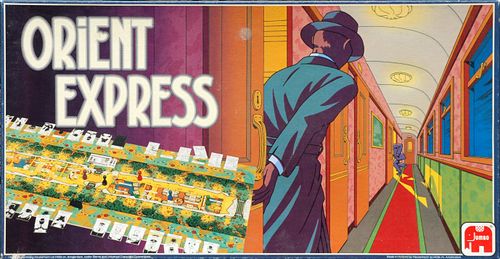
Orient Express
Orient Express Rulebook
Table of Contents
Table of Contents
Contents of a Box
- A plan of the train (playing-board)
- 6 playing pieces
- 1 special die (1 and 6 red, 2-5 green)
- 1 note-book
- 10 mystery plots
- 12 chips in 6 colours
- 1 train
Preparation
Put the playing-board in the centre of the table. You see a plan of a train. Each player selects a playing piece and places it on the connection between the two carriages. The players get two chips in the colour of their pawn. The train is placed on the Paris section. The players get a sheet of note-paper each. Each large sheet in the box covers 1 complete mystery. It is recommended to play the plots in the correct order. So number I first (the folding table). You don't separate the cards until you actually start playing a game. Without reading the cards you tear them gently along the perforation. There are 30 ordinary cards, two super clues and 1 reconstruction in all for each case. You put the 30 ordinary cards with the text face down on the sections of the playing-board. So the card baroness on the section baroness, the card telegram victim on the section of that name, etc. The 2 super clues and the reconstruction you leave face down and you put these aside.
The Playing-Board
On the playing-board you see the plan of the two carriages of the Orient Express. Around these you see the distance which the train covers in this game. So from Paris to Istanbul with all the important intermediate stations.
On the long sides on the sections destined for that purpose all clues are situated, which are put at your disposal during the game. In each case you play there are eight suspects, viz. the actress, the baroness, the ballerina, the count, the colonel, the fortune-teller, the diplomat and the gambler. Besides there is a staff of seven: the chief guard, the conductor, the doctor, the steward, the porter, the waiter and the cook, none of whom can actually be the culprit. You can interrogate these fifteen people. Besides you can search the train sections: first-class, second-class, the saloon, the kitchen, the restaurant and the library. In addition telegrams about the suspects and the victim are read out from time to time. This is background information which can be very useful.
30 clues for each case in all. Clues which lead beyond any doubt to the culprit or culprits. At least if you use your grey matter. All people (suspects and personnel) are seated in fixed seats on the train at the beginning of the game. So the actress is seated in compartment 21, the waiter in the restaurant of course and the gambler is seated in the library, etc. Just look in the train where the 15 people are. This doesn't mean that the suspects were also there at the time of murder. They are there the moment you interrogate them. The fact that the actress is now seated in sleeping compartment 21 doesn't mean that the compartment is actually hers. She just happens to be there for a while.
If you have already had a number of clues, but if it doesn't make sense to you yet, you can make use of a so-called super clue. You are helped well on your way by this. There are two of these super clues. If you want to make use of these, you have to take super clue I first and possibly later, not until a next turn, number II.
Purpose of the Game
Who solves the crime and needs fewer clues than the other detectives?
The Game
The playing pieces are moved from the connection between the carriages. These are the detectives, which will subject the train, the personnel and the passengers to a search. The players throw the special dice in turn and move their detective. They move their detective through the train sections to a maximum they have thrown. So if a player throws '4' he may move his pawn 1, 2, 3 or 4 sections. The train sections are separated by a dotted line. Detectives may move through the train along a route which the players have chosen themselves. When a detective halts at a suspect, a member of the staff or in a section and he wants to interrogate somebody or search the space, he takes the corresponding card from the edge of the board. A player may turn one card only each turn. For instance: a playing piece arrives at the restaurant. Here you will find the waiter and the colonel. It is up to the player which card he wants to turn: the waiter's, the colonel's or the card of the restaurant. That player may possibly leave his piece standing in a next turn in order to turn one of the other cards. He must however throw the special dice then!
The Special Dice
The players throw with the special dice. At the beginning of the game the train is put on the section 'Paris'. Each time a player throws 2, 3, 4 or 5 (green), the train is moved one station further then. If a player throws 1 or 6 (red), the train remains standing.
When a player has thrown 2, 3, 4 or 5 and this player halts his piece at a place where more information can be obtained, he takes the card and reads it out loud. The card is put back face up to that end. Players may always reread these cards which lie 'face up'.
When a player has thrown 1 or 6 and he halts his piece at a place where more information is available, only he reads this information then. The information is kept secret from the other players. Consequently the card is put back face down. Should a second player with 1 or 6 arrive at the same place, only he reads the information then. When another player has thrown 2, 3, 4 or 5 later on and he wants to turn this card, it is read out loud then and put down face up.
The players use the sheet of note-paper to take notes and to cross out the suspects, members of the staff and spaces of which they already know the cards. For instance: explanations of the diplomat's actions you note next to his name.
The players get to know more and more in this way and the secret is being gradually revealed all the time. There is however no time to be lost. The train leaves from Paris and when it arrives in Istanbul the game is over and the players have to expose the culprit(s). The players get extra information on the way. Each time a player moves the train to a station with a 'T' he may choose a telegram about one of the suspects or about the victim. Telegrams must always be read out loud. They cover background information which can be very useful. Telegrams are extra. In the same turn a player may also read another card.
If you decide to take a super clue on the way, you put one of your two chips in the section destined for that purpose in the centre of the board (S) and gently tear super clue I loose. You must always take super clue I first. It counts for 6 other clues. If you take the second super clue in a next turn, you also put your second chip in section S. Super clue II counts for 10 clues.
Counting
If one of the players thinks he knows the culprit(s), he doesn't reveal his solution yet but notes it on his sheet of note-paper. The clues are counted which lie face up at that moment. If this player has used super clue I, 6 points are added; if he has used super clue II as well, another 10 points are added. This total is noted by each player behind his solution on the sheet of note paper. The other players continue their game till they have also found a solution or till the train has arrived in Istanbul. The proper solution is read out then, i.e. super clue I first, then II and finally the reconstruction. If there are more detectives with the proper solution, the issue is then who has found the proper solution with the least number of clues. These were the rules of the game. There are a number of important features which you should take into account.
Important Features
-
Each case you play is a new one. This means that possible qualities which somebody possessed in a previous case are cancelled. The baroness, being an evil woman in one case, can be a very good person in a next case, etc. Somebody called Johnson in one case, can be called Jones in a next case, etc.
-
Nobody lies, but the people can keep things secret. All facts presented are true. If somebody says that he was eating between 5 and 6, then that is true beyond any doubt. He can't however have been somewhere else at that hour, unless that is clearly stated. If somebody gives his opinion about another person, you can take that with a pinch of salt. For instance: if the actress says: 'I would not trust the count if I were you', this doesn't mean that the count can't be trusted. It can be true, but not necessarily.
-
Clues and hints from personnel are very important. They are at no time intended to put you on the wrong track and surely deserve to be followed.
-
The doctor has examined the victim. He can answer at the most one or more of the next questions:
- Who has been murdered?
- Where did the murder take place?
- How did the murder take place?
- At what time did the murder take place?
-
You must not associate qualities of character with the suspects if they are not obviously apparent. Possible (qualities of) characters which you associate with a gambler or a baroness are therefore not always applicable.
-
The personnel is always innocent of course. The culprit(s) are found amongst the eight suspects.