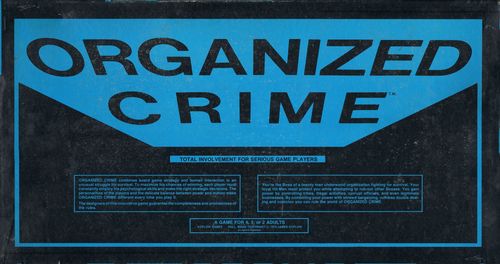
Organized Crime
Organized Crime Rulebook
Table of Contents
Table of Contents
Overview
ORGANIZED CRIME is a game of survival. It has been designed so that varying combinations of money, power and shrewdness will help you reach your goal - the survival of your Boss. However, possessing the most power or money does not guarantee that you will win the game. To win, you must manipulate other players, form temporary alliances and make decisions beneficial to your position.
ORGANIZED CRIME demands your total involvement. As a member of the National Commission of Bosses, you will constantly be called upon to vote the distribution of income and penalties for all players. It is during these National Commission meetings that the psychological and strategic demands of the game come together.
In strategic and psychological terms, here are some of the decisions you will have to make:
- How many Hit-Men should you keep in your Home Base? Early in the game, buying Hit-Men to defend the Home Base is vital; yet, since each $100,000 in a player's possession gives him an additional vote on the National Commission, it is tempting to skimp a little on defense. This can be disastrous.
- How do you vote when an opponent asks for a Business Investment, Illegal Activity or City? You can vote in favor of the request, thereby giving that player additional income. Or you can vote "no", which may cause that player to hold a grudge or vote "no" when you ask for income properties.
- How many Corrupt Officials or income properties should you acquire? Each Marker you use reduces the number of potential Hit-Men available to defend your Boss. Remember, you have only 20 men with which to play the game and attrition becomes crucial at the end.
- Which Hit-Men should you move and in which direction should you move them? Your Hit-Man can move to a space that will improve your strategic position; your Hit-Man can attack another Home Base; or your Hit-Man can move around the playing track acquiring Income Properties, Power, or Corrupt Officials. Every move should be made after careful consideration of your own position and the position and attitudes of other players at the time.
In order to survive, you must obtain maximum efficiency from your psychological and strategic skills. Often, the smallest detail will be the difference between victory and defeat and nothing is worse than being beaten by your own blunder.
Preparation for playing ORGANIZED CRIME is important. Included in the Bylaws are several examples which you will be asked to set up on the board. Following these examples is necessary for a complete understanding of rub-out procedures and movement of Hit-Men.
Bylaws
These are the Bylaws of ORGANIZED CRIME. They must be read thoroughly in order to play this game properly. These Bylaws are complete and are meant to be taken literally.
Object
The object of the game is to be the only surviving player. A player is eliminated when his Boss is removed from the game.
Commission Treasury
One player is chosen Treasurer and operates the Commission Treasury. Each player receives $150,000 from the Treasury at the start of the game. The Commission Treasurer distributes and collects for the Treasury all money paid for Markers, Hit-Men, Mistakes, Power, and Government.
Pieces
Each set of pieces contains 20 Men and one Boss.
MEN - Men may be used as Hit-Men or Markers:
- Hit-Man - During his turn, a player may buy Hit-Men which must be placed in his "Home Base Hit-Men". A Hit-Man remains on the space he occupies until moved or rubbed out.
- Markers - A Marker is placed in the appropriate circle on the board, outside the main playing track, to indicate ownership of a City, Illegal Activity, Business Investment or Corrupt Official. Each circle accommodates only one Marker at a time. Once placed on the board, a Marker can never be moved, except when removed from the game.
A player must pay $10,000 to the Treasury for each Man he places on the board. Once designated Hit-Man or Marker, a Man cannot change functions. When a Man is removed from the board, it is out of the game and cannot be reused.
BOSS - The Boss is the most important Hit-Man on the board. He differs from other Hit-Men in that:
- He is larger;
- He is the only piece placed on the board without payment;
- He starts from the space marked "Home Base Boss".
Once a player's Boss is removed from the board, that player is out of the game.
The Cards
There are four decks of cards: Power, Corrupt Official, Mistake and Penalty. After use, cards are discarded face up at the bottom of their decks. When all cards in a deck have been drawn, the deck is shuffled and reused.
POWER CARD - A player may obtain Power cards in any of the following ways:
- by landing on a space marked "Power" and drawing the top card from the Power deck;
- by paying the Treasury $200,000 for each card to be drawn from the top of the Power deck. A player may buy Power cards during his turn only;
- by eliminating another player from the game, thereby assuming ownership of that player's Power cards;
- by receiving them as part of a bargain.
There are two types of Power cards:
- Hit - These cards are used to rub out Hit-Men.
- Money - These cards may be exchanged for $100,000 at the Treasury.
NOTE: Power cards may be kept hidden until used.
CORRUPT OFFICIAL CARD - A player may obtain Corrupt Official cards in three ways:
- by landing on a space marked "Corrupt Official" and drawing the top card from the Corrupt Official deck;
- by eliminating another player from the game, thereby assuming ownership of that player's Corrupt Official cards;
- by receiving them as part of a bargain.
There are three types of Corrupt Official cards: 1. Judge, 2. Governor, 3. U.S. Senator.
On any of his turns, a player may purchase an unowned Corrupt Official, providing he has a corresponding Corrupt Official card, a Man to use as a Marker, the price of the Corrupt Official as stated on the card and the price of the Marker. (Example: Ownership of a Governor is arranged this way: 1. by presenting a Governor card; and 2. by paying the Treasury $30,000 - the price of a Governor; and 3. by paying the Treasury $10,000 - the price of a Marker; then 4. by placing the Marker on the appropriate circle.)
Owning a Corrupt Official does not provide income for a player. However, a player receives two additional votes on the National Commission for each Corrupt Official he owns (See: The National Commission). Owning a Corrupt Official also can help a player avoid some Mistakes. NOTE: Corrupt Official cards may be kept hidden until used.
MISTAKE CARD - If a player's Hit-Man makes a Mistake, that is, he lands on a space marked "Mistake", the player draws the top card from the Mistake deck and reads it aloud. He must comply as soon as possible.
There are two types of Mistake cards:
- Remove the Hit-Man from the game;
- Pay the Treasury a fine.
PENALTY CARD - A Penalty card must be drawn when a penalty is voted by the National Commission (See: Penalty section under The National Commission). If the Commission votes a player a penalty, he draws the top card from the Penalty deck, reads it aloud, and complies with the penalty as soon as possible.
There are three types of Penalty cards:
- Remove a Hit-Man or Hit-Men from the game;
- Pay money to another player;
- Lose voting power of Corrupt Official(s).
NOTE: If a player's Boss is removed from the board due to a Penalty or a Mistake, that player is out of the game. His money is returned to the Treasury and his cards are returned to the bottom of their respective decks. All of his Hit-Men and Markers are removed from the game.
Moving Hit-Men
A "move" is the use by a Hit-Man of his share of the roll of the dice. A Hit-Man has "landed on" the space he occupies at the end of his move.
GENERAL MOVEMENT - Each count of the dice can be used to move a Hit-Man from the space he occupies to an adjacent space. NOTE: "Home Base Hit-Men" is adjacent to three spaces - the two spaces connecting it with the main playing track, and "Home Base Boss". On his turn, a player may move either one or two Hit-Men. Before rolling the dice, he must specify which Hit-Man or Hit-Men he will move. Also, before rolling the dice, he must specify the direction - either right or left - each Hit-Man will move on that turn. If two Hit-Men are being moved on the same turn, the total rolled on the dice is split as evenly as possible. (Example: On his turn, a player specifies he will move Hit-Man A to the right and Hit-Man B to the left. He throws a six and a one, for a total of seven. He must move one Hit-Man four spaces, and the other Hit-Man three spaces.)
A Hit-Man may enter the main playing track from his Home Base onto either of the two adjacent track spaces. If any part of a Hit-Man's move is along the main playing track, that Hit-Man must use at least one count of the dice to go in his specified direction before he can go in the opposite direction. During a move, a Hit-Man cannot return to the space he has just left. Moving between the inside and outside tracks and changing direction can be accomplished only through the "Government" spaces. A Hit-Man can never cross the thick black line. (Example: One Hit-Man is on the space marked "Oakland" and the other Hit-Man is in the Home Base near the space marked "Boston". The player specifies the Hit-Man on Oakland will move to the right and the Hit-Man in the Home Base will move left. The player rolls a six. The Hit-Man on Oakland has a choice of landing on one of three spaces - Boston, Corrupt Official, or Power. The Hit-Man in the Home Base has a choice of landing on one of two spaces - Boston or Mistake.) (See the diagram in the original rulebook.)
A Hit-Man may enter another player's Home Base only when he has declared an attack. He cannot return to his Home Base unless he has completed a successful attack on another Home Base (See: Rubbing Out the Boss in the Home Base).
The Rub-Out
A rub-out can occur only when two Hit-Men occupy the same space. During a player's turn - AND AT NO OTHER TIME - his Hit-Man may rub out other Hit-Men using counts of the dice and/or "Hit" Power cards for the rub-outs.
(Example: Place one Green Hit-Man on the space marked "Boston" and one Green Hit-Man on the space marked "Mistake" next to Boston. Now place a Yellow Hit-Man on the space marked "Business Investment" two spaces to the right of Mistake. It is Yellow's turn. Yellow decides to rub out the two Green Hit-Men, if possible. (This need not be announced.) He specifies he will move the Hit-Man on Business Investment to the left. Yellow rolls a six. He moves his Hit-Man left, using count number:
- to Corrupt Official;
- to Mistake;
- rub out the Green Hit-Man on Mistake and remove him from the game;
- to Boston.
He then uses "One Hit" (or "One or Two Hits") Power card to rub out Green Hit-Man on Boston and remove him from the game;
- to State Government;
- to Corrupt Official. Stop.
Yellow picks a Corrupt Official card, completes his turn and passes the dice. Green may now call for a penalty.)
Rubbing Out an Opposing Boss
On a player's turn, his Hit-Man may rub out an opposing Boss on any space on the board (including the Home Base). When a player's Hit-Man rubs out another player's Boss, the attacking player receives all of the eliminated player's Power and Corrupt Official cards. All of the eliminated player's other cards are turned in and all of his Hit-Men and Markers are removed from the game. The eliminated player's money is divided as evenly as possible between the attacking player and the Treasury. In cases of odd amounts, the extra $10,000 goes to the Treasury.
When a player is eliminated from the game, the Treasury immediately pays his debts. All debts owed to the eliminated player are now owed to the Treasury.
RUBBING OUT A BOSS ON THE MAIN PLAYING TRACK - A Boss may be rubbed out on the main playing track in the same manner as any other Hit-Man.
RUBBING OUT THE BOSS IN THE HOME BASE - A Boss may be rubbed out in the Home Base only by a Hit-Man carrying out a declared attack.
ATTACKING THE HOME BASE - On a player's turn, his Hit-Man may attack a Home Base. Before the roll of the dice, the attacking player must declare that a specific Hit-Man will attack a specific Home Base. He also must specify the direction the attacking Hit-Man is moving. An attacking Hit-Man may enter a space marked "Home Base Hit-Men" from either adjacent track space. He may then use counts of the dice and/or "Hit" Power cards to rub out Hit-Men. A Hit-Man cannot move to the space marked "Home Base Boss" until all other Hit-Men in the Home Base Hit-Men are rubbed out. Once he has moved to the space marked "Home Base Boss", the attacking Hit-Man may rub out the Boss with a count of the dice or a "Hit" Power card. An attack on a Home Base has failed if the attacking Hit-Man does not rub out the Boss. An attack on the Home Base has succeeded if the attacking Hit-Man rubs out the Boss.
FAILED ATTACK - When a declared attack on the Home Base has failed, the attacking player must remove the attacking Hit-Man from the game before passing the dice. In addition, the attacking player owes the attacked player $200,000, payable when the attacking Hit-Man is removed (See: Debts). If any of his Hit-Men were rubbed out, the attacked player may call for a penalty.
SUCCESSFUL ATTACK - At the completion of a successful attack, the attacking Hit-Man is returned to his Home Base Hit-Men. NOTE: This is the only time a Hit-Man may be returned to his Home Base.
SAMPLE RUB-OUTS OF THE BOSS IN HIS HOME BASE - Place a Green Hit-Man on the space marked "Chicago". Place five Yellow Hit-Men in the space marked "Home Base Hit-Men" nearest Chicago. Place the Yellow Boss in the space marked "Home Base Boss" adjacent to the Yellow Hit-Men. The player controlling the Green Hit-Man on the space marked "Chicago" specifies that Hit-Man will move to the right and attack Yellow's Home Base. This setup of men is to be used for both the following examples.
Example I. Green rolls a seven. He moves right, using count number:
- to Mistake;
- to Corrupt Official;
- to Yellow's Home Base Hit-Men;
- rub out one Yellow Hit-Man;
- rub out one Yellow Hit-Man;
- rub out one Yellow Hit-Man;
He then uses two "One Hit" Power cards or a "Two Hits" Power card to rub out two more Yellow Hit-Men. All rubbed out Yellow Hit-Men are removed from the game.
- to enter Yellow's Home Base Boss. NOTE: The player controlling the Green Hit-Man can enter Yellow's Home Base Boss only with a count of the dice.
He then uses a "Hit" Power card to rub out the Yellow Boss. The Yellow Boss is removed from the game.
Example II. Set up as previous example. Green rolls an 11. He moves right, using count number:
- to Mistake;
- to Corrupt Official;
- to Yellow's Home Base Hit-Men;
- rub out one Yellow Hit-Man;
- rub out one Yellow Hit-Man;
- rub out one Yellow Hit-Man;
- rub out one Yellow Hit-Man;
- rub out one Yellow Hit-Man;
All rubbed out Yellow Hit-Men are removed from the game.
- to enter Yellow's Home Base Boss;
- rub out Yellow's Boss;
The Yellow Boss is removed from the game.
- this move is not needed and therefore is not used.
Yellow is now out of the game. The successful Green Hit-Man in the space marked "Home Base Boss" returns to his space marked "Home Base Hit-Men". The player completes his turn and passes the dice.
The National Commission
The National Commission, which consists of all the players in the game, votes on the distribution of Income Properties and Penalties.
VOTES - Each player is entitled to:
- one vote for his Boss;
- one vote for each $100,000 in his possession;
- two votes for each Corrupt Official he owns (unless limited by a Penalty card).
A player may cast any portion of the votes to which he is entitled.
INCOME PROPERTY - A player earns income from ownership of property - Cities, Illegal Activities and/or Business Investments. A player cannot acquire Illegal Activities or Business Investments until he owns his first City.
FIRST CITY - A player acquires his first City in the following manner only:
- His Hit-Man lands on a space marked with the name of an unowned City; and
- On the same turn, he notifies the National Commission of his intention to acquire that City; then
- On the same turn, he buys a Marker for $10,000 and places it on the circle representing ownership of that City outside the main playing track.
ADDITIONAL CITIES - A player acquires Additional Cities in the following manner only:
- His Hit-Man lands on a space marked with the name of an unowned City; and
- On the same turn, he calls a National Commission Meeting (See: Commission Meeting) and asks permission to acquire that city.
If the Commission votes approval of the acquisition, then 3. On the same turn, the player buys a Marker for $10,000 and places it on the circle representing ownership of that approved city outside the main playing track.
BUSINESS INVESTMENTS - A player acquires a Business Investment in the following manner only:
- His Hit-Man lands on a space marked "Business Investment"; and
- On the same turn, he calls a Commission Meeting and specifies the Business Investment he wishes to acquire.
If the Commission votes approval of the acquisition, then 3. On the same turn, the player buys a Marker for $10,000 and places it on a circle representing ownership of that approved Business Investment.
ILLEGAL ACTIVITIES - A player acquires an Illegal Activity in the following manner only:
- His Hit-Man lands on a space marked "Illegal Activity"; and
- On the same turn, he calls a Commission Meeting and specifies the Illegal Activity he wishes to acquire.
If the Commission votes approval of the acquisition, then 3. On the same turn, the player buys a Marker for $10,000 and places it on a circle representing ownership of that approved Illegal Activity.
PENALTY - A player receives a penalty when it is voted by the National Commission.
Calling for a Penalty - A player may call for a penalty only when any of his Hit-Men are rubbed out. (Definitions: The player whose Hit-Man is rubbed out is called the "offended" player; the player whose Hit-Man makes a Hit is called the "offending" player.) A penalty is called for at the end of the offending player's turn (the turn on which the rub-out occurred) - that is, within 10 seconds after he has passed the dice.
Multiple Penalties - All players offended on a single turn have the right to call for a penalty. No player may call for more than one penalty on a single turn. If more than one penalty is called for during a single turn, the Commission considers each penalty in the order in which the rub-outs occurred.
If the Commission votes a penalty, the offending player draws the top card from the Penalty deck, reads it aloud, and complies with the penalty as soon as possible.
Drawing a Penalty card is the only type of penalty that can be issued.
COMMISSION MEETING - A player can call a Commission Meeting only when seeking Additional Cities, Illegal Activities, or Business Investments or calling for Penalties. The Commission Meeting proceeds in the following manner:
-
The player calling the meeting presents the issue.
Example I. A player's Hit-Man lands on "Illegal Activity". He calls for a Commission Meeting and says: "I want a piece of the action in Narcotics and I would like a favorable vote from the Commission because I need a new connection."
Example II. A Yellow Hit-Man rubs out a White Hit-Man. At the conclusion of Yellow's turn, White calls for a Commission Meeting and says: "I would like to ask the Commission to give Yellow a penalty because he rubbed out my favorite Hit-Man Tom, who was minding his own business."
-
Bargaining for votes begins (See: Bargaining). After ample time, the player who brought the issue to the Commission can call for a vote - thereby stopping all bargaining.
-
Voting begins to the left of the player who called the meeting and proceeds to the left. Each player votes in turn by displaying to the Commission the number of votes he is casting. Votes cast out of turn do not count and must be recast in turn. Properly cast votes cannot be changed. A majority of the votes cast is needed to carry. A tie vote does not carry.
-
At the conclusion of the vote, the Commission remains in session to allow for completion of bargains, payment for and placement of Markers, or drawing of Penalty cards.
-
The Commission Meeting ends.
BARGAINING - A player may bargain cards, money and promises at any time during the game except while the Commission is actually voting. However, the only time cards and money can change hands among players is during a Commission Meeting (except for the payment of debts). Bargains are not binding.
Debts, Income and Accounting
DEBTS - A debt is incurred when a player lacks sufficient funds to pay money owed to another player or to the Treasury. When a player is in debt, he can use his money only to pay off his debts - in the order in which they were incurred.
COLLECTING INCOME - During his turn, a player can collect his income from the Treasury - but only upon request. A player's income is equal to the total value of his holdings (Cities, Illegal Activities, Business Investments) at the start of his turn. (Example: At the start of his turn, a player owns New York ($40,000), one Narcotics Activity ($30,000) and one Trucking Investment ($20,000). On his turn, he can collect $90,000.) (See: The National Commission: Income Property.)
ACCOUNTING - A player may ask for an accounting of any other player's money at any time during the game.
How to Start
Shuffle the decks of cards and place them on the appropriate spaces on the board. The Treasurer gives each player $150,000 to start the game.
CHOICE OF HOME BASE - Each player rolls the dice; high roller takes a set of pieces and has first choice of Home Base. Second highest has next choice, etc. Once he chooses his Home Base, a player places his Boss in the space marked "Home Base Boss".
TO BEGIN - Each player again rolls the dice; high roller goes first and play proceeds to the left.
A TURN - A player's turn begins when he receives the dice, unless a rub-out has occurred on the preceding player's turn. When a rub-out has occurred, the player must wait 10 seconds after receiving the dice to allow the offended player(s) time to call a Commission Meeting to ask for a penalty. If an offended player calls a Commission Meeting, a player's turn begins after the meeting.
A player's turn ends when he passes the dice. On his turn, a player may do any of the things he is entitled to do in any order he wishes, unless otherwise directed by these Bylaws.
On his turn, a player must throw the dice and use the entire count (except if he rubs out an opposing Boss in the Home Base).
These Bylaws are complete and are to be interpreted literally. All players must agree to abide by these Bylaws.