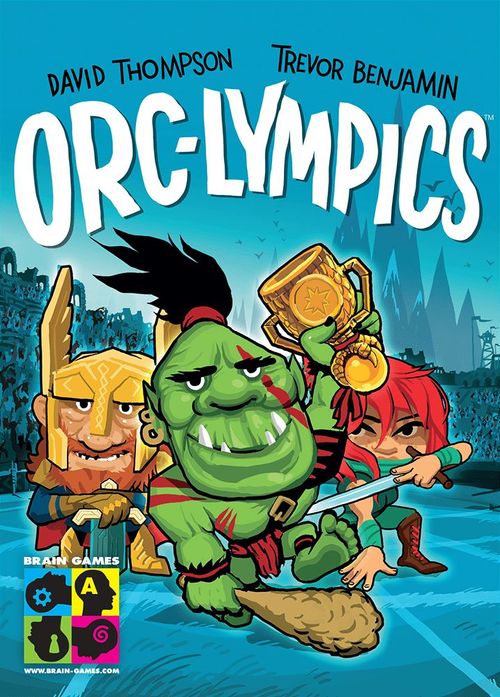
Orc-lympics
Orc-lympics Rulebook
Table of Contents
Table of Contents
Components
- 42 Orclympian cards (9 humans, 7 goblins, 7 dwarves, 7 elves, 4 orcs, 4 halflings, 4 djinns)
- 15 Competition cards
- 12 Standard Competitions (worth between 3 and 6 points)
- 3 Main Events (worth 7 points)
- 2 Cup tokens (Gold and Silver)
- 2 standees (to hold the gold and silver cups)
Each Competition card shows its Type of Competition, the Value of its Gold Cup (front side) and the Value of its Silver Cup (back side).
Orclympian cards
There are seven races of Orclympians (humans, goblins, dwarves, elves, orcs, halflings, djinns). Each race has its own distribution of skill points across three skills — Speed, Cunning and Strength. Humans are the most common but have the least total skill points (one rarity dot). Goblins, dwarves and elves are uncommon and moderately skilled (two rarity dots). Orcs, halflings, and djinns are the least common but have the most skill points (three rarity dots).
Aim of the Game
In Orc-lympics, players draft a team of Orcs, Elves, Halflings and other fantasy Orclympians, each with their own strengths and weaknesses. Then they enter these Orclympians into a series of seven Competitions. To score points in a Competition, a player's Orclympians must have the highest or second highest total value in the appropriate Skill. The player who earns the most points across the seven Competitions is the winner.
How to Play
The game is played over three phases, in the following order:
- Reveal Competitions
- Build Teams
- Compete!
After the Compete! phase is complete, the player with the most points is the winner.
1. Reveal Competitions
- Place the Gold Cup and Silver Cup on the table, next to the deck of Orclympian cards.
- Shuffle the 12 Standard Competition cards and deal 6 of them face up in a row in the middle of the playing area (Gold Cup showing).
- Sort the 6 Competitions according to their value, with the lowest valued Competition first and highest valued Competition last (breaking ties randomly).
- Shuffle the 3 Main Event cards and deal one of them face up at the end of the row, after the highest valued Standard Competition.
- Finally, place the remaining 6 Standard Competition cards face down (Silver Cup showing) in a row below the face up Standard Competition cards. Then deal one of the remaining 2 Main Events face down below the face up Main Event. Place the last remaining Main Event card back in the box.
2 Players: If you are playing with 2 players, there are no Silver Cups. After dealing the 7 face up Competitions, place the remaining Competition cards back in the box.
2. Build Teams
- Shuffle the 42 Orclympian cards and deal 8 to each player. Place the remaining cards face down in the box.
- Each player simultaneously chooses one Orclympian card from their hand to keep and places it face-down in front of them. After each player has chosen a card to keep, they pass the remaining cards in their hand face down to the player on their left. Then everyone picks up their new hand and selects one of their new cards, placing it face down on top of their previously selected card. This process continues until all players have chosen 8 cards.
- The players now pick up the 8 Orclympian cards they have drafted. Simultaneously and secretly, they use these cards to build their team roster. A roster may include whatever combination of Orclympians a player likes, with one important restriction: A team roster may only contain up to three races of Orclympians.
- Any cards not included on a team roster are returned face down back to the box.
Example: Sally drafts 3 Orcs, 2 Goblins, 1 Dwarf, 1 Djinn and 1 Human. She chooses the 3 Orcs, the 2 Goblins and the 1 Djinn to form her team. She places the Dwarf and Human face down in the box.
3. Compete!
The oldest player begins the first Competition of the game. For the subsequent 6 Competitions, the player who won the Gold Cup in the previous Competition begins.
On your turn, you must either Enter Orclympians or Pass.
Enter Orclympians
- Choose one or more Orclympian cards from your hand and place them face up in front of you, alongside any other Orclympians you may have played earlier this Competition.
- Orclympians must have a value of at least 1 in the current Competition's depicted skill (Speed, Strength, or Cunning).
- Add up the values (of the Competition's Skill) across all of the Orclympians you have entered so far. Compare your new total with the current total for all other players.
- If your total is the highest, or is tied for the highest, take the Gold Cup, and place it on the table in front of you. If you took the Gold Cup from another player, that Player takes the Silver Cup in its place.
- If your total is the second highest, or tied for the second highest, take the Silver Cup, and place it on the table in front of you.
- If your total is neither the highest or the second highest, leave the cups where they were.
Remember! You don't need to beat an opponent to take their Gold (or Silver) Cup. A tie will do!
Pass
When you choose to pass, you may not play any more Orclympian cards into this Competition. You maintain possession of any Cup you are holding, but it is still possible for other players to steal it from you.
Award Points
After all players have passed, the current Competition ends and the player(s) with the Gold or Silver Cup in their possession are awarded points.
- Award the faceup Competition card to the player with the Gold Cup and give the facedown Competition card to the player with the Silver Cup. Return the Cups to the middle of the table.
- Place all Orclympians who competed in this Competition face down in front of their owners, on top of any other Orclympians played in earlier Competitions. These Orclympians are considered "resting".
- Any players who did not win a Gold or Silver Cup this Competition may now take one of their resting Orclympian cards (used this round or in a previous round) and return it into their hands.
End of the Game
The game ends after the Main Event is complete. All players then add up the points of all the Competition cards they've won, being careful not to flip them over. The player with the most points is the winner! In the case of a tie, the player with the single highest valued Gold Cup is the winner. If there is still a tie, look at the second highest valued Gold Cup, and so on.
Example of Play
Landolf, Gilbo and Begolas have just finished the first Competition. The second Competition is a Competition of Strength. Landolf won the Gold Cup in the last Competition, so she begins. She chooses to enter an Orc (Strength 4) into this Competition. She now has the highest total Strength (4) and so takes the Gold Cup.
Next up is Begolas. He plays a Human (Strength 1). He has the second highest total (1) and so takes the Silver Cup.
Gilbo plays next. She plays 2 Goblins (Strength 2), giving her a total Strength of 4. She ties Landolf and so takes the Gold Cup from her. Landolf then takes the Silver Cup from Begolas.
It's Landolf's turn again. She chooses to pass. She holds on to her Silver Cup, but can no longer enter Orclympians into this Competition.
Begolas plays an Orc (Strength 4). Together with his Human, he has a total of 5. He takes the Gold Cup from Gilbo, and Gilbo takes the Silver from Landolf.
Gilbo passes and then Begolas passes too. Begolas wins the Gold Cup and Gilbo wins the Silver Cup. The players turn the Orclympians they entered in this Competition face down. Landolf did not win a Cup, so she chooses one of her face down cards and returns it to her hand. Because Begolas won the gold, he will take the first action in the next Competition.
Variants
Random Events
Do not order the Competition cards by value during the Reveal Competitions phase. Leave them in the order they were dealt.
Orclympics Season
At the end of each game, the winner of that game scores 1 point. Play to an agreed upon number of points.