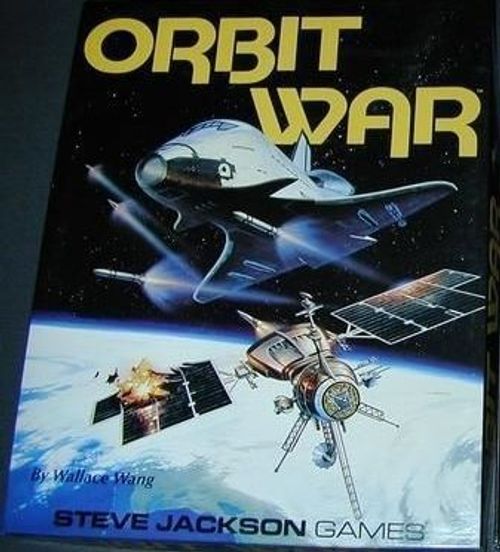
Orbit War
Orbit War Rulebook
Table of Contents
Table of Contents
- 2.0 Map
- 3.0 Counters
- 4.0 Game-Turn Sequence
- 5.0 Movement
- 6.0 Stacking
- 7.0 Combat
- 8.0 Missiles
- 9.0 Mines
- 10.0 Earth-Launched Rockets
- 11.0 Orbit-Launched Rockets
- 12.0 Supplies
- 13.0 Special Forces Infantry (SF)
- 14.0 Shuttles (S)
- 15.0 Early Warning Reconnaissance Satellites (EWR)
- 16.0 Communications Jamming Satellites (CJS)
- 17.0 Orbital Weapons Platform Satellites (OWP)
- 18.0 Suicide Satellites
- 19.0 Nuclear Warheads
- 20.0 Earth
- 21.0 Reinforcements
- 22.0 Preparation for Play
- 23.0 Victory Conditions
- 24.0 Scenarios
- Space Stations: An Advanced Rule for Orbit War
- Orbit War Units
2.0 Map
The map represents a region of two-dimensional space surrounding the Earth. A regular series of lines, called Orbit Lines, are overlaid across the hexes.
2.1 Orbit Lines. Orbit Lines regulate Orbital Movement. Each Orbit Line has a number from 1/3 to 4. The number of an Orbit Line determines how many hexes a satellite must move during Orbital Movement. In the case of fractions, the first number determines the number of hexes a satellite will move and the second number indicates how many turns must elapse before Orbital Movement takes place for that particular Orbit Line. Example: 1/2 means the satellite moves every other turn.
2.2 Combat Results Table. The Combat Results Table (CRT) is printed on the map for the convenience of the players. To determine the combat differential for any given combat, subtract the defense strength from the attack strength. Example: A strength of 5 attacking a defense of 2 is a differential of 3.
2.3 Game-Turn Track. The Game-Turn Track is printed on the map. The Game-Turn Track is used to keep track of game turns and to remind players when specific actions take place, such as Earth rotation and Orbital Movement for the outer Orbit Lines.
2.4 Force Boxes. These boxes hold reinforcements, rockets launched from Earth, and rockets striking Earth for each player.
3.0 Counters
The counters in Orbit War are divided into two categories: satellites and payloads. All satellite counters have five printed values: Unit Type, Identification Number, Attack Strength, Defense Strength, and Movement Allowance. Counters representing payloads do not have all five values; some (i.e., Nukes) have no printed values at all.
3.1 Satellite types include:
3.11 Early Warning Reconnaissance satellite (EWR). This counter represents a typical "spy" satellite equipped with cameras and infrared sensors.
3.12 Communications Jamming satellite (CJS). This counter represents a satellite equipped with a variety of electronic countermeasure equipment.
3.13 Orbital Weapons Platform satellite (OWP). This counter represents a satellite armed with long-range missiles, mines, and a short-range laser.
3.14 Hunter-Killer satellite (HK). This counter represents a heavily armed and armored satellite equipped with high intensity lasers, designed to destroy other satellites.
3.15 Special Forces Infantry (SF). This counter represents a squad of elite commandos specially trained to fight in space.
3.16 Shuttle (S). This counter represents a re-usable space vehicle able to launch and return to Earth.
3.17 Earth-Launched Rocket (ELR). This counter represents a typical large payload-carrying rocket.
3.18 Orbit-Launched Rocket (OLR). This counter represents a small rocket launched from orbit.
3.2 Payload counters include:
3.21 Mine. This counter represents an explosive charge with small thruster rockets and a simple computer "brain."
3.22 Supply. This counter represents a packaged load of mines and missiles to resupply OWP satellites and Space Shuttles.
3.23 Nuke. This counter represents a single nuclear warhead.
3.24 3-MIRV. This counter represents three nuclear warheads.
3.25 7-MIRV. This counter represents seven nuclear warheads.
3.26 Blank. Blank counters can be used as decoys or as replacements for lost pieces.
Counter Diagram. The counter diagram shows the printed values: Defense Strength (top), Movement Allowance (upper right), Attack Strength (upper left), Unit ID (lower center), Unit Type (lower left), and Unit Silhouette (center).
4.0 Game-Turn Sequence
Players alternate who moves first every other turn (i.e., on all odd numbered turns player A moves first, then player B; on all even numbered turns player B moves first, then player A).
The game sequence proceeds as follows:
I. Check for Earth rotation. The Earth rotates at the beginning of every fourth turn (see Section 4.4).
II. The first player for this Game-Turn may launch rockets and shuttles from the Earth. He may also launch rockets from orbiting Shuttles and OWPs. The second player for this Game-Turn repeats the above procedure.
III. Move all counters by Orbital Movement.
IV. The first player for this Game-Turn may take Optional Movement, moving satellites in any direction up to their maximum movement allowances. Shuttles and OWPs may lay mines.
V. The second player may now take Optional Movement and lay mines with his Shuttles and OWPs.
VI. Resolve all mine combat. Announce all missile attacks. Check for possible missile jamming due to enemy CJSs. Resolve all missile combat (see Section 7.2).
VII. Resolve all combat between opposing forces occupying the same hex. Combat is simultaneous.
VIII. Award victory points (VP) for reconnaissance and for destroyed satellites. Deep space reinforcements enter during this step in Turn 4 or later. OWP satellites and Space Shuttles are resupplied at this time.
IX. Move the Game-Turn marker one box.
4.1 Game-Turn Track. The Game-Turn marker is placed in the first box of the Game-Turn Track. Each box has a number in the upper right-hand corner, representing the game turn being played. When the marker reaches the end of the track, return the marker to the first box. Each turn represents approximately one hour.
4.2 First Player of Each Game-Turn. Each box on the Game-Turn Track has two letters, A and B, representing players A and B respectively. On all odd numbered turns player A is the first player and on all even numbered turns player B is the first player.
4.3 Orbit Line Reminders. The numbers 1/2 and 1/3 appear in the lower left corner of certain boxes on the Game-Turn Track. This is to remind players that units on the 1/2 and 1/3 Orbit Lines take Orbital Movement, moving one hex, during those turns only. Units on the 1/2 lines take Orbital Movement every other turn; units on the 1/3 line take Orbital Movement every third turn. Note that on Turns 6 and 12, units on both the 1/2 and the 1/3 lines move.
4.4 Earth Rotation. In certain boxes on the Game-Turn Track an R appears in the lower right-hand corner. This is a reminder that the Earth counter should be rotated, at the beginning of that particular turn, one hexside counter-clockwise.
5.0 Movement
A satellite can move in two ways: Orbital Movement and Optional Movement. A payload without a rocket can only move by Orbital Movement.
5.1 Orbital Movement. Orbital Movement is inherent movement due to a counter's position on an Orbit Line. All units must move counter-clockwise the number of hexes corresponding to the Orbit Line number printed on the map. (In the case of fractional Orbit Line numbers, Orbital Movement occurs every second or third turn.)
5.2 Optional Movement. Each satellite has its Movement Allowance printed in the upper right-hand corner of the counter. The Movement Allowance represents the maximum number of hexes a satellite may move in one turn after Orbital Movement. Movement Allowance may not be exceeded, saved from one turn to another, or transferred between satellites.
5.21 Gravitational Acceleration. All satellites may move one hex towards the Earth at no extra cost. This bonus movement is known as gravitational acceleration. Satellites may gravitationally accelerate at any time during optional movement only. (A satellite may gravitationally accelerate before movement, after movement, or not at all.) Gravitational acceleration is optional. Non-satellites may not take gravitational acceleration.
5.3 Movement Restrictions. No satellite may move onto the Earth counter. Any satellite which does is considered to have burned up in the atmosphere and is removed from play, awarding the opposing player victory points for the satellite's destruction. Exceptions: Special Forces Infantry, Space Shuttles, suicide satellites, and rockets with nuclear warheads may move onto the Earth counter.
5.31 Zones of Control. There are no "zones of control" in Orbit War. Satellites are free to move in or out of, but not through, enemy-occupied hexes.
6.0 Stacking
Any number of units of any type may be stacked together in the same hex.
7.0 Combat
There are three forms of combat: Mine Combat, Missile Combat, and Normal Combat.
7.1 Mine Combat. Mine Combat is always resolved before Missile Combat. Each mine counter has an attack strength of 6. Mines may attack all, some, or none of the enemy counters in their hex, but may not attack units outside their hex. When multiple targets are attacked, each attack is rolled separately.
7.11 Mine Attack Strength. The attacking strength of the mine (6) is divided by the number of defending satellites in the same hex, rounding fractions up. This number is the attack strength of the mine against each satellite. The minimum attack strength of each mine counter is 2. Mines are removed from play immediately after an attack.
7.2 Missile Combat. Missile Combat is always resolved after all Mine Combat but before Normal Combat. There are no missile counters in the game. Each missile may attack any one unit (attacking player's choice) up to two hexes away from the launching OWP, Shuttle, or country. Missiles have an attack strength of 5. Each missile attacks separately; missile attacks may not be combined.
7.3 Normal Combat. Normal Combat occurs when opposing units occupy the same hex. Units do not have to attack. The values for the attack strength and the defense strength, printed on the counters, are used to calculate the odds differential for combat resolution.
7.4 Combat Resolution. Combat is resolved by comparing the attack strength of the attacking unit(s) with the defense strength of the defending unit. The defense strength is subtracted from the attack strength to determine a combat differential, as shown on the Combat Results Table (CRT). No satellite may attack more than once per turn. Exceptions: Missile and mine combat are considered separate from Normal Combat. Suicide satellites may self-destruct for a second attack (see Section 18.1).
7.5 Multiple Attacks. Any number of satellites may combine into one attack, but only one satellite may be the target of each attack (in other words, defense strengths may not be combined). A player may make several attacks in series, against the same or different targets, observing the result of each before making the next. (Missile attacks are an exception to this. The target of each missile attack in a hex must be announced before any attack is rolled.)
7.6 Combat Results. Roll two dice for each attack. The target is destroyed if the attacker rolls the number indicated on the CRT, or higher.
8.0 Missiles
There are no missile counters in the game. Missiles detonate the turn they are launched. Missiles may only be launched from OWP satellites, Space Shuttles, or Earth. Missiles have a maximum range of two hexes and an attack strength of 5.
8.1 Missiles and Mines. If a missile's path must take it through an enemy mine hex, the enemy player may attack it with a mine. Both mine and missile are lost. This also holds true if the target hex is mined; the mine(s) may intercept the incoming missile(s), one mine counter per missile.
9.0 Mines
Mines may only be carried by OWP satellites, Shuttles, or rockets. Mines may begin the game "laid" in orbit.
9.1 Mine Laying. Space Shuttles and OWP satellites may lay mines any time before, during, or after Optional Movement. Mines are placed in the unit's own hex or any adjacent hex. (It is perfectly legal to lay a mine in an enemy-occupied hex.) Mines may also be carried by rockets launched from OWP satellites, Space Shuttles, or Earth. All mines laid by rockets are placed in the hex where the rocket discharges them (see Section 10.4). Mines may not attack on the turn they are laid.
9.2 Mine Attacks. A mine may attack any enemy unit in the hex with it at the end of both players' Optional Movement. A mine may also attack during the enemy player's Optional Movement if an enemy satellite moves through a hex containing it. This may occur either because the enemy wishes to detonate the mine, or because the enemy has no choice but to pass through that hex. If more than one enemy unit pass through the same mined hex, the mine's attack strength may be divided between them (see Section 7.1).
All mine attacks are at the option of the owning player. A mine may attack any, all, or none of the enemy counters in its hex.
9.3 Attacks Against Mines. Mines may be attacked by missiles during the Missile Combat phase. This may occur if the missiles entered a mined hex but the mine was newly laid (or the mine-owning player chose not to detonate it). Each mine counter must be attacked separately.
Mines may also be attacked by enemy satellites during the Normal Combat phase — but, again, this will not happen unless the mine-owning player chose not to detonate it, or it was just laid and therefore was not able to detonate.
10.0 Earth-Launched Rockets
ELRs may only be launched from Earth. An ELR may carry one mine, one type of nuclear warhead (a Nuke, a 3-MIRV, or a 7-MIRV), one satellite, or one Supply counter as a payload. Rockets may not carry other rockets or Space Shuttles.
10.1 Launch. To launch a rocket, place it face-up in the launching player's "Launch" box. This box is used to prevent a pile of counters from appearing on Earth each turn. The rocket must move away from Earth (up to three hexes) during Optional Movement.
10.2 Payload. Any unit (a satellite or payload) carried by a rocket is placed upside down beneath the rocket counter and is moved with the rocket until it is discharged.
10.3 Combat Status. Any unit being carried by a rocket is considered to be inside the rocket. If attacked, only the rocket's defense strength is used. If the rocket is destroyed, its payload is also considered destroyed.
10.4 Discharging Contents. The owning player of a rocket may, at any time before, during, or after Optional Movement, announce that it is discharging its contents. The rocket counter is removed and its payload (the counter beneath it) is flipped right-side up. Satellites may not move or attack the turn they are discharged from a rocket or shuttle. Exception: Special Forces (SF) may move and attack the turn they are discharged.
10.5 Launch Limitation. Each player may launch a maximum of three ELRs from Earth each turn.
10.6 Dummy Payloads. If a rocket is launched with a blank (decoy) counter, that rocket is carrying a dummy payload to distract the enemy and make him waste missiles. A dummy payload may never be "dropped." When a rocket with a dummy payload is destroyed, the fact that it was a dummy is revealed.
11.0 Orbit-Launched Rockets
OLRs may be launched only from space — either from Orbital Weapons Platforms or from a Space Shuttle. An OLR consists of little more than a maneuvering engine and some tracking hardware; therefore, any OWP is assumed to have an infinite number of OLRs available, at no cost. OLRs may not be used to place any unit in orbit from Earth — they are far too weak!
11.1 Launch. To launch a rocket, place it face-up on top of the Shuttle or OWP that is launching it. It will move with the launching satellite during Orbital Movement, and may move away during Optional Movement.
11.2 Payloads. An OLR may carry (a) a warhead (any kind); (b) a mine counter; or (c) a dummy payload as per 10.6 above. It may not carry a satellite.
11.3 Combat Status. The cargo of an OLR is carried inside the OLR, and only the OLR's defense strength is used (as for Earth-Launched Rockets). If the rocket is destroyed, its payload is lost.
11.4 Discharging Payloads. A payload may be discharged at any time before, during, or after the OLR's Optional Movement. Mines may not attack on the turn they are discharged.
11.5 Launch Limitation. Each player may launch a maximum of three OLRs from each Orbital Weapons Platform per turn. No OWP may launch more than one warhead-carrying OLR per turn. OLRs may not begin the game in orbit as satellites.
12.0 Supplies
The contents of a Supply counter consist of any combination of mines, missiles, or nuclear warheads not exceeding ten. A MIRV counts as a single unit. The contents of a Supply counter are taken from the arsenal of mines, missiles, and nuclear warheads designated in 22.3, step 4 as starting the game on Earth. Supplies may only be used to replenish a Space Shuttle or an OWP's arsenal. Supplies may never attack enemy units on their own. Supply counters may only be carried by rockets or Space Shuttles. Players must keep track, on a separate piece of paper, of exactly what is being carried by a Supply counter.
12.1 Resupplying. To resupply a Space Shuttle or an OWP satellite, the rocket or Space Shuttle carrying the Supply counter is placed in the same hex as the satellite to be resupplied.
If the resupplying rocket or Space Shuttle is destroyed, the supplies are considered destroyed. A satellite being resupplied may not attack (engage in either Missile or Normal Combat) the turn it is being resupplied. A Space Shuttle may not attack (engage in either Missile or Normal Combat) the turn it is resupplying an OWP satellite or another Space Shuttle. Resupplying satellites and satellites being resupplied defend against all attacks normally. A resupplying rocket counter is removed from play at the end of the turn it resupplies a satellite.
13.0 Special Forces Infantry (SF)
13.1 Endurance. Special Forces counters may remain in space for a maximum of twelve Game-Turns, after which they must return to Earth by moving the Special Forces counter onto the owning player's country on the Earth counter. Any Special Forces counters which fail to return in time are removed from play and the opposing player gains victory points for the Special Forces' destruction. After spending three turns on Earth, the Special Forces counter may return to play via a rocket or a Space Shuttle.
13.2 Discharging from Rockets and Space Shuttles. Special Forces may move and attack the turn they are discharged from either a rocket or Space Shuttle.
14.0 Shuttles (S)
The USA player has five Space Shuttles available. The USSR player has two Space Shuttles available. Shuttles launch in the same way rockets do (see Section 10.1).
14.1 Movement. A Space Shuttle can launch from Earth without a rocket. Thus, in one turn a Space Shuttle can launch from Earth and attack in the same turn. (Remember: Satellites discharged from rockets may not attack the turn they are discharged.)
14.2 Cargo Hold. A Space Shuttle may hold any combination of missiles and mines not exceeding six. Alternatively, it may carry one OLR and one nuclear warhead (a Nuke, a 3-MIRV, or a 7-MIRV), one Supply counter, or one satellite of any type, in addition to a combination of missiles and mines not exceeding two. Exceptions: A Space Shuttle may not carry an ELR or another Space Shuttle.
14.3 Discharging Cargo. A Space Shuttle may discharge its cargo (a rocket with a nuclear warhead, a Supply counter, or a satellite) in its own hex at any time before, during, or after Optional Movement. Satellites may not move or attack the turn they are discharged. Exception: Special Forces may move and attack the turn they are discharged.
14.4 Returning to Earth. A Space Shuttle which returns to Earth is removed from play. A Space Shuttle may return to Earth by moving the Shuttle counter onto the owning player's country on the Earth counter. The opposing player does not gain victory points for the Shuttle's return to Earth. A Shuttle which returns to Earth may not return to play and is effectively out of the game.
14.5 Transferring Weapons. Space Shuttles may freely give mines, missiles, or nuclear warheads to other Space Shuttles or OWPs occupying the same hex. Treat a weapons transfer according to the rules for resupplying (see Section 12.1).
15.0 Early Warning Reconnaissance Satellites (EWR)
An EWR satellite may detect enemy rocket launchings if it is in the enemy country's spotting cone. Therefore, an EWR satellite gains 1 victory point (1 VP) each turn it is in the enemy country's spotting cone.
15.1 Spotting Cone. Printed on the Earth counter are the two countries: USA and USSR. The shaded regions represent the spotting cone which must be extended outward to the edge of the map to fully define the complete spotting cone.
Spotting Cone Diagram. The diagram shows the USA Spotting Cone and the USSR Spotting Cone, each a shaded region of hexes extending from the Earth outward.
15.2 Reconnaissance. Each turn an EWR satellite is in the enemy country's spotting cone, the owning player is awarded 1 victory point (1 VP). Each EWR satellite in the enemy country's spotting cone gains 1 VP, so if there are five EWR satellites in the spotting cone, 5 VPs are awarded at the end of the turn.
16.0 Communications Jamming Satellites (CJS)
A CJS contains a vast array of electronic jamming equipment.
16.1 Radius of Effectiveness. A CJS's radius of effectiveness extends two hexes. Overlapping radii of effectiveness from friendly CJSs each take effect separately! A radius of effectiveness may extend into the Earth hex, but never through it. Overlapping radii of effectiveness between opposing CJSs do not affect one another.
16.2 Missile Jamming. Missiles fired from or at a unit within an enemy CJS's radius of effectiveness may be jammed. Roll one die. A missile which passes through the radius of effectiveness is jammed on a roll of 1-3. Jammed missiles are considered destroyed and do not attack. Friendly missiles are never jammed by friendly CJSs.
16.3 Increased Defense. The defense strength of any unit within a friendly CJS' sphere of effectiveness, including the CJS itself, is increased by one.
16.4 Jamming. An enemy EWR satellite is automatically jammed if it ends the turn in a CJS's radius of effectiveness. Jammed EWRs do not gain VPs.
16.5 Destruction. If a CJS is destroyed, its effects continue until the end of that turn's combat.
17.0 Orbital Weapons Platform Satellites (OWP)
OWP satellites may be launched with, and carry, any combination of mines, missiles, and nuclear warheads not exceeding ten (10). OWP satellites contain an unlimited number of orbital launch rockets for the purpose of the game. OWP satellites may not hold other satellites.
17.1 Combat. OWP satellites may launch any number or combination of mines and missiles in one turn (see Turn Sequence). An OWP may not lay mines or fire missiles on a turn it launches rockets (whatever their contents). Only one nuclear warhead may be launched per turn. An OWP may use rockets to lay mines. OWPs must use rockets to launch nuclear warheads.
18.0 Suicide Satellites
Normal suicide satellites may be designated as nuclear suicide satellites by expending an additional point (i.e., a Hunter-Killer satellite in orbit may be converted into a suicide satellite at a total cost of four points). Special Forces and Space Shuttles may not be converted into suicide satellites. Suicide satellites need not be revealed until detonation.
18.1 Combat. Suicide satellites may detonate at any time, at the owning player's discretion. Thus, a suicide satellite may attack with its regular weapons and then self-destruct for a second attack, or it may elect to self-destruct before being attacked. Any suicide attack, regardless of satellite type, has an attack strength of 5 against all units, friendly or enemy, in the hex. A suicide satellite which detonates is removed from play and the opposing player is awarded victory points for its destruction.
18.2 Rocket-Borne Nuke. A warhead (any kind) carried by a rocket (either kind) may attack as a suicide satellite. However, no warhead may begin the game in space, except aboard a Shuttle, an OWP, or a suicide satellite.
18.3 Earth Attack. A suicide satellite has the option, during the owning player's Optional Movement step, to move onto the enemy country. Place it in the enemy "rocket strike" box and proceed as in 19.3, below. The opposing player gains victory points for the satellite's destruction.
19.0 Nuclear Warheads
Nuclear warheads come in three varieties: Nuke, 3-MIRV, and 7-MIRV. A Nuke represents a single nuclear warhead, a 3-MIRV represents a cluster of three nuclear warheads, and a 7-MIRV represents a cluster of seven nuclear warheads.
19.1 Launch. Nuclear warheads may only be used when built into a suicide satellite (see above) or when carried by an ELR or OLR. Nuke counters never appear separately.
19.2 Combat. If a rocket carrying a warhead is attacked, its defense strength is 1. A rocket or missile carrying a warhead may attack as a suicide satellite (see Section 18, above).
19.3 Striking Earth. When a rocket counter with a warhead is moved through the enemy spotting cone onto the Earth hex, this constitutes a nuclear attack. The rocket, with payload underneath, is placed in the enemy country's "rocket strike" box. The enemy player will have a chance to intercept Earth-fired rockets during the missile phase. If he does not try to intercept, or if the intercepting missile misses, the rocket strikes Earth. Dummy payloads have no effect; nuclear warheads score victory points.
19.4 Interception. During the missile launch phase, each player may attempt to intercept the enemy rockets in his "rocket strike" box. (The purpose of this box and the launch boxes, of course, is to avoid a huge pile of counters on Earth.) These attacks are carried out like any other missile attack; the defense strength of a rocket is 1, and the defense strength of a suicide satellite is equal to that of the satellite carrying it. The intercepting player must designate which (numbered) rockets are being attacked, since often most rockets in an attacking wave will have dummy payloads.
19.5 Set-up Limitation. Nuclear warheads cannot begin the game in space unless carried by an OWP or Shuttle, or as part of a suicide satellite.
20.0 Earth
Printed on the Earth counter are the spotting cones for each country (see Section 15.1).
20.1 Combat. Each country may fire missiles against satellites. These missiles have a range of two hexes and may only be fired at targets within the attacking country's spotting cone. No target outside the two-hex range or outside of the attacking country's spotting cone may be attacked by Earth-launched missiles. Missiles on Earth may be sent to resupply OWP satellites and Space Shuttles, as part of a Supply counter.
20.2 Rotation. Every fourth turn the Earth counter is rotated one hexside counter-clockwise.
21.0 Reinforcements
Reinforcements are not initially placed on the map but are held in the reinforcement boxes. Reinforcements may begin play on Earth or in deep space. Costs for reinforcements are less than for units that begin in orbit.
21.1 Earth Reinforcements. Earth reinforcements can come into play only if they are launched into orbit by an ELR or Space Shuttle.
21.2 Deep Space Reinforcements. In addition to designating which satellites are deep space reinforcements, players must also note from which map edge (numbered 1-6) the deep space reinforcements will enter. Deep space reinforcements must first appear on any one of the numbered outer map hex edges on the turn they are activated. They are placed in alternating sequence, with the player who moved first that turn placing the first unit, as for game set-up. Deep space reinforcements may not attack the turn they appear on the map. Any turn afterwards they may move and fight normally.
Deep space reinforcements may only enter the game on Turn 4 or any turn thereafter.
21.3 Reinforcement Restrictions. The point cost of mines, missiles, and nuclear warheads is fixed, wherever they start. Special Forces, rockets (with or without payloads) or Space Shuttles may not be designated as deep space reinforcements.
22.0 Preparation for Play
22.1 Scenario Selection. Players decide which side and which scenario they will play.
22.2 Selection of Forces. Each player secretly selects his forces limited by the total number of points available to him according to the scenario selected.
22.3 Bookkeeping. Each player must write down, on a separate sheet of paper:
(1) which satellites are Earth reinforcements;
(2) which satellites are deep space reinforcements;
(3) the number of mines, missiles, and nuclear warheads carried by each OWP satellite and Space Shuttle;
(4) the number of mines, missiles, and nuclear warheads in each country;
(5) which satellites are suicide satellites.
22.4 Set-up. Each player rolls one die. The high roller is player A and the other player is player B for the remainder of the game.
Player A places one of his satellites face down (blank counters can be used as decoys) on the map and player B does likewise, alternating until all satellites are on the map. Reinforcements remain hidden off the map at this time. Counters may be placed on top of enemy counters.
Flip all counters right-side up, remove all blank counters and begin play.
23.0 Victory Conditions
Players receive victory points (VPs) for each enemy satellite destroyed by any means, for each turn their EWR satellites are in the enemy country's spotting cone, and for each nuclear warhead which hits the enemy country. Victory points are awarded as follows:
- For each EWR each turn in the enemy country's spotting cone: 1 VP
- For each OWP or HK destroyed: 1 VP
- For each CJS or Special Force destroyed: 2 VP
- For each EWR or Space Shuttle destroyed: 3 VP
- For each Nuke which strikes the enemy country: 10 VP
- For each 3-MIRV which strikes the enemy country: 30 VP
- For each 7-MIRV which strikes the enemy country: 70 VP
Each scenario may have additional victory point tabulations.
24.0 Scenarios
24.1 BLOCKADE. This scenario depicts an attempt by one side to deny the other side access to space.
24.11 Beginning the Game. One player is designated as the blockading player and receives 45 points to build his forces. The other player receives 35 points to build his forces. All but 10 of these points must be designated as either Earth reinforcements or as deep space reinforcements; no more than 10 points may be used in deep space.
24.12 Special Rules. No nuclear warheads are allowed.
24.13 Ending the Game. The game ends after twelve turns or when either player's forces are completely destroyed. The winner is the player with the most victory points.
24.2 INTERCEPT. This scenario depicts a Soviet attempt to pick off a Space Shuttle carrying an important military-hardware experiment.
24.21 Beginning the Game. The USA player gets 40 points to build his forces, plus one Space Shuttle at no additional cost. The USSR player receives 45 points to build his forces.
24.22 Special Rules. Before setting up, the USA player must designate both the area (numbered 1-6 on the map edges) and the turn the Shuttle will enter the game. The special Shuttle may carry up to a half-payload of weapons. The USA player may not attack until the turn after the USSR player moves any of his satellites by Optional Movement. No nuclear warheads are allowed.
24.23 Ending the Game. The game ends when the Shuttle either returns safely to Earth or is destroyed. The USA player receives 10 VPs for returning the Shuttle to Earth. The USSR player receives 10 VPs for destroying it. The winner is the player with the most VPs at the end of the game.
24.24 Optional Rule. For a cost of only two points each the USA player may purchase additional Shuttles in deep space. He must designate which Shuttle is carrying the experimental hardware, in addition to designating the area and the turn each Shuttle will enter the game. Note that this is an exception to Rule 21.3.
24.3 TRIP-WIRE. This scenario depicts a "limited" action, with each side waiting for the optimum moment to attempt a pre-emptive strike.
24.31 Beginning the Game. Each player receives 50 points to build his forces.
24.32 Special Rules. The first player to successfully hit the enemy with a nuclear warhead loses 10 points (though he still gets points for the hit). If both players hit on the same turn, each loses the 10 points. In addition, players get VPs for their own surviving forces at the end of the game, equivalent to the VPs the enemy would have gotten if he had destroyed them — i.e., a surviving HK is worth one point, and so on.
24.33 Ending the Game. The game ends at the end of the 12th turn either player attacks. The winner is the player with the most victory points.
24.4 TOTAL WAR. This scenario depicts the beginning of World War III.
24.41 Beginning the Game. Each player receives 100 points to build his forces.
24.42 Special Rules. None.
24.43 Ending the Game. The game ends when either country is behind by 150 VP. In reality, either player loses if his country is hit by a nuke. For gaming purposes, the winner is the player with the most VPs.
24.44 Optional Rules. The Trip-Wire Special Rule is particularly suited for this scenario. You may find it practical to limit in-orbit build points to 25 to 40 for each side.
Space Stations: An Advanced Rule for Orbit War
Description. Space Stations (SS) are large satellites, built a piece at a time from components carried into orbit by rocket or Shuttle. Each side has two Space Station counters. A Space Station has an attack factor of 4, defense of 4, and movement of 1. Its point cost in orbit is 12; it is worth 10 victory points.
Setup. Space Stations are not available as reinforcements; if chosen, they must begin the game in orbit. Since they are very large, they are impossible to hide; Space Station counters must be set up first, face up.
Contents. A Space Station may carry an unlimited number of missiles, mines, and/or nukes — up to a player's whole arsenal. A Space Station may be resupplied in the same way as an OWP. It may also make up Supply counters from its arsenal, and send them, via OLR or Shuttle, to resupply other satellites. Supply counters may not be sent from the Space Station to Earth except on a Shuttle.
Combat. During one turn, a Space Station may do any or all of the following: (a) fire up to 10 missiles at one or more targets; (b) lay up to 10 mines; (c) launch up to three OLRs containing any payload (or no payload); (d) make a normal attack using its combat strength of 4.
Special Forces. An SF unit may treat a Space Station like Earth for "endurance" purposes (13.1) — that is, after spending 12 Game-Turns in space, it can spend three Game-Turns at the station and then return to action.
Observation. A Space Station in the enemy spotting cone counts as two EWR satellites for victory point purposes, unless jammed by an enemy CJS.
More advanced rules for Orbit War, plus an article from the designer, will appear in the next issue of Space Gamer.
Orbit War Units
| Unit Type | Attack Strength | Defense Strength | Movement Allowance | Point Cost: Orbit | Point Cost: Deep Space | Point Cost: Earth | Number Available** | VPs |
|---|---|---|---|---|---|---|---|---|
| EWR | 0 | 1 | 1 | 2 | 1½ | 1 | 8 (each) | 3 |
| CJS | 0 | 1 | 2 | 4 | 2½ | 2 | 2 (each) | 2 |
| OWP | 1 | 2 | 1 |
* The number of OLRs available to each side is considered to be unlimited within the scope of the game, and their cost is considered negligible.
** When a number is given, this is the number of counters provided, and no further satellites of that type may be bought. "Unlimited" indicates that players may buy as many units as they like, recording the number bought and re-using counters as necessary.