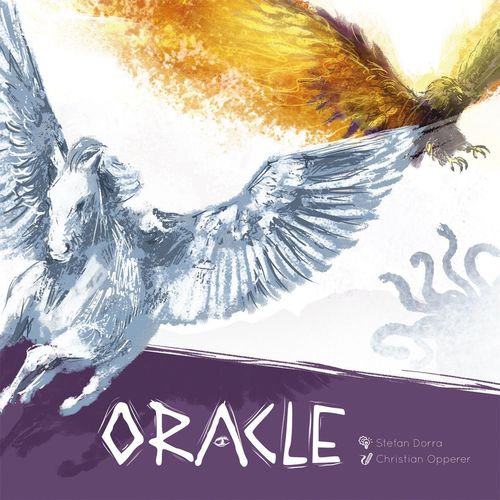
Oracle
Oracle Rulebook
Table of Contents
Table of Contents
Game Idea
The players try to collect fabulous creatures by winning tricks through skilful play of their hand cards, or by deliberately not winning certain tricks.
The player who wins a trick takes a chip showing a fabulous creature (Phoenix, Pegasus or Hydra). At the end, these creature chips count 2, 3 or 5 points respectively. However, whoever receives the last chip of a creature type (a crossed-out Loser chip) must give back all chips of that creature type at the end of the game, unless they have got rid of the Loser chip.
In addition, over the course of the game all players try to fulfil the prophecies on their two Oracle cards to earn additional victory points. Whoever has the most points after a set number of rounds wins the game.
Components
- 60 playing cards (5 different colours, each with values 1 to 12)
- 16 wooden discs (to be covered with the enclosed stickers before the first game)
- 40 Oracle cards
- 1 scoring pad
- 5 overview cards
Playing card
Each playing card shows 1 creature. Each creature is combined with certain card values.
- Hydra with value 1 to 5
- Pegasus with value 6 to 9
- Phoenix with value 10 to 12
Example: Phoenix with value 11.
During the game, so-called tricks are played, in which each player plays one playing card from their hand. The card values determine who wins the trick.
Creature chip
Each chip shows 1 of 3 creatures. Chips with stars are so-called victory point chips:
- 6 Phoenix chips with 2 stars
- 4 Pegasus chips with 3 stars
- 3 Hydra chips with 5 stars
Chips with crossed-out creatures are so-called Loser chips, of which there is 1 per creature type (Phoenix, Pegasus, Hydra).
Victory point chips bring points at the end of a round equal to the number of stars shown on them.
But beware! If a player also owns a Loser chip of the same creature type, they lose all victory point chips of that type before they receive points.
Oracle cards
Oracle cards show prophecies (such as "Exactly one Pegasus chip (any number of other chips)", "No Hydra victory point chip", "Fewer chips than the neighbour to your right", "At least one each of Phoenix, Pegasus and Hydra chip (any number of other chips)") together with the victory points (SP) earned if the prophecy is fulfilled.
Setup
Each player takes an overview card. Depending on the number of players, different numbers of chips and cards are used:
- 3 players: All 16 chips are used and 12 playing cards of any one colour are removed.
- 4 players: All 16 chips and all 60 cards are used.
- 5 players: 13 chips and all 60 cards are used. 1 each of the Phoenix, Pegasus and Hydra chips with stars are removed.
Course of Play
Oracle is played in rounds. In each round the following 6 steps are carried out:
- Lay out chips
- Deal playing cards
- Deal Oracle cards
- Play cards and take chips
- Carry out scoring
- Begin a new round
1) Lay out chips
All chips needed are laid face up in the middle of the table.
2) Deal playing cards
In the first round a dealer is determined by lot. The dealer shuffles all the playing cards needed and deals them evenly and face down to all players. Each player takes them into their hand.
- 3 players: 16 playing cards each
- 4 players: 15 playing cards each
- 5 players: 12 playing cards each
3) Deal Oracle cards
The dealer shuffles all 40 Oracle cards and deals them face down to all players. Any Oracle cards left over are set aside unseen for this round.
- 3 players: 10 Oracle cards each
- 4 players: 10 Oracle cards each
- 5 players: 8 Oracle cards each
Each player chooses exactly 2 Oracle cards that they wish to keep. To do so they may look at their Oracle cards and playing cards. The choice of Oracle cards should be guided by the hand cards, since fulfilling one's own prophecy in the following trick-taking game brings additional victory points.
When a player has decided on 2 Oracle cards, they set the remaining Oracle cards aside face down for this round. The dealing action ends as soon as every player has decided on 2 Oracle cards.
The chosen Oracle cards may be looked at by their owner at any time during the game, but should be kept secret from the other players.
4) Play cards and take chips
The player to the left of the dealer becomes the starting player and plays any card.
Going clockwise, the other players each play one card as well. The colour of the card first led must be followed. A player who cannot follow the colour led may play any card of another colour.
The player who has played the card with the highest value (even if it did not follow the colour led) wins the "trick". They take a chip showing the creature that is pictured on the card with which they won the trick.
Afterwards the played cards are placed on a face-down pile and the winner leads the next trick. Tricks are played until all hand cards have been played.
Example: Stefan leads Blue 7. Uwe can follow suit and plays Blue 10. Beate cannot follow suit and plays Red 11. Beate wins the trick and takes a Phoenix chip, because she won the trick with the 11 (Phoenix card). Beate leads the next trick by playing the first card of the new trick.
Special rule: 1 beats 12
If a card with the value 12 is in a trick, it is always beaten by a card with the value 1, regardless of which card was played first.
Example: Beate leads Red 12. Stefan can follow suit and plays Red 1. Uwe cannot follow suit and plays Blue 2. Stefan wins the trick and takes a Hydra chip, because he won the trick with the 1 (Hydra card). Stefan would also have won the trick if Beate had played Red 12 after him.
Resolving ties
If several cards with the highest value (or value 1) were played, the one that matches the colour led wins.
Example: If Blue 7 was led, then Red 10, then Blue 10, Blue 10 wins.
If several cards with the highest value (or value 1) were played and none matches the colour led, the card played first always wins.
Example: If Blue 12 was led, then Green 1, then Red 1, Green 1 wins.
Special rule: Taking a Loser chip
If after winning a trick a player must take a chip of a certain creature type and no victory point chip of that type remains, they must take the Loser chip of that creature type instead.
A player can get rid of a Loser chip in two ways:
- If another player later wins a trick with a card showing the creature of the Loser chip, the Loser chip passes into the possession of that other player.
OR
- If the player later wins a trick themselves again with a card showing the creature of the Loser chip, they may put the Loser chip back into the middle.
Example: Thomas has won a trick with Blue 11 (Phoenix card). Since no Phoenix victory point chip is left in the middle, he must take the Phoenix Loser chip. Marc wins the next trick with Red 12 (Phoenix card). Thomas passes the Phoenix Loser chip on to Marc. Later Marc wins another trick with a Phoenix playing card. Now he can put the Phoenix Loser chip back into the middle.
5) Carry out scoring
At the end of each round every player receives points for their won chips and, where applicable, for their two Oracle cards. These points are noted down.
Scoring creature chips
After the last trick has been played, the player who owns the Hydra Loser chip must put all their Hydra victory point chips back into the middle. The Loser chip remains in front of the player.
The same applies accordingly to the players who own the Pegasus Loser chip and the Phoenix Loser chip. The victory points (SP), in the form of stars, of the remaining chips are counted.
Scoring Oracle cards
If at the end of the round a player fulfils the prophecy of their chosen Oracle cards, they additionally receive the victory points (SP) printed on them.
Example: At the end of the round Stefan owns exactly one Pegasus victory point chip with 3 stars, so with this card he receives an additional 5 SP. The prophecy has come true. Whether he also owns further victory point chips or Loser chips is irrelevant for this card. If he owns no Pegasus victory point chip or more than one, he does not receive the 5 SP.
Note: The Pegasus Loser chip does not count as a Pegasus chip for this card!
6) Begin a new round
All creature chips needed are put back into the middle of the table (step 1) and the player to the left of the last dealer becomes the new dealer. The new dealer again shuffles and deals first the playing cards and then the Oracle cards to all players (steps 2 + 3), and so on.
End of the Game
As many rounds are played as there are players in the game. The player who has the most points in total after three (3 players), four (4 players) or five (5 players) rounds wins the game.
A scoring example (end of a round)
Chrisly's Oracle cards: "Exactly two Pegasus chips (any number of other chips)" and "At least one each of Phoenix, Pegasus and Hydra chip (any number of other chips)".
Scoring: Chips 3+3+2 = 8 SP; first Oracle card +9 SP; second Oracle card +0 SP.
At the end of the round Chrisly owns the Hydra Loser chip and therefore must give up the Hydra victory point chip (5 SP). For the two Pegasus victory point chips (3+3 SP) and the Phoenix victory point chip (2 SP) she receives 8 SP in total. The Oracle card "Exactly two Pegasus chips" has come true. For it there are an additional 9 SP. The Oracle card "At least one each of Phoenix, Pegasus and Hydra chip" has not come true. For this card she receives no victory points. Chrisly has therefore won 17 victory points in this round (8 + 9 SP).
Had she not received the Hydra Loser chip, she could have kept the Hydra victory point chip. Both prophecies would have come true and she would have won 28 points in total (13 SP for all creature chips + 15 SP for both Oracle cards).
Variant
Variant for "Deal Oracle cards"
- The dealer shuffles the 40 Oracle cards and then counts off 16 cards, which are removed from the game unseen. Then the dealer deals 2 Oracle cards face down to each player and places the remaining Oracle cards as a face-down stack in the middle of the table. Each player takes their two Oracle cards into their hand.
- The player to the left of the dealer becomes the starting player of this round and takes 2 more Oracle cards from the face-down stack, thus holding 4 Oracle cards in hand. Then they must pass 2 of these 4 cards to their left neighbour. That player likewise chooses 2 of their 4 cards, which they pass to their left neighbour. The dealer, as the last player in the round, decides which 2 of their 4 cards to put onto a face-up discard pile. The cards travel, so to speak, from player to player until they are kept or discarded.
- Afterwards the player to the left of the dealer again takes 2 cards from the face-down stack and again passes 2 cards on to their left neighbour. This happens until the face-down stack is empty. After the last round every player has chosen 2 Oracle cards whose prophecies they hopefully can fulfil.