Ora et Labora: Die kleinen Wunder der Abtei Liesborn
Ora et Labora: Die kleinen Wunder der Abtei Liesborn Rulebook
Table of Contents
Table of Contents
Setup
Replace the Wonder tiles of the base game with the 26 wonder tiles of this expansion. These have two different sides: a dark-blue front with variable point values, and a light-blue back with a fixed value of only 20 points.
At the start of the game, with 1, 2, 3 or 4 players, take 3, 5, 7 or 9 randomly chosen wonder tiles, respectively, with the dark-blue side face up, and place them in a display (Auslage). Set the remaining tiles aside with the light-blue side face up, as a stack.
Taking Wonder Tiles
Whenever you receive a wonder, you may choose either one with the dark-blue side from the display or one with the light-blue side from the stack.
After taking a wonder tile, do not turn it over: if you took a dark-blue tile, it stays dark-blue, and if you took a light-blue tile, it stays light-blue.
The display of dark-blue tiles is not refilled. Once all dark-blue wonders have been taken, the only option left is to take a light-blue one from the stack.
Dark-Blue Wonders
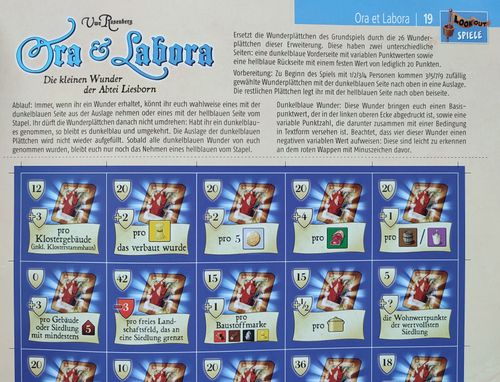
Each dark-blue wonder gives you a base point value, printed in the upper left corner, plus a variable point value. The variable value is printed below the base value, together with a condition in text form.
Four of these wonders have a negative variable value. They are easy to recognize by the red shield with a minus sign in front of the value.
Reduced Values for the Long Two-Player and Solo Game
Three wonders have a reduced variable value for the long two-player game and for the solo game. You recognize them by the symbol printed next to them: two figures, one black and one grey, standing on a red base.
In the short two-player game and in the multiplayer game, the left (higher) value applies.
Explained Tiles
The following tiles are explained in the printed rules. Each entry gives the base value, then the variable value and its condition.
- Base 0. +1 per building material used (pro Baustoff, der verbaut wurde). The tile shows four material icons: clay, wood, stone and straw. In the long two-player and solo game the reduced value is +½.
- Base 45. −3 per landscape (pro Landschaft, inkl. Kernland). This includes the heartland. In the long two-player and solo game the reduced value is −1.5.
- Base 60. −2 per building (pro Gebäude, inkl. Start-Gebäude). This includes the starting building. In the long two-player and solo game the reduced value is −1.
The following tile examples are shown in the rules without the explanation above. Their values are read from the printed tiles:
- Base 12. +3 per cloister building (pro Klostergebäude, inkl. Klosterstammhaus). This includes the cloister main house (Klosterstammhaus).
- Base 20. +2 per straw that was used in building (pro Stroh, das verbaut wurde). The icon is the yellow sheaf.
- Base 20. +2 per 5 coins (pro 5 Münzen). The icon shows a 5-coin tile.
- Base 20. +4 per meat (pro Fleisch). The icon is the green-backed meat tile.
- Base 20. +1 per barrel icon / jug icon (pro [barrel icon] / [jug icon]). The slash is printed as shown. Both icons are unnamed in the print; see the icon note below.
Only building materials of the type shown count, and only the ones on the cards in your own Auslage. This note applies to the material tiles below.
- Base 18. +1 per clay that was used in building (der verbaut wurde). The icon is the red-brown clay piece.
- Base 18. +1 per wood that was used in building (das verbaut wurde). The icon is the dark-brown wood piece.
- Base 20. +2 per straw that was used in building (das verbaut wurde). The icon is the yellow straw sheaf.
- Base 12. +2 per stone that was used in building (der verbaut wurde). The icon is the grey stone piece.
Combination Tiles
When forming combinations, the good depicted on the tile that you have fewer of counts. (Bei diesen Plättchen zählt bei der Kombinationsbildung die abgebildete Ware, von der ihr weniger übrig habt.)
- Base 20. +2 per combination of a green-backed livestock icon (white animal) and a yellow grain icon.
- Base 25. +1 per combination of a brown book icon and a red-brown jug icon.
Tiles Not Transcribed
The second row of dark-blue tile examples on page 19 is cut off at the bottom edge of the photograph. Their base values are legible as 0, 42, 15, 15 and 5, but their variable values and conditions are not visible, so they are not transcribed here.
Light-Blue Wonders
The light-blue side of each wonder has a fixed value of 20 points and no other effect. Page 20 shows the light-blue backs. The grid is cut off at the bottom edge and only the first two rows are visible.
Icon Note (Transcriber)
The printed rules name some icons only by picture. Their identity is inferred by matching them to the base game's goods tiles, as listed under the goods list of the base rulebook. The inferred matches are: the brown barrel icon as whiskey, the white jug icon as ceramic, the green-backed white animal icon as livestock, the yellow sheaf icon as grain (or straw, where the tile says "used in building"), the brown book icon as book, and the red-brown jug icon as ceramic. Check these against the BGG English translation when it is available.