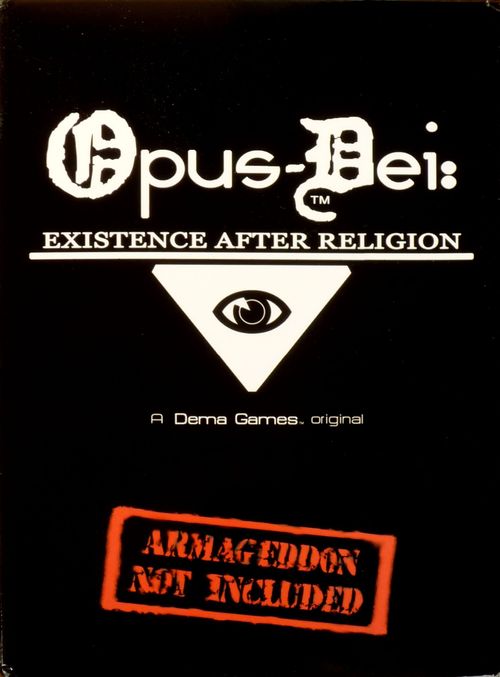
Opus-Dei: Existence After Religion
Opus-Dei: Existence After Religion Rulebook
Table of Contents
Table of Contents
Conflicting demands
It is inevitable that conflicts will arise between Sun cards, Earth cards, Miraculum cards and Special Abilities - therefore a rule of hierarchy is given:
1st: Sun, 2nd: Earth, 3rd: Special Ability (SA), and 4th: Miraculum cards
- Example: A human's SA (e.g. Machiavelli) demands another human from Pre to be placed at the end of the Pot, but the Sun card 'Atheism' is active, which demands all SAs are neutralized. As Sun cards trump SA, the SA is simply not executed and the game continues as if Machiavelli had no SA at his creation.
- When situations arise in which conflicts between e.g. Miraculum cards seems unsolvable, see the list of extensive explanations of certain action cards below.
In any internal conflicts (i.e. between two Earth cards) the last played card trumps. Action cards played by another Zeitgeists can however not be trumped.
Recommendations
- Whenever a Human is created from the Pot, you could say that he or she actually comes to life. Honour this by reading his or her quote out loud.
- Whenever you play an action card, say the name of the card aloud. This helps getting to know the structures of the game better, which might prove to be an advantage later on.
Hints
- 'Choose a Zeitgeist' includes oneself.
- A human with 3 points and a nice SA is sometimes better than 4 points.
- Try to remember the names of the high-valued humans and who created them.
- If you have poor action cards, try to use as many as possible just before the year ends.
- Instead of 'flip a coin' you could 'flip a card'.
Extensive explanation of certain action cards (just in case)
- 3rd World, The: Zeitgeist can play 3 action cards in total, incl. the turn it is played.
- Dualism: 2 action cards can be drawn starting from Zeitgeist's next turn.
- Electromagnetism: 'Last created' means the last human Zeitgeist has created during its own turn. The card has no effect if Plato was the last created.
- Existentialism: Zeitgeist is still allowed to create humans from Pre, Non or other Worlds.
- Monotheism: If Zeitgeist has 2 or more Earth cards in its World, it may choose which card(s) to discard.
- Original Position: With 'A Posteriori' in the world, no action cards can be discarded or drawn.
- Religion: A Zeitgeist can, at any point in time, only hold three cards and must therefore discard one if it has three action cards at the beginning of its turn in order to draw one. Even though Zeitgeist has 'A Priori' in the World, 'Religion' looses its effect when the Sun sets.
- Via Negativa: The value is determined by the isolated points of the Humans. If more than one Human share the highest value on the Pot, the Zeitgeist can decide which one to move.
Have fun!
Winning the game
To win the game, the Zeitgeist (player) must strive to create the best human minds from the line of potential existence into their own potential world. Ending up having the best minds (the most points) actualises the World's potential existence, and the Zeitgeist wins!
Preparations
- The two different piles of cards (humans and action cards) are shuffled separately.
- 12 random humans are placed in a line-up (as shown on the following page).
- Genesis (the card-board feature) is placed at one end indicating the playing direction (which is always towards the Genesis - it being the front of the line).
- Every player is dealt 4 action cards, face down, and it is decided who goes first (you decide how).
The first turn
- At the beginning of a turn, a player must draw one action card (this is not optional).
- During this turn a player may use up to 2 action cards (these either alter the order of the line or changes the possibilities of the game for him-/herself or another player).
The main goal is to move humans with the most points to the front of the line (at Genesis).
- When the one has played its action cards (if any), one must 'create' (collect) the first human in line from the 'Pot' and place it face down on the table in front of oneself (one's 'World').
Example: Aristotle with 5 points is second in line and therefore needs to be moved one step closer to Genesis to be created. A player plays the action card 'Induction' which allows moving a human one step forward in line. Aristotle is now at the front of the Pot and can be created. The player chooses not to play anymore action cards and thereby ends its turn when creating Aristotle to its World.
- It is not allowed to play more action cards once you have created from the Pot.
- The created human may have a Special Ability which has to be executed at the point of creation. (see 'Special Ability' on the next page). Aristotle in the example has none.
- It is now the next player's turn and he/she begins the same way by drawing an action card.
During the game
- The 12 humans indicate one year and when the Pot is empty, the year is over. Another 12 humans are laid up as the 2nd year begins, etc. When the 3rd year is over, the game is over, and the collective points in every World are counted to determine who the winner is.
- The years continue immediately after one another and every Zeitgeist (player) keeps its action cards for continued play in the next year.
- Before the following year begins, every Zeitgeist who holds less than 4 action cards draws until it again has 4 cards in hand. Players with 4 or more just keep them.
- During the game no Zeitgeist can hold more than 7 action cards at any time. If one holds 7 cards before its turn, it must discard one before drawing, otherwise it would be holding 8 cards, if only just for a moment.
- It is only allowed to play action cards within one's own turn.
- It can be possible during the game to 'create' humans from elsewhere besides the 'Pot' e.g. other Worlds, Pre and Non (See Terminology below). Unless otherwise specified on the action card it is therefore possible to create more than one human during a turn.
- Whenever a Zeitgeist is forced to discard a random card, it must shuffle the specified cards, and let another Zeitgeist draw the card to be discarded.
- When Humans are placed in the Pot, they are laid out from the back to the front.
- Humans drawn from Pre, Non or other Worlds must always be shown to the other players.
- A Zeitgeist must always finish its turn as the year ends.
Human cards
Each Human card shows: a Name; a Lifetime (e.g. Aristotle, 384-322 BCE); a Nationality (shown as a flag); a Points value; a Special Ability (Aristotle has none); a Quote; and Bonus Information (irrelevant to the gameplay).
Points: Scientists have a Scientist symbol instead of points.
- 1 Scientist symbol in a World = 1 point.
- 2 Scientist symbols equal 2 x 2 = 4 points.
- 3 Scientist symbols equal 3 x 3 = 9 points.
- 4 Scientist symbols equal 4 x 4 = 16 points.
- Note: Scientist symbols can never exceed 4 points.
- 6 Scientist symbols then equal 6 x 4 = 24 points.
Special Abilities
- Special Abilities (SAs) are only executed when a human is created from the Pot, or function whilst in the Pot, and NOT when taken directly from other Worlds, Non or Pre.
- The majority of SAs are executed when the human is created, but not all. Some humans' SAs have a function while being in the Pot. Therefore it is recommended for each player to read the SAs of the humans in the Pot before the year starts.
- In the rare event of a human being created by you to a rival player's World, in stead of one's own, the SA affects the particular Zeitgeist (e.g. forced to discard an action card).
Action Cards
The game options & consequences are explained on each card. See "Terminology".
Terminology
Opus Dei: Lat. 'Work of God'
- Action cards - 'Action card' is a common denominator for 'Earth', 'Miraculum' and 'Sun' cards.
- Create - to 'create' a human is to bring it into existence i.e. taking it from the front of Pot and placing it face down in your World.
- Discard - remove a card from your World/hand and place it in Non/discard pile (the fiery bulb card)
- Earth cards (green) - when placed in a Zeitgeist's World, it influences only this Zeitgeist in either a positive or negative way. Each Zeitgeist can have a maximum of 4 Earth cards in the World. Earth cards can be swapped e.g. a Zeitgeist placing a 5th, discards one of the original ones as it wishes.
- Fool (dogmatic figure) - human with purple background, one who will pollute your World of ideas.
- Genesis - the point of creation all humans move towards (the included card-board feature).
- Human - common denominator for Philosophers, Scientists and Fools.
- Miraculum cards (blue) - the most common action card. Zeitgeists perform a miracle by playing a miraculum card, which is then placed in the discard pile.
- Non (pile of Non-Existence) - pile of humans no longer in play (the skull & bones card).
- Pot (line of Potential-Existence) - line of humans.
- Pre (pile of Pre-Existence) - pile of humans not yet in play.