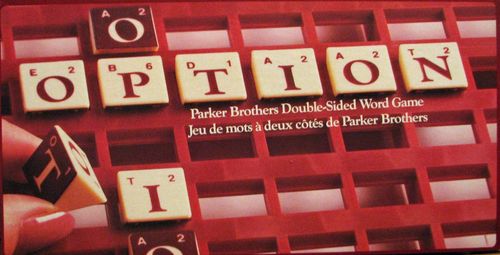
Option
Option Rulebook
Table of Contents
Table of Contents
Object
Players make up crosswords with letter prisms taken at random from the bag. The letters carry different point values and appear on two differently colored sides of a prism. On each turn, try to make a word of the highest total point value that you can, using any of the letters available to you. If you can make a word with letters of the same color, you can double the point value of the word. The player with the highest total score at the end of the game wins.
Players may not use proper nouns, abbreviations, foreign words, and words spelled with apostrophes or hyphens.
Players may not consult a dictionary during the game, except to settle a challenge.
Equipment
A two-piece interlocking game board, 96 letter prisms, 4 letter racks, a plastic bag.
Set Up
- Snap together the two pieces of the game board. Place the board onto the center of the playing area.
- Select a scorekeeper. The scorekeeper will need a pencil and paper.
- Place all the letter prisms into the bag and shake them up.
- Each player draws one letter prism from the bag at random, adds the point values of both its letters, and returns the prism to the bag. The player with the highest total will go first. Play will proceed, in turn, to the first player's left.
- Each player takes seven prisms from the bag and arranges them on his or her rack so that both letters are clearly visible to him or her. (Don't let the other players see your letters.)
The Prisms
On each side of the prisms is a letter. The point value of the letter is in the upper right corner. The letter that appears on the opposite side of the prism is in the upper left corner.
Example prism, shown as a letter with its point value in the upper right corner and the letter on the reverse in the upper left corner: "A" with a value of 2, reverse side "T".
This symbol serves as a substitute for any letter of the alphabet. It has no point value. When used, announce which letter it represents. The letter you choose cannot be changed, except by turning over the prism.
The substitute prism is shown with an "x" in the upper left corner and an asterisk ("") as its symbol.*
Playing
- The first player starts the game by forming a word from his or her letter prisms, then places the word anywhere on the board. The first word on the board must have at least four letters. a) You may form a word vertically or horizontally, but never diagonally. b) You may select either letter on your prisms to form a word.
- As soon as the player's word is formed on the board, he or she adds the point values of the letters and the scorekeeper records the total. The player then randomly chooses additional letter prisms from the bag so that there are seven prisms on his or her rack once again. Then the next player plays.
- On each subsequent turn, the word formed must relate to a word that's already on the board in one of the following ways:
a) You may change a word on the board by adding a letter or letters.
Examples:
CARD + S = CARDSCARD + DIS + S = DISCARDSb) You may form a crossword by using one letter in an existing word. Examples:
(TRICK on the board; TRUST formed vertically through its R.)T T R I C K U S T
(TRICK on the board; TENSE formed vertically from its T.)T R I C K E N S E
(TRICK on the board; SILK formed vertically ending at its K.) c) You may change a word by adding a letter to the beginning or to the end and use this letter to start a new word. Examples:S I L T R I C KLAMEchanged toBLAME. (BLAME on the board; BULGE formed downward from its B.) (BLAMES on the board; SERENE formed downward from its S.) d) You may place letters between words to form a "ladder" with one or more "rungs." (ROUGH and TENTH joined by the rung GOON.) A second example shows the same kind of ladder with the longer rung word BUSTER running across it.
Notes: a) If a player cannot form a word on a turn, he or she may exchange any or all of his or her prisms with the same number of prisms from the bag. But the player must wait until his or her next turn before placing a word on the board. b) Any time a player uses all seven prisms on a turn, he or she receives 15 bonus points. b) Any time a letter is used twice, it counts twice in the score.
Note: the printed rules label both of the last two notes "b)". They are transcribed as printed.
Words of One Color
If you can form a word of five letters or more, using either all dark colors OR all light colors, you may double the point value of the word.
Example: PICTURE = 23 × 2 = 46
Turning Over a Letter Prism
A unique and fundamental aspect of this game is that you may turn over a letter prism that's already on the board to form a new word. Turning over a letter prism is only allowed, however, when you either form a crossword or when you add letters to a word.
Examples:
a) You can do this:
T O T                 R O T
                      A
                      C
                      E
                      R
(TOT changed to ROT by turning over the T, and RACER formed downward from ROT.)
You cannot do this:
T O T R O T
b) You can do this:
M U S T Y             D U S T Y
E                     E
A                     A
L                     L
                      I
                      N
                      G
(Left: MUSTY with EAL formed downward from its M. Right: MUSTY turned over to DUSTY by changing M to D, with DEALING formed downward from its D.)
You cannot do this:
M U S T Y             D U S T Y
E                     E
A                     A
L                     L
(Left: MUSTY with EAL formed downward from its M. Right: DUSTY with DEAL formed downward from its D.)
Note: as printed, the two left-hand diagrams under "You can do this" and "You cannot do this" look identical. They are transcribed as printed.
For an even more challenging game, follow this rule: When you turn over a letter prism as described above, you may, on the same turn, turn over one or more letter prisms in the words which have at least one common letter with the word formed.
Example:
Words already on the board:

            M U S T Y
R I D E
    A
T O O L
You add ING and change M to D to form DEALING.

            D U S T Y
R I D E
    A
T O O L
    I
    N
    G
Because RIDE and TOOL have a common letter with the word formed (DEALING), you may change R to T and O to L to form the words TIDE and TOLL.

            D U S T Y
T I D E
    A
T O L L
    I
    N
    G
Scoring Turned-Over Prisms
Each time a letter is turned over in this way, you receive 25 bonus points (in addition to the total point value of the word formed). If you turn over more than one prism on a turn, you receive 25 additional points for each prism turned.
Examples:
By playing RACER, you score the following:
    14 points (normal points scored for RACER)
  + 25 points (bonus for changing T to R)
  +  6 points (normal points for ROT)
  = 45 points
By playing DEALING, you score the following:
    20 points (normal score for DEALING)
  + 20 points (normal score for DUSTY)
  +  8 points (normal score for TIDE)
  + 11 points (normal score for TOLL)
  + 25 x 3 points (bonus score for turning over three prisms on a turn)
  = 134 points
Challenging an Opponent's Word
If you think an opponent has made an error in his or her word, you may challenge that opponent. Consult a dictionary to settle the challenge. If you're correct in challenging the word, your opponent removes the word from the board and forfeits the turn. If you're incorrect in challenging the word, you must deduct 10 points from your score.
Ending the Game
The game can end in one of two ways: When there are no prisms left in the bag and someone has played all his or her letter prisms; or when it's impossible for players to form additional words.
Scoring and Winning
At the end of the game, the scorekeeper totals the points for each player. Each player then must deduct from his or her score the total number of points on both sides of the prisms which he or she has not used. If one player has played all his or her prisms, that player earns the total point value of all the letters remaining in each opponent's rack. The player with the highest total point score wins the game.