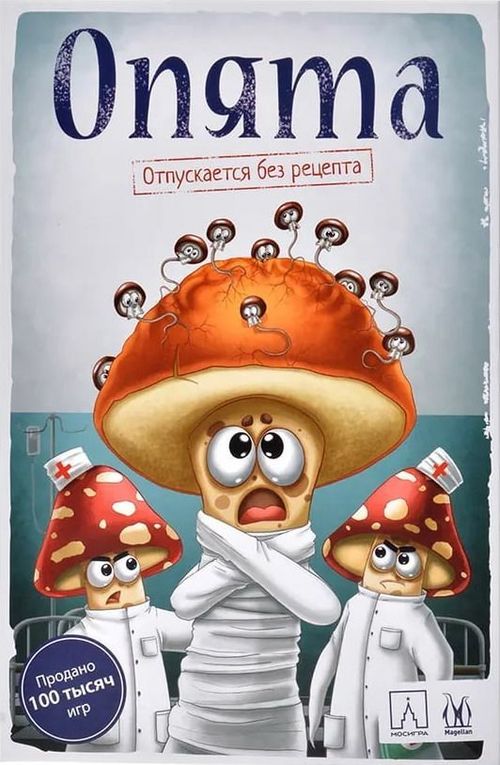
Опята (opiata)
Опята (opiata) Rulebook
Table of Contents
Table of Contents
Components
- 117 illness cards (yellow back), with words and topics written on them.
- 20 medicine cards, which help the patient cope.
- A list of illnesses for the doctor.
- A reference game board.
- A marker.
- An hourglass.
- These rules.
Roles
The game features at least four moderately crazy people:
- Patient: a person with a very rich inner world, who talks with hallucinations.
- Doctor: the smartest person in the room.
- A pair of hallucinations: they have just appeared to the patient, but the doctor and other people around do not see them.
To begin, decide who plays which role in the first round, and prepare to listen to the patient's stream of consciousness.
Hallucinations in the Body
Every patient has hallucinations. Unfortunately, they do not want to get acquainted with anyone except the patient, and so they remain invisible to the doctor and other people. Patients have to tell everyone around them which hallucination is doing what, hoping for the experience of medicine. The hallucinations are very cheerful and entertain the patient so much that he does not even notice what is going on in the outer rather than the imaginary world.
When the patient visits the doctor, he is in exactly this state, and so he simply transmits his vision of the world in response to the questions of a qualified specialist. For example, if the doctor asks what the patient's favourite dish is, he answers not on his own behalf, but as the hallucinations suggest.
A doctor is far from a first-time visitor to such cases in his practice, so from the patient's delirium he will most likely be able to work out which hallucinations are tormenting him and how to treat them.
Basic Game
Setup
First shuffle the illness deck (these cards have a yellow back), and assign roles, that is, choose the doctor, the patient, and the good and evil hallucinations according to the number of players:
- 3 players: doctor, patient, one hallucination (see "Will You Be the Third?" below).
- 4 players: doctor, patient, a good hallucination and an evil hallucination.
- 5 or 6 players: doctor, patient and hallucinations, among which there must be an evil one and a good one.
- 7 players: 2 doctors, patient, 2 good hallucinations and 2 evil ones.
Then seat the doctor facing the patient and with his back to the hallucinations. The hallucinations draw one card from the deck with words and choose one word.
Before the game, the players may agree, for example, that today's game uses only word set No. 2.
After this, the hallucinations secretly agree between themselves who plays which role, unnoticed by the doctor and the patient. Then the doctor starts a timer and begins carefully listening to the patient, who in detail and vividly describes everything the hallucinations show him by gestures. A good hallucination wants to convey to the unfortunate patient the topic of the card (written at the top of the card), while an evil one wants one of the six words (at the bottom of the card). Everyone is busy: the patient tells his story, the hallucinations show, and the doctor listens and glances at the list of illnesses lying in front of him. Each wants to achieve their own result.
Scoring
Points are marked on the game board. The board also shows the number of rounds in the game.
- The doctor must guess the topic of the illness from the patient's garbled speech. The list of illnesses contains all the topics that the hallucinations may show. After one minute, the doctor may mark one or two illnesses on the list. If he marks one topic and guesses it, he receives three points. If he marks two topics and guesses one of them, he receives one point. If the doctor does not guess the topic of the illness, he receives no points.
- The patient must work out the word chosen by the hallucinations. If the patient named the chosen word during his story, he receives one point. If, after his story, the patient can guess the chosen word on the first attempt, he receives two points. So in one round the patient can score from zero to three points.
- Both hallucinations must make the patient name the chosen word during his story. For this each hallucination earns one point. But: the good hallucination must help the doctor. If the doctor guesses the topic of the illness, the good hallucination receives two points. The evil hallucination must make the patient able, after his story, to name the chosen word. If the patient manages this, the evil hallucination earns two points. In this way, each of the hallucinations can score from zero to three points in a round.
At first it is advantageous for the hallucinations to work together (so that the patient names the chosen word), and only then to pursue their personal goals.
It is always advantageous for the patient to tell what he sees, for the hallucinations to disguise themselves as one another, and for the doctor to try to pick out the main points in the patient's delirium that will help him make a diagnosis.
The scoring table is as follows:
| Scoring event | Doctor | Patient | Good hallucination | Evil hallucination |
|---|---|---|---|---|
| Doctor guesses the topic from one attempt | 3 | – | 2 | – |
| Doctor guesses the topic from two attempts | 1 | – | 2 | – |
| Patient says the chosen word during the story | – | 1 | 1 | 1 |
| Patient names the chosen word after the story | – | 2 | – | 2 |
After each round the players rotate clockwise. The winner is the player who, after all the rounds, has the most points.
Example
Doctor: Patient, what did you do last night?
The good hallucination, explaining the category "mechanisms", shows how he hammers a nail into the wall.
The evil hallucination, explaining the word "drill", shows how he dances.
Patient: I was making noise and stomping on the floor. Oh, and then I saw a cockroach on the wall and started beating it with a slipper.
The good hallucination shows the process more vividly.
Patient: And I hammered a nail into it.
The evil hallucination starts pretending to drill.
Patient: Then the neighbour turned on karaoke, and I drilled two more holes with my drill.
Doctor: So that's why they brought you here?
The evil hallucination nods approvingly. The good hallucination draws the outline of a nail in the air.
Patient: No, it's all because of a woman. Skinny, you know…
When the time is up, the doctor marks the topic "mechanisms" on the list of illnesses and guesses it. The patient names the word "drill" and also guesses correctly.
In this way, everyone achieved their goals and each earns three points.
After the round, the roles are rotated clockwise.
Distribution of Roles
When one team contains several identical characters (for example, 2 doctors), points are awarded as follows: first the team's total number of victory points is determined, then it is divided by the number of players in the team and rounded up.
For example, if 2 doctors earned three points, then each receives one and a half points. Taking rounding into account, each receives two points.
Advanced Game
Medicine knows no obstacles: in the more complex and fun variant of the rules, the doctor has the opportunity to test his entire medicine chest on the patient. The course of the game is the same as the standard one, but two medicine cards are laid out in front of the patient, the conditions of which he must follow. For example, they may instruct him not to laugh and to speak with an accent: this is what the treatment requires. To lay out these cards, the doctor shuffles the medicine deck, and the patient draws two cards from it and places them in front of himself.
The hallucinations strive to make the patient not follow the medicine instructions. For each violated condition of each medicine, the hallucinations receive an additional point.
The doctor may guess the topic twice, and the first time he must name it aloud during the patient's story. If he manages to guess the topic on the first try, the doctor receives five points; if not, the game proceeds as in the basic variant.
A patient who keeps the medicine's condition until the end of the treatment session receives one point for each condition (that is, a maximum of two additional points).
If one medicine contradicts another, put one of them back into the deck and draw again.
Will You Be the Third?
This is a variant for three players, in which only the doctor, the patient and a lone hallucination take part. The hallucination draws a card and memorises the word written on it. He must explain it to the patient. Two medicine cards are laid out in front of the patient, the conditions of which he must follow.
Points are distributed as follows:
- The doctor and the patient receive points in the same way as in the basic variant.
- The hallucination receives one point for the word named by the patient in the story, and one point for each of the violated medicine conditions.