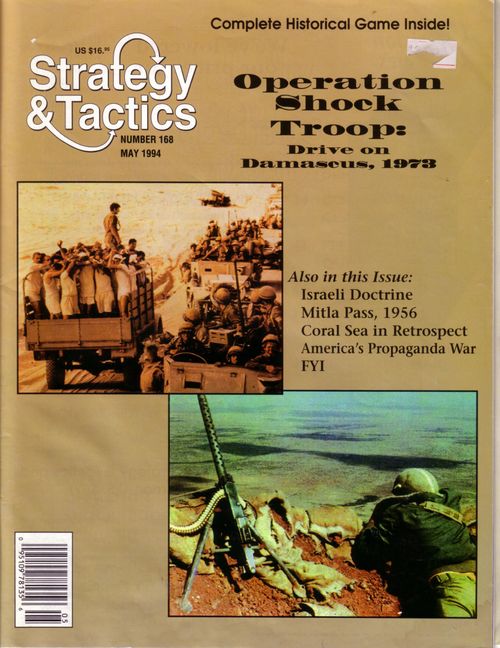
Operation Shock Troop: The Israeli Counterstroke Against Syria, 1973
Operation Shock Troop: The Israeli Counterstroke Against Syria, 1973 Rulebook
Table of Contents
Table of Contents
- 1.0 Introduction
- 2.0 Sequence of Play
- 3.0 Operations
- 4.0 Stacking
- 5.0 Zones of Control
- 6.0 Supply
- 7.0 Ground Combat
- 8.0 Artillery Barrage
- 9.0 Air Strikes
- 10.0 Special Units
- 11.0 Syrian Morale
- 12.0 Reinforcements
- 13.0 Victory
- 14.0 Beginning Play
- 15.0 Optional Rules
- 16.0 Designer's Notes
- 17.0 Players' Notes
1.0 Introduction
1.1 The Map
The map includes the area from the Golan in the west to the city of Damascus in the east, plus a variety of tables, charts, tracks, and boxes to record or access.
1.2 The Counters
The cardboard counters represent all the ground and air forces involved in the historical action, as well as game markers.
1.2.1 Units
1.2.1.1 Unit Colors
| Nation | Color | Nation | Color |
|---|---|---|---|
| Israel | Purple | Morocco | Tan |
| Iraq | Red on Gray | Saudi Arabia | Pink |
| Jordan | Dark Green | Syria | Red |
| Kuwait | Green on Gray |
1.2.1.2 Unit Size
| Symbol | Size |
|---|---|
| I | Company or Battery |
| II | Battalion |
1.2.1.3 Abbreviations
| Abbr | Meaning | Abbr | Meaning |
|---|---|---|---|
| X | Brigade | FB | Fighter Bomber |
| xx | Division | P | Paratroop |
| B | Bomber | Tk | Tank |
1.2.1.4 Unit Types
- Armor*
- Recon*
- Self-Propelled Artillery*
- Mechanized Infantry**
- Heavy Weapons Infantry
- Anti-Tank Weapons Infantry
- Towed Artillery
- Airborne Infantry
- Engineer
- Tank Hunter Infantry
- Special Forces
- Command Post
- Aircraft
* Mechanized for movement and combat. ** Mechanized for movement. Other ground units are leg for all purposes.
1.2.1.5 Sample Units
The rulebook's sample-unit illustrations (1.2.1.5.1 Ground Unit, 1.2.1.5.2 TOW Unit, 1.2.1.5.3 Air Unit) are counter images and are not reproduced in this text transcription. The printed captions read "* with formation colors".
1.2.2 Markers
A. Markers used in the game include:
- Minefield
- Cleared
- Emplacement
- Destroyed
- Fort
- Destroyed
- Cannot Move, Attack, or Be Attacked
B. If players run out of markers, they can make their own. Players must provide spare markers to indicate the current turn and the Syrian Morale level once it reaches 10 or more.
1.2.3 Counter Errata
A. Israeli SP artillery units with colors matching the 70th brigade (70x) should be labeled 70x, not 679x. The 679th and 70th brigades have 2 SP artillery units each.
B. Each Israeli TOW unit should have a unique identification number (1-5) if the Israeli Support Chart is used to keep track of which TOW units have provided support fire during a turn.
C. The Syrian Assad AT battalion should read 4-1-A on the back side, not 7-2-A.
D. The Saudi mechanized infantry unit (1-1-B) is actually a recon unit, and should have a recon symbol.
E. Some replacement counters will appear in S&T 169
1.3 Definitions
The following terms are used throughout the rules:
1.3.1 Armor Strength
The value used when attacking armor-type units. Armor-type units also defend with their armor strengths.
1.3.2 Emplacement
A variable number of obsolete T-34 tanks deliberately dug into selected positions. These provide some added protection to Arab troops against ground attack, as well as extra firepower on defense. They do not help against air attacks because they actually make a position easier to target, though harder to kill. These effects cancel each other out.
1.3.3 Force
One or more Israeli units that begin movement in the same hex. Units may be dropped off, but cannot be picked up.
1.3.4 Formation
A. A unit's parent organization, listed above the unit's symbol type box. Israeli formations are brigades, usually marked with an x symbol following the number. Arab formations are usually divisions, with some brigades.
B. A unit's box colors also help identify the formation at a glance. Formation affects the ability of Israeli units to serve as reserves (3.1.6) and to provide artillery support (7.1.B). It also affects Arab movement and combat in some special cases (7.8.4).
1.3.4 Fort
A specially prepared defensive position that provides added protection for Arab units against ground and air attack.
1.3.5 Leg Strength
The value used when attacking leg-type units. Leg-type units also defend with their leg strength.
1.3.6 Mechanized Type
All units depending on tracked and wheeled vehicles for movement. Mechanized units may not enter leja (lava bed) terrain. Regular artillery is wheeled, but could be hauled about by troops on foot when the need arose.
1.3.7 Morale Rating
Used to determine how far a unit must retreat from combat. The morale rating (MR) of each Syrian unit may change during the course of the game as well as the overall Syrian Morale.
1.3.8 Movement Allowance
A. The maximum number of Movement Points (MPs) a unit can move in a single friendly movement phase. Movement Allowance (MA) is printed on each unit.
B. Each MP enables a unit to enter one clear terrain hex. Other types of hexes may cost more MPs, per the Terrain Effects Chart (TEC).
1.4 Scale
A. Units represent battalions and in some cases Arab brigades.
B. Each hex measures 2.4 kilometers (1.5 miles) from side to side.
C. Each turn represents either one or two days, as indicated on the Turn Track (TT). The change in time scale after Turn 3 reflects the reduced pace of operations after the initial big push through the Arab line of resistance.
1.5 Unit Type Abbreviations
| Abbr | Meaning | Abbr | Meaning |
|---|---|---|---|
| abn | Airborne | hvy wpns | Heavy Weapons |
| inf | Infantry | art | Artillery |
| mech inf | Mechanized Infantry | AT | Anti-Tank |
| SP | Self-Propelled Artillery | CP | Command Post |
| TH | Tank Hunter | egr | Engineer |
1.6 Other Abbreviations
| Abbr | Meaning | Abbr | Meaning |
|---|---|---|---|
| CRT | Combat Results Table | MR | Morale Rating |
| DRM | Die Roll Modifier | OOS | Out of Supply |
| EZOC | Enemy ZOC | TEC | Terrain Effects Chart |
| MA | Movement Allowance | TT | Turn Track |
| MP | Movement Point | ZOC | Zone of Control |
2.0 Sequence of Play
Each turn is divided into a series of phases. Players may not deviate from the sequence, but may skip any phase in which no action is desired or required.
2.1 Israeli Air Attack Phase
Place any or all available friendly air units on selected targets and resolve air attacks.
2.2 Israeli Operations Phase:
A. Enter or delay any reinforcements due this turn.
B. Place TOW units on any friendly unit in supply.
C. Each friendly force may move. One force must complete its movement before another begins. The force can stop at any time, but it must stop when it enters an enemy Zone of Control (ZOC).
D. Once a force ends its movement, none of the units in the force may move again that phase, except to perform advance after combat (7.9). Place affected units beneath a Moved marker as a reminder.
E. Whenever a force moves adjacent to an Arab occupied hex, it may attack along with any other adjacent Israeli units.
F. Reserves (3.1.6) may be brought up and self-propelled artillery (SP) Support and TOW support (7.1.5) assigned before resolving the attack. Once a unit completes an attack, it cannot move or attack again in the same phase. Rotate attacking units 180 degrees as a reminder. Use the Israeli Artillery Support Chart to keep track of support fire each turn.
G. The hex the force attacked can be immediately attacked again, if the Israeli side wishes. At the end of the second attack (or the first, if no second attack occurs), place a Moved marker in the hex. No additional attack is permitted there unless a retreating Arab unit stops in the hex (3.4).
H. A unit that has moved but not yet attacked may still join an attack initiated by a moving Israeli force against any Arab hex adjacent to the previously moved unit.
I. Forces move and units attack in this fashion as long as the Israeli side wishes, or until all Israeli units adjacent to Arab occupied hexes are rotated upside down, and the rest are beneath Moved markers.
J. Remove all Moved markers in play and rotate all units right side up.
2.3 Arab Artillery Barrage Phase
A. Eligible Arab artillery units in range may conduct special Barrage attacks (8.0) against Israeli occupied hexes.
B. Rotate firing units upside down. Do not rotate them right side up at the end of the phase.
2.4 Arab Air Attack Phase
Place any or all available friendly air units on selected targets and resolve air attacks.
2.5 Arab Operations Phase
A. Enter or delay any reinforcements due this turn.
B. Refit one eligible Syrian armor unit (3.2.5).
C. Each friendly unit may move as far as its MA permits. It must stop moving when it enters an Israeli ZOC, unless the unit is a TH (10.2). Each unit must complete its movement before another begins.
D. Once all units that the Arab side wishes to move have completed movement, combat may occur. Any and all units belonging to the same nation that are adjacent to a single Israeli-occupied hex may join in the same attack. The Israeli-occupied hex selected for the attack may not be attacked again during the same phase, unless a retreating Israeli unit stops in the hex (3.4). Place a Moved marker in the Israeli hex as a reminder that it can be attacked again.
E. Remove all Moved markers currently in play and rotate all units right side up.
2.6 End of Turn Phase
A. Flip the Syrian Command Post (CP) unit to its normal side, if it is currently Suppressed.
B. All Israeli SP units regain the ability to provide support (7.2).
C. Move the Turn marker to the next space on the TT. If the Syrian CP is located in the same space as the marker, place the CP in any Damascus city hex.
D. If there are no more spaces available, the game ends and victory is evaluated.
3.0 Operations
A. All movement and combat occurs during the Operations Phases of a game turn. During an Operations Phase, friendly units move across the map, from one adjacent hex to the next.
B. Each unit must check for Supply (6.0) before it moves. Other restrictions are outlined below, and in the rules for Stacking (4.0) and ZOCs (5.0).
C. In an Arab phase, all units must complete movement before any combat occurs.
D. In an Israeli phase, the instant a force moves adjacent to an enemy-occupied hex, it must stop moving for the phase and may attack if desired. Prior to an Israeli attack, reserves may be moved into position adjacent to the target hex.
E. A unit or force may always move one hex, as long as it does not move directly from one enemy ZOC (EZOC) to another.
3.1 Israeli Forces
One or more Israeli units that begin a friendly Operations Phase in the same hex may form a single force. A hex may contain as many forces as there are units, if the owner wishes.
3.1.1 Force MA
A force's MA equals that of the unit with the lowest printed MA. This never changes, regardless of which units in a force are dropped off during movement. If any unit in a force cannot enter a hex because it is prohibited by the TEC, the force may not enter the hex unless it drops off the affected unit(s).
3.1.2 Dropping Off Units
A. One or more units in a force may be dropped off in each hex a force enters, subject to stacking limits (4.1).
B. This does not affect the force's MA, or the number of MPs left for the force to use during its movement. A force may never pick up any units as it moves.
3.1.3 Arab ZOCs
A. The instant an Israeli force moves into a hex containing an Arab ZOC, even a hex containing friendly units, it must stop moving for the phase. It may attack immediately, or wait until another force moves adjacent to any hex to which the force is also adjacent.
B. Entering an Arab ZOC costs no additional MPs.
C. A force beginning in an Arab ZOC hex must first enter a hex containing no Arab ZOCs. If it cannot, then the force may not move at all.
3.1.4 Special Movement Restrictions
A. Units that begin or enter the game on one side of the Operational Boundary Line (3.3.5) running east and west across the map must remain on that side of the boundary.
B. This restriction ends the instant Israel captures either Kiswe (2035) or Sassa (2923) for the first time. Israeli units may move freely for the remainder of the game, even if the Arabs recapture either or both places.
3.1.5 Initiating Combat
A. The instant a force stops moving and is adjacent to any Arab-occupied hexes, any or all of the units in the force may choose to attack one of the hexes.
B. Each unit can attack only once per friendly Operations Phase. Rotate units 180 degrees after they attack to keep track of which units remain eligible to conduct combat.
C. Any Israeli unit adjacent to the hex selected by the force may join an attack initiated by a moving force, if it has not already conducted combat.
3.1.6 Reserves
A. Any and all units that have not moved or attacked during the current Israeli Operations Phase may act as a reserve and join the attack.
B. If a unit belongs to the same formation as any unit in the attacking force, it may automatically join the attack. Any other unit must roll a 1-4 to join the attack.
C. Each reserve unit must:
- Move by itself, within normal movement restrictions;
- Enter a hex adjacent to the enemy hex the force is attacking; and
- Obey stacking limits (4.1) in the destination hex.
D. Reserve units need not begin stacked together in the same hex.
E. Rotate upside down all reserve units, including those that fail to join the attack, to indicate they may not move or attack for the remainder of the phase.
3.1.7 Maximum Attack
A. Each Arab-occupied hex can be attacked twice per Israeli Operations Phase. Immediately after the first attack is over, another force must move adjacent and perform the second attack. Eligible units may act as reserves (3.1.6), provide support (7.1.5), and join the attack (3.1.5). Units involved in the first attack may not participate.
B. If the second attack does not occur immediately, it may not be performed later in the phase.
C. Whether or not a second attack occurs, place a Moved marker in the hex to indicate that it may not be attacked again.
Exception: A hex in which units end their retreat may be immediately attacked, regardless of maximum attack limits (3.4).
Design Note: This restriction is to prevent an unrealistic amount of activity in one location during one or two days of time.
3.2 Arab Units
Arab units move individually. No combat occurs until the Arab side has moved all the units it wishes.
3.2.1 Nationality
A. An Arab unit may not end movement in a hex containing any other Arab unit belonging to a different nation.
B. All Arab units belonging to the same nationality and adjacent to the same Israeli hex may attack together.
3.2.2 Syrian Command Post
A. The CP unit has an unlimited MA when unsuppressed.
B. The CP must still move from hex to hex, and obey all normal movement and ZOC rules. The CP cannot move at all when on its suppressed side.
C. If the Syrian CP is suppressed or not on a Tel (hill) hex, each Syrian mechanized unit (printed MA of 14) from the formations listed below may not move unless there is an Israeli unit within two hexes of its location at the instant the unit seeks to move. (Count the Israeli unit's hex but not the Syrian unit's hex when determining the distance.)
- 1st Tank Division (1tkxx)
- 3rd Tank Division (3tkxx)
- 1st Mechanized Bde/7th Div (1/7xx)
D. If the Syrian CP is on the TT, no units of the formations listed above can move at all, regardless of the location of Israeli units.
3.2.3 Release from CP Movement Restrictions
A. If any Israeli unit enters a hex within three hexes of Kiswe (2035), all 1tkxx units are released from the restrictions in 3.2.2 for the rest of the game.
B. If any Israeli unit enters a hex within two hexes of Sassa (2923), all 3tkxx units are similarly released.
C. The 1/7xx units may never be released from the restrictions in (3.22).
3.2.4 Maximum Attack
Each Israeli-occupied hex can be attacked once per Operations Phase.
Exception: Retreats (3.4).
Design Note: This restriction reflects both the general exhaustion of Syrian troops and the defensive doctrine of the Syrian high command. Units from other nations are also restricted due to the uncoordinated and ad hoc nature of their entry into the fighting.
3.2.5 Syrian Armor Refit
A. At the beginning of each Arab Operations Phase, one eligible Syrian armor-type unit on its weak side can be flipped over to its stronger front side.
B. If Syrian morale is 9 or less, an armor type unit that is in supply (6.3) and at least four hexes from any Israeli units may refit. (Count the Israeli unit's hex but not the armor unit's hex when determining the distance.)
C. If Syrian morale is currently 10 or more, an armor unit must be located in a Damascus city hex in addition to the above restriction.
3.3 Terrain Effects
The terrain in a hex affects a force's movement. The terrain in a defender's hex affects the die roll on the Combat Results Table (CRT). See the TEC for details. Special cases are described below.
3.3.1 Roads
A. Any force entering a hex through a hexside containing a road always pays 1 MP, regardless of other terrain present in the hex.
B. Mechanized units may enter, exit, or retreat from a leja hex only through a road hexside.
3.3.2 Minefields
A. Each uncleared minefield hex affects the movement of all Israeli forces, even those containing an engineer. Once cleared, treat the hex as clear terrain.
B. Arab units always treat minefields as clear terrain, whether or not they are cleared.
C. Each minefield hex is cleared the instant it is entered by an Israeli engineer unit. Place a Mines Clear or other spare marker in the hex.
3.3.3 Wadi
The defender gains the die roll benefit only if all units attack through wadi hexsides.
3.3.4 Cities and Towns
A. These benefit whichever side occupies them. They may not be destroyed.
B. A barrage (8.0) or air strike (9.0) against units in a city hex has no effect.
3.3.5 Israeli Operational Boundary Line
A. Units that begin on one side of the line may not cross the line.
B. Because the line does not cross the entire map, any unit that moves beyond the eastern end of the line is no longer restricted.
3.3.6 Forts and Emplacements
A. Only Arab units occupying these hexes gain the indicated defensive benefits.
B. Add the emplacement's printed value to any units present. If no Arab units occupy the hex, treat the value as if it were a unit. Treat the emplacement as armor when determining the dominant type in combat (7.1.1).
C. Apply the die roll modifier (DRM) from the TEC to the attacker's die roll.
D. If the emplacement itself (not a unit in the emplacement) takes a step loss or retreats, the emplacement is destroyed. Place a DE marker in the hex.
E. A vacant fort can be entered by any moving, retreating, or advancing Israeli unit. The instant this happens, the fort is destroyed. Place a DE marker in the hex.
Example: A force consists of an armor and an infantry unit, which means it has an MA of 6, equal to the infantry unit's printed MA. The force enters a clear hex using 1 MP. Then it enters a Leja hex without using a road. Since mechanized units cannot enter leja, the armor unit must be dropped off to allow the force to continue moving. The infantry unit, now the only unit in the force, enters the hex and expends 3 MPs. Finally, it enters a tel hex, expending 2 MPs. At that point, the force has expended its entire MA and must stop for the phase. If the force had moved adjacent to any enemy-occupied hexes during its movement, it would have had to stop at that point and move no farther that phase.
3.4 Effects of Retreat
A. The hex in which a friendly unit ends its retreat may be attacked again. The attack must occur immediately.
B. If an Israeli unit retreats, then only adjacent Arab units that have not already attacked are eligible to make the special attack. The attackers must all belong to the same nation.
C. If an Arab unit retreats, an Israeli force that has not yet moved during the phase must move adjacent to the hex and attack. Reserves and adjacent units may join the attack normally.
4.0 Stacking
A. Having more than one unit in a single hex is called stacking. Stacking limits apply only at the end of a phase, except during retreats (7.8). Units may freely violate limits during the course of a phase.
B. If a violation occurs, the owning side displaces units to adjacent hexes until only one nationality exists in each hex. Units unable to perform displacement without violating movement or stacking restrictions are eliminated. Follow the procedure for displacement (7.8.5).
4.1 Stacking Limits
A hex may contain:
- One anti-tank (AT) unit;
- Three non-AT companies or one non-AT battalion;
- The Syrian CP unit; and
- Any number of friendly TH or TOW units.
4.2 Israelis and Arabs
No hex may contain both Arab and Israeli units. The only way to enter a hex containing enemy units is to attack and then advance into the hex after clearing it of all occupying enemy units.
4.3 Arab Nationalities
Arab units belong to distinct nations: Syria, Jordan, Saudi Arabia, Iraq, Kuwait, and Morocco. An Arab unit must end a phase in a hex containing only units belonging to its own nation.
5.0 Zones of Control
A. Most units exert a ZOC. Each hex adjacent to a unit is usually part of the unit's ZOC. The presence of friendly units in an enemy ZOC hex has no effect on the ZOC during friendly movement.
B. An EZOC occupied by any friendly units does not affect friendly supply determination (6.0), retreat (7.8), or advance after combat (7.9).
C. A vacant hex containing overlapping Israeli and Arab ZOCs affects whichever side's units enter the hex during movement.
5.1 Special Restrictions
A. A single company-sized unit by itself in a hex never exerts a ZOC. Two or more companies in a hex do exert a ZOC.
B. Arab TH units and the CP unit never exert a ZOC. If a hex contains a single company plus any number of TH/CP units, it still does not exert a ZOC.
C. A unit never exerts a ZOC into a hex that it could not enter using normal movement across the intervening hexside. If only one company in a stack could enter an adjacent hex, it does not exert a ZOC into the hex.
D. Unoccupied forts and emplacements never exert a ZOC.
5.2 Effect on Movement
A. A unit must stop moving for the phase the instant it enters an enemy ZOC.
B. The first hex a unit enters if it begins its movement in an EZOC may not contain an EZOC.
C. Only THs (5.2.D) can move from one EZOC hex directly to another.
D. A Syrian TH unit that begins in an EZOC hex may move directly to another EZOC hex. The unit must stop and move no further that phase. Once a TH leaves its starting hex and enters a hex not containing an EZOC, it loses the ability to move directly from one EZOC to another.
Historical Note: TH squads carrying hand-held anti-tank guided missiles had a limited infiltration capability.
5.3 Effect on Combat
A. No unit may retreat into an EZOC hex unless it is already occupied by a friendly unit which did not retreat during the current attack.
B. An advancing unit ignores EZOCs, but must follow all other rules for advance after combat (7.9).
5.4 Effect on Supply
A. No unit may trace supply into an EZOC hex unless it is already occupied by a friendly unit.
B. A unit may always trace supply out of an EZOC hex.
6.0 Supply
A. A unit's supply condition must be checked each time it begins to move.
B. Each unit traces its own supply path. When tracing from the unit to a road hex, count the road hex but not the unit's hex. The supply line must enter each succeeding road hex through a hexside containing road terrain.
6.1 When to Determine Supply
A. A unit's supply status is always judged immediately before it begins to move during an Operations Phase. It remains supplied or out of supply (OOS, 6.5) for the remainder of its movement.
B. The instant a unit attacks or provides fire support (whether offensive or defensive), it must check for supply.
C. Units in a defending hex never check for supply. They are always treated as supplied.
6.2 Israeli Supply Lines
A. An Israeli unit is in supply if it can trace a path two hexes or fewer to a road hex.
B. The road hex must then be linked by any number of road hexes leading to the west edge of the map.
6.3 Arab Supply Lines
A. An Arab unit is in supply if it can trace a path five hexes or fewer to a road hex.
B. The road hex must then be linked by any number of road hexes leading to:
- The south or east edge of the map; or
- Any Damascus city hex.
6.4 Blocking a Supply Line
A. A hex cannot be used as part of a friendly supply line if it contains any:
- Enemy units; or
- EZOCs not occupied by any friendly units.
B. Certain units do not exert ZOCs (5.1). They must physically occupy a hex to keep it from being used.
6.5 Out of Supply
A. An unsupplied mechanized unit has its printed MA halved from 14 to 7. The MA of all other types of OOS units is unaffected.
B. An OOS unit has its attack strengths halved; fractions are handled according to the rules of combat (7.2).
7.0 Ground Combat
A. Once the side performing an Operations Phase selects a hex to attack, brings up any Israeli reserves, and decides which units will join the attack, the combat is then resolved.
B. Retreat from combat and advance after combat may be allowed or required, depending on the result.
C. Artillery Barrage (7.0) and Air Strikes (8.0) are handled differently, and do not occur during an Operations Phase.
D. Units can attack or fire across the Israeli Operational Boundary Line, but may not advance after combat across the line.
7.1 Unit Type
A. The defender determines the number of friendly armor type units and leg type units involved in combat. Count an undestroyed emplacement as an armor type unit. TOW units are not counted at all. The type with more units present is called the dominant type. If there is a tie, the defender chooses the dominant type. (Optional: May treat a battalion as three companies.)
B. If armor is the dominant type in the defending hex, all units on both sides use their armor strengths to determine combat odds.
Exception: Add the leg strength of all artillery units present in the target hex to the defender's total if the Arab side is defending.
C. When the dominant type is leg, the two Syrian AT/Sagger battalions (8-0-A-6 on front) do not contribute anything to attack or defense, and cannot take any losses unless all participating units with leg strength are eliminated first. If one or both of the battalions are alone in a hex and must use leg strength on defense, treat the combat as an automatic 5:1 attack subject to normal column shifts.
D. If leg is the dominant type, all units on both sides use their leg strengths to determine combat odds.
E. Israeli TOW units have only armor strength. Their combat strength is zero (0) when leg strengths are used in combat.
F. An undestroyed Arab emplacement's strength is always added to the Arab defender's total.
7.2 Israeli Fire Support
Any and all eligible Israeli SP and TOW units may add their strength to a friendly attack during an Israeli Operations Phase, or to a friendly defense during an Arab Operations Phase.
7.2.1 Support
A unit can provide support if it has not moved or attacked earlier in the same Operations Phase. In addition, the unit must not have fired support any time during the current game turn (7.2.6).
7.2.2 SP Artillery Fire
A. There must be at least one unit from the SP's parent formation adjacent to the target hex to spot the artillery fire. The adjacent unit need not be involved in the attack, and may spot even if it is rotated upside down or is underneath a Moved marker.
B. An SP unit must be within range of the target hex. Count the number of hexes between the unit and the target. (Include the target hex but not the SP unit's hex when determining the length.) Intervening terrain and units on both sides have no effect. If the number of hexes is equal to or less than the range printed on the counter, the SP unit may provide support.
C. Each SP unit uses the type of strength (armor or leg) that matches the dominant type (7.1.A).
7.2.3 Israeli TOW Support
A. A TOW unit can support attacking or defending Israeli units that are currently using their armor strengths.
B. A TOW unit must be adjacent to a hex containing enemy units involved in the combat, or within two hexes of such a hex. The intervening hex between the TOW and the target must be clear terrain and contain no units of any kind.
C. The Israeli unit to which the TOW is currently assigned for movement purposes need not be involved in the combat that the TOW supports.
7.2.4 Support Strength Modifiers
A. Units providing support to an Israeli attack use their printed strength, subject to supply effects (6.0).
B. Units providing support to a defending Israeli hex use half their printed strength. This may be further reduced if the unit is OOS.
C. Each supporting unit must check for supply prior to firing.
D. Any combat results suffered by the friendly side do not apply to a supporting SP unit, unless it is in or adjacent to the defending Israeli hex, or adjacent to the defending Arab hex.
E. Once a unit provides support during a turn, it may not do so again for the remainder of that turn.
F. If a unit fires offensive support in the Israeli Operations Phase, it may not fire defensive support during the Arab Operations Phase. Use the Artillery Support Chart to keep track of support fire.
7.3 Optional Combat Resolution
The following is more involved but provides a better sense of how modern combined arms warfare works. Stacking limits will keep this rule from becoming much of a factor except when the target contains a mixture of armor and tank hunters. or when the Arabs manage to mount a local counterattack.
A. When using this rule, disregard rules 7.1.B and 7.1.C.
B. Only attacking and defending units that belong to the dominant type are used to determine combat odds. The dominant type is chosen by the defender. Count TOWs and emplacements as in (7.1.A). Only defending units of the dominant type are affected by the result.
C. If the result on the CRT causes any defenders to suffer step losses or retreat, the attacker may make a special Breakthrough Attack.
D. Total the strength of all attacking units, including those that just performed combat. Use the type of strength (armor or leg) not used to obtain the first result. Refer to the Barrage, Air Attack and Breakthrough Attack Table, find the appropriate strength column, roll a die and apply any result received to all defenders remaining in the original target hex.
Example: An Israeli force with three armored companies attacks an Arab hex containing an armored battalion and a TH unit. The Israeli companies have an armor strength of 9 and a leg strength of 6. The Arab side decides to defend with armor out front (5 armor strength), which produces an attack of 9:5 (1:1). The Israeli side gains an R result, forcing the B morale armored unit to retreat two hexes. The entire Israeli force now uses its leg strength (6) to conduct a Breakthrough Attack against the remaining TH, which is a leg type unit. The result is S which eliminates the TH. One or more Israeli attackers may advance into the hex if desired, but no further.*
7.4 Odds Calculation
A. Add up each side's strength. Each attacking unit halved because of supply retains any leftover fraction and adds it to its side's total. Drop any remaining fraction from the final total. Compare the strength of the two sides and calculate the odds.
B. If the attacker's strength (A) is at least equal to the defender's (D), divide A by D and drop any fraction. The resulting number (N) is used to express the final odds ratio for the combat, in the form N:1.
C. If the attacker's strength (A) is less than the defender's (D), divide D by A and round any fraction up. The resulting number (N) is used to express the final odds ratio for the combat, in the form 1:N.
D. Odds less than 1:2 are treated as 1:2. Odds greater than 4:1 are treated as 4:1.
7.5 Column Shifts
7.5.1 In General
A. After determining the basic odds, locate the appropriate column on the attacker's CRT. Each side uses its own CRT when attacking.
B. Then determine the number of shifts to the right the attacker has earned, and how many shifts to the left the defender has earned. The specific CRT used to resolve the attack has details about the shifts.
C. More than one shift may apply. The effects of shifts are cumulative.
D. Add up the number of right shifts (R). Then total the number of left shifts (L). If R is greater than L, subtract L from R and make that number of right shifts. If L is greater than R, subtract R from L and make that number of left shifts.
7.5.2 Arab Tank Hunters
If the odds column is already 4:1 on the Arab CRT, subtract one from the die roll for each shift for a TH unit that is still supposed to occur.
7.6 Die Roll Modifiers
7.6.1 In General
A. The type of terrain the defender occupies may require an addition to the attacker's die roll.
B. More than one DRM may apply. Simply add them together.
7.6.2 Arab Formation Integrity
Each attacking Arab unit must check the location of all other units belonging to its formation that are still in play. If any unit is two or more hexes away from the attacker's hex, apply a +1 DRM. The most that any attack can be affected by this modifier is +1. In other words, once a unit in an attack suffers the penalty, no more checking need be done for that attack.
7.7 Combat Results
The exact effects of each result are listed beneath the appropriate CRT. The following provide additional explanation of special results.
7.7.1 Step Loss
A. When a unit suffers a step loss, flip it over from its stronger (front) side to its back side containing lower combat strengths. (Some Arab units also have a lower Morale rating.)
B. If a unit is already on its weaker side, it is eliminated instead.
7.7.2 Israeli Battalions
A. Results shaded in red require an Israeli battalion to take a step loss, if one is present. If a battalion is not present, any unit in the hex can lose a step.
B. All other unshaded results never affect an Israeli battalion for any reason, but other units in the hex must suffer the results normally.
7.7.3 Counterattack
A. A CA result means that the defender has the option to perform a special attack against all attacking enemy units occupying a single hex. Israeli battalions may counterattack, even when the CA result is unshaded.
B. All normal combat rules are followed, except that the role of attacker and defender are reversed. Units not belonging to the dominant type (7.1.A) are left out of CA combat when using Optional Combat Resolution (7.3).
C. If a CA produces another CA result, the roles are reversed again. The process continues until the attacking side obtains a result other than CA, or chooses not to attack. The Operations Phase then resumes normally. If it is the Israeli Phase, for example, only Israeli units may move and attack until another CA result occurs or the phase ends.
7.7.4 Syrian Command Post
A. If any retreat or step loss result occurs against any unit in a hex occupied by the CP, flip it over to its suppressed (back) side. If already suppressed, there is no additional effect. While suppressed, the CP's functions are severely limited (3.2.2, 8.3).
B. If the CP takes a step loss or is unable to retreat, it is eliminated. Place it on the TT in the space designated for the upcoming turn.
Example: If the CP is eliminated during Turn 3, it would be placed in the Turn 4 space on the TT.
C. The CP reenters play per 12.4.
7.8 Retreat From Combat
If a combat result requires a retreat, each unit retreats individually.
7.8.1 Effect of Morale Rating
A. A unit's current MR determines the length of the retreat:
| MR | Retreat Length* |
|---|---|
| A | 1 |
| B | 2 |
| C | 3 |
* in hexes
B. If Syria has Broken Morale, all Syrian units have their MR reduced one level (11.3.2).
C. A unit must attempt to retreat the required number of hexes, even if this causes a stacking violation which must be resolved by displacement (7.8.5).
D. Units may not enter prohibited terrain.
7.8.2 Step Loss Instead of Retreat
A. A unit that cannot retreat at least one hex due to movement and ZOC restrictions must take one step loss (7.7.1) instead.
B. The owning side may also choose to have a unit ignore a retreat result. Each unit that does so must remain in place and take one step loss.
7.8.3 Restrictions
A unit may only retreat into a hex it could normally enter during movement.
Exception: An Israeli unit may retreat into a hex containing only Syrian TH and CP units. If it ends retreat in such a hex, the enemy units are displaced into adjacent hexes (7.8.5).
7.8.4 Effect of EZOCs on Retreats
A. A retreating unit may enter an EZOC hex only if it already contains a friendly unit. A hex can be entered only once during a retreat.
B. Israeli units must attempt to retreat as directly as possible toward the western map edge.
C. Arab units must attempt to retreat as directly as possible toward the eastern map edge.
D. Roll a die to settle disputes.
7.8.5 Displacement
A. A retreating unit ignores stacking limits until it reaches the final hex of its retreat. If a stacking violation occurs, a number of units originally in the hex must be displaced to one or more adjoining hexes.
B. If displacement causes a unit to violate movement restrictions, another unit must be chosen. Otherwise, it is eliminated.
C. If displacement causes a stacking violation, displacement occurs again. The process continues until no stacking violation occurs.
7.8.6 Forts and Emplacements
If the defender suffers any type of retreat result on the CRT and occupies either an undestroyed fort or emplacement, no retreat occurs. Instead, either the fort or emplacement must be eliminated, or one unit of the defender's choice takes a step loss. This is in addition to any step losses required by the combat result received.
The decision to stand fast meant that losses would be higher.
(Unlabelled sentence printed under 7.8.6 in the source, apparently a sidebar; transcribed as printed.)
7.8.7 Minefields
Israeli units may enter active minefield hexes only if there is no other alternative route, even one requiring overstacking and displacement.
7.9 Advance After Combat
Any and all friendly units except towed artillery may advance if all enemy units involved in a combat actually vacate their hex. Advancing units obey all normal movement rules, unless otherwise noted below.
7.9.1 In General
Advancing units must enter a hex vacated by the retreating units. Thereafter, advancing units may enter any vacant hex and those occupied only by enemy TOW, TH, and/or CP units. Displacement due to overstacking occurs per 7.8.5.
7.9.2 Length of Advance
Units may advance a number of hexes equal to that required of the retreating unit with the lowest MR. This number remains unchanged even if retreating units do not retreat the full number of hexes.
7.9.3 Effect of EZOCs
Advancing units ignore EZOCs.
7.9.4 Special Arab Restrictions
A. No Arab unit can advance into a hex if by doing so it would be three or more hexes away from any non-artillery unit of its formation still in play. (Count the formation unit's hex but not the hex the advancing unit wants to enter when calculating the distance.)
B. Anti-tank units are not considered artillery units.
7.9.5 Special Israeli Restrictions
Units may not advance into an uncleared minefield hex.
8.0 Artillery Barrage
A. Arab artillery units may perform a special type of combat in the Arab Artillery Barrage Phase. No other units may participate in combat during the phase.
B. Any number of eligible artillery units from the same nation may combine their strengths to fire at a single target hex.
C. A hex may be attacked once per Barrage Phase.
D. Arab artillery that fires in this phase may not move or attack in the Arab Operations Phase. However, an artillery unit that defends during the Israeli Operations Phase may still fire in the Barrage Phase.
8.1 Supply
An artillery unit must be able to trace normal supply (6.0) the instant it fires. OOS units may not fire at all.
8.2 Range Determination
A. An artillery unit must be within range of the selected target hex.
B. Count the number of hexes between the unit and the target. (Count the target hex but not the artillery unit's hex when determining the length.) Intervening terrain and units have no effect.
C. If the number of hexes is equal to or less than its range, the unit may fire if it meets the requirements listed below for its nation.
8.3 Syrian Artillery
A. If the Syrian CP unit is not on its suppressed side and occupies a tel (hill) hex, range is determined normally per 8.2.
B. Otherwise, every Syrian artillery unit has a range of two hexes regardless of its printed range value.
8.4 Non-Syrian Artillery
A. There must be at least one unit from the artillery unit's parent formation adjacent to the target hex to spot the artillery fire.
B. If no spotting unit is present, the artillery unit may not fire on the hex at all.
C. The Kuwaiti unit is considered part of the Saudi 20th brigade (20x) for all game purposes, including spotting for barrage attacks.
8.5 Resolving Barrage
A. Sum the printed strengths of all participating artillery units and find the appropriate column on the Barrage, Air Attack and Breakthrough Table.
B. Roll the die, applying relevant DRMs. (The Arab Formation Integrity DRM does not apply to barrage.)
C. Apply the indicated results. Results shaded in red require an Israeli battalion to take a step loss, if one is present. Otherwise, any unit in the hex can lose a step.
D. All unshaded results never affect an Israeli battalion for any reason, but any other units in the battalion's hex are affected normally.
E. After applying all results, rotate each firing artillery unit 180 degrees upside down to indicate it may not move or attack in the upcoming Arab Operations Phase.
F. Ground units may never advance into a hex cleared by a barrage.
9.0 Air Strikes
A. During a friendly Air Strike Phase, a side may use any or all air units located in the Ready section of the friendly Air Units box. Simply place one or more air units on any non-city hex containing enemy units and consult the Air Attack Table.
B. After resolving an air strike, place used air units in the Grounded section of the friendly box.
9.1 Restrictions
A. Air units have unlimited range, and any number of available units can be placed on any map hex.
B. The target hex's terrain has no effect on air strikes, unless it contains an undestroyed Fort occupied by Arab units.
C. Apply all relevant DRMs.
D. Air strikes against Damascus city hexes have no effect.
9.2 Resolving Air Strikes
A. Place one or more available air units on a hex.
B. Sum the strength of all air units and locate the appropriate column on the Barrage, Air Attack, and Breakthrough Attack Table.
C. Roll a die, applying all relevant DRMs.
D. Results shaded in red require an Israeli battalion to take a step loss, if one is present. Otherwise, any unit in the hex can lose a step. All unshaded results never affect an Israeli battalion for any reason, but other units in the hex must suffer the results normally.
E. Follow the retreat rules (7.8) for retreats caused by air strikes.
F. Ground units may never advance into a hex cleared by an air strike.
9.3 Displaced Units
Units that retreat into a hex that receives an air strike must suffer any results that apply to all units, and can be chosen to receive other results.
10.0 Special Units
10.1 Israeli TOW Units
10.1.1 Assignment
A. Any number of TOW units can be assigned to a single combat unit. They are originally assigned to combat units at the beginning of the game.
B. Those received as reinforcements are placed with any Israeli unit that can trace a normal supply line (6.2).
10.1.2 Combat Effects While Assigned
While assigned to a parent unit, the TOW is considered to be part of the unit for all purposes. If the parent unit moves, advances or retreats, so must the TOW. If the parent unit is eliminated, the TOW is also eliminated. If the parent unit receives a Moved marker, it affects the TOW as well.
10.1.3 Transfer After Assignment
A. Once assigned to a unit, a TOW unit can only be transferred to another unit that belongs to the same formation. Both units involved in the transfer need not be in the same hex, but must be in supply.
B. To transfer a TOW, simply pick it up and place it on another eligible unit at the beginning of an Israeli Operations Phase.
10.1.4 Combat Use
For TOWs in combat, see 7.2.3.
10.2 Syrian Tank Hunter Units
A. A force containing only TH units can move from one EZOC to another. See ZOCs (5.0) for details.
B. Whenever a TH is eliminated, place it on the TT two spaces ahead from the current turn.
Example: A TH eliminated on October 12 would be placed on the October 14-15 space.
C. If no turn space is available, the unit is lost for the rest of the game.
D. THs return during the indicated turn's Arab Operations Phase, in any Damascus city hex.
E. THs are treated as normal units in all other respects.
10.3 Syrian Command Post
A. The CP unit moves only when unsuppressed, per 3.2.2.
B. The CP unit affects Syrian movement 3.2.2 and artillery barrage range (8.3).
C. If the CP is eliminated, it returns to play per reinforcement rule 12.4.
11.0 Syrian Morale
The Syrians had fought Israel since early October. Despite notable successes, morale was shaky and could easily diminish once battlefield reverses occurred.
During the course of the game, Syrian Morale points will increase as Israel captures certain designated geographical locations.
11.1 Capture
Capturing a morale location works exactly like capturing cities and towns for victory purposes (13.1).
11.2 Morale Track
A. Each special location has one to four small blue boxes printed near its name or in the hex. This indicates the number of spaces that Syrian Morale is raised or lowered, depending on which side captures the location.
B. The higher Syrian Morale is, the more likely it is Syria will suffer Broken Morale.
C. The following is a complete list of Morale hexes:
| Morale Effect | Locations |
|---|---|
| 1 | Hara (1714), El Mal (2017), Um Budne (2210), Knaker (2426), Jaba (2512), Tel Shams (2720), Hales (3116), Hines (3223), Horfa (3314), Mazrat Beit Jan (3320) |
| 2 | Sassa (2923), Bethina (3227) |
| 3 | Ghabaghig (1126), Fort hex (2928) |
| 4 | Kiswe (2029), Daidot (2729), Katania (3334) |
11.2.1 Capture of Morale Hexes
When Israel captures a Morale hex, move the Syrian Morale marker the indicated number of boxes up the Syrian Morale Track. When the marker enters the zero box for the first time, place a spare marker in the 10 box. If a marker is already in the 10, 20 or 30 box when the Syrian Morale marker enters the 0 box, move the spare marker to the next higher box.
11.2.2 Arab Capture
When the Arab side recaptures a specified hex, move the marker the indicated number of boxes down the Syrian Morale Track. If the marker enters or crosses the zero box, remove the marker in the 10 box. If a marker is already in the 20, 30 or 40 box, move it to the next lowest box.
11.3 Broken Morale
11.3.1 Onset
Whenever Syrian Morale is 10 or higher, all Syrian units suffer Broken Morale.
11.3.2 Effects
The instant Broken Morale occurs, each Syrian unit's printed MR is reduced one level. A becomes B, and B becomes C. A unit with a printed C rating remains C, but must take a step loss each time it retreats. A C unit cannot refuse to retreat if it is able.
11.3.3 Restoration of Morale
The instant Syrian Morale is reduced to 9 or less, the effects of Broken Morale end.
12.0 Reinforcements
Reinforcements are units that do not begin the game in play. They arrive later and are deployed per Beginning Play (14.3).
12.1 Entry Areas
A. Each unit is placed in one hex along the map edge belonging to its formation's designated entry area.
B. Entry area D is a single hex. All other areas contain two labeled hexes plus all the map edge hexes in between.
Example: Area A contains hexes 1015 through 1022.
C. Each unit that enters through Areas A or B must roll a die. On a 1-4, the unit has an MA of 5 for the current phase. On a 5-6, the unit uses its printed MA.
12.2 Deployment
A. Each unit is placed on an entry area hex at the beginning of the friendly Operations Phase of the indicated turn of entry, unless it is delayed (12.3).
B. Units may be placed in excess of normal stacking limits. A unit can be placed in an EZOC.
C. Each unit is automatically in supply throughout the Operations Phase during which it enters play.
12.3 Delay
A. A unit must be delayed if all the hexes in its entry area are enemy occupied.
B. The owning side may voluntarily delay any or all units due to enter this turn.
C. Place delayed reinforcements on the TT in the space corresponding to the following turn.
Example: A unit scheduled for Turn 3 would be placed in the space for Turn 4.
D. Units already on the TT can be delayed again. Simply move them to the next space on the track.
E. Units can be delayed for any number of turns in this fashion, and need not enter play at all.
12.4 Syrian Command Post
A. If the CP unit is located in the space for the current turn on the TT, it is eligible to return to play as a special reinforcement.
B. Place the CP in any Damascus city hex at the beginning of the Arab Operations Phase for that turn.
13.0 Victory
When the game ends after turn 8, the winner and the level of victory are determined. Each side is awarded Victory Points (VPs) for various reasons. Comparison of the two VP totals determines the outcome.
13.1 Geographical Objectives
A. The side that was the last to capture or recapture a hex with a VP listing near its name receives the indicated number of points.
B. VP hexes include:
| VPs | Locations |
|---|---|
| 2 | Kfar Shams (1519), el Hara (1714), Knacker (2426), Maatz (2617), Tel Shams (2720) |
| 3 | Shaqhab (1929), Sassa (2923), Mazrat Beit Jan (3320) |
| 5 | El Mal (2017), Hines (3223), Bethina (3227) |
| 15 | Ghabaghig (1125) |
| 20 | Kiswe (2029), Katania (3334) |
Editor's note: the source prints the hex numbers inconsistently. Ghabaghig is 1126 in section 11.2 but 1125 here; Kiswe is 2035 in sections 3.1.4 and 3.2.3 but 2029 in sections 11.2, 13.1 and 14.1.1. They are transcribed as printed.
13.1.1 Israeli Capture
Each time an Israeli unit enters or passes through a marked location that was last occupied or passed through by an Arab unit, the location is considered captured by Israel. A location is also captured if no Israeli unit has previously entered or passed through it.
13.1.2 Arab Capture
Each time an Arab unit enters or passes through a marked location that was last occupied or passed through by an Israeli unit, the location is considered recaptured by the Arabs.
13.2 Israeli Artillery
A. Award Israel 5 VPs for each SP unit (full or reduced strength) within artillery support range of a Damascus city hex or El Meza air base (2732).
B. An Israeli unit does not need to be adjacent to a hex as a spotter in order to gain the points.
13.3 Eliminated Units
A. Israel earns 1 VP per completely eliminated Arab unit, except for TH and CP units which are worth 0 VPs.
B. The Arabs gain VPs for each completely eliminated Israeli unit, as indicated below:
| VPs | Unit Type |
|---|---|
| 6 | Armor battalion |
| 3 | Other battalions |
| 2 | Armor company |
| 1 | Other companies |
| 0 | TOW unit |
13.4 Determining the Winner
13.4.1 Procedure
Total the Israeli and Arab VPs separately, and subtract the Arab total from the Israeli total to arrive at Net VPs.
13.4.2 Historical Victory Conditions
Compare the result to the following list to determine the winner and level of victory.
| Net VPs | Victory Level |
|---|---|
| ≥ 69 | Israeli Decisive |
| 58-68 | Israeli Substantive |
| 48-57 | Israeli Marginal |
| 39-47 | Draw |
| ≤ 38 | Arab Victory |
13.4.3 Tournament Victory Conditions
Use this to judge play performance.
| Net VPs | Victory Level |
|---|---|
| ≥ 80 | Israeli Major |
| 70-79 | Israeli Minor |
| 60-69 | Draw |
| 50-59 | Arab Minor |
| ≤ 49 | Arab Major |
Historically, the Israelis won a Substantive Victory. Assume that a Decisive Victory triggers Soviet military intervention, a superpower confrontation, and the best chance for nuclear holocaust since Cuba in 1962. Arab historical victory has no levels because any sort of Arab win would have had tremendous political side effects, and might well have propelled Israel into serious negotiations about "land for peace" two decades before it actually happened!
14.0 Beginning Play
A. Punch out all the counters and segregate them by nation and formation. Relying on the background colors and unit type box colors will speed up the process. Place the Israeli TOW and Arab TH units in separate piles. Set all the brown game markers off to one side together.
B. Consult the Initial Forces list. The Arab side sets up first, followed by Israel. Place each unit in one of the hex locations specified. In some cases, units can be placed near a location hex per the instructions provided in the setup.
- Units must be set up within normal stacking limits.
- Units from different formations may stack together.
C. Place all reinforcements on the TT in the appropriate turn boxes, and all air units in the Ready box of the friendly Air Display on the map.
14.1 Initial Forces
(The source's column layout splits the opening sentence of this section across the preceding page; the continuation reads:) indicated locations, and west of the Setup Line printed on the map. Use the Identification symbols printed on the map to aid set up. The abbreviations used for the unit descriptions are in 1.5. The notation w/i # means within that number of hexes of the specified location.
14.1.1 Arabs
Place each unit on or adjacent to one of the indicated locations, and east of the Setup Line printed on the map. Units may set up in violation of Formation Integrity (7.6.2).
| Location(s) | Formation | Unit(s) |
|---|---|---|
| 1105 | 61/5xx | 3 x 2-7-A inf; 4-2-B-14 arm |
| 1407 | 112/5xx | 3 x 2-7-A inf |
| 1108 | 50/5xx | 3 x 5-10-A-17 art |
| with any 5xx unit | 5xx | 8-0-A AT |
| 2912, 3116, 3314 | 68/7xx | 3 x 4-5-B inf*; 4-2-B-14 |
| 2411, 2712 | 85/7xx | 3 x 4-5-B inf |
| 1 each in 3223, 3227, 3320 | 1/7xx | 3 x 5-5-A mech inf |
| 3223, 3424 | 78/7xx | 3 x 5-10-A-17 art |
* one per hex. ** All units begin on weak side.
14.1.2 Israelis
Place each unit on or adjacent to one of the indicated locations, west of the Setup Line. Use the ID symbols on the map to aid setup.
| Hex | Map ID | Formation | Unit(s) |
|---|---|---|---|
| 3611 | 75 Mech Bn | 75bn/7thx | 4-8-A mech inf |
| 3510 | 77 Bn | 77bn/7thx | 10-5-A arm |
| 3310 | 82 Bn | 82bn/7thx | 9-5-A arm |
| 3210 | Barak Bn | Barak/7thx | 5-2-A arm |
| 3110 | 74 Bn | 74bn/7thx | 8-4-A arm |
| * | — | 7thx/Barak | 3 x 0-2-A inf |
| * |
* any of the hexes listed above, within stacking limits.
14.2 Special Rules
14.2.1 Arabs
A. No Syrian or Moroccan units move on Turns 1 and 2. All other Arab units move freely. Arab units adjacent to enemy units are free to attack, even if they cannot move. Units that are unable to move may conduct air strikes and artillery bombardment.
B. All Arab units are in supply during Turn 1.
14.2.2 Israelis
A. All Israeli units in supply during Turns 1 and 2.
B. Units in the 70x and 9x formations may move normally on Turn 1, but they may not attack.
14.3 Reinforcements
14.3.1 Israeli
| Turn | Unit(s) | Area |
|---|---|---|
| 2 | TIRAN (6 x 2-1-A armor) | C |
| 3 | 31Px (9 x 0-3-A airborne) | C |
| 3 | 2 x TOW | Rule 10.1 |
| 4 | 1 x TOW | Rule 10.1 |
14.3.2 Arabs
| Turn | Unit(s) | Area |
|---|---|---|
| 2 | Iraq 3/3tkxx (3 x 6-3-A arm); Iraq 8/3tkxx (3 x 3-6-A mech) | A |
| 3 | Iraq 6/3tkxx (3 x 6-3-A arm); Iraq SF (2-4-A inf) | A |
| 4 | Iraq 6/3tkxx (6-3-A arm, 3 x 5-10-A-6 art) | A |
| 4 | Jordan 40x (3 x 5-2-A arm, 5-10-A art); Kuwait (3-10-B art) | B |
| 4 | Saudi 20x (3 x 2-3-C inf, 1-1-B recon, 1-3-B art) | D |
| 5 | Iraq 12/6tkxx (3 x 5-2-A arm) | A |
| 6 | Iraq SF (2 x 2-4-A inf) | A |
| 8 | Jordan 90x (3 x 4-2-A arm) | B |
15.0 Optional Rules
The following rules may be used in any combination the players desire. An estimate of which side a rule favors (if any) is included.
15.1 Combat Resolution
A. Favors neither side consistently.
B. See 7.3 for details.
15.2 Soviet Intervention
A. Favors Israel.
B. The instant Syrian Morale reaches 20, the game ends in an Israeli Decisive Victory. Assume that the Soviets have intervened with paratroops. Roll the die to see if nuclear holocaust occurs: the chances would have been about 50-50!
15.3 Free Deployment
A. Favors Israel unless fully free Arab deployment and movement allowed.
B. Syria sets up first as shown in 14.1.1, except that the units of 1tkxx may set up anywhere east of the Setup Line.
C. Completely free Arab setup with no movement restrictions (14.1) may occur if both players agree. Israel may then set up units anywhere west of the Setup Line.
D. Ignore the special Israeli Movement Restrictions and the Operational Boundary Line (3.14).
E. The Israeli 70x and 9x units may move and attack normally on Turn 1.
15.4 TOWs Delayed
A. Favors Arabs.
B. The US sent TOWs as fast as it could, but diplomacy, domestic politics and logistical SNAFUs could have slowed the process.
C. Beginning on Turn 3, roll one die for each TOW unit scheduled to arrive on or before the current turn, but which has not yet received. Consult the following table:
| Roll | Result |
|---|---|
| 1-3 | N |
| 4-6 | Y |
D. Apply a +1 DRM on Turns 5 and 6, and +2 on Turns 7-8.
E. On a natural roll of a 1, the TOW is not received regardless of the DRM.
15.5 "Plougot Hamahatz" Plan
This was the original Israeli approach that was ultimately shelved. The airborne units perform airmobile operations using helicopters.
A. Favors Israel.
B. Set up normally, except all other 7thx units set up within two hexes of Kudne (1506) and west of the Setup Line.
C. Any or all units of the Israeli TIRAN brigade can enter at hex 1603 instead of Entry Area C.
D. Each airborne unit not currently on the map may be placed within two hexes of any Israeli unit at any time during an Israeli Operations Phase. The landing hex may not contain any enemy units, but may contain EZOCs. A unit cannot leave the landing hex but may attack normally. An Israeli force must complete its movement before any airborne units can land.
E. As many airborne units as desired can be held out of play for as many turns as the Israeli side wishes.
15.6 Kurdish Offensive Plan
Israel planned to support a revolt by Iraqi Kurds if Iraq sent military forces to aid Syria. U.S. Secretary of State Henry Kissinger got wind of the scheme and threatened the Kurdish leader, General Barzini, with a cutoff of supplies. The Kurds backed off, only to have Kissinger arrange an Iran-Iraq pact in 1975 that halted all aid from all sources to the Kurds! This option assumes Kissinger did not learn of the Israeli plan, or could not pressure Barzini into abandoning the effort. The Kurdish revolt goes ahead as planned.
A. Favors Israel.
B. Iraqi reinforcements scheduled for Turns 4-6 are canceled and never arrive.
15.7 Full Syrian Commitment
The Syrians cautiously held back most of the 3rd Tank Division during their initial assault on the Golan Heights. This variant assumes full commitment occurred from the start, which would have left both sides somewhat weaker when the Israeli counterattack occurred.
A. Favors Arabs.
B. All Israeli 7thx units except for the SP units, Golani infantry, and Barak infantry begin the game on their weak sides.
C. The Syrian 3tkxx contains only one armor, two mech inf, and two artillery units of the Arab side's choice. All begin on their weak sides.
D. The weak Syrian armor unit is eligible for refit (3.2.5).
16.0 Designer's Notes
A. I call this the Mideast Bulge game. The events covered here occurred after the Syrians recaptured a large portion of the Golan Heights taken by Israel in the previous Six Day War of 1967. To see how this went, play another game of mine called Operation Badr (West End Games, 1984).
B. The opponents in this game differ greatly in terms of capabilities and doctrine. That is why Israel and the Arabs have their own CRTs and Operations Phases. The Israelis were masters of mobile defense and attack. They had used it to save themselves from total destruction in the initial Syrian onslaught, and they used it in Operation Shock Troop to bring their big guns within range of the Syrian capital, Damascus.
C. For these reasons, Israeli units move and fight "on the run" as forces, have the ability to call up reserves when they are available, and can immediately attack an Arab hex again with a one-two punch. This simulates how the Israeli Defense Force (IDF) was able to punch holes in the line, toss in reserves and create a deep penetration of the forward line. This performance anticipated the US Army's "Air Land Battle" doctrine by nearly a decade, and served as a model for its development.
D. Arab movement and combat basically follow tried-and-true gaming conventions: all units that wish to move or are able to do so must complete movement, and then all combat is resolved. Rigid move/fight rules, with no reserves or follow-up attacks, renders the Syrians and their allies much less flexible. But a careless Israeli can get into trouble, because when the Arabs hit they do it with everything they have, all at once. The effect can be devastating if too many IDF units are left exposed at one time.
E. The map is tilted almost 90 degrees from the standard north-south atlas projection to cover the narrow corridor through rough terrain leading from the Golan to Damascus. The orders of battle are drawn from Steven Katz's book Israeli Tank Battles (1988), which is much more accurate than earlier works done in the late 1970s and early 1980s. The data for these were screened by Israeli military censors, who often deleted numerals from a unit's designation to confuse Arab intelligence gatherers!
F. Strategy is fairly simple and straightforward. Israel must be quick and ruthless, since time is of the essence. The tournament victory conditions are deliberately designed to balance the game, so simply repeating historical performance will not get you much more than a draw. Avoid getting bogged down, but be sure to cover your southern flank as you drive toward Damascus. Pound the Syrian CP unit every turn with air power, and be sure to seize Morale hexes to break the enemy's will at the earliest possible moment. Remember that the ultimate goal is to get your SP artillery in range of Damascus.
G. For the Arab side, the object is to slow things down as much as possible. Work hard to get the Arab allies on the map in an orderly fashion and keep all your formations together to permit coordinated spoiling attacks. Cut off any exposed Israelis; they will be hard to kill but just putting them in a tight spot will consume precious time. When the time comes, defend Sassa, Tel Shams, and the road leading to hex 2928 to the hilt. This is bound to become the pivot of the game. If the IDF gets bogged down slugging it out with you in this corridor of death, you have a real shot at victory.
17.0 Players' Notes
A. The most important Arab tactic is to attack constantly. Since the CRT does not penalize attackers (except with CA results) the Arab player has little to lose and everything to gain by attempting to bleed the IDF. Arab artillery is also a critical component of this attrition battle. Since Israeli battalions are so difficult to hit, I recommend concentrating fire on smaller stacks of company sized units which can be hit in the immediately following operations phase. Weakened companies must be immediately attacked before they can be withdrawn to safety.
B. The Israeli player must hit hard and fast. Eight turns are barely enough time to push up the two roads which logistics dictate are the main attack routes to get within artillery range of Damascus. The key Israeli advantages are air power and double attacks. The IAF must suppress the Syrian CP, thus turning off the dangerous Arab artillery arsenal.
C. Arab defensive positions can be pierced, surrounded, and destroyed by echeloned attacks. Using the Israeli advantages in combined arms (an odds column shift) and elite units (another shift), most Arab lines can be defeated. Speed is critical, and the temptation to pocket and destroy Syrian battalions can be overwhelming. This mission is best left to the reinforcements and follow on units.
D. The Israeli spearheads should never slow down as they move down the roads. However, the IDF cannot neglect rear-area security. Nothing is worse than a stalled advance caused by a Saudi recon battalion cutting road supply. Keep the roads clear and maintain the pace of advance.