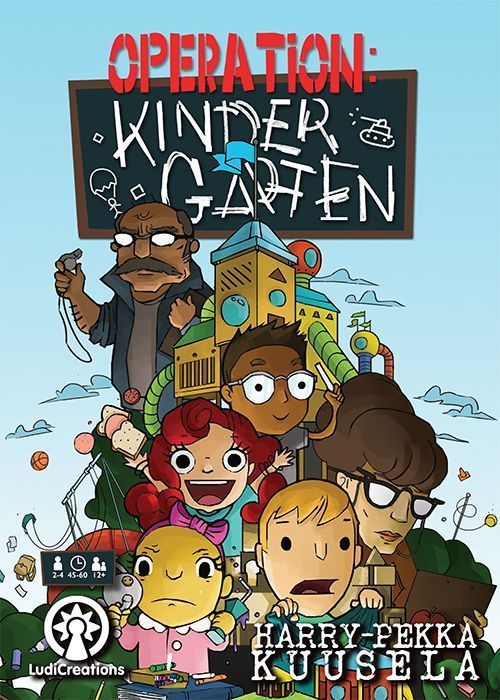
Operation: Kindergarten
Operation: Kindergarten Rulebook
Table of Contents
Table of Contents
Components
12 dice
The dice are used to indicate how far the teachers may move, how far and in which direction the children will move, how far the head teacher will move, and the range of Routines that the teachers have at their disposal.
5 wooden person tokens
- 4 Teachers – blue, red, green, yellow. The teachers are moved by the players, taking actions in the yard to protect the children from dangers, and from each other, in an effort to safely bring them back to their parents.
- 1 Head Teacher – grey. The Head Teacher is retiring at the ripe old age of 27, due to exhaustion. She is trying to survive her last day on the job, while also evaluating the teachers – she hopes to recommend one of them to take over. The location of the Head Teacher token indicates which player is the starting player and causes additional points to be lost due to noise made by upset children.
76 wooden tokens
- 4 Evaluation discs (1 in each player color). These are used to keep track of the Head Teacher's assessment of each teacher's performance.
- 24 Boo-Boo cubes (6 in each player color). Boo-Boos mark incidents in the yard, and the tokens are placed on hexes where the affected children are located. They remain in the hex where they occurred, and may only be removed by a PATCH UP Action / Routine.
- 48 Boo-Hoo discs (12 in each player color). Boo-Hoos are caused when the children are upset about something, and the tokens are placed in the classrooms around the yard.
60 hexagonal cardboard tiles
- 36 Children (9 blue hummingbirds, 9 red ladybugs, 9 green turtles, 9 yellow bumblebees). The children are divided in four different groups, each one being the responsibility of one teacher. Each group has children of three different ages:
- The Tots are the youngest children and are represented by the smallest tiles.
- The Tykes are the middle children and are represented by the medium-sized tiles.
- The Toddlers are the oldest children and are represented by the largest tiles.
- 24 Chaos. Chaos tiles are double-sided. On one side is a location on the board, which is either a hex or the Danger Zone. On the other side are various types of chaotic items and events that affect the children. (see 4. Chaos).
2 cloth bags. These are used to draw Children tiles at random during the 0. Recess phase, and Chaos tiles at random during the 4. Chaos phase.
1 Yard board. The side of the game board for 2 or 4 players contains four sectors, each containing a part of the yard and a classroom. On the reverse there is the board for games with 3 players, with three sectors. The children run wild in the yard, and the goal of the teachers is to safely gather them into the classrooms before the end of the day.
The classroom areas, represented by doors, are where Boo-Hoo tokens are placed. Noise is bad, and especially bothersome to the Head Teacher.
Each yard sector is divided in hex-shaped spaces where children, teachers and chaos roam. Each hex is numbered to identify it, and its six sides are marked with a number of dots that matches the dots on a 6-sided die, with the dots indicating direction.
In the middle of the yard there is the sandbox, a safe space for children to play in. On the four corners of the yard there are four Danger Zones, where children will almost certainly get hurt if they stay too long.
The Sandbox. In a game with four players, up to 12 children may fit in the Sandbox. In a game with three players, up to 9 children may fit in the Sandbox. In a game with two players, up to 6 children may fit in the Sandbox. The Sandbox is adjacent to all surrounding hexes for purposes of movement, Actions and Routines. Children do not form stacks in the Sandbox and are safe from collision.
The Danger Zones. Up to 6 children may fit in each of the Danger Zones. Each Danger Zone is adjacent to all surrounding hexes for purposes of movement, Actions and Routines. Children do not form stacks in the Danger Zones, but are not safe from collision.
1 Teachers' Lounge board. The Teachers' Lounge contains spaces for the dice placed during 1. Roll Call, as well as spaces for Chaos tiles and the Head Teacher's evaluation track, where each teacher's performance is measured.
Setup
- Place the Yard board in the middle of the table, place the Teachers' Lounge board next to it, and gather the dice into a central supply. In a game with 2 players, use 10 dice. In a game with 3 players, use 11 dice. In a game with 4 players, use all 12 dice.
- Each player selects a color and receives the corresponding teacher token, evaluation token, 9 children tiles (3 Tots, 3 Tykes, 3 Toddlers), 6 Boo-Boo tokens, and 12 Boo-Hoo tokens. Place all of the Chaos tiles in one of the cloth bags.
- The players place their evaluation tokens on the "100%" space of the Evaluation Track.
- The Head Teacher token is placed on the classroom space of the starting player, who is the player who has most recently been to kindergarten. Players may also choose the starting player randomly, or in any way that they all agree on.
- The players place their teacher tokens on their classroom spaces, ready to enter the yard by one of the hex sides adjacent to the classroom doors.
Rules of Play
The game is played in 6 rounds, during which players try to keep the children entrusted to them safe and sound, and ultimately deliver them to their classrooms, in time to be picked up by their parents.
Each round has the following phases:
- Recess (first 3 rounds only)
- Roll Call
- Children
- Teachers
- Chaos
- Evaluation
0. Recess (first 3 rounds only)
Don't scream until you see the whites of their eyes!
At the beginning of each of the first 3 rounds, children will be let out into the yard.
- In the 1st round, the tots, the youngest children, appear.
- In the 2nd round, the tykes come out to play.
- In the 3rd round, the toddlers, the oldest ones, enter the yard.
To randomly distribute the children, the starting player places all children tiles of one age group inside the second cloth bag. Then, tiles are drawn one by one and placed on the marked starting hexes (marked by their underlined numbers) on the yard, starting from any such hex and proceeding clockwise.
In the 2nd and 3rd rounds tiles may already be present on a starting hex. When placing a new tile on such a hex, simply stack the new tile on any existing tile(s) (see Stacks, in 2. Children). If there already is a full stack of three tiles, roll a die, and place the new tile on the hex matching the direction indicated by the die (1-6). Repeat the process if the new spot also has three tiles on it.
1. Roll Call
Time to make a plan for the day. Or the next hour. Or the next minute. Or whatever time it takes to clean up this mess.
The starting player for each round is the player whose classroom the Head Teacher is currently in.
The starting player rolls the dice and groups them according to their results, thereby allowing players to plan their turns more efficiently.
Beginning with the starting player, each player selects a die and places it on a space in the Teachers' Lounge board. A player may not place a die on another player's Teacher Move space.
A player who can not place a die (because there is no eligible space) is skipped, and the rest of the players continue to place dice until all dice have been placed.
After placing all dice, move the Head Teacher token clockwise the number of classrooms indicated by the die on the Head Teacher Move space. Each one of the four classrooms counts as one such movement.
2. Children
Heroes are not born. Heroes are made. Teachers, however, are born...to suffer at the tiny little hands of kindergarteners.
Stacks
Two or three children in the same hex constitute a stack.
Children in a stack are always sorted according to age:
- Tots (youngest children, smallest tiles) are placed on top.
- Tykes (middle children, medium tiles) in the middle.
- Toddlers (oldest children, largest tiles) at the bottom.
If children of the same age are in a stack, the newest child is placed on top of any children of the same age previously present in the stack.
When children in a stack are to be moved, only the bottom-placed child is moved, by the player of the same color. Any children stacked on top of it are moved with it and may not be moved again on the same turn.
The only way to remove children from stacks is with the ORDER or REGROUP Actions / Routines, or the CARRY Action. A stack also ceases to exist when the children in it are moved to or placed in the Sandbox or a Danger Zone.
Children movement
Beginning with the starting player and proceeding clockwise, the players move all children tiles of their color.
The children move in order of descending age, starting with the oldest children (largest tiles). They move a number of hexes corresponding to the number of the die placed on the Child Move slot matching that age group.
Children move in the direction corresponding to the number of the die placed on the Child Direction slot matching that age group, always following the direction of that number in every new hex from which they move. High numbers generally lead to safer places, while low numbers generally lead to dangers.
Children may not move in this phase if they start movement in:
- the same hex as a Chaos tile.
- the Sandbox or a Danger Zone.
Children must stop after entering:
- a hex with a Chaos tile.
- the Sandbox or a Danger Zone.
- a hex with one or two other children in it.
The movement of children is not affected by the location of the teacher tokens or any existing Boo-Boo tokens.
Collisions
If a child (or stack of children) would enter a location where the total number of children would exceed the limit (3 in a hex, 6 in a Danger Zone), it does not enter, stops movement, and causes a collision.
In a collision, the children in the target hex (the hex where the limit would have been exceeded) become upset and cause noise:
- If only one child is in the target hex, it causes a Boo-Hoo.
- If two or three children are in the target hex, only the youngest ones cause Boo-Hoos. If all children are of the same age, all cause Boo-Hoos.
The effects of a Boo-Hoo are described in page 8 (4. Chaos).
Children in the Sandbox are safe from collision, but once the capacity of the Sandbox is reached, no more children may enter.
Children in a Danger Zone are not safe from collision, making an overcrowded Danger Zone a very dangerous place for the youngest children to be in as a collision may result in four, five, or even six Boo-Hoos.
3. Teachers
They say that if you can't do, teach. They have obviously never had to do what it takes to teach.
During this phase each player takes a turn, beginning with the starting player and proceeding clockwise. During a turn, a player may perform:
- One Action
- One Routine
A player may perform these in any order, and may also choose to not perform any or all of the above.
Once a turn is complete, the die placed on the Teacher Move space matching that player's color is removed from the Teachers' Lounge.
The goal of the teachers is to return the children to the classroom, safe and sound, so that they are ready for their parents to pick them up. To do that, they may perform certain Actions and Routines.
Actions and Routines are similar, except that all of the possible Actions are always available as an option, while only a certain range of Routines are available every round, depending on the number of the die placed on the Routine die placement space.
The higher the number on the die placed there, the wider the range of available Routines. For example, if a 4 is placed on that space, a player may choose to perform a CLEANUP, a PACIFY, a REGROUP, or a RUN Routine.
A Routine is essentially a bonus Action.
A player may always perform movement as part of an Action, before or after executing it. A player may not perform movement as part of a Routine.
Movement
The active player's teacher token may be moved up to a number of hexes corresponding to the number of the die placed on the Teacher Move space that matches that player's color.
During this movement, the teacher may pass through children, teachers and the Sandbox, but may not end movement in the Sandbox, in a Danger Zone, or in a hex containing children or teachers. Crossing the Sandbox costs two movement points, and the teacher crossing it may exit to any hex bordering it.
Movement rules also apply to any Action or Routine that results in movement of the teacher tokens.
Actions & Routines
Each of the first five items below (ORDER, PATCH UP, CLEANUP, PACIFY and REGROUP) is an Action, but can also be a Routine, depending on the die placed on the Routine space of the Teachers' Lounge board.
ORDER. Select one child tile of your color in the yard sector where your teacher is located, and move it up to as many hexes as the number of the die placed on the Child Move space for that age group. The child may be moved in any direction and may change direction while moving, but may not cause a collision (see Collisions in 2. Children). If the child is part of a stack, remove it from the stack and leave the other children behind.
PATCH UP. Remove 1 Boo-Boo token of your color from a hex adjacent to the one where your teacher is located.
CLEANUP. Remove one Chaos tile from the same or an adjacent hex as the one where your teacher is located and place it in the bag. This is the only way to prevent an incident from being resolved in the 4. Chaos phase.
PACIFY. Remove one Boo-Hoo token of your color from the classroom in the sector where your teacher is located.
REGROUP. Select up to three children tiles (of any color) from any hexes adjacent to the one where your teacher is located. Rearrange those tiles as you wish, placing them in locations (a hex, the Sandbox, a Danger Zone, or your Classroom) adjacent to your teacher. You may remove children from a stack and/or form new stacks. Regroup is one of the two ways (the other being CARRY) to move a child tile out of the Sandbox or a Danger Zone.
CARRY (available only as an ACTION). Before performing the movement part of this Action, select up to three children tiles (of any color) from any hexes adjacent to the one where your teacher is located, and set them aside. After moving, place the tiles set aside in one single location (a hex, the Sandbox, a Danger Zone, or your Classroom) adjacent to the one where your teacher is now located. Carry is one of the two ways (the other being REGROUP) to move a child tile out of the Sandbox or a Danger Zone.
RUN (available only as a ROUTINE). Move your teacher token up to the number of hexes corresponding to the number of the die placed on the Teacher Move slot matching your color. This does not count as your movement.
Returning children to a classroom
Children may be returned to a classroom and removed from the board by moving them across the hex borders that lead to your classroom through the use of:
- ORDER Action/Routine
- REGROUP Action/Routine
- CARRY Action
Returning children to the classroom is possible only in the 4th, 5th or 6th round.
Players may return a child tile of any color to their classroom, even tiles belonging to other players. Place all returned tiles in front of you, to be kept there until the end of the game and final scoring.
4. Chaos
"In the midst of chaos, there is opportunity." – Sun Tzu
Any Chaos tiles that are located in the same hex or Danger Zone as one or more children are resolved, then placed back in the bag. Any unresolved Chaos tiles remain on the board.
When resolved, Chaos tiles may have the following effects:
- Boo-Hoo: Every player matching the color of an affected child places a Boo-Hoo token of their color in the classroom in the sector where the incident occurred.
- Boo-Boo: Every player matching the color of an affected child places a Boo-Boo token of their color on the hex where the incident occurred.
Boo-Hoo and Boo-Boo tokens are limited in quantity; if all tokens of a player color are on the board, ignore any further such incidents.
The potential chaotic incidents may be:
| Incident | Effect | Affected children |
|---|---|---|
| A firecracker | 1 Boo-Hoo | Every Tot in this sector. |
| A deflated ball | 1 Boo-Hoo | Every Tyke in this sector. |
| An ice cream truck | 1 Boo-Hoo | Every Toddler in this sector. |
| A toy | 1 Boo-Hoo | Every child in this location if two or more children are present. |
| Poo | 1 Boo-Hoo | Every child in this location. |
| Sticks & stones | 1 Boo-Hoo | Every child in this location. |
| A dead animal | 1 Boo-Hoo | Every child in this location. |
| A live animal | 1 Boo-Boo |
Then the starting player draws 8 Chaos tiles from the cloth bag, one after another, and places them on the appropriate spaces on the Teachers' Lounge board.
- The first 4 tiles are placed with the side showing a location (hex number or Danger Zone) facing up on the Location spaces, each of which are marked with a small triangle indicating a sector color. If a number is on the tile, then the chaos occurs in the hex of that number, in the sector matching the color of the Chaos tile placement space. If any of the drawn tiles show a Danger Zone icon instead of a number, then the corresponding chaos affects the Danger Zone of that sector.
- The second 4 tiles are placed with the side with the incident image facing up on the Chaos spaces, each of which is next to a Location space, thus pairing a Chaos tile with a location within that sector.
After having drawn and placed these 8 tiles, place the 4 incident tiles on the Yard board, in the locations indicated by their corresponding location chaos tiles.
Chaos tiles placed on the board remain there until they:
- are removed by teachers using the CLEANUP Action / Routine.
- are resolved at the beginning of a future Chaos phase.
5. Evaluation
Not everything that counts can be counted, and not everything that can be counted counts.
The players lose:
- 1 Evaluation Point for each of their Boo-Boo tokens on the board.
- 1 Evaluation Point for each of their Boo-Hoo tokens in any of the classrooms on the board.
- 1 Evaluation Point for each of their Boo-Hoo tokens in the classroom where the Head Teacher is currently located.
Then, all Boo-Hoo tokens are removed from the classrooms and returned to the players.
Note: All Boo-Boos stay in the yard and may cause even more points to be lost in future rounds until they are removed with the PATCH UP Action / Routine.
End of the Game
The game ends after the Evaluation phase of the 6th round. At that time, the players lose Evaluation Points depending on how many of their 9 children were not returned to their own classrooms.
- 1-2 missing children: 3 Evaluation Points
- 3-4 missing children: 6 Evaluation Points
- 5-6 missing children: 10 Evaluation Points
- 7-8 missing children: 15 Evaluation Points
If a player did not return any of their own children to the classroom, that player is not eligible to win.
The player who has the highest score on the evaluation track is the winner, and succeeds the Head Teacher. If two or more players are tied, the winner is the player with the fewest Boo-Boos on the board. If there is still a tie, the winner is the player who returned the most of their own children to the classroom. In case of a further tie, the oldest player wins.
Operation Kindergarten for 2 Players
The game is played with the same rules, with the following changes:
- The players must pick colors that correspond to two diagonally opposite (e.g. blue and green) sectors of the yard.
- In 0. Recess, children are placed only on the marked starting hexes in the two neutral yard sectors.
- In 1. Roll Call, if the Head Teacher is in a classroom of a neutral color, the turn order remains unchanged.
- In 1. Roll Call, only 10 of the 12 dice are rolled and placed on the Teachers' Lounge, and the two neutral Teacher Move die placement spaces are not used.
Operation Kindergarten for 3 Players
The game is played with the same rules, except by using the reverse side of the Yard board.
In 1. Roll Call, only 11 of the 12 dice are rolled and placed on the Teachers' Lounge, and the fourth Teacher Move space is not used.
Variants
Gamer variant
At the end of setup, perform the following:
- Draw four Chaos tiles to place on the board. Draw an additional chaos tile for each one of the first four, using the backside of the newly drawn tile to determine the location of the previously drawn tile, as in the 4. Chaos phase.
Children in the Sandbox are no longer safe from collision, and any Boo-Hoos given due to a collision there are assigned to the classroom spaces of each affected child's color. There may be only one collision per game round in the Sandbox.
During the 4. Chaos phase, the following effects are applied only on children of specific age groups.
| Incident | Effect | Affected children |
|---|---|---|
| Poo | 1 Boo-Hoo | Every Tot in this location. |
| Sticks & stones | 1 Boo-Hoo | Every Tyke in this location. |
| A dead animal | 1 Boo-Hoo | Every Toddler in this location. |
| A live animal | 1 Boo-Boo | Every Tot in this location. |
| A pointy object | 1 Boo-Boo | Every Tyke in this location. |
If an incident is not triggered by a child of the corresponding age, the corresponding effect is not applied and the Chaos tile remains on the board. For example, a Tyke would be not affected by a dead animal, so the tile would remain at that location and might affect any Toddlers that later come upon it.
Wargamer variant
In 0. Recess, make sure to place the children tiles with the side showing the red dot facing down.
During the 2. Children phase, the players do not move all of their children on their turn. Instead, a turn consists of moving one child (or a stack of children). Thus, the players take turns moving them one at a time until all movable children have been moved.
To mark that a child has been moved, turn its tile to the opposite side (with the red dot). To mark that a stack has been moved, turn the topmost stacked tile to the opposite side. Children in a stack that has even one flipped tile may not be moved this round. At the end of the phase, turn every tile so that the side with the red dot is face down.
Quick Reference
Goal: Protect children from harm and return them to your classroom in time for them to be picked up by their parents.
0. Recess (first 3 rounds only): New children tiles are placed in the yard.
1. Roll Call: The starting player is determined according to the Head Teacher's location. Roll dice and place them in the Teachers' Lounge to determine children movement, teacher movement, Head Teacher movement, and Routine availability.
2. Children: Children move (individually or in stacks) and sometimes collide.
3. Teachers: The players move the teacher tokens, taking Actions and executing Routines, to deal with chaos tiles and (during rounds 4, 5, 6) return children to the classrooms.
| Actions | Routines |
|---|---|
| ORDER | ORDER |
| PATCH UP | PATCH UP |
| CLEANUP | CLEANUP |
| PACIFY | PACIFY |
| REGROUP | REGROUP |
| CARRY | RUN |
4. Chaos: Chaos tiles are resolved, and new tiles are placed in the yard.
5. Evaluation: Lose points according to Boo-Boos, Boo-Hoos, and the Head Teacher's location, marking them on the Teachers' Lounge.
Game End: At the end of the 6th round, the players lose points according to how many children they did not return to their own classroom.