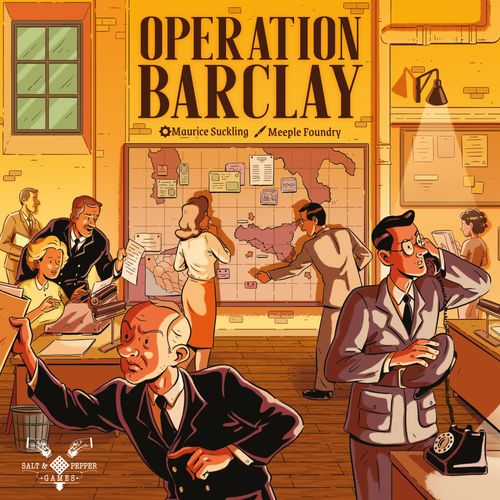
Operation Barclay
Operation Barclay Rulebook
Table of Contents
Table of Contents
Components
- 86 cards (1 deck of 60 Intelligence Channels cards, 1 deck of 13 Abwehr cards, 1 deck of 13 LCS cards)
- 25 Intelligence tokens
- 6 Evidence tokens
- 1 aid card
- 1 draw bag
- 4 Intelligence Assessment tokens (2 Abwehr, 2 LCS)
- 1 rulebook
- 1 board
- 6 Calendar track markers
Summary of Play
Operation Barclay is played in 6 phases, called 'Months'. Each Month consists of 5 steps, within which players perform one set action. Players choose to play as the London Controlling Section (LCS) (Allies) or the Abwehr (Axis).
Players are attempting to play the best hand they can to win the chance to either reveal information about the planned Allied offensives of 1943, or keep it hidden.
But players win even more chances to do so if they correctly bet on who will have the best hand by the end of the Month.
If the Abwehr player wins enough chances to reveal information, they will likely discover where the Allies plan to invade, and which offensives are nothing more than deceptions, and in so doing will win the game.
If the LCS player wins enough chances to keep information hidden, the military intelligence will be preserved, the Allies will launch successful offensives, and win the game.
Object of the Game
There are 5 possible campaign sectors shown on the game board. Over the course of the game, the Abwehr player is going to attempt to discover which 2 sectors are hiding the planned primary and secondary offensives. They have 6 Months to do this. The LCS player is going to attempt to stop them.
Each Month, the Abwehr player is going to attempt to win the opportunity to turn over as many Intelligence tokens as possible. The LCS player is going to attempt to prevent those Intelligence tokens from being turned over.
If at the end of Month 6 - or beforehand - the Abwehr player has revealed where the primary and secondary offensives are planned (that is, they have turned over tokens to show where 4 green radar tokens are in one sector, and where 3 green radar tokens are in another sector), or they can demonstrate through logic exactly where those sectors must be, then they win. If the Abwehr player cannot fulfill the victory conditions, the LCS player wins.
Set Up
-
Determine who will play the British LCS and who will play the German Abwehr.
-
Place the game board between you.
-
The LCS player takes the 25 Intelligence tokens and, unseen by the Abwehr player, places them face-down on the empty spaces on the board, placing 5 in each of the 5 sectors (one in each space on the board). Each sector represents one of the 5 different strategic choices the Allies might make in the summer of 1943: The South of France; Sardinia/Corsica; Sicily; Peloponnese; Dodecanese.
The LCS player chooses one sector to be the location of their primary offensive, one to be the location of their secondary offensive, and the other three are diversions, where no offensive of any kind is planned.
- In the primary offensive sector place: 4 tokens with green radar and 1 with red radar
- In the secondary offensive sector place: 3 tokens with green radar and 2 with red radar
- In the other three sectors place: 2 tokens with green radar and 3 with red radar
The LCS has already placed their tokens unseen and flipped them all to show the reverse side. The Abwehr player can now look at the board.
All these tokens are placed face-down, so they show their sunset sides face-up, and the Abwehr player should not know where any of the green radar tokens are at the start of the game.
-
Keeping them all in their separate decks, shuffle the 60 Intelligence Channels cards, the 13 Abwehr cards, and the 13 LCS cards. Place all three decks on the locations marked on the board, so just the top part of each deck is on the board with the rest of the deck off the board. Deal 4 Intelligence Channels cards to each player, face-down.
-
Each player takes their 2 Intelligence Assessment tokens and places them on their player area. The 6 Evidence tokens and 6 Calendar track markers are set aside.
Gameplay Summary
-
PREPARATION — Players pull all Evidence tokens from the draw bag one at a time and place them on the Evidence boxes on the board.
-
FIRST THREE CARDS — Players take turns playing 3 cards one by one to their tableau face-up and drawing a new card to their hand after each time they play.
Starting with the Abwehr player, players take it in turns to play a card to the table, face-up (and then collect a new card, either from the Intelligence Channels deck, the Double-Cross deck, or their own deck).
-
INTELLIGENCE ASSESSMENT — Players both play an Intelligence Assessment token to the board, face-down.
When each player has 3 cards on the table, each player plays one of their Intelligence Assessment tokens face-down on the board (they are betting on which player will have the best hand at the end of the current game month).
-
FINAL TWO CARDS — Players take turns playing 2 cards to their tableau face-down and drawing a new card to their hand after each time they play.
Players play their final 2 cards to the table face-down.
-
EVIDENCE RESULTS — All cards are turned face-up and the results will determine which Intelligence tokens in which color sector may be turned over.
When both players have played 5 cards in total to the table (3 face-up, and the last 2 face-down) all the face-down cards are revealed, and hands are compared.
If the Abwehr has not won the game, add one marker on the next month of the Calendar track. If the marker is already at Month 6 and the Abwehr player has not won, the LCS player wins the game.
- Players flip over their Intelligence Assessment tokens to see who has bet on the best hand.
- The player with the best hand wins the 2 Evidence tokens in the Alpha box.
- The player who successfully bets on the best hand wins the 3 Evidence tokens in the Beta box.
- The player with the most Reconnaissance/Raids icons in their hand wins the Evidence token in that box.
- The Abwehr player uses their Evidence tokens to turn over Intelligence tokens in sectors of the matching color. (A black Evidence token allows the Abwehr player to choose any of the five sectors.)
- Any Evidence tokens the LCS player wins simply prevent the Abwehr player from using them in the current Month.
- Any Intelligence tokens the Abwehr player flips over remain turned over for the rest of the game.
- The 5 cards from each player's tableau in the current Month are then stacked to one side, a new Calendar Track Marker is placed on the Calendar, and a new month begins.
1. Preparation
Players collect up the 6 Evidence tokens from the box, or from the board (if already on the board from a game in progress), and place them in the draw bag. The LCS player then pulls them out one by one without looking and places them on the Evidence Boxes on the board.
- The first 2 tokens pulled out are placed in the Alpha box.
- The next 3 tokens are placed in the Beta box.
- The last token is placed in the Reconnaissance/Raids box.
Any cards from the previous month are collected into a single face-up discard pile placed to one side of a player's play area - one discard pile for each player. Players may inspect this pile at will, or the other player's, but it is recommended to keep this to a minimum to not slow down the game.
Players start the game with 4 cards in their hand. They draw a new card immediately after they play one so that their hand always remains at 4 cards. At the very end of the game there may be insufficient cards to draw from, in which case players have smaller hands.
2. First Three Cards
Only cards with the "×3" icon may be played in this step.
These cards are played face-up.
Starting with the Abwehr player and taking turns, players play a single card face-up to their tableau - the space in front of them clear for both players to see. All effects on the cards must be implemented at the moment the card is played (if possible). Effects on these cards do not trigger later unless the card explicitly says so. After each card is played, a player draws 1 new card into their hand, either:
- from the top of the Intelligence Channels deck, or
- from the top of the Double-Cross deck (if formed), or
- from the top of their own deck. (The Abwehr player may only draw from the Abwehr deck, and the LCS player may only draw from the LCS deck.)
When playing a Spy card (5, 6, or 7) you must draw 2 cards from the top of the Intelligence Channels deck, look at them both, put 1 in your hand, and put the other face-down at the top of the Double-Cross deck.
Some cards tell you to replace them with other cards; the text on the cards will make it clear where from. When you are told to replace a card but to retain its icon, you keep the card in your tableau, but play the replacement card on top of the replaced card, showing the section of the card where its icon (Reconnaissance or Raid) will still be visible: it will contribute to the Reconnaissance/Raid score at the end of the round.
When both players have 3 cards in front of them, this phase ends.
The Double-Cross Deck
At the start of a game there is no Double-Cross Deck. However, it will form over the course of play when any player plays a Spy card (a 5, 6, or 7) to their tableau as one of the first three cards, which are always played face-up. After a Spy card is played, players must draw 2 cards from the top of the Intelligence Channels deck, examine them, choose 1 for their hand and put the other face-down on top of the Double-Cross deck or space if not formed yet. Certain other cards allow players to look through and reorganize the deck.
Examples of use of the Double-Cross Deck in play
As one of your first 3 cards, you may decide to play a Spy card (1) on your turn with a value of 5 (or 6 or 7) to your tableau. (As one of the first 3 cards, this card must be played face-up, and its effect can be read by both players.) Because of this card's Active Agent effect, you now pick up 2 cards from the Intelligence Channels draw pile (2) (if there is only 1 card in this pile you may only pick up 1 card, if there are no cards in this pile you may not pick up any). You look at both these cards (keeping their faces hidden from the other player) and choose 1 for your hand and place the other face-down on top of the Double-Cross space (3) on the board, or on the already formed deck - or space, if the deck is not formed yet. You will maintain 4 cards in your hand, but now you also know which card is on top of the Double-Cross Deck.
At the end of your turn, after playing a card to your tableau, you will - unless a card stipulates otherwise - draw a new card into your hand. You may do this from the Intelligence Channels deck, your own unique deck (LCS or Abwehr), or from the Double-Cross deck. If you know what the top card of the Double-Cross deck is you may decide you want to draw from here, rather from elsewhere.
As 1 of your first 3 cards, you may decide to play a Double Agent card on your turn, with a value of 11 (or 12 or 13) to your tableau. (As 1 of the first 3 cards, this card must be played face-up, and its effect can be read by both players.) Because of this card's Double Agent effect, you now pick up the top 3 cards of the Double-Cross Deck (or fewer if there are fewer in that deck at the time) look at them, rearrange them in any order you like, and then place them face-down on the top of the Double-Cross Deck.
3. Intelligence Assessment
These tokens are played face-down.
Starting with the Abwehr player, the players take it in turns to play 1 of their 2 Intelligence Assessment tokens face-down onto the appropriate space on the board. These tokens register a player's bet on who will have the best hand by the end of the Month. If the LCS player uses the Ultra card, its Reconnaissance effect is still used in the Evidence Results phase.
Examples of use of the LCS Ultra card
During Intelligence Assessment, the LCS player has an Ultra card in hand and decides to play it (1). They show the card face-up. This compels the Abwehr player to reveal their own Intelligence Assessment token (2), which shows they think the LCS player will have the best hand at the end of the Month. The LCS player now plays their own Intelligence Assessment token - keeping it face-down - thus keeping the Abwehr player in the dark about who they are betting on. Then the LCS player draws another card into their hand (to retain 4 cards) from the Intelligence Channels deck, the LCS deck, or the Double-Cross deck.
4. Final Two Cards
Only cards with the "×2" icon may be played in this step.
These cards are played face-down.
Starting with the Abwehr player, the players take it in turns to play a single card, face-down to their tableau, joining the 3 cards already placed face-up. Any effects on these cards will not trigger at the moment they are played, but may trigger during the Evidence Results Step if relevant. After each card is played, a player draws 1 new card into their hand, either from the top of the Intelligence Channels deck, Double-Cross Deck or from the top of their own LCS or Abwehr deck. This phase ends when both players have 5 cards in the current tableau in front of them.
5. Evidence Results
Token Reveals and Token Allocation
The 2 face-down cards on each tableau are simultaneously turned face-up. It is now possible to tell who has the best hand. (see Best Hand section on page 22.) If there are any cards that need effects implemented or any cards that need their values or colors determined in this step, the Abwehr player resolves their cards first, before the LCS player. The player with the best hand receives the 2 Evidence tokens in the Alpha box.
- The LCS player never does anything with any Evidence tokens they win, they merely prevent the Abwehr player from using them.
- If there is a tie, the Abwehr player receives 1 Evidence token of their choice from the Alpha box.
The 2 Intelligence Assessment tokens are turned face-up. It is now possible to tell who bet correctly on who was going to have the best hand. The player who bets correctly (the player whose Intelligence Assessment token matches who has the best result for the Month) receives the 3 Evidence tokens in the Beta box.
- If there is a tie (both players bet correctly) the Abwehr player receives 1 token of their choice from the Beta box.
- If there is a tie (both players bet incorrectly) neither player receives any Evidence tokens.
The winner of the Evidence token in the Reconnaissance/Raids box is the one with the most Reconnaissance icons OR the most Raids icons, whichever total is highest on each player's respective tableau. There are different icon types:
-
Reconnaissance icon.
-
Raid icon.
-
This icon cancels out ALL the Reconnaissance icons on the other player's tableau.
-
This icon cancels ALL the Raid icons on the other player's tableau.
-
If there is a tie the Abwehr player receives the Reconnaissance/Raids token.
Example #1:
- Abwehr player has 1 Raid and 3 Recon icons.
- LCS player has 2 Raid and 2 Recon icons.
Abwehr player wins.
Example #2:
- Abwehr player has 2 Raid and 3 Recon icons.
- LCS player has 1 Raid, 2 Recon, and two icons that cancel out all enemy Recon icons.
Tie. Abwehr player has 2 Raid. LCS player has 2 Recon. (Ties mean the Abwehr player still wins the token.)
Token Meanings
Each Evidence token corresponds to a specific sector on the board, allowing the Abwehr player to turn an Intelligence token in the corresponding sector face-up. Any token the LCS player wins limits the tokens the Abwehr player may turn over but does not give them any direct action to perform.
- The pink color token allows the Abwehr player to turn any one token face-up in the Southern France sector.
- The red color token allows the Abwehr player to turn any one token face-up in the Sardinia/Corsica sector.
- The blue color token allows the Abwehr player to turn any one token face-up in the Sicily sector.
- The green color token allows the Abwehr player to turn any one token face-up in the Peloponnese sector.
- The purple color token allows the Abwehr player to turn any one token face-up in the Dodecanese sector.
- The black token allows the Abwehr player to turn any one token face-up in any sector they wish.
Token Actions
The Abwehr player chooses which order they want to turn over Intelligence tokens on the board, corresponding to the color of the Evidence tokens they have won this Month.
End of Game Scoring
There are two ways for the Abwehr player to win:
- Revealed Intelligence tokens: at the end of each turn when the Abwehr player has turned over sufficient Intelligence tokens to reveal which sector is the primary offensive sector (with 4 green radar Intelligence tokens face-up), and which is the secondary offensive sector) with 3 green radar Intelligence tokens face-up).
- Logic: at the end of each turn when the Abwehr player has turned over sufficient Intelligence tokens to be able to argue irrefutably where the primary and secondary sectors must be, and which is which.
If the Abwehr player wins the game is immediately over.
Place 1 Calendar token on the track on the board in the next available chronological space (Month).
If the Abwehr player cannot be certain where both the primary and secondary offensive sectors are, the game continues, unless all 6 Calendar markers are on the Calendar track, in which case the Abwehr player has run out of time and the LCS player wins.
If the game continues, players now return to the Preparation step (page 10 of these rules). Unlike in the first Month of the game, players do not draw new cards - they should already be at a hand of 4 cards when Month 2 begins. Players move through the same 5 phases of play from Preparation through to Evidence Results (steps 1-5) and then perform an End Game scoring.
FAQ
LCS 'A' Force Card:
This card can only be replaced by one with a matching sector color, including cards that possess more than one color, provided that the Dodecanese purple is one of them.
Defector Cards:
The Abwehr player always resolves all their card effects in the Evidence Results Step before the LCS player resolves theirs.
Replacing Cards:
If replacing a card, you may use any relevant card from your own discard pile (1). If a card says it may be only replaced by a card with the same color it may only be replaced with a card with the same sector color (2), but this includes cards that also have other sector colors (3). If a card does not specify what cards it may be replaced with, players may choose any card from their discards (4).
Cards with Multiple Numbers and Colors:
Some cards show more than one number and more than one sector color. Players determine the values and colors of these cards during the Evidence Results Step. The Abwehr player always determines values and colors before the LCS player.
Effect on Cards with "×3" / "×2":
Some cards have both icons which means they can be played in either phase. Nevertheless, the effect of the card only applies to the phase it refers to.
Evidence Tokens in Revealed Sectors:
If the Abwehr player wins an Evidence token for a sector where there are no more Intelligence tokens to be revealed the Evidence token is ignored.
Promo Cards
If you have promo cards these are added to the LCS or Abwehr deck respectively.
What is the Double-Cross Deck for?:
Building the Double-Cross deck can allow you to build knowledge of the sequence of cards in this deck, allowing you to build a good hand or to confound your opponent. A good strategy and a pinch of luck is key.
Examples of an Abwehr Victory Through Logic
In this example, the Abwehr player has turned over all Intelligence tokens except 3 in the Southern France sector. Although only the secondary offensive sector (Sardinia/Corsica) has been revealed, the only sector where the primary offensive can be is in Southern France: 2 of the tokens not revealed must logically be in that sector. The Abwehr player does not need to know precisely which token is a green radar token or not; only which sector the green radar-tokens must be in.
In this very similar situation, the Abwehr player has turned over all Intelligence tokens except 3 in the Southern France sector, 1 in the Sicily sector, 1 in the Peloponnese sector, and 1 in the Dodecanese sector. The secondary offensive is in the revealed Sardinia/Corsica sector. Although the primary offensive sector hasn't been revealed, it can only be in the Southern France sector.
Best Hand (from best to worst)
The player holding a card with 1/13 can decide the value - choosing either number when assessing the hands to give them the outcome they prefer. The Abwehr player chooses first when assessing the cards.
These hands are like poker, but not identical.
- Five of a Kind — All five cards are the same number. In the case of a tie, the highest number wins. If the numbers of each player are equal, it remains a tie.
- Straight Flush — All cards are in consecutive numbers in the same suit. In the case of a tie, the run with the highest numbers wins. If the numbers of each player are equal, it remains a tie.
- Four of a Kind — Four cards are the same number. In the case of a tie, the highest number wins. If the numbers are equal, it remains a tie.
- Full House — One treble, and one pair. In the case of a tie, the treble with the highest number wins. If they are equal, the double with the highest number wins. If both are still equal, it remains a tie.
- Straight — All cards are in consecutive numbers, but not all in the same suit. In the case of a tie, the run with the highest numbers wins. If the numbers are equal, it remains a tie.
- Three of a Kind — Three cards are the same number. In case of a tie, the highest number wins. If the numbers are equal, it remains a tie.
- Two Pairs — Two sets of cards are the same number. In the case of a tie, the highest number pair wins. If these are equal between players the highest of their second pair wins. If these are also equal it remains a tie.
- One Pair — One set of cards is the same number. In the case of a tie the pair with the highest number wins. If these are equal between players it is a tie.
- Highest Card — If no player has a winning hand, the best hand is that with the highest single card value. If the players have the same value card, it is a tie.