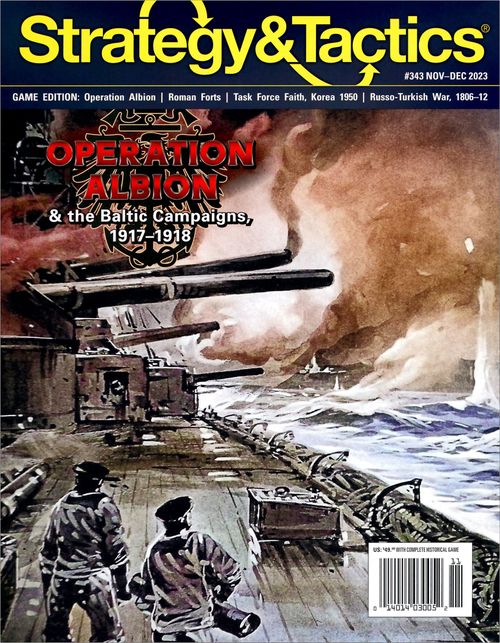
Operation Albion: Germany versus Russia in the Baltic, 1917-1918
Operation Albion: Germany versus Russia in the Baltic, 1917-1918 Rulebook
Table of Contents
Table of Contents
- 1.0 Introduction
- 2.0 Components
- 3.0 Set Up
- 4.0 How to Win
- 5.0 Control of Spaces
- 6.0 Sequence of Play
- 7.0 Weather, Incidents & the October Revolution
- 8.0 Actions
- 9.0 Stacking
- 10.0 Movement
- 11.0 Combat
- 12.0 Combat Procedure
- 13.0 Special Combat
- 14.0 Transport/Amphibious Operations
- 15.0 Reinforcements
- 16.0 Ports & Logistics
- 17.0 Air Basing
- 18.0 Refit & Rally
- 19.0 Home Bases
- 20.0 Fog of War
- 21.0 Unique Units
- 22.0 Engineers & Bases
- 23.0 Mine Warfare
- 24.0 Finnish Civil War
- 25.0 Scenario
- 26.0 Action List
- 27.0 Joint Operations
- Terrain Effects Chart (TEC)
- Optional Rules (Online Only)
1.0 Introduction
Albion is a combined naval-air-land campaign. The game system shows the effects of various operations over the course of a scenario. Players conduct actions which encompass combat, logistical, intelligence, and other operations. A player can conduct one or more actions per turn. All units use a similar combat system, showing the interaction of naval, air, and land forces.
1.1 Game Scale
Each game turn (GT) represents from one day to one month depending on the pace of operations. One inch on the map represents 40 kilometers. Ground units represent regiments, brigades, and divisions. Aircraft units represent squadrons. Ship units represent divisions of one to three battleships or battlecruisers, four to eight other cruisers, flotillas of twelve to twenty destroyers, or various numbers of other ship types.
1.2 Game System
The rules are based on designs such as Red Dragon Rising, South Seas Campaign, and Netherlands East Indies which have appeared in previous DG magazines. Substantial changes have been made. These rules changes are not retroactive to prior games as they model the conditions specific to this campaign.
2.0 Components
A complete game of Albion includes a 22×34-inch game map, rule set. and a sheet of 176 5/8-inch counters. Players must provide one six-sided die to resolve combat and other random game events.
2.1 Game Map
Errata: The map compass should be rotated 90 degrees to the left.
The map is divided into two general regions:
- Off-Map Home Bases: There are two home bases:
- German Home Base, representing the High Seas Fleet bases.
- Russian Home Base, representing the naval base at Petrograd.
- Operational Area: The map includes sea zones and land areas. Zones and areas are collectively termed spaces.
- Sea zones are divided by sea borders.
- Land areas are delineated by land borders.
- Sea zones are divided from land areas by coastlines.
- Fortresses & Towns: These are land areas with special stacking and combat rules (Example: Riga).
- Island Areas: Are represented by areas within or between sea zones. They function as land areas (Example: Aland).
- Coastal Areas: These adjoin sea zones. Coastal areas include all islands, ports and land areas adjoining sea zones.
- Finland: Finland is all areas north or northwest of Petrograd. Finland is part of Russia.
Important: Borders have been redrawn for the purpose of the game map.
2.1.1 Tracks & Displays
- Turn Record Track (TRT): The TRT is used to indicate the current GT.
- Action Points (AP) Track: Each side has an AP Track. It is used to indicate the current number of APs available to the corresponding side.
- October Revolution Track: Is used to indicate the slide towards the Bolshevik Revolution.
- October Revolution Reinforcements Display: Each side uses these displays to hold special units deployed after the October Revolution.
- Units Destroyed Display: Each side uses these displays to hold units that have been permanently eliminated.
- Base & Supply Units Displays: Each side uses these displays to hold special reinforcements.
- Battle Area Display: Players may remove units that are conducting combat and place them in these displays. Place the battle marker in the area or zone from which the units were moved as a mnemonic to remind players where the battle is taking place.
- Units for Refit Displays: Each side uses these displays to hold units that were on the map but were eliminated for any reason. These units may be refit and returned to play.
- Units Withdrawn Displays: Each side uses these displays to hold units that have been withdrawn from play without being eliminated.
- Task Force (TF) Displays: Each side has two task force markers. They may be used on the map to provide additional fog of war and to reduce stacking. Naval units represented by a TF marker are placed in the corresponding TF Display and the TF marker is placed on the map.
2.1.2 Charts & Tables
- Refit Table (on the map): Each player has a Refit Table to determine the outcome of refit (returning units to play) attempts during the game.
- Incident Table (on the map): Each player has an Incident Table to determine the occurrence of random events.
- Terrain Keys (on the map): Are graphical displays used by the players to determine the types of terrain and area/zone borders.
- Terrain Effects Chart (TEC): Used by the players to determine the effects of terrain on movement, stacking, and combat. The TEC is on the last page of the rules.
2.2 Nationalities & Contingents
There are two opposing sides in the game: German and Russian. Each side is composed of multiple contingents. Nationalities and contingents are identified by the background color of the counters.
German Contingents: The German player controls these contingents:
- Imperial German: Dark or Light Gray
- Finnish White Guards: Light Blue
Important: The German player initially controls Imperial German forces. After the October Revolution the German player also controls the Finnish White Guards.
Russian Contingents: The Russian player controls these contingents.
- British Royal Navy: Dark Tan.
- Russian Provisional Government: Tan
- Russian Bolshevik Red Guard: Dark Red
- Finnish Red Guards: Orange
The back of the counters are red to show that the units are controlled by the Russian player after the October Revolution.
Important: The Russian player initially controls the Provisional Government and British Royal Navy. After the October Revolution the Russian player controls the Russian Bolshevik, Finnish Red Guard, and the British Royal Navy.
2.3 Counters
There are two general types of counters: Combat units, that represent various land, sea, and aerial combat forces; and markers.
2.3.1 Combat Units
There are three basic types of combat units; Naval Units, Air Units, and Ground Units. All three types depict the same type of information. The counter diagram identifies the following: Unit ID; Anti-Ground Factor; Anti-Aircraft Factor; Reinforcement Code; Unit Type Symbol; Anti-Submarine Factor; Anti-Ship Factor; Movement/Range Factor.
Unit Size Symbol: Only ground units depict a unit size symbol. The symbol represents the unit's organizational size. From largest to smallest, they are:
- XXX: Corps
- XX: Division
- X: Brigade or Task Force
- III: Regiment
- II: Battalion
Movement & Range Factors: The parenthesized number is the unit's movement (naval and ground) or range (air).
Reinforcement Codes: Units that do not begin the game on the map are reinforcements. The reinforcement code designates when the unit is placed in the Reinforcement Pool, or if the unit is placed in one of the displays.
Important: Units without a reinforcement code begin the game on the map.
- R1: Units are placed in their corresponding side's Reinforcement Pool on GT 1.
- Opt: Units that are only used with the optional rules.
- Stars: Units with a star to the left of the unit type symbol are available after the October Revolution takes place.
Counter Errata: The Russian TD-4 is marked with a Start-R code. Ignore the code. The unit begins on the map.
2.3.2 Naval Units
Naval units have identifying icons; they also carry letter abbreviations of their types. The number after the ship type is usually the historic naval formation.
- There are two categories of naval units: Surface and Submarine (SS).
- If a rule applies to naval units, it applies to both surface and submarine units.
- If a rule applies only to surface or submarine units, the appropriate naval unit category will be used in that rule.
Surface ships are defined by three major types: Combat, Transport, and Carrier.
Combat Types:
- BB: Dreadnought Battleship
- BC: Battlecruiser
- BP: Pre-Dreadnought Battleship
- CL: Light Cruiser Squadron
- CP: Protected Cruiser Squadron
- TD: Torpedo Boat Destroyer Flotilla
- MW: Mine Warfare Flotillas
Transport Types (TR): Transport types have a number printed on their reverse side. This number is the number of ground or air units the unit can transport.
Errata: The back of the Russian TR units have a flag. They should depict a transport icon with a 1 below the icon (the current back of MW-1, MW-2, and SS-3; those units should have flag backs).
Submarine Types: SS are naval units but are treated differently from surface ships.
Optional Carrier Types: Are naval units with special abilities. These units are only used when using the optional rules.
- AV: Seaplane Tender
Minefields: These are special static naval-type units. Errata: The back of the Russian Minefields should have red background. They remain on the map after the October Revolution (7.0). This has no effect on play.
2.3.3 Aircraft Types
Air units represent groups of squadrons.
- B: Battle (Mixed Fighter/Bomber/Recon)
- F: Fighter
- HB: Heavy bomber
- SP: Seaplane
- LZ: Luftschiff (Airship) or Zeppelin
Important: The reverse of certain air units is the unit's patrol mode. This is used only in the optional rules.
2.3.4 Ground Unit Types
The ground unit types in the game are identified by NATO style symbols. Ground units are broken into two categories: Mobile (can move and be transported) and Static (cannot move).
Mobile Ground Units: Infantry, Marine infantry, Cavalry, Armored Train, Armored car, Militia, Engineer, Partisan, Artillery, Shock troops.
Important: Any type of mobile ground unit with an anchor symbol is a Marine unit for naval transport purposes (21.1.1).
German Shock troops have a light gray unit type symbol.
Errata: The Optional LW Corps should not have a light gray background in its unit type symbol.
Static Ground Units (Bases): These have a movement of zero. They can neither move nor use sea/lift transport.
2.3.5 Ground Unit Step Strength
A step represents the overall ability of a ground unit to absorb damage in combat prior to being eliminated from play.
- One Step Units: Are units with combat factors printed on only the front side of their counter. They require only one hit to eliminate them from play. Place them in the appropriate Units for Refit Display.
- Two Step Units: Are units with combat factors printed on both sides of their counter.
- The front side is full strength. When a two-step unit suffers a hit in combat, flip it over so its reduced side shows.
- If a reduced unit takes another hit in combat, it is fully eliminated and removed to the appropriate Units for Refit Display. The yellow line across the back of the counter indicates the unit is reduced.
Russian Latvian Rifles & Armored Train: The reverse side of the LR units and armored train represents their defection to the Bolsheviks. These units are one-step units. Front (Provisional Gov.); Back (Bolshevik).
2.4 Unit Abbreviations
German
- 8A: Eighth Army
- 42 Div: Group of 42nd Division (rest of the 42nd Division is with the 65th Brigade)
- Bav: Bavarian
- BAK: Bruchmuller Artillerie Kommand
- Bic: Bicycle
- Brand: Brandenstein Detachment
- Drgn: Dragoon (Finnish White Guards)
- Gd: Guard
- Gd Erz: Guard Ersatz (Replacement)
- J: Jaeger (Finnish White Guards)
- LW: Landwehr (the LW designation is for historical purposes only. No effect on game play)
- MRC: Military Revolutionary Committee
- OST/OS: Ostsee (East or Baltic Sea) Division
- R: Reserve
- SeeB: See Battalione (Naval Landing Troops)
- Sturm: Assault
- SW Vol: Swedish Volunteers (Finnish White Guards)
Russian
- 12A: Twelfth Army
- DB: Death Battalion
- Don C: Don Cossack
- LR: Latvian Rifles
- KS: Kronstadt
- RG: Red Guards
- Sib: Siberian
2.5 Markers
Markers are used for various administrative and information purposes.
- Action Points (AP): Used to track each player's current number of APs.
- Port Demolition (front): Indicates a destroyed port (used in Optional rules).
- Attack/Amphibious Assault (back): Used to indicate the areas from which attacking forces moved into a fortress or town, or for an amphibious assault.
- Battle: A mnemonic used to mark which space a battle takes place in when units are removed from the map to resolve combat.
- October Revolution: Used to indicate the current progress of the October Revolution.
- Psychological Warfare (PSYWAR): Indicates a target for a PSYWAR action (Action List).
- Turn: Indicates the current GT.
- Weather in Effect: A mnemonic used to remind players weather is in effect.
- Task Force Marker: Used to represent naval units in the TF Displays.
2.6 Definitions
- 1d6: Indicates that the player must roll one six-sided die.
- Adjacent: Spaces are adjacent if they have a common border.
- Adjoining: A sea zone is adjoining to a coastal land area if separated by a coastline.
- DR: Die Roll.
- DRM: Die Roll Modifier.
- EZOC: Enemy Zone of Control.
- Force: A force is one or more units conducting an action together. Normally, units comprising a force must begin the action in the same area, and then move and/or attack into the same area. If a player has more than one unit in an area, they can use less than all of them to compose a force. A player composes a force on an action-by-action basis.
- Friendly & Enemy: A friendly unit is a unit that you control. An enemy unit is a unit controlled by the other player (2.2).
- Functional Port: An area with a port and a friendly base unit. The presence of enemy units does not affect functionality. Important: A player must have a friendly base in the area for the port to be functional. An area containing a port without a base unit is not functional for either player.
- GT: Game Turn.
- May: A player is not required to perform the action (player's choice).
- Movement Factor.
3.0 Set Up
Each player sets up their units according to the instructions and in the order provided in the scenario. A player may be required to set up a unit with a specific unit identification, or by unit type. Important: If a type of unit is called for and there are units of that type with different combat or MF, the owning player may select which unit is set up.
- Units must be set up within stacking (9.0) and/or air basing requirements (17.0).
- Two-step units are set up at full strength side unless scenario instructions state otherwise.
- Ground units may begin the scenario on ships (14.0).
4.0 How to Win
There are two ways to win Albion: Sudden Death Victory and End of Game Victory.
4.1 Sudden Death Victory
Play immediately stops and the Russians gain a decisive victory if Russian units occupy all fortresses.
4.2 End of Game Victory
Upon completion of the last GT players determine victory.
- Contested and uncontrolled areas do not count for VP (5.0). Units from any friendly contingent (2.2) count for control of spaces.
- For units to count for VP, they must be eliminated (not reduced). Withdrawn units do not count. Units which were eliminated but have returned to play via refit do not count for VP.
- Each player totals up their VPs.
-
The German player receives VP for having control (5.0) of specific areas and for specific enemy units that are in the Russian Refit and Units Destroyed Displays. The German player receives: a) Two VP for control of Riga. b) One VP for control of each of the following towns or fortresses: Reval, Narva, Helsingfors, Pskov, Hango, Vyborg. c) One VP for control of all three of the following islands: Dagden Is., Moon Is., Oesel Is. d) One VP for each BB, BC, or BP in the Russian Refit or Units Destroyed Displays.
-
The Russian player receives VP for having control of one location and for specific enemy units in the German Refit or Units Destroyed Display. The Russian player receives: a) Two VP for the control of Libau. b) Two VP for each BB and BC in the German Refit or Units Destroyed Displays. c) One VP for each German shock division in the German Refit or Units Destroyed Displays.
4.3 Victory Level
The players then determine the level of victory by subtracting the Russian VP from the German VP. The result is the level of victory:
- 10 or More: Decisive German Victory
- 8–9: Theater German Victory
- 6–7: Marginal German Victory
- 4–5: Draw
- 3 or Less: Russian Decisive Victory
5.0 Control of Spaces
An area or zone may be controlled, contested, or uncontrolled. Important: Home bases are always controlled by the owning player. The owning player is not required to have a unit in the home base.
- A side controls a land area if a friendly ground unit (mobile or static) is in that area and no enemy ground unit is in it. Air and naval units by themselves can never control or contest control of Areas.
- A side controls a sea zone if it has a naval unit (any type) in it and there are no enemy naval units in it.
- If both sides have any of the above units in the same area or zone, then neither side controls the area/zone, it is contested.
- If neither side has any eligible units in it, then the area or zone is uncontrolled.
5.1 Changing Control
If a player moves a unit into an area and there are no enemy units in it, then that player gains control. If the player moves the unit out of a space, then control is lost (and can be regained later by moving another unit into it).
5.2 Functionality
If a player has a base unit in an area, that player can utilize its port and use it as an airfield. Only one side can have a base unit in a port at a time (9.0).
5.3 Land Area Restrictions
Certain areas have restrictions due to their special nature.
- Fortresses and towns are land areas but have various limits on stacking (9.0) and combat (11.0).
- The Riga Gulf Islands (Oesel, Moon and Dagden) are separate areas.
- Units can move between Oesel and Moon via a common land border even though the two land area boxes are not adjacent.
Designer's Note: Oesel and Moon were connected by a causeway.
- Dagden is a separate island and ground units require naval transport to move to/from Dagden to/from any other land area (including Oesel and Moon islands).
- Units may move anywhere on the map, within normal movement rules and stated restrictions. Exception: Air, naval, and ground units cannot enter enemy home bases (19.0).
6.0 Sequence of Play
Operation Albion is played in game turns (GTs).
- Each GT consists of a sequence of steps, called phases.
- Each time the Turn Record Phase is reached, move the turn record marker forward one space on the TRT. If this is the last GT of the scenario, the game comes to an end and victory is evaluated.
Important: If the conditions for a sudden death victory are reached at any point, the scenario comes to an immediate end (4.1).
- The various phases are explained in separate rules sections.
- A single player Actions Execution Phase may include any number of actions (up to the player's current AP maximum). Do not advance the turn marker simply for taking an action.
- The player taking the turn is the phasing player and the opposing player is the non-phasing player.
- Once a phase or a sub-routine within a given step has been completed, no portion of it may be taken back or redone unless the opponent graciously gives their permission.
6.1 Sequence of Play
- Weather Check Phase: Players must make a weather check (7.1).
German Player Turn
- German Action Determination Phase: The German player determines the number of AP received this GT (8.1).
- German Incident Phase: The German player checks for an incident (7.2).
- German Actions Execution Phase: The German player conducts all actions for this GT (8.0).
Russian Player Turn
- Russian Action Determination Phase: The Russian player determines the number of AP received this GT (8.1).
- Russian Incident Phase: The Russian player checks for an incident (7.2).
- Russian Actions Execution Phase: The Russian player conducts all actions for this GT (8.0).
- October Revolution Execution Phase: If the conditions for the October Revolution are in place, then take the actions detailed in 7.3.
- Turn Record Phase: Advance the Turn marker one space on the TRT, or if this is the last GT of the scenario, determine end of game victory.
7.0 Weather, Incidents & the October Revolution
7.1 Weather
If the turn marker is in a GT box on the TRT with two numbers at the bottom of the box, the players must conduct the Weather Check Phase.
- To conduct the weather check, one player (your choice) rolls 1d6. If the result is within the range of the two numbers (inclusive), weather goes into effect. Place the weather marker in the current GT box. The effects of weather are:
Naval Effects:
- All naval units have their MF reduced by one (minimum of one).
- Russian naval units cannot move into or out of their home base (owing to ice). They may move into or out of other ports.
Air Effects: A maximum of one air unit (from each side) can fly a mission into a single space per action.
7.2 Incidents
During each player's Incident Phase, the current player must randomly determine the current GT's incident.
Important: The Russian player has two Event Tables. The Pre-Revolution Table is used when rolling for incidents prior to the October Revolution and the Post-Revolution Table is used after the revolution occurs.
- The player consults his side's Incident Table and rolls 1d6.
- The player then cross references the DR with the corresponding incident and immediately applies the result.
Note: The Incident Table results are printed on the game map, not in the rules text, and are not reproduced here.
7.3 October (Russian) Revolution
The Russian player has an October Revolution Track, measuring the progress of the Bolsheviks towards overthrowing the Provisional Government (Revolution Index).
- Revolution can go higher and lower (usually the latter!) by various game actions and incidents. The various factors shifting the index are below the table.
- The number on the lower part of the track is the number of free AP the Russians receive each GT (8.0).
- During the October Revolution Execution Phase check the track; if the marker is in the zero box, the revolution occurs.
- The Finnish Civil War commences (24.0). Deploy units per 15.1 and 15.2.
Note: The factors that shift the Revolution Index are printed on the October Revolution Track on the game map, not in the rules text, and are not reproduced here.
- On the GT that the revolution takes place, the Russian then the German player must immediately follow the below procedures:
The Russian Player:
-
Must flip the Latvian Rifles and Armored Train units (2.3.5) to their Bolshevik side if on the map or in the Refit Display. Treat them as Red Guards for the rest of the game.
-
Must withdraw all other Russian units (7.4). Exception: Russian minefields remain in place.
-
Deploys the following units:
- Bolshevik Petrograd Corps in Petrograd
- Narva Corps in Narva
- Pskov Corps in Pskov
Important: If any or all the above spaces are controlled by enemy units, the affected unit(s) may deploy in the Petrograd A land area.
- The October Revolution marker remains at zero for the rest of the game.
- The Russian player receives the number of AP equal to 1d6. Incidents may award or deduct AP.
The German Player:
- Withdraws all German BC, BB units.
- Withdraws all German shock divisions.
Important: Only withdraw division sized units.
- Withdraws the German artillery corps.
- Rolls 1d6, the result is the number of German infantry divisions (non-shock divisions) that must be withdrawn.
7.4 Withdrawing Units
Withdrawn units are picked up and placed in the appropriate Units Withdrawn Display.
- Withdrawn units are not eliminated for VP purposes; however, they may not return to play.
Important: When withdrawing units, all units (those required to withdraw) in the Refit Display or Reinforcement Pool are also withdrawn.
- Units in the Destroyed Units Display are not withdrawn.
8.0 Actions
Action is the term used to describe the basic increments of movement, combat, and other player-initiated operations. Actions procedures are listed in 26.0. Actions are quantified as Action Points (AP).
- Players track the number of available AP on the AP Track using their AP marker when gaining or expending AP.
- A player's Action Point Track can go no higher than the maximum number on the track, nor may it go lower than zero.
- A player can execute any number of AP on the track during a GT.
- Unused AP cannot be accumulated from GT to GT. If not used, they are lost. Reset the action marker to zero at the start of each player's turn.
8.1 Number of Actions per GT
During the Actions Determination Phase of the player's turn, the player totals the number of action points available for the GT.
Russian AP:
- Prior to the Russian October Revolution occurring, the Russian player receives the below number of AP:
- Russian Morale: The Russian player receives the number of AP listed at the bottom of the October Revolution Track of the box where the October Revolution marker currently is placed.
- Add one AP if Russian ground units control Riga and the three Riga Gulf islands.
- Add one AP if Russian ground units control both Hango and Helsingfors.
- After the October Revolution occurs, the Russian player rolls 1d6, the result is the number of AP the Russian player receives that GT.
German AP (all GTs):
- The German player automatically receives four AP each GT and any AP listed below if the conditions are met:
- Add one AP if the German player controls Riga and the three Riga Gulf islands.
- Add one AP if the German player controls both Hango and Helsingfors.
Incident Additions and Subtractions: Incident events may award players additional AP.
Example: During the Russian Actions Determination Phase, the Russian player controls Riga and the three Riga Gulf islands, thus the Russian player receives one additional AP. During the ensuing player turns, the German player gains control over one of the islands, no deduction from the Russian total is made during the current GT. If the German player still controls one island during the next GT's Action Determination Phase, the Russian player will not receive the AP for Riga and the three Riga Gulf islands.
8.2 Type of Actions (Operations)
There are four types of actions in the game. These are given categories of the American general staff system for simplicity. These include:
-
G-1: Administrative Actions
-
G-2: Intelligence and & PSYWAR Actions
-
G-3: Operational Actions
-
G-4: Logistic Actions
-
The phasing player announces the action being taken. The phasing player then expends one AP for the action.
-
Players may select any action any number of times during an Actions Execution Phase and/or a game (within other restrictions).
-
All actions are described in the Action List (26.0).
Important: Each player completes all their actions within their own turn. The sequencing of actions is not interactive.
- Most G-3 Actions involve one force of units in one area or zone. Exception: Combined Actions.
- Each action must be completed prior to the next one being initiated.
8.3 Forces
A force is defined as a single group of units conducting one action.
- In the standard game, all units on the same side can conduct operations as part of the same force. Elements of this may change in the optional rules.
- A unit may participate in any number of actions in each Actions Execution Phase.
- The specific types of units that can conduct an action as a single force are defined by the Action List (26.0).
8.4 Incident Actions
Incidents may allow a player to take an action. Incident actions are resolved immediately (during the Incident Phase). Important: Incident generated actions do not deduct AP from the player's AP Track.
9.0 Stacking
Stacking is the placement of more than one friendly unit in the same sea zone or land area at the same time.
- All units of all contingents (2.2) on the same side can stack together.
- Friendly and enemy units may be in the same space. They do not count against each other's stacking limits. Important: If both sides have units in the same space, combat may be required (11.0).
9.1 Naval Unit Stacking
A player can stack an unlimited number of naval units in a zone. See 26.0 for the maximum number of naval units that can participate in a single action. Important: Only one friendly and one enemy minefield may be in a sea zone.
9.2 Land Unit Stacking
The number of units that can stack in a single area is given on the TEC.
- The stacking limit for ground units is enforced at the end of an action. An unlimited number of ground units may move through a single area.
Important: Artillery corps and armored trains do count for stacking.
- Base units do not count against the land area stacking limits.
- There can be only one (friendly and/or enemy) base unit in an area.
- If there is an enemy base in an area, the player cannot build a base in that area, nor can a player build more than one base in an area.
9.3 Air Unit Stacking
Air units not currently flying a mission are based (17.1). Based air units do not count against the air mission stacking.
- Each side has a maximum number of air units that may participate in an action within a space (land area or sea zone):
- German: 3
- Russian: 2
9.4 Over-Stacking Penalty
At the end of any action, if either player is discovered to have forces over-stacked in any area or zone, the owning player must eliminate the number of units required to bring the number of units to the legal maximum stacking for that zone and/or area. Units eliminated in this manner are placed in the owning player's Units for Refit Display.
10.0 Movement
Players move units across the map via movement actions. Move counters between contiguous land areas and/or sea zones within the parameters of the various actions and terrain rules.
Important: G-3 Redeployment Actions will increase a unit's movement or range factor (26.0).
10.1 Forces & Movement
Important: Finnish Red and White Guard units cannot leave Finland.
The phasing player designates which units will comprise the force immediately after expending the AP for the current action.
- Units designated must all start in the same area/zone (unless otherwise stated in the action).
- The player can select from one unit to all units in one area or zone.
- Naval and ground units may be dropped off as the force moves.
- Air units must all move together.
Important: Certain actions allow for special cases.
10.2 Naval Unit Movement
See 26.0 Naval Actions.
10.3 Ground Unit Movement
Ground units can only move into land areas and friendly home bases.
- Units with a MF of zero may never move once placed on the map.
- Land areas have differing movement costs (TEC).
- Ground units may expend the number of points up to their MF.
- Ground units may move from adjoining land area to adjoining land area (across borders).
- A ground unit may move the number of contiguous land areas equal to its MF (see TEC for MF costs when entering specific areas).
- Land movement may not be across all-sea boundaries.
- Ground units must stop the instant that they enter a land area containing an enemy ground unit. They can move out of that zone in their next action.
- If there are two land areas in the same area/zone but separated by water, land movement cannot occur between them. Ground units must be positioned in one specific area.
- Ground units may be transported by sealift over sea zones as part of a separate action.
- Ground units must cease movement when they enter a forest area. They may move out in the next action. Exception: If a ground unit is moving along contiguous railroads (by normal or railroad movement) they continue moving normally. See the G-3 Railroad Action.
10.4 Air Unit Movement
Air units can move into sea zones, land areas, and friendly home bases.
- Air units are land-based aircraft, operating from and landing on friendly bases.
- An air unit's range factor is the number of zones and/or areas an air unit may move through to conduct a mission.
- Each border crossed on the way to the target counts as one point of range.
- When returning from the target area/zone, the air unit again counts out the areas/zones through which it is moving until reaching a friendly base (17.0). Important: Fortresses, towns, and islands each count as one area when expending range factors.
- Air units may move through zones/areas containing enemy ground and naval units.
- Air units must cease movement when entering an area with enemy air units (even based) or carriers (optional AV).
10.5 Dropping off Units
Air units must always move together. Air units may not be dropped off.
- A force of ground or naval units may drop off units as they move. Units dropped off have completed their action and may not participate in any kind of attack or amphibious operation.
- A moving force may never pick-up units as it moves (other than at the start of a move for naval transport).
11.0 Combat
Combat is used to attack and destroy enemy units. Combat normally occurs between enemy units in the same sea zone or land area.
- A player may only conduct an attack if the action being conducted states that combat may occur.
- The player conducting the action is the attacker and the opposing player is the defender.
- In most cases, combat is voluntary and at the discretion of the phasing player. Combat is mandatory if:
- Units move into an enemy-occupied fortress or town; or,
- The player is conducting a transport action into an island or into an area containing a ground unit with an anti-surface ship factor; or,
- An action specifically mandates combat.
Important: In the above cases, all friendly units take the action attack, and all enemy units in that zone/area defend.
- Opposing units can co-exist indefinitely within the same land areas and/or sea zones (within the special cases stated above).
- In most cases, combat can occur only when one side's units are within either a sea zone or land area and enemy units are present in that zone/area. The following are special cases:
Naval Bombardment: Naval units may conduct bombardment attacks against enemy ground units in an adjoining land area (13.2).
Amphibious Invasions: See 14.0 for specific details.
11.1 Attack Integrity
All units in the phasing player's force may attack.
- Units cannot add their combat factors together, they fire individually.
- In most actions, a player cannot combine different types of units in the same attack (i.e., air, land, and naval). See Combined Actions for special cases (13.1).
- Different types of enemy units can always be attacked (and defend together) in the same combat. Example: A Russian force of two air units attacks an area which contains one German air and two ground units.
- Any combination of defending units always fires back at units attacking them, regardless of their types. Example: In the above case, both the German air and ground units would fire at the Russians air units using their anti-air strength.
12.0 Combat Procedure
The combat procedure is different from other games in the series owing to the nature of World War I operations.
- Combat takes place in stages. Execute attacks in the below order:
- Air Stage: Air units conduct combat.
- Submarine Stage: Submarine units conduct combat.
- Surface Naval Stage: Surface naval units conduct combat.
- Ground Stage: Ground units conduct combat. This includes conducting amphibious operations.
12.1 Combat Factors
Each unit has four combat factors. A unit must have a combat factor of one or more to fire in a particular stage.
Important: Minefield attacks are made prior to resolving naval combat (23.1).
-
A unit can fire only once per combat, and only during its own stage.
-
If a unit's printed combat factor for a combat type is zero, that unit cannot fire at that type of target.
-
Each unit can use only one combat factor during its stage:
-
Anti-Aircraft Factor: Can only be used by a unit when it fires at an enemy aircraft unit.
-
Anti-Ship Factor: Can only be used by a unit when it fires at an enemy surface ship unit.
-
Anti-Submarine Factor: Can only be used by a unit when it fires at an enemy submarine unit.
-
Anti-Ground Factor: Can only be used by a unit when it fires at an enemy ground unit.
Example 1: An air unit has an anti-aircraft factor of 2 and an anti-ground factor of 1. During the Air Unit Stage, it could fire at enemy air units (using a factor of 2) or at enemy ground units (using a factor of 1). It could not fire at both, nor could it fire in any of the other stages.
Example 2: A German naval force with a SS and LC attacks a Russian naval force containing a BP and TD. In the Submarine Stage the SS attacks first and fails to inflict a hit. The German LC then attacks in the Surface Stage and inflicts a hit. The Russians select their TD for elimination. The Russians then fire the BP; it could either target the German LC (with anti-ship fire) or the SS (with anti-submarine fire), but not fire on both.
12.2 Tactical Superiority (First Fire)
At the start of each of the four combat stages, players determine who fires first. The side that fires first executes all fires and inflicts all losses before the other side returns fire.
Important: Players can determine First Fire potentially four times in a battle. First Fire may change from stage to stage.
- Normally, the defender has first fire. The following are special cases:
Air Stage: If the defender has fighters, the defender will have first fire. If there are no defending fighters, the attacker will have first fire.
Submarine Stage: Defending submarines always fire first.
Surface Naval Stage: If the attacker has a surface naval unit with a MF greater than the highest single defender surface naval MF, the attacker will have first fire.
Ground Stage: The attacker will have first fire if:
- If the attacker has shock units or armored trains; or,
- The attacker is conducting an amphibious assault.
Example 1: A German force containing a fighter unit and a cavalry division attacks a Russian force containing a fighter and an infantry corps. The Germans fire first in the air stage; the Russians fire first in the ground stage.
Example 2: A Russian force containing a SS and TD (MF of 3) attacks a German force containing a CL (MF of 4) and a TD (MF of 3). In the Submarine Stage the Russian SS fires. Then in the Surface Stage the German CL and TD fire, followed by the Russian TD (if it survives).
12.3 Combat Procedure
Players should remove the involved units of both sides from the map and place them in the Battle Display. Put the battle marker in the area/zone from which those units were taken to serve as a mnemonic of the place to return surviving units to.
- Units engage in combat by using their corresponding combat factor to fire at enemy units in each stage (12.0).
- Neither side can withhold units from participating in combat (unless otherwise stated).
- Players do not assign individual units to fire at specific enemy units. Rather, you fire each unit individually and then apply hits per 12.7. If more hits are inflicted than there are enemy units to be eliminated, there is no overkill; hits do not carry over from round to round.
- Each involved unit on both sides can fire once per stage.
- At the completion of the Anti-Ground Stage, the battle is over. Return surviving units to the positions on the map from which they originated and remove the battle marker. Units eliminated in battle are placed in their side's Units for Refit Display.
Important: Each battle consists of one round. To continue a combat, another action must be expended.
12.4 Combat Strength Modification
Certain events and actions may cause a unit's various combat strengths to be raised or lowered. If more than one such modification applies, use the cumulative total/difference.
- A unit with a printed combat strength of zero may not have it raised to one or more.
- A unit with a combat strength of one may not have its combat factor lowered.
- A unit can never have a printed combat strength raised to six or more.
12.5 Defending Air Units
Air units on a base being attacked automatically rise to fight attacking enemy air or ground units in the same area (this is regardless of aircraft type). There is no separate action to provide interception, defensive support, etc.
- Air units must fight if their area is attacked; a player cannot leave them on the ground.
- Air units that are on bases being bombarded by enemy naval units can fire back at them (13.2).
12.6 Attacking Fortresses & Towns
Attacking units enter a fortress or town space, then execute a combat with the below modifications.
Important: Air units never retreat. Surviving attacking air units always return to a friendly base.
Fortresses:
The attack strength of each unit attacking into a fortress area is reduced by one (to a minimum of one). Exception: Shock units always attack at full strength.
- If an attacking force fails to clear all defending units from a fortress, then all attacking ground units must retreat. The owning player moves all attacking units back to the area from which they moved into the battle area. The owning player should place an attack marker to note the area from which they originated.
- If conducting an amphibious assault (14.0) then the attacking units may reembark on their transport. If the transport was previously eliminated, the attacking units are eliminated.
Towns:
If a defending force in a town fails to eliminate all attacking units, then all defending ground units must retreat. The defending player moves all defending units into any one adjacent area not containing enemy ground units.
Important: Defending units cannot retreat into the area from which the attacker entered the battle area.
12.7 Combat Resolution
The units' various combat factors are hit numbers. If the DR is less than or equal to that corresponding combat factor, one hit is inflicted. If the DR is higher than the corresponding combat factor, there is no effect.
- Each player may choose which friendly units will be eliminated or reduced by hits.
- One and two step units that are hit are affected as follows:
- One Step Units: One hit will eliminate a one-step unit.
- Two Step Units: One hit will reduce a full-strength two-step unit (flip it over). One hit will eliminate a reduced two-step unit. Two hits will eliminate a full-strength two-step unit.
13.0 Special Combat
Special combat situations include combined attacks, bombardments, base defense, and amphibious attacks on islands.
13.1 Combined Actions
Naval, air, and ground units cannot normally attack in the same action; however, various G-3 Combined Actions will allow land, air and/or naval units to attack together.
- In certain cases, they must have moved together (such as an amphibious assault).
- In other cases, air units can fly from separate areas and support a ground attack.
13.2 Naval Bombardments
A force of naval units may attack a land area adjoining to their sea zone (across a coastline). See 26.0 Naval Actions for procedures.
14.0 Transport/Amphibious Operations
Certain ground and air units can go to sea aboard friendly transport type naval surface units. Certain ground units can also conduct amphibious assaults.
- Each naval transport TR unit can transport the following:
- Regular Transport: A total of two brigade, regimental, or battalion-sized units; or, one unit of a larger size; or, one air unit.
- Emergency Transport: Each BB, BC, BP, CP, or LC unit can transport one Marine unit.
14.1 Naval Transport Procedure
See G-3 Combined Actions (26.0).
15.0 Reinforcements
Units which appear in the game after the initial scenario set up are called reinforcements. Placing reinforcements on the map is called deployment.
Important: Major ports are ports in a fortress or home Base. All other ports are minor ports.
- Each player maintains their own Reinforcement Pool.
- The scenario designates which units the players will place in their respective Reinforcement Pools.
- A player uses G-1 Reinforcement Actions to randomly pick units from their pool and then deploy them on the map in accordance with the instructions below.
Important: Base units are deployed by a separate G-4 procedure. Do not place base units in the pool.
- Various rules may provide additional deployment instructions.
- Units must be deployed within stacking limits and airfield capacity, in addition to other restrictions (9.0 & 17.0).
- Ports and airfields can be used for deployment if other conditions apply.
- Two-step units deploy at full strength (unless a rule states otherwise).
- Naval units cannot deploy in zones containing enemy naval units unless otherwise stated.
- Ground and air units can deploy in areas containing enemy units if there is a friendly base, or if rules state otherwise.
- The number of units in the counter mix is a limit.
15.1 German Deployment
Imperial German reinforcements always deploy in the German home base. The German player may deploy the following units in alternative locations:
- Naval Units: In sea zones adjoining German-controlled functional Major ports. Exceptions: BB units cannot deploy in the Gulf of Riga (A, B, or C) zones. Naval units cannot deploy in the Gulf of Riga A zone if there is a Russian ground unit with an anti-ship factor on Dagden, Oesel, or Moon Islands. The same applies for Riga B zone if a Russian unit with an anti-ship factor is on either Oesel or Moon Island.
- Air Units: On any German-controlled functional airfields.
- Ground Units: On any German base units in Russia (not Finland) with a railroad LOC traced back to the German home base (16.2).
- Finnish White Guards: In any areas in Finland on the north map edge, regardless of the presence of friendly or enemy units and in any friendly-occupied Finnish fortresses.
15.2 Russian Deployment
Russian reinforcements are deployed as follows:
- Naval Units: In sea zones adjoining Russian controlled functional Major Ports. BB cannot deploy in the Gulf of Riga, A or B sea zones.
- Air Units: On any Russian-controlled functional airfields.
- Ground Units: On any Russian base units in Russia (including Finland!) with a railroad line of communications that can be traced back to the Russian home base (16.2).
- British Naval Units: Same as Russian naval units plus the West Baltic Sea zone (A or B).
- Russian Bolshevik Red Guards: In the Russian home base, Narva, Pskov, or in the Petrograd A land area. They can be placed in enemy occupied areas (but not enemy occupied cities or fortresses).
- Partisan Unit: In any area in Russia (not Finland) with no German units, or in Petrograd.
- Finnish Red Guards: In any spaces in Finland containing a city or town. Units cannot be placed in spaces containing enemy units. No more than two units can be placed per space.
16.0 Ports & Logistics
There are two types of ports on the map: Major and Minor. They function in the same general manner (5.0).
- Major Ports are those in fortresses and home bases. Minor ports are all other ports.
- Certain actions are allowed owing to the presence of a functional Port. See also deployment of reinforcements (15.0).
- Control of Major Ports can generate AP and provide deployment for certain naval units.
- Ports are not affected by combat. Units on them are attacked normally.
- Home bases are major ports for the controlling side (19.0). No base unit is required.
16.1 Logistics
Most logistical functions are factored into various actions and refit.
- Naval units may stay at sea an unlimited amount of time.
- The logistics to keep units on station are built into the AP cost to move them.
- Air units must land at the end of their missions.
16.2 Railroad Line of Communications
A Railroad Line of Communications (RR LOC) is defined as a path of areas with connected railroad lines from a unit to one of the following:
- A friendly base unit; or,
- A friendly controlled port with a naval transport unit in the adjoining zone; or,
- A friendly home base.
- Units in a friendly home base are considered to have a RR LOC.
- A unit can trace a RR LOC out of but not into an enemy occupied area.
17.0 Air Basing
Air units that are not flying missions must be in areas that have friendly functional airfields. Friendly airfields include:
- A land fortress or town land area containing a friendly base unit; or,
- A friendly home base.
Important: Enemy units in the same space as an airfield do not interfere with its operations.
17.1 Flying Missions
Air units that fly a mission will temporarily be off their airfields. They must land on a friendly functional airfield with sufficient capacity at the end of their mission. Airfield capacity is dependent on the level of the base unit:
- A two-step base unit has a capacity of four air units.
- A one-step base unit has a capacity of two air units.
- Home bases have an unlimited capacity. No base unit is required (19.0).
- If the number of air units on an airfield (on the ground, not flying over it) exceeds its capacity at any time, then the owning player must eliminate excess units to bring it back to capacity.
- An air unit flying a mission must land on the base from which it started unless it is conducting a Re-Deploy Action.
- If air units are flying defensively over a base (intercepting enemy air units) and the base is eliminated, then the air units complete their mission but are eliminated upon landing.
18.0 Refit & Rally
When a unit is eliminated, place it in the friendly Units for Refit Display.
- Eliminated units may be returned to play via the G-4 Refit Action.
- Reduced units are restored to full strength via the G-4 Rally Action.
- Withdrawn units cannot be Refit. They are out of play (7.4).
18.1 Refit Procedure
You can choose to refit either all ground units, or all naval units, or all air units. When refitting units follow the below procedure:
- Designate the units to be refit. They must be one contingent (2.2).
- Consult the owning player's Refit Table and roll 1d6 for each unit attempting refit.
- Cross reference the DR with the unit type. This gives the outcome of the refit:
- Refit: Immediately deploy the unit (at full-strength) on the map (15.0). If there is no available space, then place the unit in the Reinforcement Pool.
- Damage: Place the unit in the friendly Reinforcement Pool (it may be picked as a later Reinforcement Action).
- Destroyed: Place the unit in the Units Destroyed Display. No further refit attempts may be attempted for the unit.
18.2 Rally Procedure
Multi-step units that are reduced in strength can be restored to their full strength via rally. See G-4 Rally Action (26.0).
- Eliminated base units are placed in the Base and Supply Units Display. They do not Refit. Instead, they are replaced by G-4 engineer actions (22.0). Reduced base units rally normally.
19.0 Home Bases
Home Bases are combined ground areas and naval zones.
- A player always controls their own home base. There is no need to garrison them.
- For all game purposes, home bases have functional major ports and airfields.
- Players may stack an unlimited number of units in a home base.
- Units in home bases automatically have a RR LOC.
19.1 Home Base Entry/Exit
Home Bases are shown on the map. Players can move friendly naval, land, and air units (plus transported ground units) to them via standard movement.
- To enter a home base, a moving force pays one MF and then ceases movement for the action.
- To exit a home base, a moving force pays one MF and enters the map (the force may continue movement).
- Air units can fly missions from a home base to attack targets on the map, then return to the home base.
- A player's units can never enter an enemy home base.
- Naval and ground units that move out of home bases and enter the map can conduct combat in the same action.
- Naval bombardments and optional carrier strikes cannot be conducted from or into home bases.
20.0 Fog of War
Players can not examine the contents of enemy stacks (other than the top unit), displays, or pools unless one of the following conditions apply:
- Any time that units end a move in the same space as enemy units.
- A player conducts a G-2 scouting action.
- A player may reveal his units to the enemy player.
- Players can always examine base units on the map.
20.1 Task Force Markers
Each side has Task Force (TF) markers. Players can use them as substitutes for units on the map.
- Place the units in the corresponding displays on the map.
- If players are using the fog of war (2.1.1) for naval TFs, they should place the unit counters with their combat sides down.
- The units are on the map for all game purposes.
21.0 Unique Units
21.1 Marines
Marine units may be transported by friendly BB, BC, BP, CL, CP per G-3 Naval Actions.
- Marines may embark or disembark on any type of coast, regardless of the presence of a port. They can also be transported normally by TR units.
Important: In an amphibious assault, an attacking marine unit gives the attacker tactical superiority in the Ground Stage (12.2).
21.2 Seaplanes
Seaplane (SP) units may only base on friendly functional airfields that are in the same land area as a port.
21.3 Armored Trains
Armored trains are normally treated as mobile ground units, with the following special cases. Armored trains:
- Can only move along connected railroad lines (up to their MF).
- Can move and fight as part of a force with other units or by themselves.
- Provide the attacker with tactical superiority during the Ground Stage (12.2).
- May not be moved by naval transport.
21.4 Shock Units
Shock units function as infantry, except that an attacking force containing shock units always gets tactical superiority (12.2) during the Ground Stage.
21.5 Bruchmuller Artillery Command
This is a German mobile ground unit. It can attack only in conjunction with other non-artillery units.
- If the artillery unit is part of an attacking force, all other ground units in the same area (not just the force) add one to their anti-ground factor. This does not apply if the force is defending.
22.0 Engineers & Bases
Engineer units can build Bases as a G-4 Action.
- An engineer must be in a space that has a base unit with a corresponding name. Expend one AP and deploy the base at full-strength in the space.
- To build a base:
- The engineer must be able to trace a RR LOC (16.2) or be in a port that has a friendly TR naval unit in the adjoining zone.
- There cannot be another friendly base in the same space.
- There can be no enemy ground units in the same space.
22.1 Base Operations
A base normally functions at full capacity if it is at full or reduced strength. The one special case is air unit basing (17.1).
- Place eliminated bases in the friendly Base and Supply Display.
- They can be rebuilt as above. Eliminated bases do not go through the refit procedure (18.0). They rally normally.
23.0 Mine Warfare
Minefields are a special type of static naval unit which conduct limited combat. Players use Mine Warfare Flotillas (MW) to lay and clear minefields. Seaplanes (SP) can also lay (but not clear) minefields. See 26.0 G-3 Naval Actions.
Important: Only one friendly and one enemy minefield may be in a sea zone.
23.1 Minefield Operations
Each player has a unique set of minefield counters. They have antisubmarine and anti-surface factors. Friendly minefields have no effect on friendly naval units.
- Whenever a naval force moves into a zone containing an enemy minefield it must cease movement.
- A force can move from one enemy minefield zone to another but then must cease movement again.
- The player whose minefield is in the zone conducts a minefield attack.
- The attack consists of one attack against any surface ships and a second attack against any submarines.
- If an MW naval unit is part of the surface force being attacked by a minefield, the MW unit must take the hit. If no MW is with the force, the owning player must randomly pick the naval unit hit.
- Minefield attacks take place prior to any other combat.
- Minefields are never affected by combat. Minefields are only affected by a Clear a Minefield Action (26.0 G-3 Naval Action).
- A force conducting a Clear a Minefield Action, clears the minefield after the minefield attack.
Important: The presence of an enemy minefield in a zone prevents embarking and debarking transported units (14.0).
24.0 Finnish Civil War
The Finnish Civil War commences when the Russian October Revolution index reaches zero. During the GT in which the Finnish Civil War commences:
- The Russian player deploys all Red Guard units in Finland. No more than two units can be deployed per space. They cannot be deployed in fortresses or towns containing enemy units. This deployment does not require a reinforcement DR.
- The German player rolls 1d6 and picks that number of White Guard units. Deploy them in areas in Finland on the north map edge (regardless of the presence of enemy units).
- All remaining White Guard units are placed in the German Reinforcement Pool.
- The German player places the Ost See (RR reinforcement code) ground units in the German Reinforcement Pool.
Important: Finnish Red and White Guard units cannot leave Finland.
25.0 Scenario
The scenario covers the historical campaign from Hutier's Riga Offensive through the capture of the Riga Gulf islands.
Scenario Length: The game starts on GT 1 and ends on GT 7, unless a sudden death victory is obtained.
Special Rules
Area of Operations: The entire map.
- a) Russian player starts with two AP.
- b) German player starts with seven AP.
- c) The German player does not roll for incidents on GT 1.
Important: The front line allows units of both sides to start in Courland B and C.
Important: Only one friendly and one enemy minefield may be in a sea zone.
Russians (set up first): Russians control Russian and British forces. They gain control of Bolshevik and Finnish Red Guard forces after the October Revolution.
Russian October Revolution Track: Place the marker in the 5 box.
Russian Start Forces
- Base Units: Deploy six bases in the same area as the names on the counter (see below for Moon, Dagden, and Oesel).
- Mobile ground units:
Important: Units with an Imperial Russian (tan) side and Russian Bolshevik (dark red) side set up with the Imperial Russian side up.
- In any town or fortress in Finland: 42A Infantry and 42B Cavalry Corps.
- On the Riga Gulf Islands (Moon, Dagden, and Oesel): 425, 426, 472 Infantry Regiments (one per island), and the three bases with the island names.
- In Russia east, northeast of the Front Line (but not Finland or the islands); all other ground units not marked with an R1 reinforcement code. At least one corps must be placed in Narva and Reval.
- Air units:
- Reval: 1× Seaplane.
- Riga: 1× Seaplane, 1× Fighter.
- Anywhere in Russia (to include Finland): 1× Seaplane, 1× Battle air group.
- Naval units:
- Petrograd: BB-1, BP-2A, CP-1, TD-1, TD-2, MW-1, SS-1, TR-1.
- Sea Zone adjacent to Riga: BP-2B, CP-2, TD-3, MW-2, SS-2, TR-2.
- Sea Zone adjacent to Hango or Helsingfors: TD-4, MW-3, SS-3, TR-3.
- British: In any zone adjacent to Hango or Helsingfors: SS-1.
- Minefields: Place four minefields in any Gulf of Riga Sea zone, Baltic Sea B Sea zone, or either of the Gulf of Finland sea zone. The remainder may be placed via a G-3 Naval Action on any GT.
- Reinforcements:
- Place all R1 units in the Reinforcement Pool.
- Place all Bolshevik and Finnish Red Guard units in the October Revolution Reinforcements Display. Deploy when the October Revolution occurs.
German (set up second): German control: German Imperial units. They gain control of Finnish White Guard forces after the October Revolution.
German Start Forces
- Base Units: Place the Libau, Windau bases: in their respective spaces; place all others in the German Base and Supply Display.
- Mobile Ground Units: Place all units not marked with a reinforcement code in the German home base, or in any space west, southwest of the Front Line.
- Air units: Place the following air units in the German home base, Windau, or Libau: 2× fighter, 2× battle air group, 1× heavy bomber, 3× seaplane, 1× Zeppelin.
- Naval units: Place all start naval units (not those with R1 or OPT on the counter) in the German home base, or in the Baltic Sea F zone.
- Reinforcements:
- Place all R1 units (including SP-4) in the Reinforcement Pool.
- Place all three Ostsee (German units with a star to the left of the unit type symbol) and the eight Finnish White Guards units in the October Revolution Reinforcement Display.
Note: The printed numbering of the German Reinforcements list runs from 1) to 3); no item 2) appears in the source.
- Minefields: Place one minefield in the Baltic Sea F zone. All remaining minefields may be placed beginning GT 1.
26.0 Action List
G-1 Administrative Actions
- Mobilize Reinforcements: The player rolls 1d6, the result is the number of units the player randomly picks from the Reinforcement Pool. Deploy those units per 15.0. Important: building bases is a separate G-4 Action.
- Mobilize Emergency Amphibious Replacements: Conduct only if all the player's TR are currently in the Units for Refit Display and/or Reinforcement Pool. The player selects one TR from the display or pool. Deploy per 15.0.
G-2 Intelligence & PSYWAR Actions
- Perform Aerial Scouting: The player may examine all enemy units in ground areas and sea zones within scouting range of all friendly base units and carriers (air units are not required). Scouting range:
- Carriers (AV): All adjacent spaces.
- Bases: All areas/zones up to three spaces away. Enemy home base can be scouted.
- Perform Naval Scouting: The player may examine all enemy units in sea zones adjacent to all friendly naval units.
- Perform Ground Scouting: The player may examine all enemy units in ground areas adjacent to all friendly ground units.
- Psychological Warfare: Designate one land area containing enemy units. Roll 1d6 and apply the result:
- 1–4: No Effect.
- 5–6: Reveal all enemy units in that space. Then select one ground unit and inflict one hit on that unit.
G-3 Operational Actions
G-3 Naval Actions
- Move Naval Force and/or Attack Enemy Naval Force: Move one force of naval units that begin in the same sea zone.
- Naval units may only move into sea zones and friendly home bases.
- Naval units may move the number of zones up to their MF (that of the slowest unit in the force). Each border line crossed costs one MF.
- Each side is restricted in the number of naval units that may move in a single action:
- German: 9
- Russian: 6
Important: An unlimited number of naval units can attack in a single action.
-
Naval units must cease movement the instant they enter a sea zone containing enemy naval units.
-
BB naval units may not enter shallow sea zones (Terrain Key & TEC).
-
Naval units may not enter land areas.
-
Certain areas contain a port symbol. If a player controls a land area with a port, then they may conduct certain actions with naval units in the adjoining sea zone.
-
The port applies to all sides of the land area having a coastline adjoining a sea zone.
-
The force may start in a sea zone containing enemy units and may move directly from one sea zone containing enemy units to another sea zone containing enemy units, then stop.
- If the force ends its move in an enemy occupied zone, the force may attack.
- If there are any friendly naval units in the final zone, they may join in the attack.
- Units which were dropped off cannot attack.
-
Move a Naval Force and Conduct Naval Bombardment: Naval units in one sea zone may attack enemy ground and air units in one land area or island adjoining that sea zone.
- The force may move in the same action prior to conducting the bombardment.
- The force cannot conduct a bombardment if there are enemy naval units or minefields in the same area (those units would have to be eliminated in a separate action).
- Use the naval units' anti-ground strength, per the Combat Sequence.
- The only units which can be bombarded are:
- All ground units on an island.
G-3 Air Actions
- Conduct Land Area Airstrike: Move one force of air units to one land area in range, then attack enemy land and air units in that area (11.0 & 12.0). If there are any friendly air units already in that area (on an airfield), they may join in the attack.
- Conduct Naval Airstrike: Move one force of air units to one sea zone in range, then attack enemy surface and submarine naval units in that zone (11.0 & 12.0).
- Re-Deploy Air Unit Force: Move one force of air units from a friendly functional airfield or home base and land in another friendly airfield or home base.
- The force may move up to double the range of the slowest air unit in the force.
- Enemy ground units may be in the original or ending land area.
- The force cannot enter a land area containing enemy air units.
- The force cannot conduct combat.
- Deploy Minefield with Seaplanes: Fly a SP unit (plus any other air units) into a target sea zone.
- The force cannot conduct any type of attack.
- The target zone may contain enemy naval units. They have no effect on the action.
- The owning player rolls 1d6 and applies the result:
- 1–3: Place a minefield in the zone.
- 4–6: No Effect.
G-3 Ground Actions
- Move a Ground Force and/or Attack Enemy Ground Force: Move one force of ground units in the same land area to another land area, up to the MF of the slowest unit in the force (10.3).
- If units end the move in an enemy occupied fortress or town, they must attack. Otherwise, they may attack. See the combat rules (11.0, 12.0).
- If there are any friendly ground units in the final area, they may join in the attack.
- Units that were dropped off cannot attack.
- Re-Deploy Ground Force: Move a ground force that starts its move in an area with a friendly base or home base unit up to twice the MF of the slowest unit in the force.
- The force must end its move in an area with a friendly base unit or home base.
- The force may not start, move through, or end its move in a land area containing enemy ground units.
- Railroad Move a Ground Force: Same as Move a Ground Force and/or Attack Enemy Ground Force, except:
- The force must start in an area with a railroad and move entirely along railroads up to six areas.
- The starting area may contain enemy ground units.
- The starting area must be able to trace a RR LOC.
- The force may end its move in a land area containing enemy ground units; however, the force may not attack.
- Railroad Move an Armored Train: The force must contain an armored train and may contain other eligible ground units, otherwise it is the same as Railroad Move a Ground Force Action, except:
- If the force contains only armored trains, the starting area does not have to trace a RR LOC.
G-3 Combined Actions
- Combined Air-Ground Attack (German Imperial units only): The player conducts a Move a Ground Force and/or Attack Enemy Ground Force Action and a Conduct Land Area Airstrike as a single action.
- Transport Ground/Air Units via Naval Transport: Naval Transports (TR) pick up land or air units (but not both) at the start of an action, move together, and then at the end of the action may drop them off (on a coastal area) or keep them embarked.
- Only TR units may be part of the force. Exception: See Transport Ground Units with Warships.
- The transport must be in a sea zone adjoining a coastal area or port. Place the ground units on the land. This is not a separate action; it is part of the transport movement.
- Units may not be embarked or disembarked if there are enemy naval units and/or minefields in the transport unit's zone.
- To show that a land or air unit is being transported by a transport unit, place the unit beneath the transport's counter.
- Boarding a transport is not a separate action, it is part of moving them out to sea.
- While at sea, transported units are an inseparable part of the unit transporting them. If their transport comes under attack, no separate attacks are made against the transported ground units nor do the transported units engage in combat.
- If the transport is sunk, all transported units on it are also eliminated (and placed in the Units for Refit Display).
- Transported units can conduct no other actions nor do they apply their combat factors (until they disembark).
- Transported units can remain on transport units for any length of time.
- Loading and unloading are purely at the player's option.
- A transport move does not necessarily require the transport unit itself to move if the entire movement is across one sea zone.
Important: The following units cannot use any naval transport: Russian Bolsheviks, Finnish Red Guards, and Finnish White Guards.
- Transport Ground Units with Warships: This is performed the same as and may be conducted in conjunction with Transport Ground/Air Units via Naval Transport Action or Conduct Amphibious Assault, except:
- Only BB, BC, BP, CL, and CP that are transporting land units may perform this. If the action is in conjunction with the above, TR may be part of the force.
- Only Marine units may be transported.
- Transported units must be disembarked at the end of the movement.
- Evacuate Ground Units: This is performed the same as Transport Ground/Air Units via Naval Transport and/or Transport Ground Units with Warships, except:
- This may be done from a coastal area or island that does not contain a friendly controlled port.
- The units may conduct no other movement in this action. This is an exception to the disembarking requirement for warships.
- Conduct Amphibious Assault: When a transport disembarks ground units on a coastal area/port containing enemy ground units, this may initiate an amphibious assault.
- Disembarkation is conducted during the Ground Stage of the combat sequence.
- If the area contains an enemy base unit, or is a fortress or town port, or if it is an island, the disembarking units must attack. If the assaulting ground force fails to eliminate all enemy units defending in that area, the attacking ground unit must be re-embarked on the transport or they are eliminated.
- In all areas (except the above), the disembarking units may attack (owning player's choice). If the assaulting force fails to eliminate all enemy units defending in that area, surviving units move into the area regardless of any combat outcome.
- Ground units with an anti-ship factor can fire at amphibious transports during the Surface Naval Stage (12.0). This provides the possibility of sinking the transport and the landing unit(s) before they disembark.
G-4 Logistical Actions
- Build Base with Engineer Unit: Designate one area containing a friendly engineer unit. Place a base unit with the corresponding name in the area. The engineer must be able to trace a RR LOC or be in a port with a friendly TR unit in the adjoining zone.
- Rally Reduced Strength Ground Units: Restore all reduced strength mobile and base ground units in one area. The force must be able to trace a RR LOC or be in a port with a friendly TR unit in the adjacent zone or be in a friendly home base.
- Refit One Contingent in the Refit Display: Attempt to restore eliminated units to play (for one contingent). Select either naval, land or air units. See the Refit rule.
27.0 Joint Operations
Once the October Revolution has occurred (7.0), the Russians cannot combine British units in the same Action as Bolshevik or Red Guard units. If British units are in the same space as Bolshevik or Red guard units, they all defend together normally.
- Russian Bolshevik and Red Guard units can combine in the same Action.
- The Germans can combine all friendly contingents (2.2) in the same Action.
Terrain Effects Chart (TEC)
| Type | Movement Effects | Stacking | Other |
|---|---|---|---|
| Land boundary | Ground & air units pay 1 MF or 1 RF. | — | — |
| Naval boundary | Ground & air units pay 1 MF or 1 RF. | — | — |
| Lake Boundary | Ground units pay 2 MF. Air units pay 1 RF. | — | Only battalions, regiments, & brigades can cross. |
| Coastal boundary | See Assault Actions (26.0) | — | See Bombardment & Amphibious Actions. |
| Land Area | Land & air units can enter. | 6 divisions/corps, unlimited smaller |
Optional Rules (Online Only)
28.0 Optional Units
28.1 Baltic Naval Arms Race: This rule represents the German and Russian navies accelerating the building of specialized warships for the Baltic Sea. During initial setup, add the German AV and Russian BC to the respective Reinforcement Pools.
28.2 Carrier Unique Operations
- Fire Order: If a carrier is part of an attacking force, then the attacker automatically gains first fire. Also, carriers fire during the Air Stage of the combat sequence (12.2).
- Carrier Strikes: Carriers can conduct bombardment per (13.2). They can also conduct the optional Carrier bombardment action. Also, if a carrier force is bombarding, then defending air units can fire back (using their anti-surface factors).
28.3 Baltic Landwehr (LW): This unit represents a German mobilization of Baltic Baron and local militia forces. Initially, hold it aside. The Germans place it in the Reinforcement Pool when the October Revolution occurs. It can be deployed only in Riga, Reval and the German Home Base. The Baltic Landwehr cannot use amphibious transport.
28.4 Kronstadt Red Sailors: Russians add the KS Shock Brigade to their Reinforcement Pool when the October Revolution occurs. When picked, deploy it as a Bolshevik Red Guard unit.
29.0 Pursuit
Certain units can conduct additional movement if they are part of a ground attack, and all enemy units are cleared from the Area (by combat or retreat). This is called Pursuit.
29.1 Pursuit Procedure: The player may immediately move these units into one adjacent land area. That area may have enemy units in it. They cannot attack again as part of that action.
29.2 Pursuit Qualified Units: The following units can conduct pursuit:
- Shock
- Armored Car
- Armored Trains
30.0 Naval Air Patrol
30.1 Naval Air Patrol Action: Patrol allows for certain air units to remain in a zone after completing a move instead of returning to a base. See the G-3 Air Patrol action.
30.2 Missions: Only seaplanes and airships can fly patrol, and only over sea zones. Fly the air units to the target zone and flip them to their patrol side.
30.3 Patrol Interdiction: Whenever enemy naval or air units enter a zone containing air units on patrol, they must cease movement. The moving force may attack those air units on patrol.
- Use their AA strength against the patrolling units, with the patrolling units firing back using their anti-air, ASW or anti-surface values depending on the moving unit types.
- If there are other units in the zone being patrolled, then they all fight together.
- Air units on patrol may not make an attack action They otherwise fight normally.
- Friendly units starting a move in a space with enemy patrolling air units can move out normally by taking another action (stopping in any ensuing patrol space).
31.0 Port Demolition
Players can use engineers to destroy ports by conducting the G-4 Demolish a Port Action. If successful, place a Demolition marker in the space.
31.1 Demolition Effects: A demolished port loses any special port capability (see transport, naval redeployment, AP generation). It still retains its coastline with the adjoining sea zone. A demolished port counts as full value for victory.
- The demolition marker remains in place until either player conducts a G-4 Remove a Demolition Action.
32.0 Optional Actions
Players can use the following Optional Actions.
G-3 Naval Actions:
- Conduct a Naval Raid: Move one friendly naval unit in a zone adjoining a friendly functional port up to its MF to a zone containing enemy naval units, or adjoining an enemy occupied coastal area. The unit then attacks (via Naval attack or Bombardment Action). A surviving raiding unit immediately moves back to its starting zone. If there are other friendly units in the destination zone, they cannot participate in the combat.
- Place submarines on station: Designate any or all friendly submarine units in zones adjoining friendly functional ports. Move them up to double their MF. The submarines cannot start in or enter zones containing enemy naval units, nor zones adjoining enemy bases, nor can they launch any kind of attack. The submarines do not have to end adjoining a friendly port (unlike Naval Re-deployment). (This Action can move more than one force.)
- Use carrier units in any one sea zone to Bombard (attack enemy ground units on land): Same as Bombardment but only carriers can attack, and they can target all ground units regardless of the type of land area. Only defending air and base units can return fire, using their anti-surface factor (against the carriers only). (See the Bombardment rule.) The force can have moved in the same Action, launching the attack at the completion of the movement.
G-3 Air Actions:
- Launch a naval air patrol: Move one force containing SP and/or LZ units (based in one area or zone) to one sea zone in range. Flip the SP/Airship to their reverse (patrol) side. No attack is made at the end of the move (if there are enemy units present). Instead, the seaplanes/airships remain in the zone until eliminated or recalled. See the Naval Air Patrol rule.
- Recall Seaplane/Zeppelin patrols: Move any or all SP and/or Zeppelin units which are on patrol (above) back to friendly functional airfields. If there are any enemy units in those areas/zones, there is no combat. (This action can move more than one force.)
G-3 Ground Actions:
- Extended Base Naval Combat: Use a base unit to conduct attacks against enemy submarine and surface units in one adjoining area. Use the base unit's anti-submarine and anti-surface naval factors. Any friendly naval units in the zone may participate in the attacks. The enemy force can fire back against the base using anti-surface factors, or against other naval units in the zone. Patrolling air units do not participate.
Designer's Note: This represents minor naval and air units attached to the fortification.
G-4 Logistics Actions:
-
Demolish a port: The player must have an engineer unit in the same space as a port. Roll 1d6 and apply the following result:
- 1–4: Place a demolition marker.
- 5–6: No Effect.
If more than one engineer is in an area, roll for each.
-
Remove a demolition: The player must have an engineer unit in the same space as a port with a Demolition marker. Roll 1d6 and apply the following result:
- 1–3: Remove a demolition marker.
- 4–6: No Effect.
If more than one engineer is in an area, roll for each.