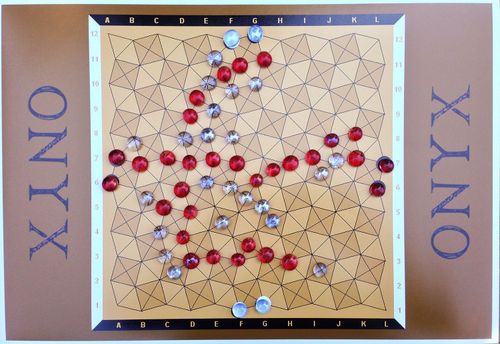
Onyx
Onyx Rulebook
Table of Contents
Table of Contents
Equipment
- Onyx is a game for two players.
- The equipment of Onyx consists of an Onyx board and a sufficient set of both black pieces and white pieces.
- One player, Black, plays with the black pieces; the other player, White, plays with the white pieces.
The Board
- The Onyx board consists of interlocking squares and triangles. The squares are further divided into four triangles forming an intersection at the midpoint of the square.
- Each one of the four sides of the board is comprised of twelve edge points. The four corner points of the board are considered to be part of both the adjacent edges that meet at that point.
- As with all connection games, board size is arbitrary. A larger board results in more strategic depth but also a longer game. It seems a board of this size with twelve points along each side is ideal for this game.
Setup
- Before the start of the game, four black pieces and four white pieces are placed on the board. Black pieces are placed on the two outside corners of the middle square on both the left and right sides of the board. White pieces are placed on the two outside corners of the middle square on both the top and bottom sides of the board. (See Diagram 9, opposite.)
- Black starts with two pieces along each white side, and White starts with two pieces along each black side.
- Of course, the game can be played with different starting positions, including having no pieces on the board at all. However, I find that having two pieces along each side of the board in this way tends to sharpen the play and results in more interesting positions.
The First Move
- At the start of the game neither player is assigned the black or white pieces. One player makes a move by placing a black piece on the board. After this first move has been made the other player then chooses to either continue playing the game as White or continue playing the game as Black. The player that becomes White makes the next move, and players alternate moves for the rest of the game. On each move a player must place a piece on the board. Black always places a black piece on the board and White always places a white piece on the board.
- Finally, this game uses the same rule that most connection games use concerning the first move. One player starts by placing a black piece on the board and the other player decides to continue playing the game as either White or Black. The player that becomes White makes the next move, and the players alternate moves for the rest of the game. This is the fairest rule for ensuring that neither player starts out with a meaningful advantage.
Placing Pieces
- A move always consists of placing a piece on the midpoint of a square or on one of the corner points of a square or triangle.
- However, a piece cannot be placed on the midpoint of a square if there are any pieces on the four corner points of that square. (See Diagram 8, opposite.)
- Once placed on the board, pieces are never moved from one point of the board to another. However, a piece must be removed from the board if it is captured. Captured pieces are returned to the player from whom they were captured.
Capturing
- If the midpoint of a square is unoccupied, and a player places a piece on the corner point of the square with the result that both players have two pieces occupying diagonally opposite corner points of the square, then the two opponent's pieces on that square are captured and removed from the board. (See Diagram 10.)
- It is possible to capture two pairs of pieces on two different squares with one move. In this case all four captured pieces are removed from the board. (See Diagram 11.)
- Since pieces can be captured in this game, is it really true that positions cannot repeat? Well, no, actually they can, but only if both players conspire to bring this about. If either player is trying to win then a repeated position would not occur. Therefore, I see no reason to have a rule to deal with repeated positions or to stipulate that the game can be won with a certain number of captures.
Winning the Game
- The object of the game for Black is to construct an unbroken chain of black pieces that includes at least one piece on one of the top edge points of the board and includes at least one piece on one of the bottom edge points of the board. The object of the game for White is to construct an unbroken chain of white pieces that includes at least one piece on one of the left edge points of the board and includes at least one piece on one of the right edge points of the board. Once either player accomplishes this goal the game is over. (See Diagram 12.)
- In the game, Black is trying to connect the top and bottom sides of the board with an unbroken chain of black pieces; White is trying to connect the left and right sides of the board with an unbroken chain of white pieces.
Notation
Aside from the midpoints of squares, each point on an Onyx board can be represented unambiguously by a letter and number according to a zig-zag coordinate system. In Diagram 12 above, for example, the first four X-marked white pieces from the left are on points A5, B6, B7 and C7. The midpoints of squares are represented by the four letters and numbers that uniquely determine the corners of the square. In Diagram 12, for example, the two X-marked white pieces on the midpoints of squares are on points DE910 and IJ1011. A move that captures one pair of pieces is followed by an asterix '*'; a move that captures two pairs of pieces is followed by two asterixes '**.'