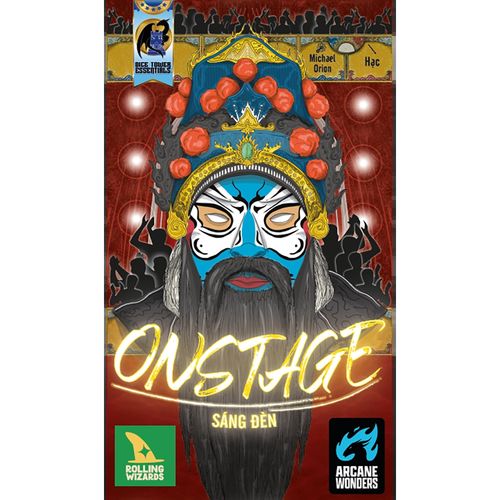
Onstage
Onstage Rulebook
Table of Contents
Table of Contents
About Hát Bội
Hát bội (Vietnamese pronunciation: [háːk ɓôjˀ]) also known as Tuồng, is a traditional Vietnamese theater art form developed from folk art and dramas dating back to the 13th century.
In 1462, during the Lê Dynasty, King Lê Thánh Tông relegated singers and entertainers to the lowest social class, banning them from enrolling in national schooling and joining the goverment. Over the centuries, this forced many artists to move south where the Nguyễn lords ruled, one of them is Đào Duy Từ.
In 1627, a scholar poet named Đào Duy Từ introduced Hát Bội to Lord Nguyễn Phúc Nguyên. The Nguyễn lords loved watching Hát Bội in their royal court so much that during the Nguyễn Dynasty (19th century), Hát Bội became the "National Opera", spreading the art form beyond the royal court and to the people.
Currently, each region has its own school of Hát Bội. The three most popular are: Hát Bội Huế - focusing on scripted content, Hát Bội Quảng Nam - combining local melodies, and Hát Bội Bình Định - incorporating martial arts choreography.
In 2014, Hát Bội was recognized as a Vietnam National Intangible Cultural Heritage and as an artform in need of urgent protection.
The Name "Sáng Đèn"
Onstage's Vietnamese name is "Sáng Đèn", which literally means "light on." Some might not associate it with the stage, but people in the profession will immediately connect with this name. Today's theaters give their best effort to "keep the lights on", which sends the message "as long as we have an audience, this traditional art will stay alive." Turning on the lights also signals that it is time to go perform… Onstage.
Game Components
- 36 Playing Cards (9 cards for each suit — diamond, circle, triangle, and star)
- 12 Performers (3 of each suit)
- 1 Rulebook
- 1 Box (with popup stage inside)
- 1 Star Performer (see Variant rules)
- 28 Scoring Tokens (each has a one and a five side)
Card Anatomy
- A - Card's Value (1-9)
- B - Card's Suit (star, diamond, triangle, circle)
- C - Card's Ability, if any (add, remove, swap)
- D - Possible Value of Winning a Trick
Setup
Follow the included assembly instructions (see 11 Stage Assembly) to build the stage and place it in the middle of the table.
Next, create an Offstage Line ("line") by randomly placing the 12 Performers in a line standing up, near the edge of the stage.
In a 3-4 player game, shuffle and deal all cards equally to all players, forming their hands. In a 5-player game, remove one card from the deck at random, keeping it hidden from all players.
Lastly, place the Scoring Tokens near the stage. These will be used to track scoring at the end of each Casting Round.
Game Flow
The game is played over a number of Casting Rounds equal to the number of players. Each round consists of a series of tricks equal to one less than the cards in your hand. Play proceeds in clockwise order with the person who took the last trick starting the next (see 6 Winning a Trick). After the final Casting Round, the player with the most Golden Blossoms wins.
Gameplay
The lead player is the person who most recently attended the theater, or choose at random.
At the start of each hand (known as a "trick"), before choosing cards to play, move the performer that is at the front of the Offstage Line onto the stage.
Trick: The lead player chooses any one card from their hand and plays it face up to the center of the table. All other players must take turns in clockwise order playing a card of the same suit as the lead player if possible.
If it is not possible for a player to follow suit because they do not have a card in their hand of the lead suit, then they may play any card from their hand.
Note - Certain cards have Abilities (see 5a Playing Card Abilities)
If a player cannot follow the lead suit they instead play:
A - A trump card (see 5b Playing Trump Suit)
B - Any off suit card (see 5c Playing Off Suit)
Playing Card Abilities
Cards 1, 4, and 7 of each suit have an Ability. When an Ability card is played, the Ability triggers immediately.
- 1 - Add: Add a single Performer from anywhere in the line to the stage.
- 4 - Remove: Remove a single Performer from onstage to the back of the line.
- 7 - Swap: Exchange a single Performer onstage with any Performer in line.
Playing Trump Suit
The trump suit is decided by the highest total number of Golden Blossoms shown on matching Performers onstage. If there is a tie, then no trump suit is assigned.
When onstage, separate the Performers by color, pushing the trump group into the spotlight to better identify them as the trump.
Cards played of the trump suit will win the trick regardless of their numerical value unless multiple trump cards are played. In this case, the highest value trump card will win the trick.
In this example, the Black suit is the trump suit. The Black Performers carry five Golden Blossoms, one more than the Blue Performers (who hold four Golden Blossoms), and two more than the Pink Performer.
In this example, both the Pink and Black Performers hold three Golden Blossoms, more than Blue's one. So there is no trump, and no one in the spotlight.
Playing Off Suit
When playing a card that does not match the suit of the lead suit and is not the trump suit, it is considered "off suit."
When playing an off suit card, you have the option to move a Performer of the matching suit to the front of the line immediately after playing the card.
If that card also has an Ability (see 5a Card Abilities), trigger the Ability after moving the Performer.
An off suit card can never win a trick, but utilizing an off suit card's Ability can change what the trump suit is!
REMEMBER: Playing an off suit card only allows a player to move a Performer to the front of the Offstage Line, not onto the stage. Performers only move onstage at the start of each trick or by a card's ability.
In this case, the Black suit is lead and the Pink suit is trump. One player cannot follow suit and plays a Blue 4. They choose to move a Blue Performer to the front of the line and then activates the (remove) Ability, removing the Pink Performer from the stage and to the back of the line. Blue now has the most Golden Blossoms onstage and becomes the new trump suit.
Winning a Trick
Once all players have finished playing a card, the player that played the highest value card of the lead suit wins the trick, unless a trump card has been played, then the highest value card of the trump suit wins the trick.
The winning player claims the onstage Performer matching the Golden Blossom value of the winning card (see Card Anatomy). If that Performer is not onstage, the winning player may claim any Performer of the matching suit instead.
If no Performers onstage match the winning suit, then nothing is gained.
Discard the played cards, off to the side, face down. The winner of the current trick leads the next trick.
Example of a Trick
Play starts with the Pink suit in trump with five Golden Blossoms.
Player 1 leads with the Black 4 removing a Pink Performer and making Black both the trump suit and lead suit.
Player 2 has no Black cards and cannot follow the lead suit. They instead play a Pink 7, allowing them to swap a Performer onstage with one currently in line. They choose to swap the 3-point Black Performer with the 3-point Pink Performer in line. Pink is now the dominant color onstage and becomes the new trump suit.
Player 3 has a Black card and must follow the lead suit by playing it. Player 2 wins the hand since Pink is trump and claims one of the Pink Performers.
Player 2 wins the trick since Pink is now the trump. They may choose either of the Pink performers available since none match the Golden Blossom value of the Pink 7.
End of Casting Round
The round ends when only one card remains in all players' hands. Each player will keep their last card to be used for the next round. Proceed to scoring at the end of the last trick.
End of Round Scoring
Each player adds up the total Golden Blossoms on their earned Performers, if any, for their score.
If, at the end of the round, there is only one player with no Performers, give all the remaining Performers onstage to that player to score. If there are no Performers onstage to give, the player instead gains all the remaining Performers in line.
Give each player Scoring Tokens equal to their score for the round. If there are not enough Score Tokens, use a notepad to keep score.
Take all claimed and onstage Performers and randomly distribute them behind the current line. Then, the player who won the trick leads the next round.
End of the Game
The game will end after playing a number of rounds equal to the number of players. Add up your total Scoring Tokens from all rounds. The player with the highest score wins. If there is a tie, the tied player with the highest card remaining in their hand is the winner. If a tie persists, the players share the tie.
Stage Assembly
- Open the box. The lid slides off; the stage sits inside the bottom.
- Remove the components from under the stage and slide the stage forward.
- Pull the top layer of the stage up (leave the bottom layer of the stage in the bottom of the box).
- Fold the two wings on the side of the stage top backward.
- Slide the box lid over the box bottom, ensuring the stage wings are tucked inside the box top.