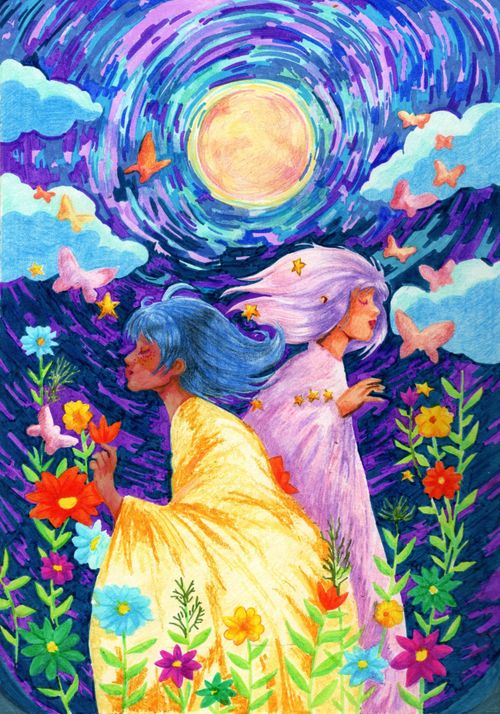
Oniria
Oniria Rulebook
Table of Contents
Table of Contents
Components
32 Sombras Cards:
- El Cadejo Negro x7
- El Charro Negro x7
- La Lechuza x7
- La Llorona x7
- Score Cards x4
14 Soñadoras Cards:
- Otomi x7
- Maya x7
12 Tokens 1 Player Aid 12 Sendas de los Nahuales Cards
Counting in Maya
In Oniria, for better immersion and out of respect for the cultures represented, we count in Maya. Don't worry, it's very simple—just add the different symbols:
- Conch shell = 0
- Each dot = 1
- Each bar = 5
Objective of the Game
Between 3 and 5 players face off in this trick-taking game. In each round, one player takes on the role of the Soñadora, and the others play as Sombras. Roles rotate in such a way that each player becomes the Soñadora once. The dreamlike journey therefore unfolds over as many rounds as there are players. At the end, the player who has scored the most points wins the game.
Setup
Each player chooses a deck of cards. One takes a Soñadora (cards 7 to 11), the others take a Sombra (cards 0 to 5), along with their score card placed in front of them on 0.
Shuffle all the Senda de los Nahuales cards and lay 7 of them horizontally, dark side up, in the center of the table to form an initiatory journey. Make sure to place the bottom of each Senda on the side of the table closest to the Soñadora.
Game Rules
The Score Card
The score card works as follows: place the "zero" side facing you.
When you score a point, flip the card so that the "one" side is facing you, then rotate it to increase the score further if needed during the round.
Additionally, you may notice that each Sombra has a special rule that allows you to earn bonus points at the end of each round.
Special Cases
In Mesoamerica, the concept of time is predominantly cyclical. To reflect this, round 4 (or round 5 in a 5-player game) is considered to come before round 1, which itself comes before round 2…
Senda de los Nahuales (initiatory path)
The Senda de los Nahuales represents the path the Soñadora must take.
Each Senda may include placement constraints that prevent players from playing the indicated card(s). The example Senda in the rulebook shows two constraints:
- In this case, the Sombras cannot play cards with a value of "2" or "3".
- The Soñadora cannot play a card with a value of "8".
Constraints and Penalties
If a player has no other choice (or makes a mistake) and plays a card whose value is prohibited by a constraint, then that card has a power of 0.
In addition, the player incurs a penalty of -1 point from their round total.
Exception: if a Soñadora's power adds a constraint that forces a Sombra to play a forbidden card, they do not suffer the penalty.
Sombra and Soñadora Cards
The Soñadora and Sombra decks are asymmetrical. And each deck is unique.
The cards are laid out as follows:
- Trick power of the Sombra card.
- Special power of the Sombra card.
- Trick power of the Soñadora card.
- Special power of the Soñadora card.
A Trick
To play a trick, each player chooses a card respecting the placement constraints, then places it face down in front of them. Everyone then reveals their card simultaneously and compares them.
Leave the trick visible around the Senda. Each player must be able to remember the cards that have already been played at all times.
Then play the next trick.
Table talker
In Oniria, Sombras are neither allowed nor encouraged to talk to each other in order to coordinate against the Soñadora. Doing so would ruin the spirit of the game.
A Trick: Alone Against All
During a trick, the Sombras compare the total of their cards with the Soñadora's card.
If the Soñadora has a higher score than the combined Sombras' cards, she wins the trick and flips the Senda to its light side, then the next trick is played.
If the Sombras score equal to or higher than the Soñadora, then they win the trick. Move on to the "trick within the trick."
Trick Within the Trick (Secondary Resolution)
Within each trick, the Sombras are in competition. If they beat the Soñadora in a trick, compare the cards played by the Sombras.
Only the one who played the highest power card scores a point (in case of a tie, all tied Sombras score the point).
Special Powers
Some Sombra and Soñadora cards have powers that activate under specific conditions. These conditions must be met and the power resolved. If a play order is necessary, the Soñadora is always considered the "first" player.
Regarding certain Sombra powers that require a -triple- to activate, it is a triple of the power value that is required.
Example: two Sombras play a "2" card with the "triple 2" power and the third plays a "2" card without a power—the effect is activated.
Specific Vocabulary
- The term -scores- refers to the score sheet. You score a point for the round.
- The term -gains- refers to a bonus usable during a trick to increase a card's power.
Special Cases:
- If a Soñadora reclaims a trick she had lost, the Sombra(s) who had scored points keep them.
- Powers that duplicate other powers' effects may only duplicate a power containing the relevant icon.
- A card may override a rule. Its effect therefore takes precedence over what you are currently reading.
A Game
A full game consists of as many rounds as there are players.
A Round
Each round consists of 7 tricks. At the end of each round, the points scored by each player are recorded.
The procedure for a trick is explained in the "A Trick" section of the Concepts.
If the Soñadora wins at least 4 tricks, she scores 3 points and 1 additional point for each extra trick.
If she only wins 3 tricks, she scores just 1 point.
If she wins 2 tricks or fewer, she scores no points.
The Sombras score the points earned throughout the round, and may add the bonus shown on their score card at the end of the round if they meet its condition.
End of the Round
Write the points on a piece of paper (or use the example score sheet provided), collect all the cards from your deck, then pass your deck to the player on your left. Roles therefore rotate for each player.
Shuffle all the Senda de los Nahuales cards (including any left out during setup) and place 7 new ones randomly in the center of the table.
End of the Game
A game of Oniria ends when every player has played as the Soñadora once. At this point, total up the points from all the rounds to determine the winner.
In case of a tie, the player who scored the most points while playing as the Soñadora wins the game. If there is still a tie, the tied players share the victory.
Three-Player Game
Each player plays as a Sombra, and the Soñadora is placed collectively via a draft that occurs at the beginning of each round after the Senda de los Nahuales cards are laid out.
The first player takes the Soñadora deck and secretly selects a card, placing it face down next to the Senda of their choice, respecting placement constraints. Then, the deck is passed to the player on their left, who does the same, and so on until six cards have been placed. The final card is placed face up in the last slot.
All the Soñadora deck cards are thus placed by the players in front of the different Sendas before tricks begin.
Note: In case of a placement error during the draft, the round is invalidated and must be replayed. So place the Soñadora cards carefully.
A three-player game is played over three rounds.
Five-Player Game
Prepare and play the game in the same way as a four-player game, with the following differences:
- The fifth player becomes the fourth Sombra.
- Triple powers become quadruple powers, and the Soñadora adds +3 to the value of all her cards and to all her placement constraints.
This is not written on each card to avoid clutter, but it's recommended to place the corresponding player aid in plain view so everyone remembers easily.
A five-player game is played over five rounds.
Downloads
You will find the following on our website yeastgames.com:
- This rulebook, which may be updated if necessary.
- A score sheet to record the points from the different rounds.
Optional Rules
Card Counting
Once all players are familiar with the game, you may place completed tricks face down after they have been resolved.
La Raza Cósmica
La raza cósmica, a concept introduced by José Vasconcelos in 1925, aimed to promote racial mixing in response to European and U.S. imperialist racism.
But under the guise of universality, this concept hides the internal power structures within Mexico and imposes an elitist and assimilationist vision, denying the autonomy of Mesoamerican peoples in favor of an authoritarian synthesis—far from the emancipation envisioned by the Mexican Revolution.
To represent this, you can play a variant of the Soñadora. Choose whichever cards you want from each Soñadora, while keeping the normal power distribution of a deck. And play.