Oneupmanship: Mine's Bigger
Oneupmanship: Mine's Bigger Rulebook
Table of Contents
Table of Contents
- The Set-Up
- Start
- Purchasing Stock
- Selling Stock
- Shareholder Meeting
- Stock Dividends
- Real Estate
- Bonus
- Gold Stars
- $ Cards
- Broker Fees, Fines and Taxes
- Wild Card
- Free Lunch
- Vegas
- Do or Die
- The Scarlet Letter "B"
- The Bitter Pill
- Winning at All Costs
- How Tos, Notes, and Miscellaneous
- Questions Players Often Ask About Oneupmanship
The Set-Up
- Prepare yourself for 1 ½ - 2 hours of excellent mental and physical fun.
- Place the board on a table and put the $ Cards facedown on their space.
- Choose one of four characters and place desired "pawn" on your home base.
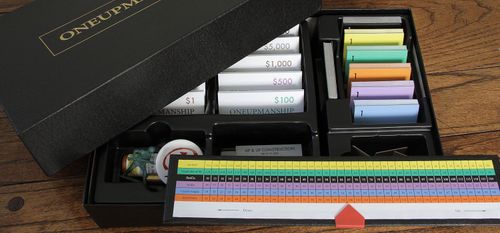
- Select a Banker to handle all the money; another player is the Broker and oversees all of the shares, title deeds, trophies and auctions.
- Each player will receive $5,000 from the Bank to begin the game as follows: 4 x $1,000, 1 x $500, 2 x $100, 2 x $50, 6 x $20, 5 x $10, 5 x $5, 5 x $1.
- The stock price indicator starts in the middle of the board and can be moved by each player on his turn, or by an appointed "Stock Board Flunky."
- $2,000 is placed on the U.S. flag to kick-start the FREE LUNCH kitty.
Start
The player with the most actual US$ (cash) in his wallet, or on his person starts first.* Hey, that's not fair. You're right! To begin, roll the dice and enter the game at the START of your home base, moving in the direction of the arrow on the first space the number indicated on the dice. After you've completed your move, the turn then passes to the left. Two or more pawns may rest on the same space at the same time. You always move in the direction of the arrow on the space your pawn rests on. Doubles roll again.
Once your pawn lands on a space, you IMMEDIATELY move the stock price indicator the number up or down printed on the space. If the indicator reaches the top or the bottom of the board, the direction is reversed, and the remaining ticks are counted off in the opposite direction.
Purchasing Stock
After the indicator has been moved, you may purchase from the Bank as many shares of the company stock named in the space as you wish, at the new quotation price. However, you may only buy shares of the company named in the space you've landed on (see WILD CARD), and only BEFORE your turn is passed.
Important note: Any time you land on a company space and choose not to purchase stock, you must pick up a $ Card instead.
If you do purchase shares of a stock, the Broker gives you the stock card(s) for the number of shares bought. No stocks may be bought on the 4 corner spaces, on the $ spaces, on the GOLD STAR spaces, on FREE LUNCH, on DO OR DIE, VEGAS, or on the BONUS space.
Selling Stock
On your turn, but BEFORE you roll the dice, you may sell any or all of the stock you own in any company(ies) back to the Bank at the quotation board price. If you have to sell shares to pay a fee, fine, lease or tax AFTER you have already rolled the dice and moved to a new space, you must sell them at the lowest board price for that stock.
Shareholder Meeting
If you land on this space, you must purchase one share of the stock for that company (at the quotation board price) to participate in the meeting. If you already own shares in that company, you still MUST purchase one additional share to enter the meeting. Once you enter the meeting, you roll one die and multiply the number of shares you already own (including the additional share you just bought) by the number on the die, and receive that many more shares from the Broker.
While at a Shareholder Meeting, you may not buy any more stock other than the one share needed to enter. You may, for some unknown reason, choose to be a dumb cheapskate and not buy a share, and not go to the meeting at all.
Stock Dividends
Every time you land on a company space that you already own shares in, you receive a cash dividend from the Bank equal to the price of the dividend that's indicated at the top of the space, multiplied by the number of shares you own.
Of course, you may also buy additional shares, but will not receive a dividend on those shares on this turn.
Real Estate
Landing on a real estate space that isn't already owned entitles you to buy the property from the Bank. The Title Deed is proof of ownership and is placed face up in front of you. If the property is already owned, you must pay the appropriate "lease" to the "landlord." If you do not have enough cash to pay it, you have to liquidate enough (or all) of your assets to satisfy the debt; or you can make a side deal with the landlord, i.e. pay him the cash you have on hand plus a trophy, or some of your stocks, or a Title Deed(s). If the landlord won't make a deal, you must liquidate all of your assets and turn them over to the Bank (the landlord gets nothing), hang your head in shame, and go back home bankrupt (see THE SCARLET LETTER "B").
You may choose not to buy a property you land on; the Broker can then auction it to the highest bidder, with a starting bid of $750. Properties must be purchased from the Bank with cash, and you may not participate in this auction. As a landlord you can, on any turn, including the turn you buy the property, build up to a 4-story building on your property(ies) by purchasing the "stories" from the Bank at the price printed on the Title Deed(s).
You may erect a building with more than 4 stories, but your lease caps out at the Penthouse price. However, if you have the biggest ego building at any time during the game, then you don't have to pay any leases to the other landlords when you land on their properties.
The mortgaged value of each property is one-half the Title Deed price (not the auction price, if applicable) plus one-half the purchase price of the building, if there is one. The Title Deed is placed face down and no leases are collected, or taxes paid, while it remains mortgaged. You may lift the mortgage at any time by paying the principal (property and building) plus 10% interest. A property cannot be partially mortgaged, or partially unmortgaged. If you want to sell a mortgaged property to another player, you must pay off the mortgage to the Bank first.
Remember: If at any time during the game the owner of a property fails to ask you for the lease money BEFORE the next throw of the dice, none is collected.
On cash-out, properties are worth: 3 times their Title Deed price + building if one property is owned, 5 times their Title Deed price + building if 2 properties are owned, 10 times their Title Deed price + building if 3 are owned, and 15 times Title Deed price + building if all 4 are owned.
Bonus
Board games, like anything else, need a little lubrication every once in a while to keep the fun going, so any time you land on or pass the BONUS space, you receive $1,000 from the Bank. If you land on BONUS, you are the decider of your own destiny and may choose the direction you move on your next turn.
Gold Stars
Another way to show yours is bigger, besides actually making the most money, is to out-envy everyone else by collecting lucrative "trophies". If you land on a GOLD STAR space, you may buy any trophy from the Bank for $2,000. You can then keep this trophy until the end (or you can sell it at any time to any other player), where its cash-out value is: $5,000 each if 1 is owned, $7,500 each if 2 are owned, $10,000 each for 3, $12,500 each for 4, $15,000 each for 5, and $20,000 each for 6. Any more than that and you're just showing off.
If you're subtle, or skint, and don't want to buy a trophy, the Bank can auction off any of the unsold ones to the highest bidder, with a starting bid of $1,500. Trophies must be purchased from the Bank with cash, and you cannot bid in this auction. Trophies are similar to cash — they are taxed at 20%, but they can be "hocked" at any time for $1,000 to pay a fee, tax, fine or lease. To reclaim hocked trophies, you must pay the Bank $2,000 (regardless of the purchase price), plus 10% interest. Hocked trophies are not taxed.
$ Cards
If you land on the "$" space, you pick a card from the top of the pile and follow the instructions. You then place the card on the bottom, unless it's a "keeper", in which case you put it in front of you until it is needed. You may sell or trade your keeper card(s) to any player for a mutually-agreed on pound of flesh at any time during the game.
Broker Fees, Fines and Taxes
When you land on the BROKER FEE or the BLACK THURSDAY space, you must pay $10/share on all the stock you own. If you land on the TAXMAN COMETH space, you must pay 20% on all of your cash, real estate — at the list price, including buildings — and "trophies", at list price. DON'T FORGET: This money is placed in the center of the board (see FREE LUNCH), as well as any fines from the $ Cards, and all VEGAS "Bank" winnings.
Wild Card
Landing on this space allows you to buy as many shares in any company(ies) you choose at the current quotation board price, from the Bank, or from another player(s) if you're feeling particularly malevolent.
Free Lunch
TANSTAAFL**, except maybe in today's America. Just kidding! If you're lucky enough to land directly on FREE LUNCH, you get all the money that's been accumulating in the center of the board. Take it, and don't look back.
Vegas
Going to VEGAS allows you to bet as much money as you'd like in a game of HI-LO dice against any other player(s) who wants to take your bet. No one has to take your bet, or they can raise or lower it. Once the bet's agreed on, each player, starting with you, throws the dice. Roll again in case of a tie. Player with the highest total wins the whole shebang. You may choose to bet against the Bank only instead. Your first roll is your score; your second roll is the Bank's — highest wins. Or, you may decide not to bet at all and the turn passes to the next player. If you don't bet and decide to pass your turn, please see the last line of the next paragraph.
Do or Die
Landing on this space gives you a License to Prey on any (or all) of the other players you want to bet against, and they MUST take your bet. And the bet can be anything: money, real estate, trophies or any combination. Each player in turn rolls one die, starting with you. Roll again in case of a tie. Highest wins the entire pot. Or, you may decide not to bet at all, and pass your turn. But you'd better not pass your turn you wussy, with a capital P.
The Scarlet Letter "B"
If you owe the Bank more than you can pay for a fee, fine or tax — even after you have liquidated, mortgaged, and hocked everything — you must give all your cash and assets back, declare bankruptcy, and go home. You then put on the Scarlet "B" for the rest of the game (unless another player goes bankrupt after you, and then he gets it). You can, however, continue to take your turn, and any time you, or any other player rolls doubles, you receive $1,000 from the Bank. Once you get $2,000 you start playing again, and don't receive any more "charity."
Sidebar: If you do go bankrupt, and claw your way back to win the game while still wearing the Scarlet "B" — a move known as Hester's Revenge — then you can wear it on your lapel for the rest of your life as a badge of honor.
The Bitter Pill
Let's say it's your turn and you announce that you can win the game — any of the other player(s) can step up and swallow a "Bitter Pill" to try to prevent this by giving all of their cash, assets (list price), and stocks (current board price) back to the Bank, and then going home bankrupt. You then must ALSO cough up this same amount to the Bank in any combination of cash, assets, and stock before continuing with your turn. Each player can swallow only one metaphorical Bitter Pill per game: popping a Quaalude, or dropping acid instead DOESN'T COUNT.
Winning at All Costs
If the current board price of all your stocks, the cash-out value of your assets, as well as the cash you have on hand is $100,000 or more, you can announce, on your turn, that you can win the game (see BITTER PILL). How you got that far is your business, and rules are meant to be broken. Barter, charm, bluff, backstab, double deal — just about anything goes in this Darwinian game of survival – but above all be creative, bold and original for crying out loud. And if you lose, maybe it's because you're a loser?
How Tos, Notes, and Miscellaneous
Indian Arm Wrestling
Stand facing your opponent with your right foot placed about one foot in front of you. He does the same, so that the outside of his right foot touches the outside of yours. Place your left hand behind your back and grasp your opponent's right forearm with your hand, while he grabs yours with his. On "Go", the first man to push/pull his opponent off balance so that his right foot moves, wins $1,000.
Alphabet Memory Game
You start with the letter A and say a word that begins with that letter, e.g. "asset". Second player repeats "asset" and then says a word that begins with the letter B, like "bastard". You (or the next player if there are more than 2) then repeat "asset, bastard", and then make up a word beginning with the letter "C", like "cunctate". Players alternate turns repeating all the previous words, before adding a new word for the next letter. Player who can recite the most words in the correct order without a mistake, wins $1,000 from each of the losers.
Thumb War
Stand facing your opponent, two feet apart. Make a loose fist with your right hand, thumb up, and grasp your opponent's fist so your fingers lock. Count 1,2,3 while moving your thumb to one side of your opponent's thumb, and then to the other, on each count. On "3" try to pin each other's thumb down. Winner gets $500.
Liar's Poker
This game is played with the 8-digit serial number on a U.S. dollar bill. Each player tries to make the highest bid of any number that doesn't exceed the combined total held by all of the other players. The numbers are ranked in the following order: 2,3,4,5,6,7,8,9,0 (10) and 1 (Ace). If you bid three 6s, you are predicting there are at least three 6s among all the players, including yourself. The next player can bid a higher number at that level (three 7s), any number at a higher level (four 5s), or challenge you. The game ends when a player's bid is challenged all around. If your bid is successful, i.e you bet seven 5s and there were eight total, you win $1,000 from each player. However, if your bid is a loser, i.e. you bet six 9s and there were only five, you pay $1,000 to each player.
Knuckles
Stand facing your opponent, about two feet away, with your left hand on your hip. Ball your right hand into a fist and extend it in front of you, palm down, touching your knuckles to your opponent's knuckles. To start, raise your right fist up and quickly bring your knuckles down hard on your opponent's knuckles before he can pull his fist away. If you hit his knuckles, you go again. If you miss, it's his turn. If he pulls his fist away before you raise your fist to strike him, you get a free hit. First one to cry "uncle" loses. Winner gets $2,000.
Staring Contest
Look deep into each other's eyes, hopefully with undisguised loathing. First to blink, or look away loses and pays $1,000.
Unauthorized "Large Richard" Variation
Rumor has it that the really serious players have their own hard-core version of Oneupmanship, which our obsequious legal counsel doesn't want us to tell you about. So we'll talk out of school, so-to-speak: they use real money.
The Company(ies) You Keep
Cataldo Supply — Meeting Demand; Dough, Ray & Me — We're only in it for the money; Jetcetera Airlines — We Fly; AUH20 — Goldwater Mining Co.; ACME — The Best of Everything; fiasCo. Films — We've given ourselves the bad name.
The Star-Spangled Banner
by Francis Scott Key
Oh, say can you see by the dawn's early light, What so proudly we hailed at the twilight's last gleaming? Whose broad stripes and bright stars, through the perilous fight, O'er the ramparts we watched were so gallantly streaming? And the rocket's red glare, the bombs bursting in air, Gave proof through the night that our flag was still there. Oh, say does that star-spangled banner yet wave, O'er the land of the free, and the home of the brave?
*This is known as the "Rockefeller Start", named after our hero John D. **"There's no such thing as a free lunch", as popularized by Heinlein/Friedman.
Questions Players Often Ask About Oneupmanship
1. Can I collect my $1,000 if I don't land directly on the Bonus space?
Yes, as long as you pass the Bonus space, you can collect your $1,000.
2. What do I do if I can't move the stock indicator up or down the required number of spaces because it's at the top or bottom of the board?
Once you reach the top or bottom of the stock board, you move the stock indicator the required number of spaces in the opposite direction.
3. Am I allowed to buy stock if I'm not on a company's space?
No, you can only buy the shares of a particular company if you are on one of that company's spaces. The sole exception is if you land on the WILD CARD space, which allows you to buy as many shares as you'd like in any company(ies).
4. Do I have to pay taxes on my trophies and real estate?
Yes, Income Tax is 20% of your total assets, including cash, trophies and real estate. If your trophies are "hocked", or your real estate is "mortgaged" — then you don't pay taxes on them.
5. If I land on the VEGAS, or DO OR DIE spaces, do I have to bet?
No, you don't have to bet at all. Or, you can bet as much or as little as you want. The question you really have to ask yourself is: "Do I feel lucky?"
6. What happens if I want to build a 5 or more story building?
Go right ahead. In a game of limited resources, let the devil take the hindmost.
7. Don't forget:
- If you go bankrupt, you must wear the Scarlet "B" until the end of the game.
- To collect dividends on any company you already own shares in.
- All fees, fines, taxes and Vegas "Bank" winnings are placed in FREE LUNCH.
- Buy low, sell high.
8. I need a calculator to play Oneupmanship — why isn't one included?
If you're reading this you already have one.
9. Can I make up my own rules?
As long as you live by them. Facetiousness aside, a lot of people like to play according to their own "house rules", and we want to encourage originality and recalcitrance at all times. How about raising the stakes to $250,000, or making side bets with real money? The whole point is just to have fun!