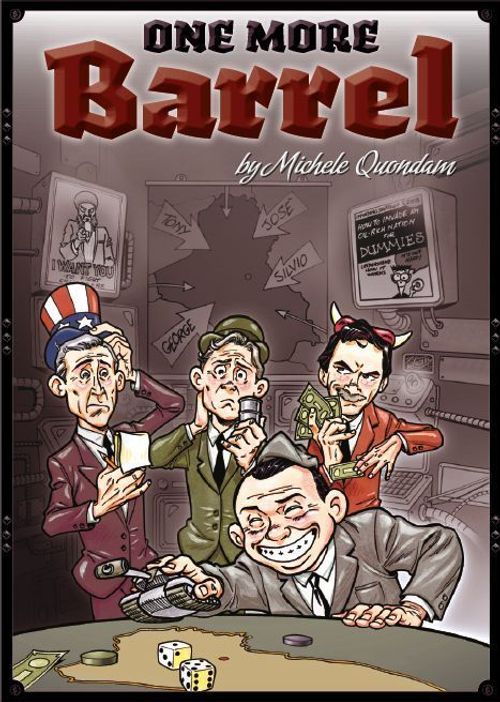
One More Barrel
One More Barrel Rulebook
Table of Contents
Table of Contents
Introduction
In this game each player represents a leader of an Western Nation. The objective is to ward off global terrorism by finding weapons of mass destruction that are hidden in a state considered to be hostile. In order to do this, each player must send troops to invade this rogue state and accomplish the overall objective.
Because, however, the weapons of mass destruction don't exist (this merely serves as an excuse to win over public opinion), to win the game, you must conquer the diverse provinces within the invaded country, steal their oil, sell as much of it as possible and award contracts to companies in your own country. At the end, whoever is the richest wins!
Each player, in addition to being a leader of a Western Nation, also takes the role as head of a rebel group within the invaded country. These rebels will become operative after the first phase of the war and can cause damage to your troops allowing you to win the last barrel of oil!
Aim of the Game
The aim of the game is to be the richest! During the game, it could be useful to hide your money and oil to prevent other players from working out who is going to win!
Game Phases
The game is played in three phases, each with 4 turns. A fifth turn can be optionally added to each phase for 3-player games or if you want a longer variant.
Phase 1. Invasion
The invasion of the oil rich Country begins! The local defense troops fight against the player troops. The oil is produced in the first conquered regions.
Phase 2. Guerrilla
The opposition of the local troops is now weakened and it is easier to conquer new regions. The rebels enter the game and bombing can take place. The oil production increases in the Country due to the higher number of conquered regions.
Phase 3. Transitional Government
The Transitional Government is installed: this happens regardless of the number of conquered regions. The government supports the oil production and keeps for itself a part of the total oil produced.
During this phase the conquest of new regions and the rebel bombing will continue.
Set Up
A. The troop tokens are given to the players according to their chosen colour. 10$ are distributed to each player.
B. A marker is put on the first game turn and another one on the lowest value of the Oil Price Track: $0,5.
C. The gaming (playing) order is sorted by a die roll. The last player will receive a bonus of 2$.
- Each player, if he wants to do so, purchases troops and/or logistics with his money. Each troop/logistic costs 1$.
- The purchased troops/logistics are placed on the Border Region. From there the invasion can start: the first regions that can be invaded are the southern ones (brown). In the following turns the troops can move to the other regions. The white tokens represent the local troops.
- The players' markers are placed on the zero of the value tracks (Pacifism (red), Influence (orange), Mass-media (blue)).
- Let's start with the Selected Actions.
How many players? For 3 players, only use the 1st and 2nd columns (of the action boxes). For 4 players, add the 3rd column, and for 5 players use all four columns.
Board elements: Playing Order track, Battle Grid, Regions, Border Region, Oil Price Track, value tracks (Pacifism, Influence, Mass-media), Government Oil Track (used during the 3rd game Phase), Contract markers and Contract Track, the action boxes (Mass-media, Purchases and moves, Constructions, Money, Playing order, New taxes, Oil production) and the Memo (shows the sequence of events for each turn).
Game Sequence
Each game turn is in three parts: First Selected Action, Second Selected Action and End Turn Checks.
First and Second Selected Actions
Following the playing order, each player selects an action box that has not been selected by other players, places his marker on the box and performs the related action. Each player performs his first action and then they each perform their second action in turn.
Generally, it is possible to do more with a first action than a second. This is true for all actions except the free ones (Additional Taxes and Oil Production): these actions can be selected by all players even if another player has selected them.
The possible actions are described below: Mass-media manipulation, Purchase and moves, Construction, Money, Game (Playing) order, and free actions (New Taxes and Oil Production).
Mass-Media Manipulation
This action increases the player's Mass Media value. The increase depends on which action box is used: the first box increases the value up to 3 points, the second up to 2 points, and the third and fourth boxes increase it by 1 point.
Cost: increasing the mass media value by 1 point is free, by 2 points costs 3$ and by 3 points costs 6$.
The Mass Media value influences the Pacifism value (see the "Pacifism" paragraph for additional information).
Purchases and Moves
With this action troops and logistics are purchased and moved (first you buy and then you move).
According to the selected box you can buy 10, 5 or 3 elements (troops and/or logistics), and make 3, 2 or 1 moves (first box: 10 purchases and 3 moves).
The player can proceed in two different ways:
Purchases
Troops cost $1. Logistic costs $1. Big Logistic (x3 value) costs $3.
- By land: the player purchases troops/logistics at the normal price (1$ each). The purchased elements are placed on the Border Region.
- By air: the player purchases troops/logistic at 2$ per element. The purchased elements can be placed in any region of the Country, conquered, free or with a war on it.
Moves
- According to the selected box the player can do 3, 2 or 1 moves of his troops/logistics.
- It is possible to move one or more elements from one region to another for each move the player has.
For example: with 3 moves the player can move three groups of elements in three different regions or move one group of elements through three regions.
The following rules have to be taken into account:
- If you enter a region that has not yet been controlled by player troops, a battle takes place and all elements stop in that region.
- It is not possible to move through a region where a battle is in progress.
- It is possible to group or separate troops and logistics.
- It is possible to move through regions under the control of another player without his permission.
- A player can only move the logistics from a region that is under his control (refer to the Control of a Region paragraph).
- It is possible to remove troops from the board: once you move your troops into the Border Region you can withdraw them with one additional move.
- Each player can have at maximum 15 troops on the board.
- Players can move freely through any region whose contiguous neighbours are under player control without expending any movement points.
Support move (alliance between players)
Players may ask for help when attacking a region. In this case, the allies can move 1 group of troops/logistics for free, out of turn. The movement has to add at least one troop to the battle.
Retreat
Allied troops can retreat from a battle under these conditions:
- Retreating from the battle causes the player to lose one troop with the related penalty to the pacifism value.
- Troops can only retreat into a region controlled by a player; if it is not possible then the troops cannot retreat.
- Logistics cannot retreat. If they are left alone with enemy units, they are destroyed.
- If there are troops from more than one player in a region, and the players choose to retreat, only one player will suffer the troop loss. All the players will receive 1 penalty point on the Pacifism track. If the players cannot agree on who will lose the troop, they can still retreat and the loss is suffered by the player who would have rolled the dice for the battle (refer to the War paragraph).
Construction
With this action, the player can perform 1 to 3 construction actions, depending on which box is chosen. The following actions are available:
- Military buildings: the player can change the logistics that are located on a region into a military building to be placed in the same region. This action can be repeated in order to build more buildings in one or more regions.
- Influence points: the player can change the logistics that are located on a controlled region into aid to the local population in order to gain 1 influence point. This action can be repeated to provide more points/aid.
- Contracts: if the player controls at least one region it is possible to gain 1 space on the Contract Track for free. This action can be repeated in order to receive more contract space advancements.
Here below is the detail of the three possible construction acts:
1. Military Buildings Construction
Military buildings provide a bonus to the player and can be destroyed by a bombing. Each region can have at maximum 3 military buildings.
- Warehouse (cost 1 logistic): A warehouse increases the maximum amount of oil that can be stored in a region to 4. It is possible to have more than one warehouse in a region.
- Police station (cost 2 logistics): In case of bombing, the police station provides a bonus of +3 to the region where it is and a +1 bonus to the contiguous regions. There can be only one police station in each region. Police Stations on different regions can combine their effects.
- Oil pipeline (cost 3 logistics): An oil pipeline allows the player to transport an additional barrel of oil from the region in which it is located, or from a contiguous region. There can only be 1 pipeline in each region. Oil pipelines in different regions can combine their effects.
- Oil refinery (cost 4 logistics): The oil refinery allows the region to produce 1 additional barrel of oil and the production needs 1 less logistic.
For example, if a player builds a refinery in the Bassora region, which normally produces 3 barrels and requires 4 logistics to be present, this region will now produce 4 barrels of oil requiring only 3 logistics to be present. A region can only contain one refinery.
2. Influence Points (Aid to Local Population)
A player can use one logistic in a region under his control to provide help to the local population. This action provides 1 influence point using a logistic. The influence points provide the players with a bonus during a bombing and allows the player to receive, at the end of the game, part of the oil accumulated by the Government.
Influence point cost: 1 point = 1 logistic (1 act x point). The bonus that the player will receive during a bombing: the +1 corresponds to an influence value of 3-5, the +2 to 6-8 and so on.
3. Contracts
The value of the contracts represent the grants that the players accord to their home industry in return for payment. A player must control at least one region in order to increase the value of the contracts. This action allows the player to get 1 Contract point and therefore to move his marker on the Contract track by one space for free.
The Contract value will provide the player at the end of the game, with bonus money according to the value reached on the Contract Track, as shown on the board.
Repeating a Construction Action
The construction actions (Buildings, Influence and Contracts) can be repeated during the same Selected Action. Repeating a construction action has a cost: the first repeated action will cost 3$ the second 6$.
Construction act cost: 1 action of one kind 0$, 2 actions of the same kind 3$, 3 actions of the same kind 6$.
For example: a player who selects the first construction box can perform 3 actions: he can get 1 contract advance, construct a building (paying the related cost with logistics) and gain 1 influence point (for the cost of 1 logistic) without paying any penalty, or the player can construct 3 buildings paying 6$ for the double repetition (plus the costs of the building in logistics), or the player can gain 2 Influence points paying 3$ for the single repetition (plus the logistics) and get 1 contract point.
Money
With this selected action the player immediately receives 2$.
Playing Sequence
The first player to select this action box will be the first player in the next turn. The other players will move down one position. The player who takes the second action box will go second in the next turn, and so on.
Free Actions
There are 2 actions that a player can perform during his turn, even if other players have already done so:
Oil Production
The player produces oil in his controlled regions (refer to the Oil Production paragraph). The produced barrels of oil are placed on the board on the corresponding regions where they have been produced.
New Taxes
The player increases taxes back home and receives $5. Due to the resulting discontentment, the player's Pacifism score is increased by 1. A player can only select this action once per turn.
Other Actions
A player can sell the oil in his hand during his turn and receives payment accordingly. This does not count as an action.
If a player sells any oil, it is a good idea to place a barrel near the track as a reminder. This will allow you to see how many players sold oil during the turn.
End Turn Checks
The following steps are performed at the end of each turn (in the order shown on the Memo): War, Rebels, Pacifism, Oil, Playing order.
War Check
Battles take place where applicable.
Rebel Check
Starting from the Guerrilla warfare phase, each player, in order, moves the rebel groups he controls as he sees fit (refer to the Rebels paragraph).
Pacifism Check
The total number of troops on the board and the Mass Media score are checked for each player: a penalty is paid based on the Pacifism score: $1 for a value of 4-6, $3 for 7-9, 5$ for 10-12, 10$ for 13-14 and 15$ for 15. If a player does not have enough money to pay the penalty, he can sell oil from his hand (this is the only time oil can be sold out of turn) or he will be forced to remove 1 troop from the board for each $ that he has to pay. It is possible that a player will be forced to remove all his troops from the board.
Oil Check
The price of oil has to be determined. Each player removes up to 2 barrels of oil from the regions that he controls (2 barrels in total, not 2 barrels for each region). The presence of an oil pipeline increases the value of the barrels. Barrels are added directly to a player's hand. If there are more barrels in the region than can be stored, the excess are lost.
Each region can store a maximum of 1 barrel. A region can store 4 barrels for each warehouse that it contains.
Playing Order Check
The new playing order is calculated and the marker on the Turn Track is moved to the next turn. The new turn begins.
Detailed Rules
War
When a player enters an unexplored region, he will face the local troops. The total number of local troops in a region is the value of the oil production. For example: in the Karbala region there will be 1 local troop, while in the Bassora region there will be 3 and in Bagdad there will be 5.
Moreover, during the first phase of the game, there will be a random number of additional local troops: the player rolls a 6-sided die; on a roll of 6, three more troops are added: on a roll of 4 or 5, 2 more troops are added; on a roll of 2 or 3, 1 more troop is added; on a roll of 1 no troops are added on a roll of 1. The die roll occurs as soon as a player's troops enter a region.
During the following phases (Guerrilla and Transitional Government) no additional local troops will be added when a new region is invaded. The mechanics of combat are shown in the box on the right (see "How battle works" below).
Local troops are white tokens; player troops are the player's colour (e.g. orange).
Allied Combat
If 2 or more players are involved in a battle in the same region, they must agree who will take any losses and will control the region if they win. If they cannot agree, then the player who rolls the dice will take any losses first but will also control the region.
If a player moves troops into a region where a battle is already taking place, the additional troops are included in the combat ratio calculation, even if there is no agreement between the players. The additional troops will take losses only after the original troops have taken their losses. If further troops are added, losses will be taken in the order of their arrival.
Battle Result
- If the player's troops win, the player who rolled the dice get the control of the region. Troops of other players in the region have no influence.
- If the local troops win, all the logistic are removed from the region and the local troops will remain in the region. In case of a new battle for the region only the remaining local troops will have to be faced.
- If both the local and player troops are destroyed, any logistics will remain in the region and 1 new local troop is added as a fresh defender. If a player subsequently takes control of the region, he can use the logistics.
Control of the Regions
A player who conquers a region gains the control of it. He keeps control of it, even if he leaves the region without troops, until in that case another player simply takes control by moving his own troops into the region. The same rules apply to a region where the troops have been eliminated by a bombing.
If more than one player has troops in a region, you should stack the markers so that the controlling player's markers are on top.
To remember that a region without troops is still under the control of a player, it's useful to put on the region a player marker between two local troop markers.
How Battle Works (Step by Step)
1. As soon as a player invades a region, he will face a number of local troops: during phase 2 and 3 the number of the local troops is the same of the oil production of the region. During phase 1, a random number of troops are added, based on a die roll.
Number of local troops during Phase 1: oil production + die roll (troops to add): die roll 6 = 3 troops, 4-5 = 2 troops, 2-3 = 1 troop, 1 = 0 troop. Example: when the roll of the die is 4-5 the total troops are 3 (region oil production 1 plus 2 added).
2. The force ratio is calculated. Any fractions are rounded in favour of the player(s). Examples:
- Example A: 4 player troops vs 7 local troops. Ratio 1:1. The local troops are not quite twice as many as the player, so the ratio is rounded in favour of the player.
- Example B: 4 player troops vs 8 local troops. Ratio 1:2. The ratio is an exact multiple, so no rounding occurs.
- Example C: 4 player troops vs 3 local troops. Ratio 2:1. The player has more troops than the locals, rounding occurs in his favour.
3. Once the force ratio has been defined and two dice are rolled, the players look at the table here below to determine the result. For example, if the ratio is 2:1 in favour of the player, it is also 1:2 for the local troops:
Black die represents the player (for example it rolls 3). White die represents local troops (for example rolls 4).
With the above rolls 3 (for the player) and 4 (for the locals), the damages according to example C (ratio 2:1) are: the locals lose 2 troops (player ratio row 2:1, die 3) and the player loses 0 troops (locals ratio row 1:2, die 4).
Troops lost table (columns are the die roll 1 to 6):
| Ratio | 1 | 2 | 3 | 4 | 5 | 6 |
|---|---|---|---|---|---|---|
| Player ratio 4:1 | 4 | 3 | 3 | 2 | 2 | 1 |
| Player ratio 3:1 | 4 | 3 | 2 | 2 | 1 | 1 |
| Player ratio 2:1 | 3 | 2 | 2 | 1 | 1 | 0 |
| 1:1 | 2 | 2 | 1 |
4. All the destroyed tokens are removed for both sides when the battle ends. The battle will resume on the next turn. This is repeated until one side is completely eliminated in the region. (Example C: troops lost 0 troops and 2 troops; remaining: 4 player troops and 1 local troop.)
Diplomacy and Alliances
Players may make any kind of in-game agreement they like: to exchange oil, logistics or money, to define payments for favours, make pacts of any kind, even to help each other to perform bombing or defend from bombings. It is also possible to grant control over a region to another player.
Written agreements must be adhered to, oral agreements can be broken at will.
Logistics
Logistics represent the machines, equipment, materials, experts and technicians, that can build, repair, restart the infrastructure destroyed in the war. Logistics are used to:
- Construct Buildings
- Provide aid to the local population (influence points)
- Produce Oil
Unlike troops, logistics belong to the player who controls the region in which they are located at the time of movement. The exception is that any logistics in the Border Region are owned by the purchaser or the last player to move them.
Mass-Media
The Mass Media value represents how much television and newspapers support or oppose the war. With a higher value it will be easier for the player to control the news and public opinion and consequently his pacifism value (the exact relation between mass-media and Pacifism is described in the Pacifism paragraph).
Pacifism
The Pacifism value varies:
- Total number of troops on the board and Mass-media value of player
- Troops killed in battle
- Bombings
(Illustration: the money that has to be paid as a penalty and the total allowed troops are shown on the Mass-Media track.)
The Pacifism value is checked at the end of each turn (End Turn Checks) and penalties are paid accordingly. At the end of the game the penalties are 10x.
1. Mass-media and troops on the board. A player can place 3 troops on the board, +1 for every 2 Mass Media points, without paying any penalties. For each troop exceeding the above value the Pacifism value rises by 1 for each game turn. For each 2 troops less then the maximum calculated above, the Pacifism value will drop by 1.
The calculation of the number of troops on the board includes those in the Border Region. This is checked during the End Turn checks related to Pacifism and before any money penalties are paid.
For example: with a Mass Media value of 10 a player can tolerate 8 troops on the board without any penalty, if the player has only 5 troops his pacifism value will drop by 1 per turn, if he has only 4 troops the pacifism will drop by 2 points per turn and so on.
2. Troops killed in battle. Each of the player's troops that is lost increases the Pacifism value by 1.
3. Bombings. If a player undergoes bombing, his Pacifism value will increase. If the bombing fails, his Pacifism value will drop by 1 point (refer to Bombing paragraph).
4. Speech to the nation. Once per game a player can perform a Speech to the Nation in order to reduce his Pacifism value. This can be done only during the Invasion or Guerrilla phases by selecting the New Taxes action without receiving any money or penalties. Instead, the speech reduces the Pacifism value as shown in the table.
| Pacifism value before the speech | 15/13 | 12/10 | 9/7 | 6/4 | 3/1 |
|---|---|---|---|---|---|
| Pacifism value reduction due to the speech | -5 | -4 | -3 | -2 | -1 |
Oil Production
In order to produce oil in a region the player needs to control the region and the required logistics have to be in the region. Each region on the board has two numbers: the first shows the number of oil barrels produced, and the second shows the number of logistics required for production.
For example: Bassora shows the numbers 3 and 4, this means that if there are 4 logistics in the region 3 oil barrels can be produced. Every time oil is produced in a region, one logistic is removed.
It is possible to produce oil in more than one region using the Oil Production action.
Oil and Transitional Government
During the phase of Transitional Government there are the following significant changes:
- There is an additional oil production for each player during the End Turn Checks related to Oil. This production does not count as Selected Action. Note: a player can also produce oil during his selected action without splitting it with the government.
- Half of the additional production of oil of a region goes to the Government. Half barrels are always rounded up. The Government Oil Track can be used to note the barrels stored.
For example: a region that produces 1 barrel of oil, will provide 1 barrel to the player and 1 for the government. In the same way a region that produces 3 barrels will provide 2 barrels to the government and 2 to the player. The total oil received by the Government is reported on the Government Oil Track on the board.
- All the regions have to produce oil in this additional production. If this does not happen, a penalty will be applied: the player will lose 1 influence point on each turn that the region does not produce any oil. If a player's influence value drops to 0, then he will have to pay $4 for each point he would normally lose. If the player does not have any influence points or enough money to pay the penalty, then he has to pay the penalty as barrel of oil instead (no change back). If the player does not have any oil in hand to pay the penalty, he must remove the barrels from a region he controls instead. If he does not have any points, money or barrels, he does not have to pay any penalty.
Oil markers: x1 barrel, x2 barrels, x3 barrels.
Oil Price
The starting price for a barrel is 0,5$. The price of oil is determined by the availability on the market and it is influenced by speculation as shown in the box below.
For example: In a 4-player game, one player sells oil and the highest pacifism value is 7, the price of oil will increase by 2 steps (+0 due to the availability on the market and +2 for speculation = +2). If two players sell oil instead of one, the price of oil will drop by 1 position (-1 due to the availability on the market, 0 due to speculation). If all the players sell oil, the price will drop by 3 steps plus a further 0 to 3 steps determined by a die roll: on a roll of 6 it drops 3 steps, on a roll of 4 or 5 it drops 2 steps, on a roll of 2 or 3 it drops 1 step and on a roll of 1 there is no further change.
Step by Step
1. First of all the variation of the oil price due to the availability on the market is calculated. This variation is related to the number of players that sell oil during the game turn.
Price variation due to availability on the market:
| Players | Sellers 0 | 1 | 2 | 3 | 4 | 5 |
|---|---|---|---|---|---|---|
| 3 players | +1 | - | -1 | -3 + random value | ||
| 4 players | +1 | - | -1 | -1 | -3 + random value | |
| 5 players | +1 | - | - | -1 | -1 | -3 + random value |
Random value (die roll): 6 = -3 points; 4-5 = -2 points; 2-3 = -1 point; 1 = 0 point.
2. Once the variation due to the market has been defined it is time to check the possible rise of price due to speculation.
If due to the availability on the market the oil price drops, the variation due to speculation is always 0. In all other cases, the variation due to the speculation depends on the Pacifism value of the player with highest Pacifism value, as shown by the symbols on the Pacifism track:
| Pacifism value | 4/6 | 7/9 | 10/12 | 13/15 |
|---|---|---|---|---|
| Increase of oil price | 1 point | 2 points | 3 points | 4 points |
3. The changes in price due to availability and speculation are added together and the price track changed accordingly.
The oil price is calculated during the End Checks related to Oil. The oil price is shown by the marker on the Oil Price Track. 0,5$ is the starting price at the beginning of a game.
Rebels
From the beginning of the Guerrilla Phase, the rebels enter the game. They are represented by 4-sided dice, one for each player (from now "rebel die"), the higher the value, the higher the damage caused.
The value on the dice shows the attack power of the rebels, the higher the value of the die, the more damage they cause. The rebel die represents a terror cell in a region. It is an invisible element on the board and it cannot be fought or destroyed.
The rebels act during the End Turn Checks related to Rebels. During the first turn of the Guerrilla phase, the players place their rebel dice with 1 in attack power in one of the east regions (marked in orange). The region cannot be under the control of a player. If that is the case, the rebels will start "off map" and they will have to use 1 movement in order to enter the eastern part of the country.
In the following turn each player could do one of the following actions:
- Move the rebels by 1, as the player do with troops/logistics. If the rebels have an attack power higher than 1 they will lose 1 point of attack power when they are moved. The rebels can move into any region regardless of control or any on-going battles.
- Empowering the rebels. The attack power of the rebels is increased by one up to a maximum of 4. This improves their effectiveness during a bombing or in a battle. The die is changed to the new corresponding attack power value.
- Bombing in the region where the rebels are or in a contiguous one.
Bombings
The rebels can perform a bombing and attack the troops, the logistics or the building of another player, under the condition that they are in the region or in a contiguous one. The target of the bombing has to be declared immediately.
The player who is the target of the bombing rolls two 6-sided dice. If the number rolled is less than the minimum value, the bombing fails.
The minimum value is determined by the number of the player's troops in the region and any contiguous regions, excluding those involved in a battle. The minimum value is modified by:
- Each rebel attack point reduces the value by 1.
- The Police station gives a bonus of +3 (or +1 in a contiguous region).
- A bonus of +1 for each 3 points of influence of the player undergoing the bombing.
If the roll is higher than the minimum value, the difference between the roll and the value represents the damage caused. If the number rolled is less than or equal to the minimum value, the bombing fails.
Damage
- Logistic. Each damage dealt destroys one logistic (2 damage two logistics, 3 damage three logistics and so on). 1 logistic = 1 damage.
- Troops. Three damage points destroys 1 troop. Partial damage on troops has no effect. 1 troop = 3 damage.
- Buildings: in order to destroy a building a total damage equal to the building costs in logistics is necessary. For example a warehouse can be destroyed with 1 damage, while a refinery needs 4 points to be destroyed. If the damage is not enough to destroy the building, the player must pay $1 per damage point suffered (to effect repairs) or the building will be destroyed.
Warehouse = 1 damage; Police station = 2 damage; Oil pipeline = 3 damage; Oil refinery = 4 damage (source note: the English edition's caption prints "=3 damage" for the refinery; the text above and the Italian page give 4 damage, equal to its cost of 4 logistics).
For example, if a refinery (which costs 4 logistics) is attacked and the bombing causes 3 damage, the player will have to pay immediately 3$ or the refinery will be destroyed. Excess damage points are not applied to another target.
Highest and Lowest Results
- With a dice roll of 11-12 the player suffer damages in any case (even if the minimum value is higher than the result of the roll). In such case if the target was a building the building is destroyed, if the target was troops or logistics 1 troop or 1 logistic is destroyed.
- With a dice roll of 2-3 the bombing attempt always fails, regardless of the minimum value.
Bombing Example (underwent by player A, orange troops): Player A has 3 troops in the region (Muthanna), the contiguous troops of Player A are involved in a battle (they cannot defend), and Player A has an influence value of 9. The rebel die of the rebel player B, who is performing the bombing attempt, has an attack power of 3 (the number at the bottom of the die). Player A has 2 troops that can defend in the contiguous region. This region has a Police Station that provides a +1 bonus to the contiguous regions.
Damage determination: Player A rolls the dice: 3 + 5 = 8. Minimum value: Police Station +1, Player A's troops +3 and +2, influence +3, rebels -3 = 6. Total: 2 damage (8 - 6 = 2).
Rebels After Bombing
After the bombing the rebel die is removed. On the next turn, the player can put the die with an attack power of 1 in one of the eastern regions.
Effects on Pacifism
A successful bombing raises the Pacifism value of the player who undergoes it by 2 points for each troop destroyed or by 1 point for each destroyed logistic (or equivalent logistics for the buildings). A failed bombing attempt will lower by 1 the pacifism of the player(s) who survived the bombing.
A bombing fails when no damage is applied, and is successful when something is destroyed. All other results have no effect on the Pacifism value (partial damage etc.).
Player Alliance in Bombing
Players can join forces as rebels to attack (and thus cause more damage). In this case, the rebel attack power values are added together.
Players can also combine forces to defend themselves against rebel attacks. In this case, they apply any defensive bonuses as if they owned the buildings concerned.
End of the Game
Once the last turn has been completed, the game ends. Each player withdraws the oil barrels from the regions under his control and the Government Oil is distributed.
Government Oil Allotment
The ascendancy of the Western Superpowers on the Local Government will define who will receive the oil and how much. In order to do that the Government ranking of the players is determined. The first three players will receive part of the Government oil.
Government Ranking: ranks are determined according to: Influence Score + Number of controlled Regions x 2,5.
The Player Memo cards show how the government oil is distributed among the three leading players.
The distribution calculation is made in this manner: 2/3 of the Government Oil are distributed between players. The first player takes 1/2 of this Oil, the third player 1/4, and the second player the average between first and third. All calculations are rounded down.
If two or more players have the same Government Ranking score, the barrels to be distributed are combined and the total is divided equally between the players.
For example, if the Government has a stock of 35 barrels, 23 barrels will be distributed between the players: the first player will receive 11 barrels, the third player will receive 5, and the second player will receive 8 (11+5=16, divided by 2 = 8).
Another example: if during a game the Government has a stock of 50 barrels and two players are both ranked 1st, each will receive 14 barrels. With 50 barrels, 33 barrels are distributed between the players: the first player receives 16 barrels, the third player 8, and the second one 12 barrels. The first two players divide equally the barrel value for the first and second position: 16+12=28 divided by 2 = 14.
Final Victory
After the Government oil has been distributed, each player sells all the oil in his hand, adds any cash in hand and money from Contracts, and finally subtracts any penalties due to his Pacifism value. The winner is the player with the most money.
Contracts: the money bonus from the contract is the one defined by the Contract Track according to the reached position.
Pacifism: a penalty of 10 times the value shown on the track is applied at the end of the game.
In the event of a tie, the player with the highest Contracts value wins. If there is still a tie, the player controlling the most regions wins. If there is still a tie, the players will be co-winners.
Play Games, Not War!