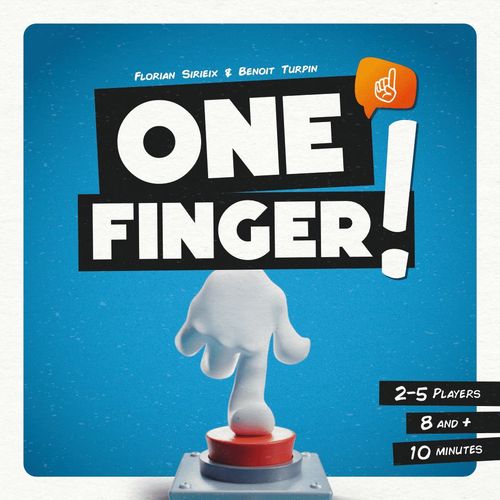
One Finger!
One Finger! Rulebook
Table of Contents
Table of Contents
Setup
- Shuffle all the Button cards.
- Place them in the centre of the table, Number side up, to form the Draw pile (Pioche) of Button cards. The + sign means "the maximum number of fingers".
- Deal one Button card to each player and have them keep it in front of them, Number side up. This card starts their Pile (Paquet).
- Deal a Player Aid card to the players who want one.
- The player who most recently used their finger goes first.
Playing a Round
- Turn over the first card of the Draw pile and place it beside the Draw pile, Button side up (the other side of the Number face).
- Step 1: All players place one of their index fingers on the Button card. With 2 players, each player places both index fingers on the card.
- Step 2: The first player calls a number between 0 and the number of fingers placed on the card. If there are 4 players, there should be 4 fingers, so the first player calls a number between 0 and 4. Got it?
- Step 3: IMMEDIATELY, neither before nor after, AT THE SAME TIME AS THE CALL, each player chooses, including the player who made the call, either:
- to lift their finger; or
- to leave it resting on the card. (With 2 players, make this decision for each of your fingers: you may leave one and lift the other, or leave both, for example.)
- Step 4: Check whether the call is successful, or failed (see below). Then, apply the effect of the Button card if applicable.
Did you know? The index finger is the finger closest to your thumb.
Successful Call
If the total number of fingers remaining on the card matches the number called by the player, that player applies the effect of the Button card.
A new round then begins by turning over a card from the Paquet and passing to the next player, clockwise.
Translator's note: the sheet says "Paquet" (the player's pile) at this point. A new round begins from the Draw pile (Pioche), as in the setup and the round opening above; the sheet's wording is transcribed as printed.
Failed Call
If the number of fingers remaining on the card does not match the number called by the player, the card stays in place and each player puts their finger back on the Button card in play.
The round then continues by passing to the next player.
The Button Effects
The Red Button, called "The Button"
If the call is successful, the player wins the card and places it on their pile in front of them, Number side visible. In addition, if the number visible on the top card of the Draw pile is the number called, the player also takes that card.
The Thief Button, called the "Sploch" Button
If the call is successful, the player wins the card and places it on their pile in front of them, Number side visible. In addition, if the number visible on the top card of one (or several) opponent's Pile is the number called, the player steals that (or those) card(s) as well!
The Double Button, called the "Au Poil" Button
When the "Double Button" card is revealed at the start of a round, place a second Button card from the Draw pile beside it, leaving it Number side up.
Each player places one index finger on each card. If the call is successful for one of the 2 cards, the player wins both cards.
Translator's note: "au poil" is French slang meaning roughly "spot on" or "great". It is kept as printed in the sheet, as the name of the button.
The Essential Concept
Immediacy is extremely important. The group is left free to arbitrate, together, any play errors that might be made, and to decide whether the round is cancelled or upheld.
Little tip: a little bad faith never hurt anyone…
End of the Game
When only one card remains and the Draw pile is exhausted, the game ends. Each player counts the number of cards they have accumulated in front of them. The player with the most cards wins.
Did you know? In 11.73% of cases, players call 0 and leave their finger on the card, or call the maximum and lift their finger…