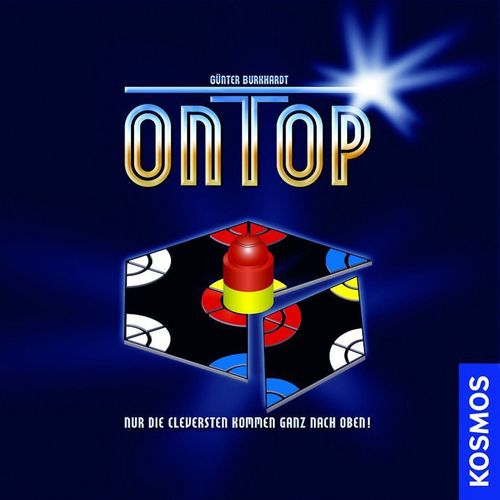
On Top
On Top Rulebook
Table of Contents
Table of Contents
Goal of the Game
Players try to place tiles so that their own colour is represented in the multicoloured circles as often as possible. As soon as a circle closes, the players' coloured pieces are stacked on top of each other. Whoever dominates the closed circle is on top of the tower and is the only one who scores: the taller the tower, the more points.
Game Components
The source text contains no written component list. The game material is shown only in the source's illustrations, which are not reproduced here.
Setup
The game board is laid out between the players. Place one triangle on each of the two red triangular spaces. The remaining triangles are placed next to the game board.
Translator's note: the rest of the rules refer to these as black triangles. The source says "red" here; it is transcribed as printed.
Each player receives 21 pieces of their own colour. In a game with 2 or 3 players, the colours not chosen by any player are also used. These play a neutral role (see Placing Pieces) and are needed when building towers.
Each player places one of their pieces on the starting space of the score track. This piece is the Player Marker. Place the rhombus tiles face down next to the game board.
Playing the Game
The youngest player starts. They take a rhombus tile from the table and place it face up on the game board, aligning it with the triangular grid. Then the turn passes clockwise to the next player. The following rules apply:
Placing Rhombus Tiles
- The first rhombus placed must share one side with one of the two black triangles already on the board.
- During play, each newly placed rhombus must share at least one side with tiles already on the board (rhombi or triangles).
- Any triangular gaps that can no longer hold a rhombus are immediately filled with black triangles.
- If, after a tile is placed, a coloured circle is closed, the players must place their pieces according to the number of segments of their colour (see Placing Pieces).
Diagram captions from the source:
- Placement allowed: one side touches a black triangle.
- Placement not allowed: the rhombus being placed touches the tiles already placed only diagonally.
- Placement allowed: the rhombus being placed touches one or more already placed tiles along one or more sides.
- Gaps are filled immediately with black triangles.
- The rhombus placed filled the last free space at the intersection point. Because all yellow spaces around the intersection are occupied, pieces are placed on it and points are counted.
- Intersection point in the centre of the game board: the intersection is very close to the rhombus being placed. This is allowed.
- Intersection point on the edge of the game board: no spaces next to the edge intersection can be filled with rhombi any more. The gap is filled with a black triangle. This is allowed.
Placing Pieces
Only the players whose colour is represented by the largest number of segments (1st and 2nd place) may place their pieces on the intersection point.
- First, the player whose colour took 2nd place places their piece. If several players are tied for 2nd place, their pieces are stacked on top of each other. The order in which they are placed does not matter.
- Then the player whose colour is represented the most places their piece on top of the tower, i.e. "On Top".
Important: Only one player's piece may be on top of the tower. Therefore the following rule applies: if several players have the same number of segments and they take 1st place, then no pieces are placed at all, not even the pieces of the players in 2nd place. The intersection point stays empty.
Important:
- Neutral colours: if only two or three players are playing, the neutral pieces are still placed on the intersection point according to the rules above.
- Points are scored only from intersection points that are completely filled.
Examples from the source:
- A tile has been placed ... Two coloured circles remain unfinished here. Yellow is represented by two segments in the colour circle, so it places its piece first on the intersection point. Red is represented by three segments, so it places its piece on top. Blue is the only colour represented at this intersection point. The black triangle is not counted when determining the strongest colour. Blue places its piece.
Other examples:
- Blue and Red are each represented by one segment in the colour circle, i.e. they are second-strongest, and therefore each places one of their pieces. Yellow is represented by two segments and therefore has the strongest colour. Yellow places its piece On Top.
- Yellow is represented by two segments, i.e. it is the second-strongest colour, and therefore places its piece first. The strongest, White, is represented by three segments and places its piece on top of Yellow's piece.
- Blue and White have the strongest colours and are first: nobody places a piece.
- The second-strongest White player is represented by one segment and places its piece first. Yellow is represented by two segments, is the strongest, and places its piece on top.
Note: Pieces that have not been placed by the end of the game are subtracted from the points the player has scored. Therefore it is sometimes worth fighting for second place. Although it does not bring points, it reduces the number of negative points at the end of the game.
Score Track and Player Marker
Only the player whose piece is on top of the tower scores. The tower is worth as many points as it has pieces. The player's marker on the track is moved forward, clockwise, by the number of points the player has earned. No two markers may be on the same space.
- A tower made of only one piece is worth 1 point.
- A tower made of two pieces is worth 2 points, but only the player whose piece is on top of such a tower scores them.
- If a tower or a single piece stands on the golden-yellow border of the game board, its value is doubled. For example, a tower two pieces high gives 4 points to the player whose piece is on top, and that player's Player Marker on the score track moves accordingly.
End of the Game
The game ends when no new rhombus can be placed on the game board. Each player then counts how many pieces they have left. According to the number of remaining pieces, each player moves their Player Marker backward on the score track. The player who scored the most points is the winner. If points are tied, the player with fewer remaining pieces wins.
Special case: the game ends early if one player has managed to place all of their pieces on the game board. In this case that player automatically wins, and the points on the track do not matter.
Notes:
- If a player can place their last piece on the last rhombus being placed, they win immediately.
- In a game with two or three players, if all neutral-colour pieces have been placed on the game board, the game ends immediately. The player with the most points is the winner.
- Neutral pieces may be placed on top of a tower in the general order, but the corresponding Player Marker is not moved on the track.
- In the rare case where all black triangles were used up BEFORE the rhombus placement that created an empty space, those empty spaces are considered filled. When determining the strength of colours, these free corners are ignored in exactly the same way as if a black triangle were already lying there.
Translator's note (from the Russian translation): nothing prevents you from taking an already "counted" triangle and placing it on the newly formed "void" for visual convenience.
Tactical tip: If a player can no longer achieve the strongest colour at an intersection, they can still simply hinder their opponents by placing rhombi so that all players are represented by the same number of segments, so that none of them receives points.
Variants
Team Game
Four players may play in two teams. Players sitting opposite each other form one team. At the end of the game, to determine the winning team, the two players of each team add their points together.
Variant Initial Triangle Placement
Experienced players may place the triangles on the game board in any order during setup; it is also possible to place more than two triangles.