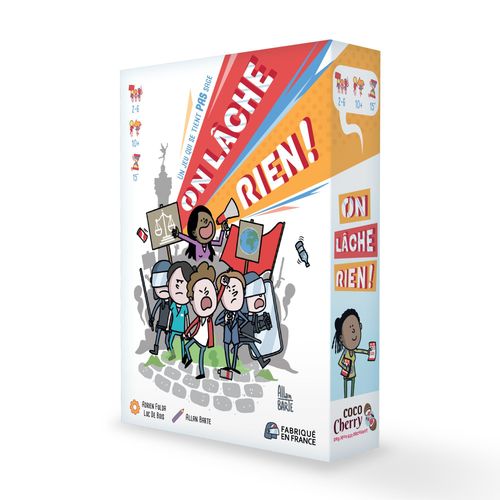
On lâche rien !
On lâche rien ! Rulebook
Table of Contents
Table of Contents
- Components
- Goal
- Setup
- Turn Order and Play
- Slapping Configurations
- End of Game
- Variant
- Special Cards
- Tear Gas (Gaz lacrymogène)
- Projectile
- Arrest (Interpellation)
- BRAV-M (Brigade de répression de l'action violente motocycliste)
- Banner (Banderole)
- Plainclothes Police Officer (Policier et policière en civil)
- Surveillance Drone (Drone de surveillance)
- Observer (Observateur et observatrice)
- Defender of Rights (Défenseur des droits)
- Police Prefect (Préfet de police)
- Blank Cards
- Declaration of Rights
- Afterword: Since the Creation of On lâche rien!
Components
71 cards, distributed as follows:
54 base cards:
- 18 Protester cards
- 18 Political figure cards
- 18 Law enforcement cards
12 special cards
4 blank cards for your own creations
1 player aid
Goal
Win as many cards as possible!
Setup
For your first game, remove the special cards. Once you have mastered the basic mechanics, you can progressively add the additional cards you want to play with. The rules for them are in the Special Cards section (p. 10).
Shuffle the remaining cards and deal them all out. Without looking at them, everyone gathers their cards face down and holds them in a hand.
Take a breath, turn up the music (HK & les Saltimbanks, or whoever you like)... ready?
Summary: Shuffle and deal all the cards to the players.
Turn Order and Play
The player who most recently went on a protest starts, and play continues clockwise.
The played cards form 3 piles in the centre of the table, side by side. They will make up the march.
On your turn, flip the first card of your pile (turn it toward the centre of the table so that you cannot see it before the others, no cheating!) and place it face up in the centre of the table.
- If there are already 3 piles, you are free to place your card on the pile of your choice.
- If there are fewer than 3 piles on the table, you must place your card so as to form a new pile.
Then the player on your left flips their card and places it as described above, and so on.
In all cases, as soon as you flip a card, place it as quickly as possible.
Summary: Flip the first card of your pile and place it face up on one of the 3 piles in the centre of the table.
Case 1 (illustration): You must place your next card here. Yes, you have to!
Case 2 (illustration): You must place your next card on one of the three piles. It's up to you. Sometimes it can be tactical, so choose well!
Slapping Configurations
But beware: depending on who is in the march, tension can rise! You must be quick and slap one of the piles with the flat of your hand in the following configurations:
On lâche rien! (We don't give up!) 2 Protester cards + 1 Political figure card. Mass mobilisation affects political decisions: slap as fast as you can on the pile where the Political figure card is.
Chargez! (Charge!) 2 Law enforcement cards + 1 Protester card. In the din, you didn't hear the police warnings? Ouch! The march is being charged: slap as fast as you can on the pile where the Protester card is.
Démission! (Resignation!) 3 Political figure cards. Under pressure from the street, the government resigns en bloc: slap as fast as you can on whichever pile you want (though it is better for you to aim for the biggest pile).
Summary: There are 3 configurations in which you must slap.
In each configuration, you take the pile you slapped, if you were the fastest. Yes, you understood correctly: in the Démission! configuration, 3 people can each win a pile.
You take the cards you have won and place them in front of you. Keep them safe, because they will be counted at the end of the game!
Summary: The first person to slap wins the pile and places the cards in front of them.
Note: You cannot win several piles. But if you change your mind and, after slapping once, you slap first on another pile, that one is yours.
Mistakes. Only these 3 configurations are allowed. If you slapped a pile by mistake, discard one of the cards you have placed in front of you; it is lost. Yes, even a brush with your little finger counts!
If you have no cards in front of you to discard, you discard nothing more, and that is even better for you!
Play then continues normally. The player to the left of the one who just placed their card continues and flips a card from their pile. They place it so as to rebuild the 3 piles of the march, if necessary.
Summary: If you slap in error, discard one of the cards you have placed in front of you.
Note: If you overdo it and slap at any time, in any way, the march's stewards will escort you out and you can no longer play at all. Let the others judge!
End of Game
If you have no cards left in your pile, you can keep slapping to win cards to place in front of you.
The game ends when no one has any cards left in their pile. Each player then counts the cards they have won. The player with the most cards wins the game!
Summary: If you have won the most cards, you win!
Variant
Don't demobilise, and want to keep the march going until you win your demands? We have a solution for you! At the start of the game, simply apply the following rules, and the game will be longer... and more intense.
- Each time you win a pile, instead of placing the cards in front of you, add them under your pile, face down.
- When you must discard a card, discard the first card of your pile.
- If you have no cards left in your pile when it is your turn, the march is unfortunately over for you, and the others continue. But since you are in solidarity, you can keep slapping piles when the configurations appear. However, if you are the one who wins the cards, you do not rebuild your pile: you discard the cards you have won.
The game ends when only one player still has cards in hand. That player wins the game!
Special Cards
If you have a strong stomach, you can use the special cards. They reflect the escalation of violence at some demonstrations.
Each card has a particular power. You can add them progressively to the game to multiply the situations to observe and the actions to take. They are presented here in increasing order of complexity.
Tear Gas (Gaz lacrymogène)
As soon as the Tear Gas card is flipped, everyone slaps it before the gas escapes! The least quick player discards from the cards placed in front of them a number of cards equal to the number of grenades shown on the Tear Gas card.
If you are playing with the variant, it is the player who still has cards in hand and is the least quick who discards the first card(s) of their pile.
Play then continues normally. The player to the left of the one who just placed the Tear Gas card continues and flips a card from their pile.
The Tear Gas card stays in play but no longer has any effect.
Example: For this card, the least quick player discards 3 cards from those placed in front of them.
Projectile
Cans, water bottles, cobblestones... These objects, used as projectiles, are a violent expression of the people who demonstrate.
As soon as the Projectile card is flipped, slap a pile whose first card is a Law enforcement card! There may therefore be 0, 1 or 2 piles concerned. The fastest players take the corresponding piles.
Whether or not anyone slapped, play continues normally. The player to the left of the one who just placed the Projectile card continues and flips a card from their pile.
The Projectile card stays in play but no longer has any effect.
Arrest (Interpellation)
Above all, do not slap the Arrest card, otherwise a plainclothes police officer arrests you right in the march itself.
If you slap the Arrest card by mistake, a protest ban is served on you and your movements are monitored. From then on, you must switch hands to hold your pile (and so you also switch hands to slap) until the end of the game.
If you are playing with the variant and slap this card again, your protests are over: when you arrive in the march, it is straight into police custody! You discard all your cards.
Whether or not anyone slapped, play continues normally. The player to the left of the one who just placed the Arrest card continues and flips a card from their pile.
BRAV-M (Brigade de répression de l'action violente motocycliste)
The motorcycle units for the repression of violent action (BRAV-M) are made up of a pair on a motorbike: the BRAV-M card counts as 2 Law enforcement cards. If it is in the presence of one or more Protester cards, slap as in the Chargez! (Charge!) configuration.
Banner (Banderole)
It takes two people to hold this banner: the Banner card counts as 2 Protester cards. If it is in the presence of one or more Political figure cards, slap as in the On lâche rien! (We don't give up!) configuration.
With 2 Law enforcement cards present, you can slap the Banner card as in the Chargez! (Charge!) configuration.
Plainclothes Police Officer (Policier et policière en civil)
Plainclothes police officers wear no uniform and operate right inside the march.
The Plainclothes Police Officer card looks like a Protester card, but it counts as a Law enforcement card.
Surveillance Drone (Drone de surveillance)
Surveillance drones used by the police to watch the people who demonstrate are not always noticed.
When the Surveillance Drone card is flipped, it has no immediate effect. Only once you cover it with another card does it count as a Law enforcement card.
Notes:
- Another Law enforcement card, either on the Surveillance Drone's pile or on another pile, is enough for you to slap as in the Chargez! (Charge!) configuration.
- The Projectile card affects the Surveillance Drone card: as soon as the Projectile card is flipped, you may slap the pile containing the Surveillance Drone card.
Observer (Observateur et observatrice)
Observers watch and record the actions of law enforcement at demonstrations, independently. These people stand at the edge of the marches and take part in defending the right to demonstrate.
As soon as you flip the Observer card, place it beside the march. You thus create a fourth pile on which cards can be placed.
As long as it is not covered, no one may slap a card: all effects and configurations are temporarily cancelled.
As soon as it is covered by another card, slapping piles is allowed again. If 3 cards form one of the configurations (On lâche rien!, Chargez! or Démission!), go for it! Slap it!
Defender of Rights (Défenseur des droits)
The Defender of Rights is an independent constitutional authority that ensures respect for rights and freedoms.
When the Defender of Rights card is flipped, it has no immediate effect. It only takes effect once you cover it: the Law enforcement cards flipped onto this same pile no longer count for the Chargez! (Charge!) configuration.
Police Prefect (Préfet de police)
The prefect has just banned the march, so it is now an unlawful gathering (attroupement). Yes, that is how it is.
Slap the next Protester card that is flipped, as in a Chargez! (Charge!) configuration.
Blank Cards
The 4 blank cards are there to customise your marches. Send us your creations and their associated rules, and we will share the good ideas!
Here are some examples:
Batucada
The batucada is there to make noise. When the Batucada card is flipped, slap the piles next to it to deafen your neighbours! Players who could not slap first discard one of the cards they have won.
Hot Dog Sales (Vente de hot dogs)
The struggle makes you hungry! The others stop to buy a cola. When this card comes into play, the others each give you a card, which you put directly into your won cards.
Political Figure Hit by Flour (Politique enfariné·e)
Someone has thrown a bag of flour at this political figure? Nobody recognises them any more!
This card counts as a Protester card.
Siamo tutti antifascisti (We Are All Antifascists)
When this card appears, clap your hands and chant this antifascist slogan. There, that's good. Nothing else happens.
Declaration of Rights
"The free communication of thoughts and opinions is one of the most precious rights of man." Declaration of the Rights of Man and of the Citizen, 1789 (Article 11)
The right to demonstrate is an essential right in a democracy. This right is today being dangerously challenged in France by law-enforcement strategies based on an excessive use of force and on the criminalisation of people who demonstrate.
On lâche rien! is a game that aims to raise public awareness of infringements on the right to demonstrate in France. If the game sometimes caricatures practices drawn from the reality of demonstrations today, it does so to be engaging, and disturbing because it is fun, with the ambition of leading players to question these practices.
On lâche rien! is not an "anti-cop" game. By staging the police violence that plagues many demonstrations in France today, and making it a major driver of the game, it challenges less the action of the law-enforcement forces in themselves than the policy implemented by governments.
On lâche rien! does not minimise the suffering of victims of violence at demonstrations. The bet is that the more the game is played, the more people will come to know, through it, about this violence and its sometimes dramatic consequences, and the more the popular voice will be able to oppose it. However, out of respect for victims of mutilation or serious injury, maiming weapons such as flash-ball launchers (LBD) and grenades are not used as a playful element. In addition, part of the revenue from sales of the game is paid to the partner associations that fight against this violence.
Afterword: Since the Creation of On lâche rien!
The doctrine of public order maintenance in France is characterised by the use of trained agents and maiming weapons, such as the flash-ball launcher (LBD) and disencirclement grenades, as well as by a disproportionate use of tear gas.
The ACAT-France, like the LDH, has campaigned against the type of public order maintenance currently used in France, both internationally (at the United Nations or the European Commission, in the context of its report on the rule of law) and before parliamentarians, to raise the alarm about the abusive use of force and the obstacles to the right to demonstrate.
The multiplication of orders banning demonstrations, notably for ecological movements and in support of Palestine, as well as their late adoption, infringes the right to an effective remedy. This is all the more troubling when authorities reissue orders already overturned by the administrative judge, discouraging the exercise of this right.
In November 2025, the revelation of images from cameras worn by gendarmes at the demonstrations against the mega-basins at Sainte-Soline (Deux-Sèvres) in March 2023 proves how dangerous the weapons used and the public order practices are. The entire public order system was designed in such a way that very serious injuries were foreseeable.
It is urgent to mobilise to defend the right to demonstrate and to reform the doctrine of public order maintenance in France, which is essential to the health of a democracy!