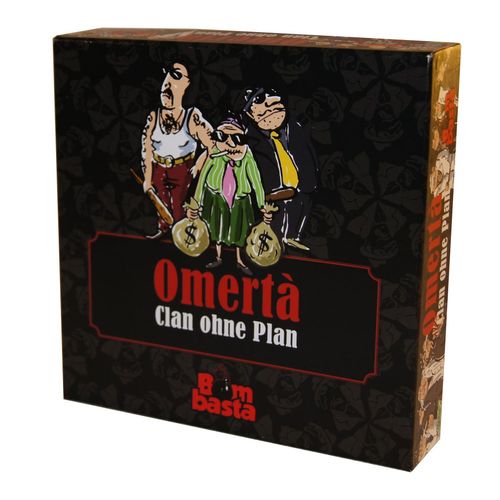
Omertà: Clan ohne Plan
Omertà: Clan ohne Plan Rulebook
Table of Contents
Table of Contents
Object of the Game
Played in teams, called "families". The goal of the game is to be the last family to survive. During play the players try to find out which player belongs to which family, in order to then eliminate the members of the other families.
Components
- 14 family cards
- 31 black action cards
- 55 white action cards
- 60 money notes (20 each of $100, $200 and $500)
Family Cards
Each player receives one family card at the start of the game, which only he may look at. It determines which family the player belongs to: Azzurro, Verde or Rosso (the blue, green or red team). It also determines the player's role in the family: Don or Consigliere.
Don
A Don is the head of a mafia family! He must survive as the last Don!
A Don plays together with his Consiglieri. He wins if all other Dons have been eliminated. If a Don is eliminated, all Consiglieri of his family are eliminated as well!
Consigliere
A Consigliere is loyally devoted to his Don and stands at his side as helper and adviser.
A Consigliere plays together with his Don and the other Consigliere. He wins if his Don wins, even if he himself has already been eliminated. A Consigliere is also eliminated as soon as his Don is eliminated.
Depending on the number of players, the game can also be played with one or two Henchmen.
Henchman (Handlanger)
Every mafioso needs protectors and henchmen. The henchman has the task of helping his right-hand neighbour, whatever that one is scheming...
A henchman is not in any family, but plays together with his right-hand neighbour. He wins if his right-hand neighbour wins, even if he himself has already been eliminated. A henchman is also eliminated if his right-hand neighbour is eliminated. It is not relevant which family card the right-hand neighbour has. What matters is that this neighbour wins.
Setup
Depending on the number of players, the game is played with two or three families and with different numbers of Consiglieri and Henchmen. For the first game, use the family cards listed below.
| Players | Family cards (as printed; families separated by "/", Henchmen listed last) |
|---|---|
| 4 | Don, Consigliere / Don, Consigliere |
| 5 | Don, Consigliere / Don, Consigliere / Henchman |
| 6 | Don, Consigliere, Consigliere / Don, Consigliere, Consigliere |
| 7 | Don, Consigliere / Don, Consigliere / Don, Consigliere / Henchman |
| 8 | Don, Consigliere / Don, Consigliere / Don, Consigliere / Henchman, Henchman |
| 9 | Don, Consigliere, Consigliere / Don, Consigliere, Consigliere / Don, Consigliere, Consigliere |
Tip: If you have already become involved in the shady mafia business of OMERTÀ, you can also add the "additional family cards". These are explained on page 11 of the booklet.
The required family cards are shuffled and dealt. The remaining cards are removed from the game. Each player looks at his family card and then places it face down in front of him on the table. Each player therefore knows only his own family card.
The black and the white action cards are shuffled separately. Each is placed as a face-down supply pile in the middle of the table. Next to these supply piles, space is left for a discard pile. The money is placed next to the supply piles. The supply piles and the money together form the "supply" (Vorrat). From this supply each player takes:
- 2 black action cards
- 3 white action cards
- $800 ($1 x $100, $1 x $200, $1 x $500)
Each player holds his action cards face down in his hand. The money lies face up and visible to everyone on the table.
Example: Luigi plays OMERTÀ together with Mario, Silvia and Giulia. Luigi and Silvia are in the same family, and so are Mario and Giulia. At the start, however, they do not yet know this...
Game Flow
Start of the Game
The most brazen player begins by announcing it loudly. Play proceeds clockwise.
Example: Luigi fires his gun wildly and shouts: "Me! Me! Me!" So he may start.
Overview
All players play at the same time! Players take their turns in turn order, but the players who are not on turn may play action cards to one another. This happens face down and in parallel with each player's turn. This process happens face down and in parallel to each player's turn. During his turn, a player reveals all cards that were played to him during the last round.
Tip: Knowing who belongs to your family and who does not is the most important thing! To find out, you must first bribe your fellow players during your turn. Make them an offer they cannot refuse! After that, protect them with white action cards or finish them off! Of course, all quietly and in secret...
Not on Turn: Playing Action Cards
If a player is not on turn, he may play action cards to himself and to his fellow players who are also not on turn. To do so, he places a card from his hand face down onto an action stack formed in front of the player concerned. Players play to themselves only black action cards, and to their fellow players only white action cards.
Each player has one action stack. The first card played forms the start of an action stack. Every card played afterwards is placed on this stack, i.e. on top of the most recently played card. Several cards may be played directly one after another, but always only one at a time (the hand must be taken back in between). It does not matter what colour the most recently played action card has. Stacks of white and black action cards can therefore arise, but also stacks consisting entirely of black or entirely of white action cards.
Delaying the Turn
When a player is up, he does not have to start his turn immediately; he may delay it at will. In the meantime he may, for example, have cards played to him or play cards to his fellow players. Only when a player is ready does he begin his turn.
Example: Luigi decides not to start his turn immediately. He has a black action card, INFORMANT, which he plays to himself. It was the first card, so it forms the start of Luigi's action stack. Giulia then plays an EINBRUCH onto Luigi. Giulia must place her action card on top of Luigi's action card. Both cards remain face down. In parallel, the other players also play action cards to one another.
On Your Turn: Reveal and Choose
Each turn consists of two phases, carried out one after the other: "Reveal" and "Choose". Only one player takes his turn at a time. A turn is only finished once both phases have been completed.
1. Reveal
The player reveals the top card of his action stack. With the reveal of this first card the turn counts as begun. The player reads the complete text of the revealed card aloud and carries it out. The revealed card may be a white or a black action card. Once the text of the card has been carried out, the player places it face up on the respective discard pile for white or for black action cards. These discard piles lie beside the respective supply piles in the middle of the table.
The player then reveals all cards of his action stack one after another. The cards of the action stack are always revealed from the top. Cards are revealed until the action stack is empty, or until a card specifies otherwise. Revealed cards are always placed on the respective discard pile, unless the card specifies otherwise.
Through the cards he reveals, a player can be eliminated (see below). If there is no card on the action stack, the player immediately starts the second phase. In this case he must briefly announce that he is starting his turn ("I'm starting now!").
2. Choose
Once a player has revealed all cards of his action stack, he may decide what he wants to do during his turn. He has the following choice:
- Buy three white action cards: The player may take up to three white action cards from the supply into his hand. However, each card costs him $100, which he must return to the supply. If a player has no money, he cannot buy a card. There is no limit to the number of cards in hand.
- Take two black action cards: The player takes two black action cards from the supply into his hand. This costs him nothing.
- Bribe a fellow player: The player may offer any fellow player any sum of money. The other player now has the option of taking the money. If he does, he must show the player who bribed him his family card. If he does not want to be bribed, he simply returns the money. If the bribe attempt fails, the player still has the choice between the other two options. If the bribe succeeds, his turn ends. (Negotiating is actually not allowed, but: you are the boss!)
Tip: White cards are the quiet favours and treacherous assignments that you can carry out when you are not on turn. Black action cards are the crooks, gangsters and thugs who protect you and collect money for you. At the start, however, it is above all important to get information through bribes...
If no white or black action cards are left in the supply, the respective discard pile is shuffled and forms the new supply pile.
As soon as a player takes the cards he received into his hand, or when he looks at the family card of the bribed player, the turn is over. The player's left-hand neighbour may now begin his turn.
Example: Luigi begins his turn. He reveals the cards of his action stack, reads them aloud and follows their instructions. While Luigi reads the cards aloud, the other players continue to play action cards to one another.
1st card: EINBRUCH: Give your right-hand neighbour $300 or your remaining money. Giulia is Luigi's right-hand neighbour. Luigi gives Giulia $300. He now has only $500 left. Luigi then places the EINBRUCH card on the discard pile for white action cards.
2nd card: INFORMANT: Take $200 from any fellow player. In exchange, show him the family card of another player. Luigi takes $200 from Mario. Luigi shows Mario Giulia's family card. Mario now knows that he plays together with Giulia. Luigi places the INFORMANT card on the discard pile for black action cards.
Luigi then tries to bribe Mario with $300. Mario declines the offer. As Luigi does not have so much money, he decides to take two black action cards. Luigi has now ended his turn, and Mario may begin his turn (or delay it beforehand).
Elimination
Certain action cards that a player reveals during his turn can eliminate him. This normally happens whenever the player no longer has the amount of money that a card demands he pay. A player is not eliminated merely because he has no money left. When a player is eliminated, his turn ends automatically. He places the remaining cards of his action stack, and any cards still in his hand, on the respective discard piles, and returns his money to the supply. He then reveals his family card.
If the revealed family card is a Consigliere or a Henchman, nothing further happens. If, however, it is a Don, then all players who are Consiglieri of that Don are eliminated too. They likewise place their cards on the discard piles and reveal their family cards. This is entirely independent of how much money these players still have.
Henchmen are eliminated in a similar way: they are eliminated as soon as their right-hand neighbour is eliminated.
Eliminated players no longer take part in the game.
Example: We are now in the advanced stage of the game. Luigi reveals his action stack. He still has $500.
1st card: COSA NOSTRA: Double all red numbers on the next card you reveal this turn. The next card Luigi reveals has double effect, provided it contains a numerical value.
2nd card: ZAHLTAG: Pay $300 or you are eliminated. The effect of this card is doubled. Luigi must return $600 to the supply, but he has only $500.
Luigi is eliminated! He must reveal his family card. He is a Don of the Azzurro. As Silvia is his Consigliere, she must reveal her family card as well. Both players place the action cards from their hand, as well as the remaining cards of their action stacks, on the respective discard piles. The remaining money of both players is returned to the supply. Had Luigi still had $600, he could have paid and would not have been eliminated.
Tip: "If you didn't know you were being cheated, you're too stupid for this job. And if you knew, you were involved. Either way, you're out!"
Game End
The game is over as soon as only one Don remains. He wins together with his Consiglieri, even if these have already been eliminated. Henchmen win if their right-hand neighbour wins, even if they themselves or their right-hand neighbour have already been eliminated.
Example: Luigi and Silvia are eliminated. Mario is the other Don. He is the only Don left, and he wins the game. Giulia is his Consigliere. Suppose Giulia had already been eliminated: since her Don wins, Giulia wins too.
And the Most Important Rule...
Omertà: the code of silence. You never betray your friends, and you always keep your mouth shut! Keep to yourselves who has which family card, and show your card only when you are asked to. Whoever breaks the code of silence is eliminated! It is nothing personal, but business is business. And it is simply not done to talk business at the table.
Additional Family Cards
Players who have already played Omertà can compose the family cards themselves at setup. The family cards "Bookmaker", "Informer" and "Man of Honour" are then also used. Each of these takes a special role and provides even more variety. Their descriptions follow below.
The following rules must be observed when composing the family cards:
- There must be at least two Dons in the game.
- There must be the same number of Consiglieri in the game for each family.
- There may be no Consiglieri in the game whose Don is not in the game.
Bookmaker (Buchmacher)
The Bookmaker really has only one goal: money, money, money! He must manage to be the richest player at the start of his turn.
The Bookmaker plays alone! He wins as soon as he is due to begin his turn and has more money than any other player. In this case he does not begin his turn, and reveals his family card. The game is over and the Bookmaker wins.
Informer (Spitzel)
The Informer collects information for the local gendarmerie. He only needs to survive until the end of the game...
The Informer plays alone! He wins if only one family remains and he himself has not yet been eliminated. In this case the Informer wins alone, and the last family loses.
If the Informer takes part, the following rule also applies: the Informer, as well as all Consiglieri and Henchmen, do not reveal their family card when they are eliminated. In this case they only say: "I was not a Don." Consiglieri and Henchmen in the game, however, reveal their family card when their Don or their right-hand neighbour, respectively, is eliminated.
Man of Honour (Ehrenmann)
For the Man of Honour it is about... well, honour. How dishonourable would it be, for example, not to be the first mafioso to die for one's cause?
The Man of Honour plays alone! He wins if he is the first player to be eliminated. In this case he reveals his family card and ends the game. If another player is eliminated first, the Man of Honour reveals his family card and is eliminated as well. He can then no longer win the game.
If the Man of Honour has a Henchman to his left, that Henchman also wins only if the Man of Honour is eliminated.
Tip: With some compositions certain family cards are easier to play than others. The Informer, for example, has it easier if only two rather than three families take part. How you put the cards together, however, is up to you. You can also play with more than nine players, but in that case make sure the table is large enough and that every player can easily play cards to every other player. A game for three is also possible. For this, take two Dons and the Man of Honour or the Informer.
Explanations of the Individual Action Cards
Should questions arise during play about individual action cards, they are explained in more detail here.
Black Action Cards
BETRÜGER: If the player has less than $600, he takes as much money from the supply as needed and adds it to his holdings until he has $600. If he has more than $600, he must return as much money from his holdings to the supply as needed until he has only $600. The card has no effect if the player has exactly $600.
DEALER: The player takes $300 from the supply and adds it to his holdings. Every other player then takes a white action card from the supply into his hand.
GANGSTER: The player takes $100 from the supply and adds it to his holdings. If at least one further action card lies on his action stack, the next card has no effect. The text of that card is read aloud, but not carried out. Further cards are carried out normally.
GANOVE: If further action cards lie on the player's action stack, he does not reveal them. They remain there until the next round. The player has now completed his reveal phase.
GAUNER: If at least one further action card lies on his action stack, the next card has no effect. The text of that card is not read aloud and not carried out. The player takes it face down into his hand.
INFORMANT: The player takes $200, or the remaining money, from any fellow player and adds it to his holdings. He then shows this fellow player the family card of another player, which he himself does not look at. He may also show the fellow player his own family card.
INTRIGANT: The player takes $200 from the supply and adds it to his holdings. Every player who has action cards in hand now chooses any action card from his hand and gives it to his left-hand neighbour.
HALUNKE: Provided that no further action cards lie on his action stack, the player takes $300 from the supply and adds it to his holdings. Otherwise HALUNKE has no effect.
HEHLER: The player must place all white action cards from his hand on the discard pile for white action cards. He then takes $200 from the supply for each white action card he has placed, and adds this money to his holdings.
White Action Cards
ABRECHNUNG: The player must add up the sum of money that he has already taken from the supply and added to his holdings during his current turn. He must then return twice that amount to the supply. If he does not have that much money, he is eliminated.
BOMBE: The player must return $400 to the supply. If he does not have that much money, he is eliminated. Afterwards his left-hand and his right-hand neighbour must each return $300 from their holdings to the supply. If a neighbour has less than $300, he returns his remaining money instead. Neighbours are counted as the players who sit nearest to the left or right of the player and have not yet been eliminated. If only two players remain, the other player loses the $300 only once.
CARABINIERI: The player must return $100 from his holdings to the supply for each white and black action card in his hand. The player may, however, keep the cards in his hand. If he does not have that much money, he is eliminated.
CHAOS: Each fellow player of the player places a white action card from the supply face down on his action stack. These cards are not looked at or taken into hand.
COSA NOSTRA: This card initially has no effect. It concerns the next action card that the player reveals during this turn. If a red-marked number appears on that next card, it is doubled. Otherwise the next card is carried out normally. If no further action card lies on the action stack, or the next card has no red number, COSA NOSTRA has no effect.
DOLCE VITA!: The player takes $500 from the supply and adds it to his holdings.
DRIVE BY: The player must return $200 to the supply. If he does not have that much money, he is eliminated. Whether or not he is eliminated, he does not place DRIVE BY on the discard pile, but must place it face down on the action stack of his left-hand neighbour. The left-hand neighbour is the player who sits nearest to the left of the player and has not yet been eliminated.
DUBIOSE GESCHÄFTE: If the player has $400 or less, he is eliminated immediately. If he has more than $400, he may take from the supply again as much money as he currently has, and add it to his holdings.
EINBRUCH: The player must give $300 from his holdings to his right-hand neighbour. If he has less than $300, he gives his remaining money instead. The right-hand neighbour is the player who sits nearest to the right of the player and has not yet been eliminated.
ENTFÜHRUNG: The player's right-hand neighbour must give the player all of his black action cards. The player takes these into his hand. The right-hand neighbour is the player who sits nearest to the right of the player and has not yet been eliminated. If the right-hand neighbour has no black action cards, ENTFÜHRUNG has no effect.
ERPRESSUNG: The player must return $200 to the supply. If he does not have that much money, he is eliminated. After the player has ended his turn, he places ERPRESSUNG back onto his action stack as the first card. If the player was prevented from revealing all cards by another card, ERPRESSUNG is placed on top of the action stack instead. Only after the player has placed ERPRESSUNG back does his turn count as ended.
EXTRA COSA NOSTRA: As COSA NOSTRA, except that the numbers are tripled instead of doubled.
FAMILIENFEIER: Each fellow player must give the player $100. If a player does not have the money, he need not give anything. Each fellow player may also give the player more money, if he wishes. If the effect of FAMILIENFEIER is strengthened by a COSA NOSTRA, the players who do not have sufficient money must give their remaining money.
GEFÄLLIGKEIT: The player takes $200 from the supply and adds it to his holdings. He then does not place GEFÄLLIGKEIT on the discard pile, but takes it into his hand.
GELDWÄSCHE: The player names any sum of money, but no more than he himself has. All players, including himself, must then return this amount from their holdings to the supply. If a player has less than the required amount, he returns his remaining money instead. The player may also let the effect of GELDWÄSCHE lapse.
HALBE SACHEN: The player returns half of his money from his holdings to the supply. If the player has an odd amount, he returns the rounded-down half. If the player has no money or only $100, HALBE SACHEN has no effect.
HINTERHALT: The player's right-hand neighbour must return $200 to the supply. If he does not have that much money, he is eliminated. The right-hand neighbour is the player who sits nearest to the right of the player and has not yet been eliminated.
INTERMEZZO: If further action cards lie on his action stack, the player does not reveal them. Instead he places them down without effect. The player has now completed his reveal phase.
KURIER: The player does not place KURIER on the discard pile, but takes it into his hand with his other action cards. He then shows his family card to his left-hand neighbour. The left-hand neighbour is the player who sits nearest to the left of the player and has not yet been eliminated.
MAMMA MIA!: The player must return $500 from his holdings to the supply. If the player has less than $500, he returns his remaining money instead.
OFFENER KRIEG: Each player who has $200 or less in his holdings shows his family card to every player. This happens simultaneously, in such a way that every player can see the card.
PLANÄNDERUNG: If at least one further action card lies on the player's action stack, this card has no effect. Instead, the player places it face down on the action stack of his right-hand neighbour. That player must then reveal it when he is on turn.
RAZZIA: The player must place all white and black action cards from his hand on the respective discard piles. He then does not place RAZZIA on the discard pile, but takes it into his hand as its only card.
SCHMUGGLER: The player takes two white action cards from the supply into his hand.
SCHULDEN: The player first chooses any fellow player. He gives this fellow player $400 from his holdings. If the player has less than $400, he gives his fellow player his remaining money instead.
SCHWARZMARKT: Each player must place all black action cards from his hand on the discard pile for black action cards. For each black action card that a player has placed, he may take one white action card from the supply into his hand.
SPIONAGE: The player first chooses any two fellow players. From these players he may look at the family card.
SYNDIKAT: Each fellow player who is richer than the player takes $300 from the supply and adds it to his holdings. The player himself, and all fellow players who have less money than he does, receive no money.
ÜBERFALL: The player must give all action cards from his hand to his right-hand neighbour. The right-hand neighbour takes these into his hand. The right-hand neighbour is the player who sits nearest to the right of the player and has not yet been eliminated.
VENDETTA: The player must return $200 from his holdings to the supply for each player who has already been eliminated. If he does not have that much money, he is eliminated. If no player has been eliminated yet, VENDETTA has no effect.
VERRÄTER: The player shows his family card to each player who has less money than he does.
VERSTÄRKUNG: Each player who no longer has black action cards in hand may take a new black action card from the supply into his hand.
ZAHLTAG: The player must return $300 to the supply. If he does not have that much money, he is eliminated.
Quick Guide (Kurzanleitung)
The official one-sheet quick guide, which is printed on the first sheet of the set. It restates the rules above.
Object of the Game
Each player is a member of a mafia family. The goal of the game is to be the last family to survive.
Setup
The family cards are composed by the players themselves. At least two Dons must be in the game, and every family must have the same number of Consiglieri. Other family cards may also be added, for example when the number of players is odd. One face-down supply pile is formed from the white action cards and one from the black action cards. Each player receives:
- 1 random family card (face down on the table)
- 2 black and 3 white action cards (face down in hand)
- $800 (face up on the table)
Game Flow
The most brazen player begins. Play proceeds clockwise. Players who are not on turn play action cards to one another. The player on turn reveals all cards that were played to him during the last round. Both happen at the same time.
Not on turn: playing action cards. A player who is not on turn may play action cards to himself and to fellow players who are also not on turn. He places a card from his hand face down onto an action stack. Players play to themselves only black action cards, and to their fellow players only white action cards.
On turn: reveal and choose. A turn consists of two phases:
- Reveal: The player reveals all cards of his action stack from the top and reads them aloud. The revealed cards are placed on the discard pile.
- Choose: The player may do one of the following:
- Take up to three white action cards from the supply into his hand. Each card costs $100.
- Take two black action cards from the supply into his hand.
- Try to bribe a fellow player with any amount of money. If the fellow player accepts the bribe, he receives the money and shows the briber his family card. If the bribe fails, the player may choose between the other two options.
A turn ends as soon as the player takes his received cards into his hand, or looks at the family card of the bribed player. The next player may then begin his turn whenever he wishes.
Elimination
Some action cards can eliminate a player when he reveals them. He then reveals his family card. If it is a Don, all of that Don's Consiglieri are eliminated too.
End of the Game
The game is over as soon as only one Don remains. He wins together with his Consiglieri.